Unknown's avatar

BAHAMAS REEF FISH (53): YELLOW GOATFISH


Goatfish, Bahamas (Melinda Riger / G B Scuba)
BAHAMAS REEF FISH (53): YELLOW GOATFISH

GOATFISHES belong to the mullet family, a large group of species with a flexible membership. In other words, there is disagreement as to whether certain fish are mullet or not. For present purposes, it’s not our problem – no one doubts that the goatfish is a mullet.

Goatfish, Bahamas (Melinda Riger / G B Scuba)

SO WHY ARE THESE CALLED GOATFISH? WAS SOMEONE KIDDING?

These fish get their name for the pair of so-called ‘barbels’ below their mouths (see image below), thought to be reminiscent of a goatee beard. The name has Latin origin, ‘barbula‘, meaning a small beard. Linnaeus may have had a hand in this choice of description.

Goatfish, Bahamas (Melinda Riger / G B Scuba)

WHAT IS THE FUNCTION OF THE BARBELS?

The barbels are sensory organs which, depending on the creature, may be located on either side of the mouth, on the chin, or even extending from the nostrils. In broad terms, the barbels are where the taste buds are located. They help a fish to find food even when the water is stirred up or murky or at night, and are used to probe into sand or into holes in the reef for prey.  

Goatfish, Bahamas (Melinda Riger / G B Scuba)

WHY ARE THEY OFTEN SEEN WITH YELLOWTAIL SNAPPERS, GRUNTS & PORKFISH?

Goatfish have limited means of self-protection. They are not poisonous or venomous, they have no spines or razor-sharp teeth, nor ink to squirt. They do have an ability to change colour rapidly to blend into their surroundings – e.g. over pale sand – to make them less conspicuous to predators. Overall, however, they are docile and probably delicious to many other species. Their bright hues may have some function as aposematic colouring to warn, scare or repel potential predators, but this is possibly of limited use among the familiar reef denizens. So instead the goatfish goes in for so-called protective mimicry, as shown in the image above.

Goatfish, Bahamas (Melinda Riger / G B Scuba)

PROTECTIVE MIMICRY?

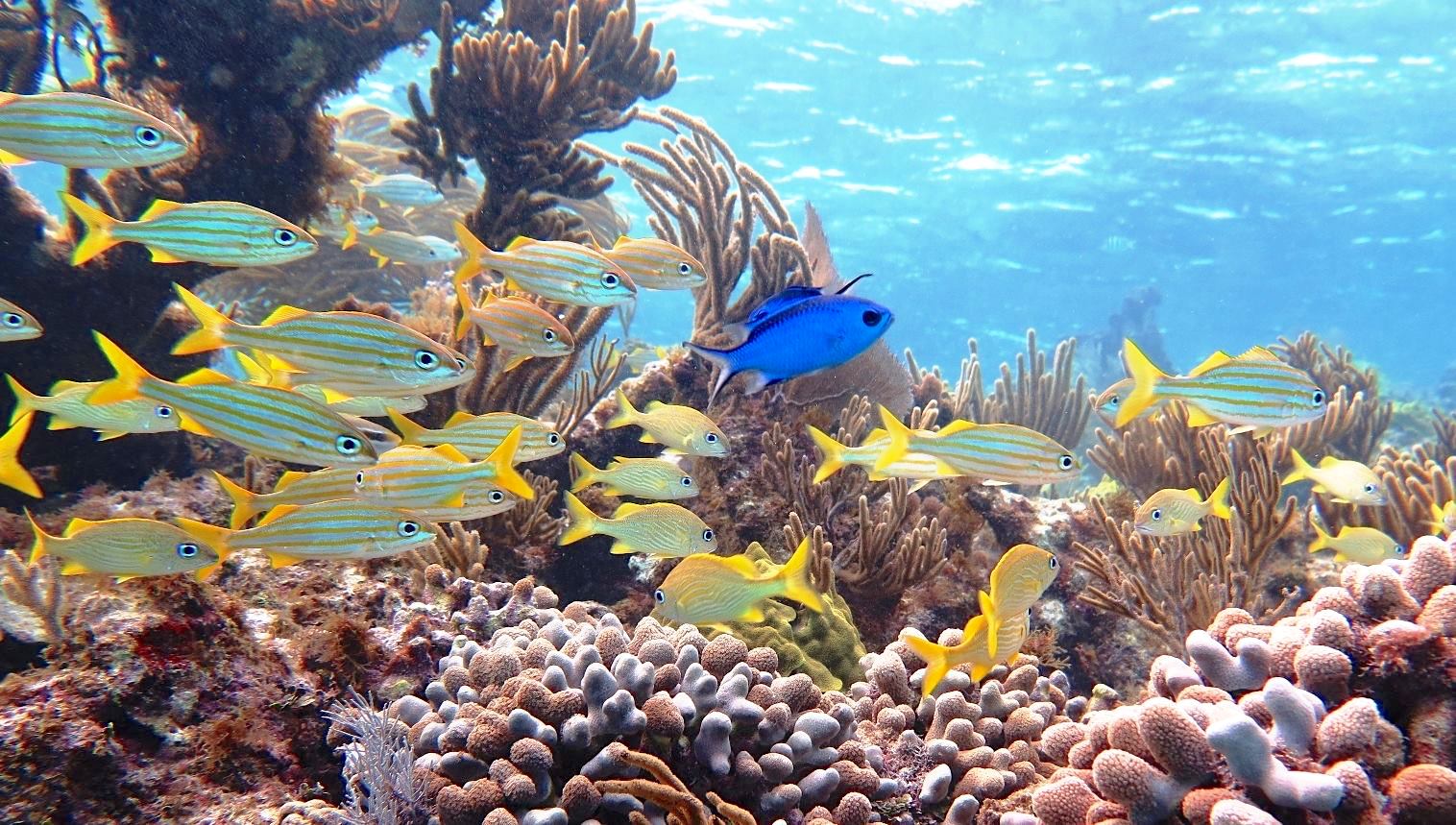
Goatfish and yellowtail snappers (in particular) are similar in size, appearance, coloration and behaviours, though the feeding patterns differ. The reason they are often found in mixed groups on the reef is for the individual protection they gain in a larger mixed school. This really amounts to taking advantage of safety in numbers (especially for the fishes in the middle). Here’s a very recent photo that shows exactly this scenario – a large mixed shoal of two almost indistinguishable fish species.

Goatfish & Yellowtail Snappers shoaling (Melinda Riger, GB Scuba)

IS THIS A ‘SPOT THE DIFFERENCE’ TEST?

If you’d like to make it so! (click on the image to enlarge it). Look out for the fish with the barbels (Goatfish); and the fish with the larger, more deeply forked tails (Snappers). A predator won’t take a great deal of notice of the finer points of difference of course, but overall this large mixed shoal gives a degree of protection to individual fish in the unit as a whole

Goatfish, Bahamas (Melinda Riger / G B Scuba)

ARE GOATFISH EDIBLE?

Goatfish are eaten in many ares of the world, though I can’t recall seeing it on a Bahamian menu. The Romans ate the local mullet / goatfish species, but then they ate many things that we do not now consider as permissible food – dormice in honey for example. Rather revoltingly, the goatfish were served live so that guests could watch them die and see the amazing change of colours in the process. Barbaric? But don’t we cook live… well, never mind that.

Goatfish, Bahamas (Melinda Riger / G B Scuba)

Photos: all great photos from Melinda Riger / Grand Bahama Scuba; magpie research pickings inc. the abstract of a scientific paper with about 23 authors; tip ‘o the hat to Wiki, no seriously

Goatfish, Bahamas (Melinda Riger / G B Scuba)

Unknown's avatar

WAVE CHASERS: SANDERLING POOL TIME ON ABACO


Sanderling, Delphi Beach Abaco Bahamas (Keith Salvesen / Rolling Harbour)

WAVE CHASERS: SANDERLING POOL TIME ON ABACO

It’s often a hard decision whether to include a short piece of video footage in a post. By short, I mean less than a minute. On the one hand, there is usually a good reason for inclusion, even if only aesthetic. On the other, it simply takes up more time for busy people who may prefer to flick through an article and enjoy some nice images along the way. Today, you can have the best of both worlds.

Sanderling, Delphi Beach Abaco Bahamas (Keith Salvesen / Rolling Harbour)

Sanderlings are definitively ‘peeps’, a group name that embraces the smallest and squeakiest sandpiper species. They are the wave chasers, the tiny birds that scuttle along the beach, into the retreating tide for a snack from the sand, and back to the beach again as the waves creep in. Their little legs and feet move in a blur, and many people immediately think of wind-up clockwork toys as they watch the birds in action.

Sanderling, Delphi Beach Abaco Bahamas (Keith Salvesen / Rolling Harbour)

One of the joys of being a sanderling is that rock pools fill and empty diurnally. At some time during daylight, there’s the certainty of a quick dip. I was lying on the beach when I took this short video, so that I didn’t spook the birds. I was equipped with a smallish camera (I drowned it the following day. By mistake I mean) but I kept my distance rather than try to get closer and spoil their joyful bathing.

I caught these little birds at a critical moment. You can tell that the tide is coming in fast. The peeps are becoming edgy, and weighing up the joys of immersion in a pool with the less enjoyable prospect of being washed out of the pool by the next wave. Within a minute or so, they had all flocked down the shoreline for a foraging session.

Waves and incoming tide getting a little too close for comfort on the edge of the pool…Sanderling, Delphi Beach Abaco Bahamas (Keith Salvesen / Rolling Harbour)

Next to the migratory PIPING PLOVERS that favour Abaco as their winter home, the wave chasers are my favourite shorebirds. My keenness on them killed my camera. I went out into the incoming waves to get shots back at the beach with the sun behind me. Great idea until I lost my balance with, as they say, hilarious consequences. Lesson learnt – never turn your back on waves.

Sanderling, Delphi Beach Abaco Bahamas (Keith Salvesen / Rolling Harbour)

All photos © Keith Salvesen / Rolling Harbour taken on the beach at Delphi, Abaco, Bahamas

Sanderling, Delphi Beach Abaco Bahamas (Keith Salvesen / Rolling Harbour)

Unknown's avatar

SPIDER WASPS & TARANTULA HAWKS: STEP AWAY FROM THIS INSECT


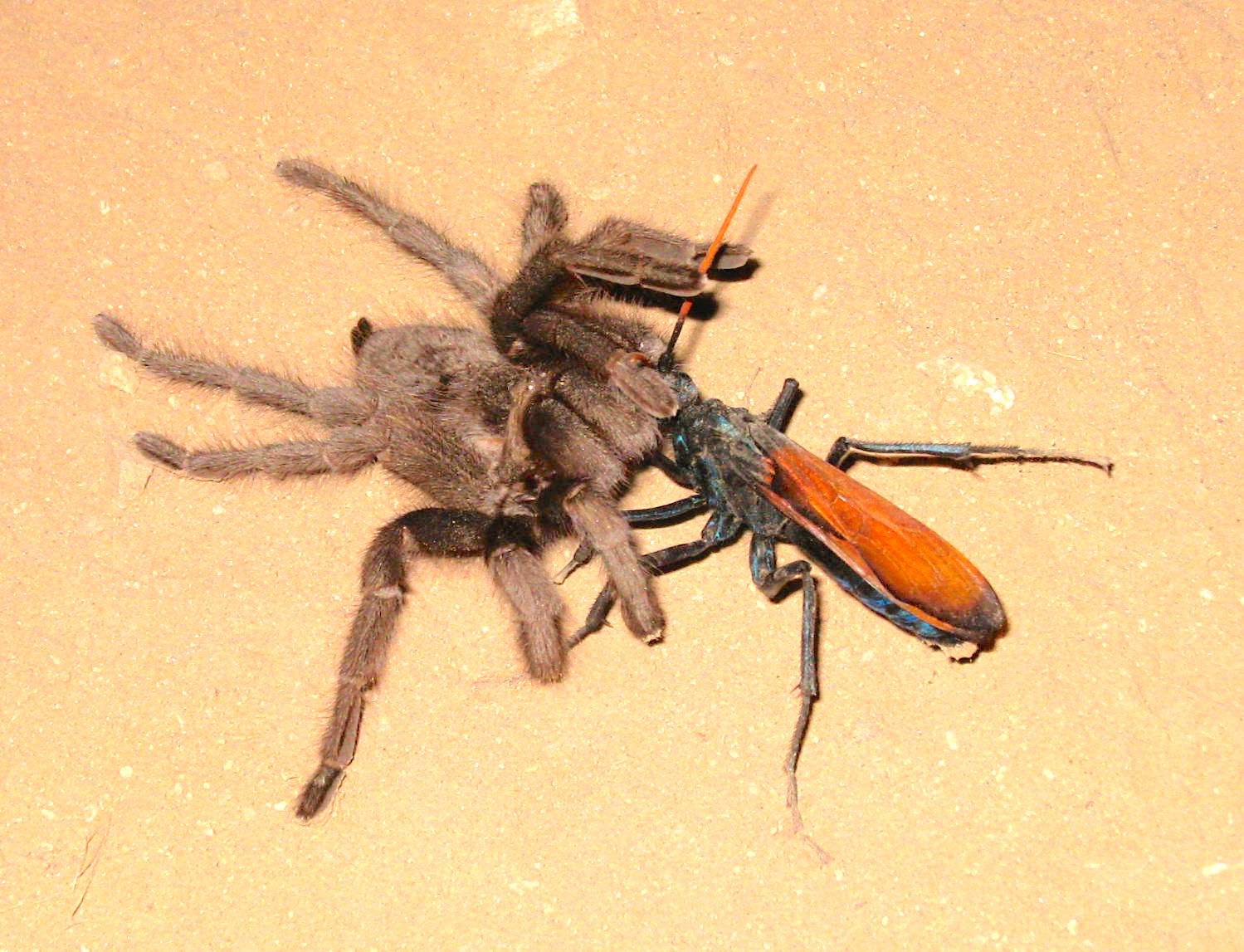
Spider Wasp / Pepsis Wasp / Tarantula Hawk Abaco Bahama (Keith Salvesen / Rolling Harbour)

SPIDER WASPS  & TARANTULA HAWKS (PEPSIS WASPS)

I’ve recently had a flood of online hits for a creature I wrote about several years ago. It’s an aggressive-looking insect that I found in the coppice on South Abaco. I have revisited and revised the original article, with some better images than my own original ones. I could only get a partial shot of the insect, and I wondered whether to try to reach it and get a more complete shot. Perhaps I could have, but very fortunately for for me (as it later turned out) I didn’t touch it.

Spider Wasp / Pepsis Wasp / Tarantula Hawk Abaco Bahama (Keith Salvesen / Rolling Harbour)

This creature turned out to be a Spider Wasp (aka Pepsis Wasp), of the Pompilidae family. The insect is familiarly known as a Tarantula Hawk, for reasons give in unsparing detail below. For it turns out that this creature would be the hardest bastard insect on Planet Bastard in the Galaxy Bastardium. 

Spider Wasp / Pepsis Wasp / Tarantula Hawk - TheCrotalusfreak

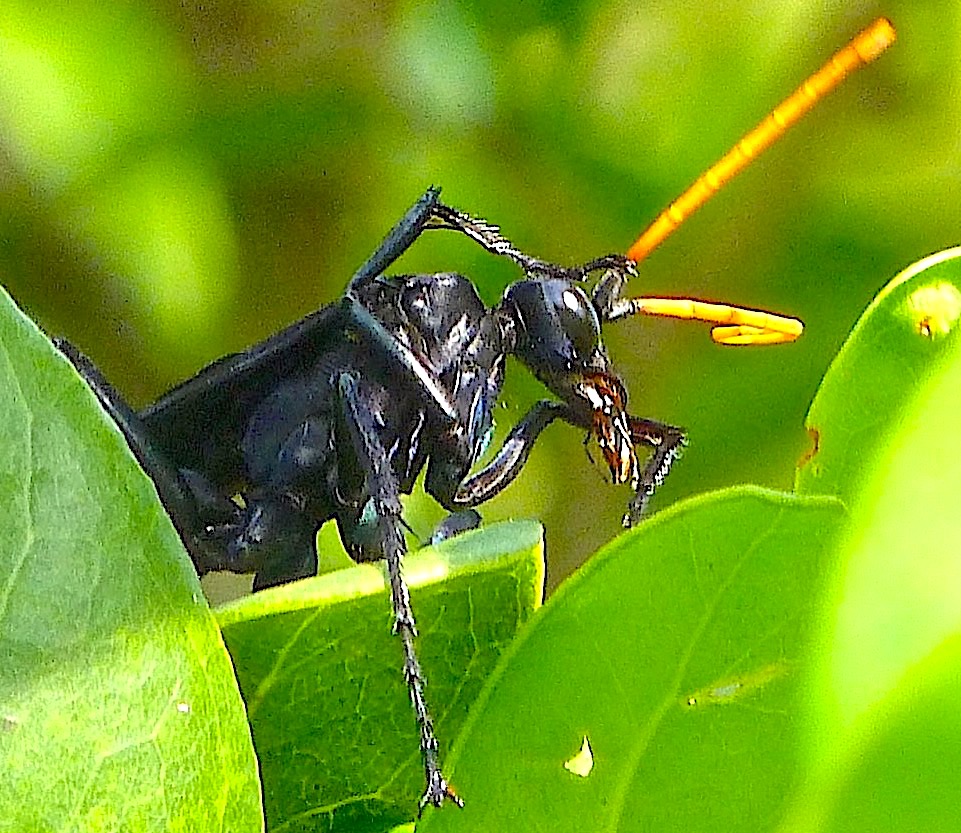
It’s lucky that I didn’t try to try to collect it to keep it in a matchbox (if those even exist now).  Note, for start, the scary eating apparatus… and it’s not for nibbling leaves as I had thought, but chopping up small insects. The leg claws and barbs are for pinning down its prey. You would not believe how unpleasant these little buddies are –  and that’s before we even mention the sting…

SPIDER WASPS IN ACTION

These wasps are known in some countries as “horse-killers”. There are many species around the world, with 6 subspecies, one of which being the Tarantula Hawk or Pepsis Wasp – so-called because it hunts tarantulas and uses them in a most ingenious and cruel way… NB the BNT have rightly pointed out that these insects are unaggressive to humans. If you leave them alone, they will spare you. I’ve also read that “The tarantula hawk is relatively docile and rarely stings without provocation” Now read on to see if it might be sensible to provoke one or not.

Spider Wasp / Pepsis Wasp / Tarantula Hawk - astrobradley

SCARY CRITTERS & LIVING LARDERS

(Trigger Warning: this is really rather gross)

SPIDER WASPS are ‘solitary’ insects that feed on ground spiders/ tarantulas by stinging them to paralyse them, then eating them. In the most sinister way, the females also make use of spiders for breeding purposes. Hear this! They build a nest in a burrow, find a spider (a tarantula for choice), paralyse it with their sting, drag it to the nest and lay a single egg on its abdomen. Then they seal up the burrow. 

Spider Wasp / Pepsis Wasp / Tarantula Hawk mshandro

When the egg hatches, the larva chews a hole on the spider’s abdomen and enters a living larder. It gradually eat its host as it grows. The spider’s vital organs are left till last, so that the spider stays alive as long as possible until the larva has reached full-size. After several weeks, the larva spins a cocoon and pupates (often over winter). Finally, the wasp becomes an adult, bursts Alien-like from the spider’s abdomen (deftly evading Ripley), and tunnels out of the burrow… 

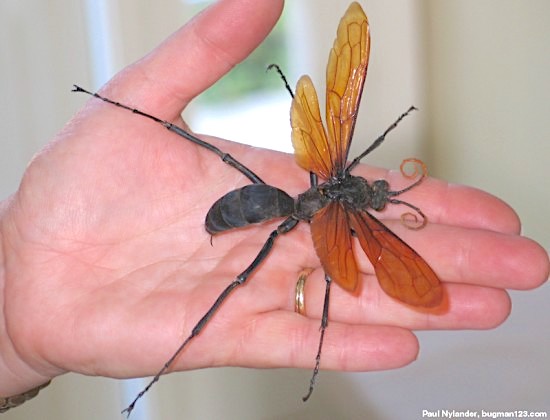
Do NOT try this at home or more than 10 yards from a medical centre Spider Wasp / Pepsis Wasp / Tarantula Hawk _ Paul Nylander

SPIDER WASPS: MORE FEARFUL FACTS

  • Their hunting improves with experience – the more spiders they eat, the quicker they find, attack & kill them
  • Males use ‘perch territories’ to scan for receptive females from a tall plant or other vantage point, a behaviour known as HILL-TOPPING
  • Adult wasps also feed on a variety of plants for nectar & pollen. They may become intoxicated on fermented fruit, which affects their ability to get around (I think we’ve all been there at some time…)
  • The female Pepsis gets her spider in two main ways: approaching a tarantula causing it to rear up defensively on its legs, thus exposing its abdomen to the sting or
  • She locates a tarantula’s burrow, using her sense of smell. She tricks the spider into emerging by tweaking the web at the burrow’s entrance or ‘intruding’ (see video below)
  • The wasp uses her long stinger to stab her prey. The poison rapidly paralyses the spider. She then drags it to her burrow, lays her egg onto the tarantula’s abdomen, seals the burrow and leaves. Job done
  • The hooked claws and barbs on the wasps’ long legs are weapons for grappling with victims
  • The stinger of a female tarantula hawk can be up to 7 mm (1/3 inch) long – and the sting is among the most painful insect stings in the world (see below)
  • Only the females sting (males may pretend to) because the stinger is linked to the ovipositor (egg-laying organ)
  • You can distinguish females from males by the curled antennae of the female. Mine was therefore female
  • The Pepsis wasp has (unsurprisingly) very few predators, though apparently roadrunners and bullfrogs may tackle them

Here is a hypnotically fascinating 3-minute video of the life-or-death struggle

SPIDER WASP  –v-  TARANTULA 

THE STING

The sting of these wasps is among the most painful of any insect, though the most intense pain lasts on a few minutes. Entomologist Justin Schmidt bravely submitted himself to the stings of various insects and described this pain as “…immediate, excruciating pain that simply shuts down one’s ability to do anything, except, perhaps, scream. Mental discipline simply does not work in these situations.” 

Schmidt produced his SCHMIDT STING PAIN INDEX The pain scale, based on 78 species, runs from 0 to 4, with 4 awarded for the most intense pain. Spider Wasps of the species Pepsis – i.e. Tarantula Hawks – have a sting rating of 4.0, described as “blinding, fierce, shockingly electric. A running hair drier has been dropped into your bubble bath” Only the bite of the Bullet Ant – and the sting of the Warrior Wasp – is ranked higher, with a 4.0+ rating, vividly described as pure, intense, brilliant pain. Like fire-walking over flaming charcoal with a 3-inch rusty nail in your heel”

LIGHT RELIEF AFTER THE PAIN

1. In 1989, New Mexico chose the Tarantula hawk wasp as the official state insect. The choice seems to have been left to schoolchildren and I’m guessing here (or gender-stereotyping) but I suspect it was the boys’ choice that won…

2. Tarantula Hawk is a “psychedelic progressive metal band” from San Diego, Ca. Their short discography includes their debut Tarantula Hawk (CD/LP, 1998); Burrow (Live CD, 2000, self-released); and Untitled. The cover of their debut provides the perfect ending for this post, vividly depicting the colour and texture of the swirling fiery pain you could experience (and I don’t really mean from listening to the music…) 

UNDOUBTEDLY PAINFUL EXPERIENCE

ARGUABLY PAINFUL STING

Mr Gordon Sumner

AN ENJOYABLE STING

Credits:  Keith Salvesen / Rolling Harbour (1, 2, 7); TheCrotalusfreak (video clip) (3);  astrobradley (4);  mshandro (5); Paul Nylander (6)


Spider Wasp / Pepsis Wasp / Tarantula Hawk Abaco Bahama (Keith Salvesen / Rolling Harbour)

Unknown's avatar

PEACOCK FLOUNDERS REVISITED: NOW YOU SEE THEM…


Peacock Flounder (Melinda Riger / G B Scuba)

        PEACOCK FLOUNDERS (Part Deux)

MASTERS OF SUBAQUATIC CAMOUFLAGE

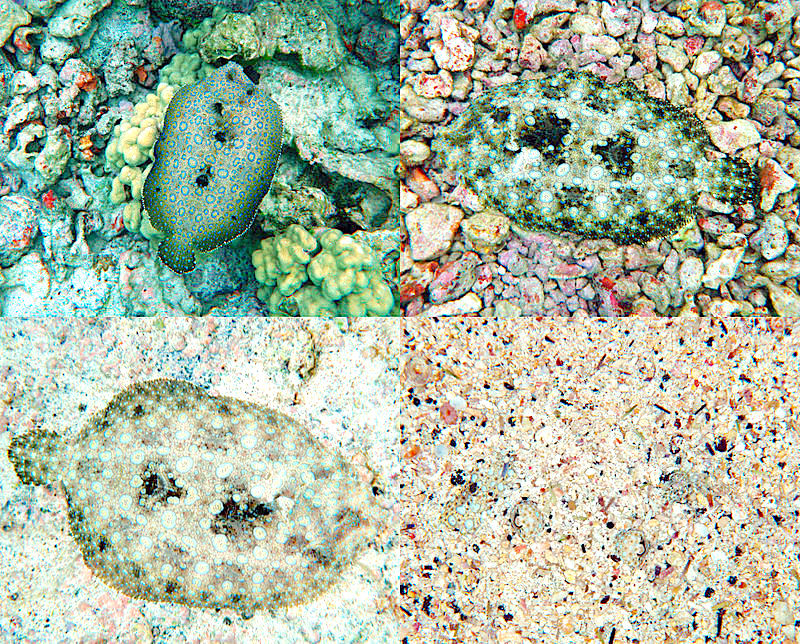
I featured the extraordinary, colour-transforming PEACOCK FLOUNDER Bothus lunatus about 3 years ago in the Bahamas Reef Fish series (No. 21 I think). These really are remarkable creatures, and I am pleased to be able to show some more wonderful illustrative photos. 

Peacock Flounder (Melinda Riger / G B Scuba)

ROVING EYES

In the fish shown here, you’ll see that – surprisingly – both eyes are on the upperside of the fish, above the rather grumpy mouth, whereas the head is horizontal to the ocean floor. Oddest of all, juveniles are constructed conventionally with bilateral eyes, and look like ‘normal’ fish rather than flatfish.

Peacock Flounder (Melinda Rogers / Dive Abaco)

As the fish matures, in some magic way the mechanics of which I can only guess at**, the right eye grows round to the topside and the flounder transforms from a ‘vertical’ fish to a flatfish. For this reason, the PF is known as a ‘lefteye’ flounder. Maybe in other flounder species in the world – the southern hemisphere maybe? – the eye that moves round to the upperside is the left eye.

Peacock Flounder (Virginia Cooper / G B Scuba)

The eyes of this fish have another special trick up their sleeves (so to speak). They operate completely independently. Thus the creature can look left and right, or forwards and backwards, simultaneously. It’s an excellent system for detecting predators coming from any angle. It’s a superpower we might all benefit from.

Peacock Flounder (Melinda Rogers / Dive Abaco)

DO THEY HAVE ANY OTHER TRICKS WE SHOULD KNOW ABOUT?

Yes they do indeed. If you have been admiring the fish shown so far, you’ll have noticed that the colour of each one differs from the others. In addition to the predator-protection that the eyes provide, the peacock flounder can make itself (near) invisible. They can rapidly change colour to match their surroundings. There are 3 reasons for this: to avoid / confuse predators; to conceal themselves on the sea-floor to catch passing prey; and, as dive expert Fred Riger has pointed out, “the male peacock flounder can, and does greatly intensify his colours to declare territory and attract females. When doing this the males will also signal with the left pectoral fin, sticking it straight up and waving it around.” 

The same fish, photographed over several minutes as it moves over the ocean floorPeacock Flounder (Wiki)

Matching the background happens as the fish swims, and in a few seconds. When they rest on the sea-floor, the camouflage may even become total. In #4 above you can just about make out the eyes. The whole effect is known as ‘cryptic coloration’ or CRYPSIS. In contrast, the image below shows just how adaptable the transformation can be. Note how the fish can even mimic the pinkish tinge of the sand perfectly. If threatened, the fish will bury itself in the sand, with just its eyes showing.

Peacock Flounder (Melinda Rogers / Dive Abaco)

HOW DO THEY MANAGE TO CHANGE COLOUR IN SECONDS?

It’s complicated! A simple answer is: a mix of hormones, pigment-cells and vision, all coordinating rapidly. The colour change works in two ways: pigments are selectively released to the skin cells; and other pignments can be selectively suppressed. An analogy might be image manipulation using variations in brightness, saturation etc. Not convinced? Then watch this short video and prepare to be impressed. Astonished, even.

WHAT IF A FLOUNDER CAN’T SEE CLEARLY FOR SOME REASON?

As with many (all?) superpowers, there is usually some kryptonite-style flaw. A flounder with a damaged eye, or one temporarily covered (by sand, for example) will have difficulty in changing colour – possibly at all, or at any rate with the swiftness it needs to have. 

Peacock Flounder (Melinda Riger / G B Scuba)

THESE SIDEWAYS FISH – HOW DO THEY… YOU KNOW…?

Take a look at the fish above with its top fin raised. It’s a ‘ready’ signal in a harem. Male flounders have a defined and defended territory within which live up to 6 females – a so-called ‘harem.’ I can do no better than borrow the description of the rituals from an article derived from scientific papers by Konstantinou, 1994Miller, et al., 1991 in the website animaldiversity.org/…ounts/Bothus_lunatus To which I can only add, ’15 seconds, eh?’

Peacock Flounder (Melinda Riger / G B Scuba)

“Mating activities usually begin just before dusk. At this time, a male and a female approach each other with the ocular pectoral fin erect. The two fish arch their backs and touch snouts. After this interaction the female swims away, and the male sometimes follows, approaching the female again from the left side. At this point the male pectoral fin is erect and the female pectoral fin moves up and down, possibly signalling willingness to mate. The male then positions himself underneath the female and mating begins. This process consists of a mating rise, during which the female and male rise in the water column together. On average, these rises last about 15 seconds. At the highest point of this rise, usually around 2 m above the substrate, gametes from both fish are simultaneously released, producing a cloud of sperm and eggs. Once the couple returns from the rise, the male “checks” to make sure mating was successful, and the pair separates quickly, swimming away from each other in opposite directions. Not all mating rises are successful, and the process of “checking” is thus important. The exact purpose of the mating rise in these flounders unknown; possible reasons for rising include better dispersal of gametes and predator avoidance.” 

Peacock Flounder – Kim Rody ArtPeacock Flounder (Kim Rody Art))

**This may in fact be through sheer laziness

Credits: Melinda Riger & Virginia Cooper / Grand Bahama Scuba; Melinda Rogers / Dive Abaco; Adam Rees / Scuba Works; Kim Rody; animaldiversity.org; magpie pickings and other credits in the text

Peacock Flounder (Melinda Riger / G B Scuba)

Unknown's avatar

ABACO’S RARE PIPING PLOVERS: CITIZEN SCIENTISTS WANTED FOR YEAR 5


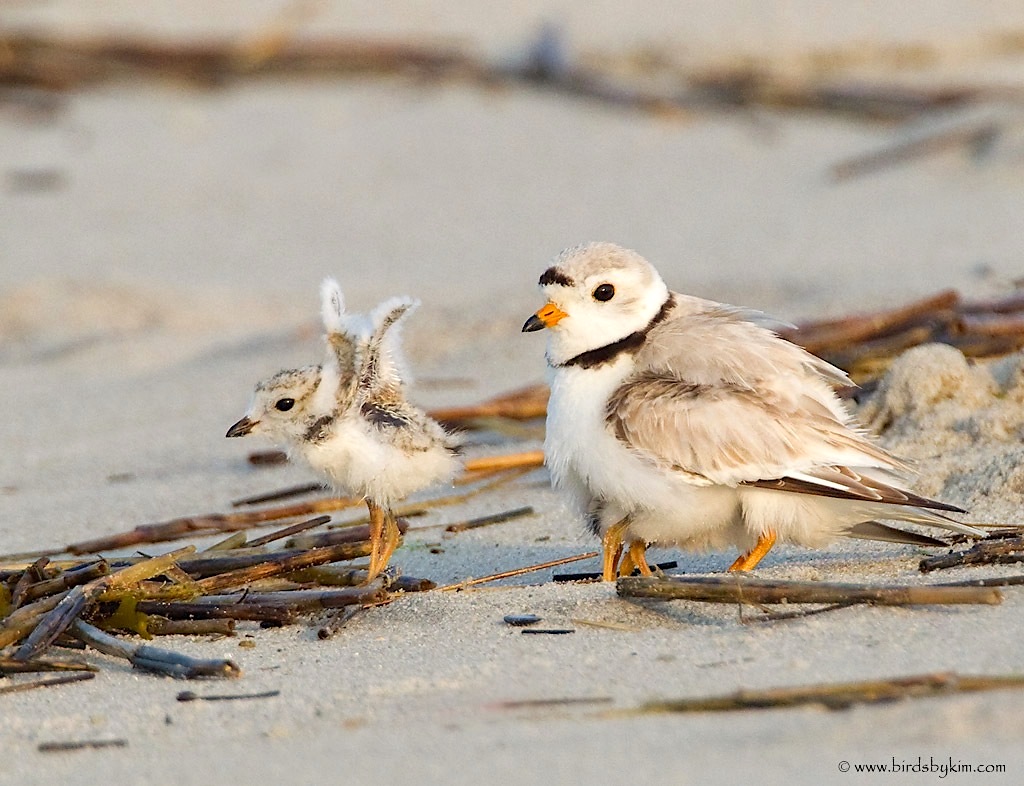
Piping plover adult & chick (Conserve Wildlife Foundation NJ / birdsbyKim)

ABACO’S RARE PIPING PLOVERS: CITIZEN SCIENTISTS WANTED FOR YEAR 5

  • BE A BEACH MONITOR IN THE CAUSE OF RESEARCH AND CONSERVATION OF A TINY RARE BIRD THAT CHOOSES ABACO FOR ITS WINTER HOME
  • NO EXPERIENCE NECESSARY; MINIMAL EQUIPMENT (pen, paper, binox & a ‘normal’ camera)
  • ABILITY TO COUNT TINY BIRDS IN (USUALLY) SMALL NUMBERS AN ADVANTAGE
  • SIMPLE AS TAKING A NATURE WALK ON YOUR FAVOURITE BEACH (but sorry, not with a dog)
  • COMMITMENT UP TO YOU – ONCE A WEEK, ONCE A MONTH, JUST THE ONCE
  • EVERY SIGHTING IS LOGGED – BANDED BIRDS ARE TRACKED BACK TO THEIR ORIGINS
  • EVERY BIRD IS A STAT THAT ADDS TO THE OVERALL PICTURE FOR RESEARCHERS
  • THE BIRDS MAY BE FOUND ON THE MAINLAND AND THE CAYS – EVEN THE MARLS
  • WE WORK IN PARTNERSHIP WITH THE SCIENTISTS  IN THE BREEDING GROUNDS
  • ABACO IS THE ONLY BAHAMAS ISLAND WITH AN ANNUAL WINTER-LONG WATCH

At the end of July – my guess is the 28th, on past form – the first piping plover of the winter season will be resighted on Abaco. It will weigh less than 2oz, and will have travelled at least 1000 miles (direct route). In practice it will be much further, because the journey will be broken by coastal stopovers en route.

‘SQUID’ from the Holgate Unit of the Edwin B Forsythe NWR, NJ, overwintering on Abaco (year 2)Piping Plover Squid from NJ - on Abaco Bahamas (Keith Kemp)

My bet is that the first bird will touch down in the Cherokee Sound area. There’s a fair chance it will be called ‘Squid’  from New Jersey (for the 3rd year) or ‘Black Flag 2J’ from Prince Edward Island, Canada (for the 2nd year). At once, ABACO PIPING PLOVER WATCH will switch from summer indolence to red alert and piping hot… for the next 7 months. The last winter visitor will leave on ± March 15 2020 to return to its breeding grounds in the North (specific parts of northern US / Canada).

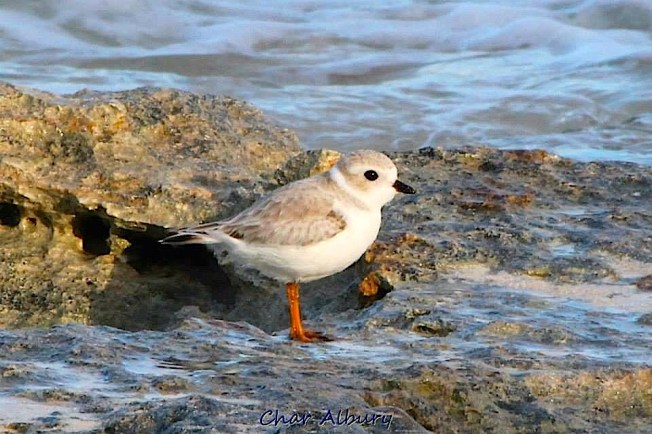
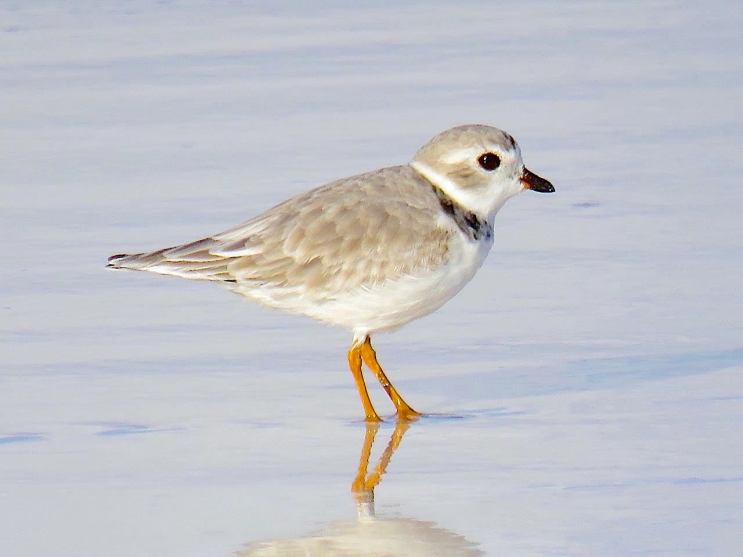
Piping Plover on Man-o-War Cay, Abaco Bahamas (Charmaine Albury)Piping Plover on Abaco Bahamas (Charmaine Albury)

HOW ON EARTH CAN YOU PREDICT THIS?

Since the 2015-16 season, we have been monitoring Abaco’s beaches, shorelines, and flats (there are specific locations that are preferred by the birds) throughout the winter season. Each year adds to the data from previous years and as the annual information is analysed, the knowledge of the behaviours of this little plover significantly increases.

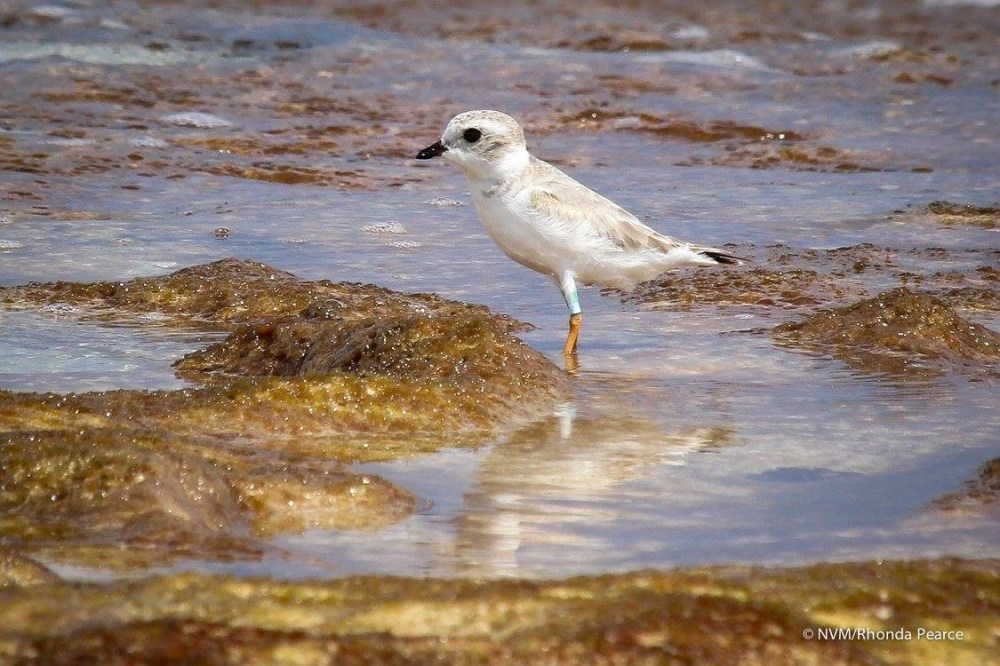
‘TUNA’ – a legendary regular from past years (Rhonda Pearce)Piping Plover on Abaco Bahamas (Rhonda Pearce)

Over 4 years, distinctive patterns have emerged.

  1. Firstly, the plover numbers each season are fairly constant.
  2. Next, we have found that a number of birds return the following winter. Some are repeat returners – the current record is held by Bahama Mama from Lake Michigan, with 5 annual visits to the very same beach.
  3. Then, we have established that many of the banded birds are (a) resighted along the US coastline where they take a stopover during migration and (b) return to exactly the same beach where they were born.
  4. Often, we can find out when they hatched, fledged and left the beach – and even the person who did the banding.
  5. Finally, the number of banded birds – especially Canadian ones – is on the rise. This in part reflects an increase in summer chicks banding – but the fact is, we can show that they are turning up on Abaco, and returners usually turn up either on the same shoreline (or very close to it) as the previous year.

Piping Plover on Abaco Bahamas (Keith Salvesen)

WOULD IT MATTER IF APPW DIDN’T EXIST?

In one sense no, because the birds would still undertake their Fall and Spring migrations, even if no one took any notice. But then, of course, no one would have any idea where the plovers might be for 6 – 8 months of the year. What the Watch can do, in conjunction with our partners in the breeding grounds, is to complete the annual migration circle and provide the specific details that help research and conservation of this rare little bird (world population around 8000). Furthermore, the Watch results provide continuing evidence that Abaco and its Cays provide a safe and suitable overwintering habitat for the birds. 

SQUIDS KIDS – THE MIGRATION CIRCLE COMPLETED

KEITH, CHEROKEE & ABACOPiping Plover 'Keith' - CWFNJ    Piping Plover 'Cherokee' - CWFNJ Piping Plover 'Abaco' CWFNJ

These 3 little chicks are this summer’s hatchlings (in June) of parents Squid (see above) and ‘Sophia’. This is on the very same beach where Squid was born and banded in July 2017. Sometime this Fall, we hope that Squid will return for a 3rd year in Cherokee Sound. And we hope just as much that one or maybe all his chicks will arrive on Abaco too. We’ll certainly know if they do – we already know their band combinations! They each have an Abaco-related name – maybe that will encourage them too.

Piping plover on the beach at Delphi (Peter Mantle)Piping Plover on Abaco Bahamas (Peter Mantle)

WHAT SORT OF PEOPLE CAN BE BEACH MONITORS?

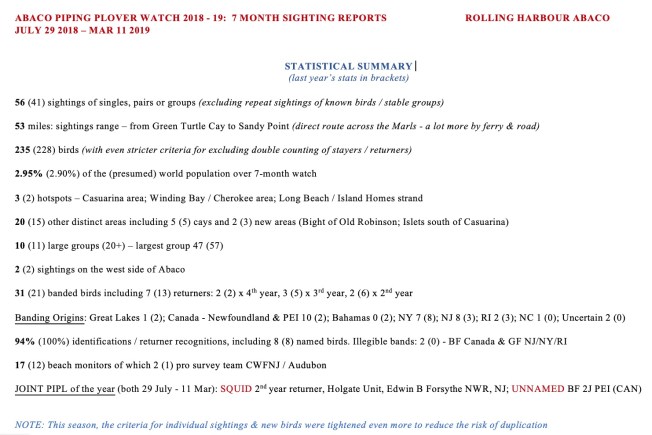
Anyone at all. No experience is needed. You’ll be given all the info you need about the birds you’ll be looking for, and it may be possible to go out with a monitor to see what it’s like. Even a blank report is useful to have, to indicate where the plovers are not… And there’s no such thing as a mistake – the system allows for occasional miscounts, for example. Below is a summary of the last season, from which you can see the kind of data that is accumulated. 

You’ll see that there were 17 beach monitors of whom most were local Abaconians or regular second-homers. You probably know some or all of them! A few were visitors from US and UK. The 2 pro monitors were from our partners Conserve Wildlife Foundation NJ, and Audubon Caribbean. Keith Kemp is the wonderful and hard-working lead monitor and very regularly visits the hotspot shorelines. Other people made quite frequent reports, some about once a month, and several made fewer than 5. Each one added to the overall picture.

Piping Plover chick on LBI (Northside Jim Verhagen)


If you would like to become involved, even on the most casual basis, please do get in touch. Ditto if you’d like to know a bit more about it. If you decide not to go ahead – or once started, to stop – that’s all fine. It’s basically up to you whether you want to turn a beach walk into a bit of research (though as I mentioned above, it’s not a thing that can be done with a dog, for obvious reasons). Take a friend – or even a spouse. A single sighting might reveal a hitherto unknown location or a new banded bird – it happens every year. It’s Citizen Science in action!

Please email me at rolllingharbour.delphi [@] gmail.com or contact me via FB. Or just comment on this post!

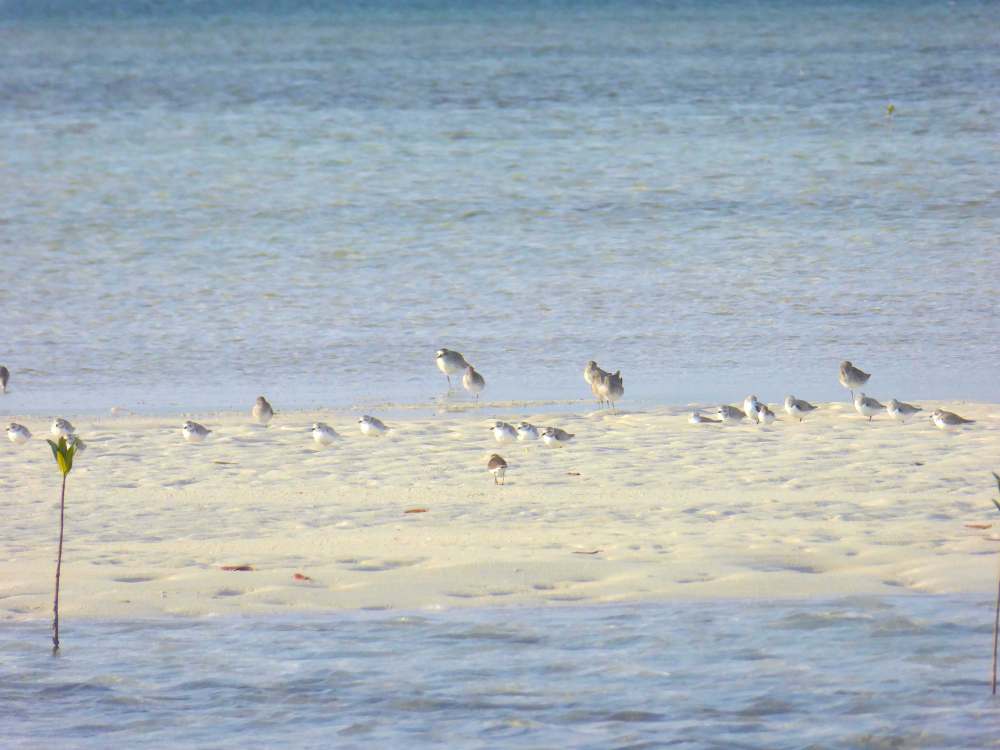
A flock of piping plovers (with a few birds that aren’t), Cherokee Flats (Lucy & mark Davies)Piping Plover Flock, Cherokee Sound, Abaco Bahamas (Lucy & Mark Davies)

Credits: CWFNJ / Kim; Keith Kemp; Charmaine Albury; Rhonda Pearce; Keith Salvesen; CWFNJ / Michelle Stantial x 3; Peter Mantle; ‘Northside’ Jim Verhagen x 2, LBI; Lucy & Mark Davies

I’m on Long Beach Island right now – hope to meet you on Abaco in the Fall (Northside Jim)
Piping Plover chick on LBI (Northside Jim Verhagen)

Unknown's avatar

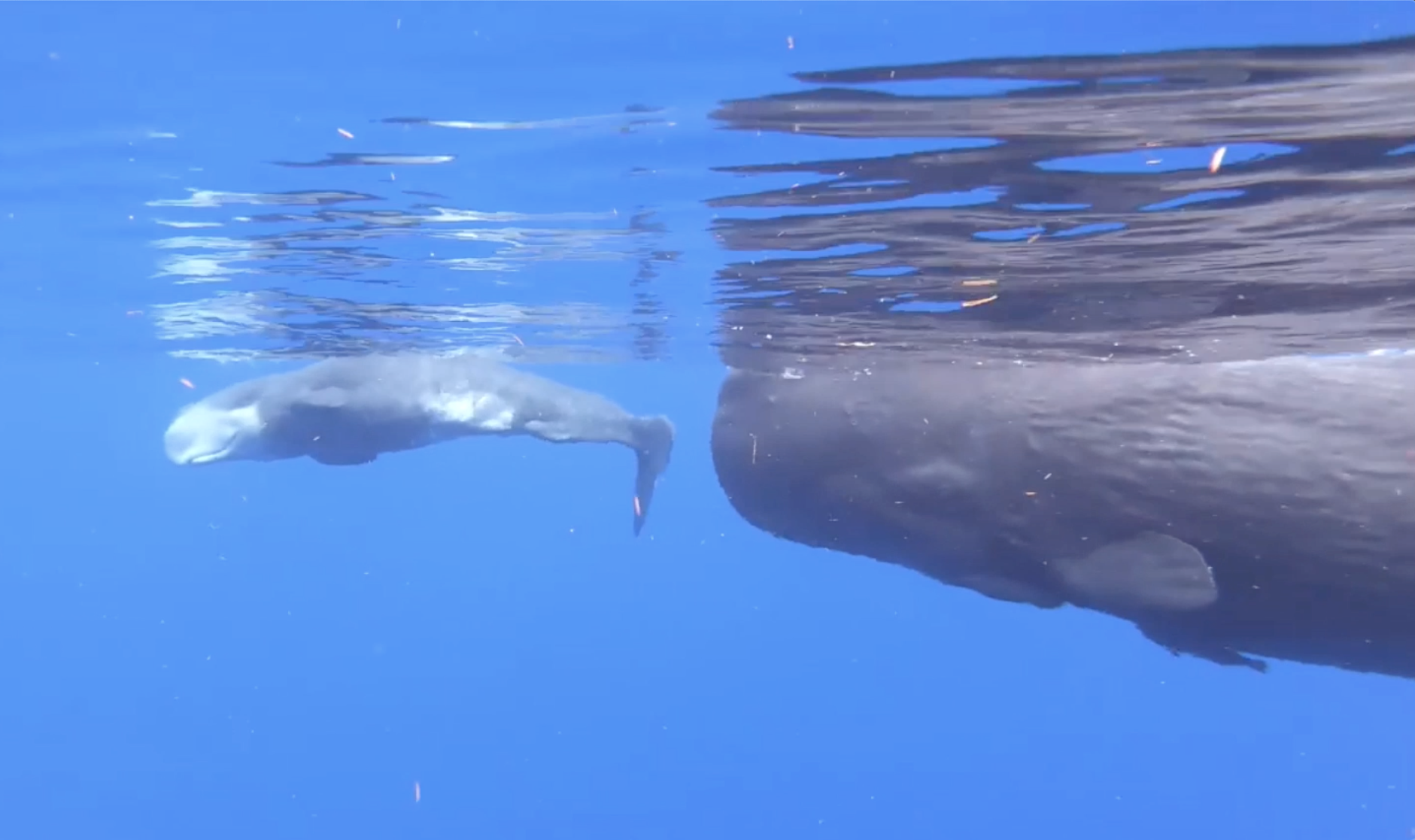
BABY SPERM WHALE IN BAHAMAS WATERS: AMAZING FOOTAGE


Sperm Whale baby (neonate) Abaco Bahamas (Charlotte Dunn / BMMRO)

BABY SPERM WHALE IN BAHAMAS WATERS: AMAZING FOOTAGE

Over several years I have had the privilege of being able to feature wonderful photographs and video footage in this blog. Birds, course, and also reef fish, sharks, seahorses, coral and anemones and a whole lot more. I have also been involved throughout with the wonderful work of the Bahamas Marine Mammal Research Organisation (BMMRO), and have been a part of team since 2017. Abaco is lucky enough to have the HQ at Sandy Point, but we must keep in mind that the organisation’s remit extends throughout the entire Bahamas archipelago, and has firm links with research and conservation organisations on the other islands.

Sperm Whale baby (neonate) Abaco Bahamas (Charlotte Dunn / BMMRO)

The clear turquoise waters around the islands and their cays are well-known to, and appreciated by, all. This is the playground of the smaller marine mammals – the dolphins, smaller whales and the (now a significant presence) manatees.


Less well known are the denizens of the deeper waters and the immense depths of the GREAT BAHAMA CANYON of the northern Bahamas. This is the realm of the large marine animals, from the mysterious speciality beaked whales right up to massive sperm whales. 

Sperm Whale baby (neonate) Abaco Bahamas (Charlotte Dunn / BMMRO)

About 3 weeks ago, the BMMRO research team encountered something truly wondrous off the south Abaco coastline – something to quicken the pulse and gladden the heart – a newborn sperm whale investigating the underwater world it has just been born into. Hopefully it will flourish and live for decades. The hope is sadly tempered by the overwhelming – and increasing – evidence of the terrible effect that humans have caused in just one generation by the pollution of air, land and sea. 

Charlotte Dunn posted the footage of 2 separate sightings. Her first caption reads:

“Close encounter with a curious newborn (‘neonate’) sperm whale yesterday – reminding us of the importance of our Shared Waters project about the effects of ship traffic on resident sperm whales, http://www.bahamaswhales.org/research.aspx. The young individuals like this one will be the most impacted if we don’t make serious conservation changes. As this young whale matures, the policy changes we make in the Bahamas now will affect its survival”.

“While their mothers are feeding at depth (knocking sound in the background) this newborn is being cared for by a slightly older calf until the adults return.”

After the second encounter, Charlotte wrote: “Here’s another amazing short clip of the neonate sperm whale we videoed off south Abaco two weeks ago – thank you to the BEP Foundation and the Devereux Ocean Foundation for funding some of our important work with sperm whales in the Bahamas”.

Sperm Whale baby (neonate) Abaco Bahamas (Charlotte Dunn / BMMRO)

On Charlotte’s conservation points above, over the last 3 months or so I have been checking daily for posts and articles specifically related to stranded, dead, and killed whales, and their stomach contents as revealed by necropsies. I have collected images from around the world. I won’t wreck this marvellous find in Abaco waters by including any of these. This casual research reveals a horrifying attrition rate for marine mammals. Most animals were full of plastics, from micro through flip-flops all the way up to very large chunks. Some of this junk clearly was the actual cause of death rather than a contributing factor. A whale may take several weeks to die in this way. All of it is entirely the responsibility of mankind – and pretty much caused in the last 50 years.

So let’s enjoy this little sperm whale, and hope it grows to an adulthood that will have seen a radical change for the better in its birth environment – the one that should never have been considered ours to destroy.

Sperm Whale baby (neonate) Abaco Bahamas (Charlotte Dunn / BMMRO)

CREDITS: Brilliant close-up footage plus the clips I have taken from it – Charlotte Dunn / Diane Claridge / BMMRO.  

DONATE: If you are touched by the magic of this little Bahamas sperm whale, may I invite you to consider making a donation to BMMRO for its research and conservation work – a scientific commitment that reaches far beyond the waters of the Bahamas. The system is set up to process donations from just $10 upwards, and every cent is used to further the work of BMMRO. Please click the logo below to reach the right page directly.

Sperm Whale baby (neonate) Abaco Bahamas (Charlotte Dunn / BMMRO)

Baby sperm whale off south Abaco, Bahamas ©BMMRO

Unknown's avatar

TINY PIPING PLOVER CHICKS CAN SWIM! WHO KNEW?


TINY PIPING PLOVER CHICKS CAN SWIM! WHO KNEW?

Birds never cease to astonish and delight. Baby birds contain additional magic ingredients such as adorbium and cuteite. Ten days ago, a whole new level of spectator infatuation was effortlessly induced in the piping plover conservation team at Good Harbor Beach in Gloucester, Massachusetts.

The episode took a grand total of 35 seconds… For that is the time it took for three tiny piping plover chicks to get from one side of a small stretch of water to the other. By swimming! They had been spotted doing this the previous day, so the team were prepared. This was no one-off water-based miracle.

WATCH THIS CLIP AND BE UTTERLY ASTOUNDED AND ENCHANTED…

WHY DID THE PLOVER CHICKS CROSS THE WATER?

Alicia Pensarosa, amazed conservationist and photographer, later posted her video captioned “Mom and Dad plover fly to the other side first and then pipe at them to swim over. I think they do this to get to a better foraging area and to be less disturbed from beach crowds. They have been making their trek over in the morning and then come back in the afternoon (both on busy and quiet beach days)“.

WHY THE BIG SURPRISE ABOUT SWIMMING SHORE BIRDS?

Because as it turns out, very very few people have seen this behaviour before with the tiniest shorebirds. Alicia’s post on FB unsurprisingly has racked up loads of Likes, Loves, WOWs, OMGs and other enthusiastic emoticons. Plus plenty of shares. Plus a whole lot of comments and replies. In the interests of research I have examined these. One person once saw snowy plover chicks take a dip. Only two people had seen PIPL chicks do so. I’m pretty sure Michelle Stantial, pre-eminent PIPL scientist, has seen this phenomenon too. But overwhelmingly the responses can be summarised by the words ‘Who Knew?’ 

And now, assuming you watched the video (and if not, why not? and please scroll back and do so forthwith), you know it too. Here’s my current favourite chick to end with.

Keith, son of Squid and Sophie, sibling of Abaco and Cherokee (for which, see HERE)

CREDITS: Alicia Pensarosa for the report, the great video and her work with PIPL; Illustrative chicks courtesy of ace PIPL photographer Northside Jim Verhagen of LBI; and Todd Pover / Conserve Wildlife Foundation New Jersey

Unknown's avatar

‘A SADNESS OF SHEARWATERS’ ON ABACO: UNWELCOME NEWS


Audobon's_Shearwater - Dominic Sherony wiki

‘A SADNESS OF SHEARWATERS’ ON ABACO

If you are walking your favourite beach on Abaco right now, it’s quite possible you may see – or may already have seen – a very poorly seabird. Or one that is dead, I’m afraid. These are Audubon’s Shearwaters, also known as Dusky Petrels. They are the only permanent resident shearwater species on Abaco. Three others (Cory’s, Great and Sooty) are rare transients; and the last – the Manx – is a very rare off-course vagrant.

Each sad bird is part of a tragic and recurrent phenomenon, a so-called die-off event. As in previous years, a few of the birds that succumb may be Great Shearwaters mixed in with the Audubon’s. I first became aware of this problem in June 2015 and wrote two detailed posts about the situation. This bleak time lasted for about a week, and many reports came in from the mainland and the cays from Green Turtle Cay right down to Crossing Rocks, all duly mapped to get the overall picture. 

audubons-shearwater-abaco-keith-kemp

There was thankfully no such problem in 2016, but in 2017 – also in June – there was another die-back event involving a large number of Audubon’s shearwaters (Puffinus lherminieri) appearing in the tideline and on beaches. Many were already dead. Some are still alive, but in a very poor state. The prospects for recovery for birds that were captured and cared for were not good.

Audubon's shearwater - Kinlarak / wiki

Two years on, and the melancholy cycle is repeating itself. A few days ago, Melissa Maura, an expert in the care and recovery of creatures of all kinds, posted an alert and some sound advice:

A heads-up to all Island folk that it appears to be a summer when exhausted Shearwaters (pelagic seabirds) are washing up on our beaches in Eleuthera and Abaco. I have had two calls in 24 hours. Should you find one, understand that it will be in a severe state of exhaustion and stress and that excessive handling will kill it. Please put in a safe pen on a sandy surface, with shallow pan of fresh water and try locate either fresh fish (important) or squid from a bait shop. This may have to be administered by gently opening the beak and inserting one inch long piece of fish every couple of hours until stable. Ideally they need tube feeding, but very few folk can do this. Please contact me on private message if you find any…

An exhausted Audubon’s Shearwater, now being cared for by Melissa Maura

WHY DOES THIS SHEARWATER DIE-OFF HAPPEN?
This is a periodic phenomenon that looks to be settling into a 2-year cycle in the Northern Bahamas (Eleuthera is also affected). The cause is probably a combination of factors, very likely stemming from prevailing mid-summer climate conditions and/or the effect of climate change. This can lead to a shortage of food far out in the ocean where the birds spend their days. This in turn leads to weakness and exhaustion as the birds try to find food. The birds may then land (or fall) in the sea, to be washed ashore in a very bad state, or dead. In 2017, well-known bird expert Woody Bracey noted a correlation between poor fishing conditions out at sea, and an unusual absence of the frigatebirds that are a sure sign of a healthy fish population.
Shearwater washed up on the beach at Winding Bay a couple of days ago
ARE PLASTICS A CONTRIBUTORY FACTOR?
As we must all accept by now, most if not all these birds will unavoidably have ingested some of our discarded plastic.  However, that in itself would not explain the simultaneous deaths of many birds of one type in a specific area, at exactly the same time of year, and for a few days only. 
Audubon's Shearwater (Neotropical Birds / Cornell / Brian Sullivan)
WHAT ELSE CAN BE DONE?
The dead birds will be quickly removed by the turkey vultures. If you do find one, you might want to bury it. The prognosis for sick birds is not that good. They may have been carried a long way from open sea and they will be exhausted and starved. Those that are strong enough may recover naturally; but most will sadly die, being too weak and emaciated to survive. There is no available facility able to deal with a large number of very poorly or dying birds.
The most practical advice I can give is:
(1) move the bird gently into the shade if in the sun
(2) provide clean water in a shallow dish
(3) offer finely chopped fish BUT no bread (it’s very bad for birds)
(4) if this seems to be working, then carry on until the bird is strong enough to fly (this may be quite a commitment)
(5) do not reproach yourself if a bird you try to help dies. Many will be in such bad shape by the time they are washed up that they are unlikely to survive whatever steps you take
(6) remember that this a part – a sad part – of the life-cycle of these birds, and (as with other species), a degree attrition is an inevitable aspect of natural life
I’d be interested to hear any other accounts of this year’s dieback, especially of any recovery stories. By all means do this as a comment, or email me, DM, or FB.
Credits: thanks to those  on Abaco who have been reporting this event over the last few days; Dominic Sherony (1); Melissa Maura (2, 5); Keith Kemp (3); Kinlarak / wiki (4); Rhonda Pearce (6); Brian Sullivan / Neotropical Birds / Cornell  (7); )Richard Crossley / Crossley Guides for the composite picture
Unknown's avatar

DOLPHINS IN THE SEA OF ABACO: PLAYTIME


Dolphins, Sea of Abaco Bahamas (BMMRO / Charlotte Dunn / Keith Salvesen)

DOLPHINS IN THE SEA OF ABACO: PLAYTIME

Earlier this year, the team at Friends of the Environment in Marsh Harbour Abaco, in conjunction with BMMRO (Bahamas Marine Mammal Research Organisation), arranged a fundraising trip to look for whales and dolphins. On both counts, the guests’ hopes and expectations were amply fulfilled – in fact, almost certainly exceeded.

Dolphins, Sea of Abaco Bahamas (BMMRO / Charlotte Dunn / Keith Salvesen)

Where there is a single dolphin, there will almost invariably be others – and so it proved. The group of bottlenose dolphins turned out to be in a very playful mode, living up to their reputation as delightful, inquisitive, entertainers.

Dolphins, Sea of Abaco Bahamas (BMMRO / Charlotte Dunn / Keith Salvesen)

One of the dolphins turned out to be a young 3rd generation animal from the same family, recently weaned. The BMMRO has a large photographic library of dolphins and whales, collected over many years. In the photo above, you’ll see that the dorsal fin of the nearest one is ragged, especially near the top. This is the primary method by which individual animals are recorded to assist with subsequent identification in the field (= water) or back at base in Sandy Point by means of the photo archive.

Dolphins, Sea of Abaco Bahamas (BMMRO / Charlotte Dunn / Keith Salvesen)

The trip was perfected when a young female sperm whale came close to the boat… and then rolled onto her side, flipper up, to get a good look at the boat and its human contents. A wonderful experience for all those on board.

Dolphins, Sea of Abaco Bahamas (BMMRO / Charlotte Dunn / Keith Salvesen)

Credits: BMMRO / Charlotte Dunn; Friends of the Environment

Dolphins, Sea of Abaco Bahamas (BMMRO / Charlotte Dunn / Keith Salvesen)

Unknown's avatar

‘TERN, TERN, TERN’: THE UN-NOTORIOUS BYRD COUSINS


Royal Tern, Abaco Bahamas (Keith Salvesen)

‘TERN, TERN, TERN’: THE UN-NOTORIOUS BYRD COUSINS

There are twelve (12!) species of tern – ‘swallows of the sea’ – that to a greater or lesser extent may be found on Abaco. Whether they will actually  be visible at any given time is less certain, though. For a start, the only resident species is the lovely Royal Tern, available at many locations on Abaco and the cays throughout the year.

ROYAL TERNS Thalasseus maximus PR1

Royal Tern, Abaco Bahamas (Keith Salvesen)Royal Tern, Abaco Bahamas (Keith Salvesen)

In the slightly less commonly-found category are the summer migrant terns that, by definition, are only in residence for around half the year. Four of these are fairly common in certain areas, and actually breed on Abaco; these include arguably the prettiest of all, the bridled tern. The other two tern species (gull-billed and sandwich) are more rare and as far as I can make out do not breed locally; or perhaps only rarely. 

LEAST TERN Sternula antillarum SR B 1

LeastTern, Abaco Bahamas (Tony Hepburn)

BRIDLED TERN Onychoprion anaethetus SR B 2

BridledTern, Abaco Bahamas (Bruce Hallett)BridledTern, Abaco Bahamas (Bruce Hallett)

ROSEATE TERN Sterna Dougallii SR B 2

Roseate Tern, Abaco Bahamas (Woody Bracey)

SOOTY TERN Onychoprion anaethetus SR B 2

Sooty Tern, Duncan Wright wiki

GULL-BILLED TERN Gelochelidon nilotica SR 3 

Gull-billed Tern, Abaco Bahamas (Alex Hughes)Gull-billed Tern, Abaco Bahamas (Alex Hughes)

SANDWICH TERN Thalasseus sandvicensis SR 4

Sandwich Tern, Abaco Bahamas (Bruce Hallett)Sandwich Tern, Abaco Bahamas (Woody Bracey)

There is one rare winter resident migratory tern species. I had to check when the last one was recorded for Abaco. It was of course only in January this year, when ace birder-photographer Sally Chisholm saw one at Treasure Cay and managed to photograph it for posterity.

FORSTER’S TERN Sterna forsteri  WR 4

Forster's Tern (Dick Daniels)Forster's Tern, Abaco Bahamas (Sally Chisholm)

The final four ‘Abaco’ terns are very much the occasional visitors. Three of them pass over the Bahamas on their longer migration, but may make a pit-stop around Abaco to take on fuel. Likelihood of sighting one? Slender but not impossible… The fourth, the Arctic Tern, is a very rare vagrant, a bird well away from its usual home or migration route as the result of storms or faulty satnav or sheer happenstance. Don’t travel to the Bahamas intent on seeing one.

CASPIAN TERN Hydroprogne caspia TR 4

Caspian Tern Abaco Bahamas (Woody Bracey)Caspian Tern Abaco Bahamas (Keith Kemp)

As for the remaining three species, they are the transient black tern and common tern; and the vanishingly rare vagrant  Arctic tern (the clue is in the name). No photos of any of these I’m afraid, so here’s a handy checklist instead. 

     ELECTIVE MUSICAL DIGRESSION

Written by Peter Seeger a few years earlier, Turn x 3 was released in 1965, the title track on the second album from the Byrds. At a rather febrile time in US history (Vietnam, draft riots, black civil rightists v cops and so on), this unusually palliative and thoughtful song with its religious connotations to some extent stood for peace and hope in a time of turmoil.

PS the somewhat laboured title of this post shoehorns in the name of another Byrds album, ‘The Notorious Byrd Brothers’

Photo credits: Keith Salvesen (1, 2, 3, 5, 18); Tony Hepburn (4); Alex Hughes (10, 11); Bruce Hallett (6, 7, 12); Woody Bracey (8, 13, 16); Duncan Wright (9); Dick Daniels (14); Sally Chisholm (15); Keith Kemp (17)

Royal Tern, Abaco Bahamas (Keith Salvesen)

Unknown's avatar

THE DITZY CHICKS & THE BEACH BYRDS: BANDS TO ADMIRE


Piping Plover Chick Holgate NJ (Michelle Stantial)

‘KEITH’

‘THE DITZY CHICKS’ & ‘THE BEACH BYRDS’: BANDS TO ADMIRE

Piping plovers are rare, tiny, unutterably cute, weigh about 2oz – and every Fall they fly south 1000 miles or more to warmer climes. Abaco is one such clime. The data collected during the 4 years of the ABACO PIPING PLOVER WATCH project shows annual counts of ±250 individual birds found either in flocks in specific hotspots, or more randomly in small groups, pairs or singles. Certain areas on the Cays are also popular. Of all these, around 10% are banded. All the birds are banded in their breeding grounds, usually as chicks (apart from a few ‘pink flags’ banded as adults on Long Beach, South Abaco). 

Piping Plover Chick Holgate NJ (Michelle Stantial)

‘CHEROKEE’

SQUID’S KIDS

To set the scene (the story is developed below). The 3 tiny chicks with the ring bling in the large photos hatched at a Wildlife Refuge in New Jersey about 10 days ago. Their parents are Squid and Sophie. The scientists who captured, weighed, measured and banded them also named them, for reasons which will become apparent, Keith, Cherokee and Abaco. This post aims to explain the background story, and in particular the great significance of banding as a tool of research into rare species.

At the outset – and because a few people express concern –  I’d better add that no deleterious effects arise from banding. The bands are not constricting, and the birds are unaware of them. Individual banded birds are often seen year after year at either end of their migration or at both; and sometimes during stopovers along the way:  they have all survived being banded, Also, if the scientists and conservationists were to take risks with the chicks in their care by using inappropriate methods, they would in fact be damaging or destroying the very creatures they have dedicated their skills to preserving.

Piping Plover Chick

WHAT’S SO SPECIAL ABOUT THIS SPECIES?

PIPL are not just rare, they are IUCN Red-listed as ‘near-threatened’. Last Autumn the IUCN estimate for adult birds was 8000. The summer breeding grounds are located in quite specific areas of North America and Canada.

These vulnerable little shorebirds nest in scrapes on the beaches and forage on the shoreline. They face many dangers including predation (eg gulls, cats, foxes), human activities and disturbance (eg the inalienable right to use beaches for off-road fun), and habitat degradation (eg. development, encroachment, and pollution). This last is the greatest problem of the three, and it is of course the responsibility – or fault – of humans. Fortunately, the establishment of extensive coastal / shoreline wildlife refuges has provided managed habitat and careful protection in some areas.

Piping Plover Chick Holgate NJ (Michelle Stantial)

‘ABACO’

WHERE DOES BANDING COME INTO ALL THIS?

For the purposes of the ongoing scientific investigation and conservation research, the wildlife organisations in each area carry out programs to examine, measure, weigh and band birds on their ‘home’ beach. This process builds a database year on year against which the health of the birds and also the habitat can be measured. 


Banding enables individuals to be identified and observed in the breeding grounds; and crucially, where the birds overwinter (see below). Birds are given flags or bands or both in unique combinations. These may be put on one or both legs; mostly they will be on the upper leg(s), but sometimes the lower legs are also used; unique alphanumerics or coloured dots provide further means of ID. Some locations have a tradition of naming the chicks during banding. Thus ‘Green Flag AH3’ became ‘Atari’ . Felicia Fancybottom is the most exotic name so far (she had a random posterior-feather sticking out when banded).

On Abaco, we sometimes give unnamed overwintering banded birds an ID to avoid confusion, for easy reference, or actually just for fun. For example Green Flag 70E became (obviously) ‘Joe’.

Piping Plover Banding Box (Steph Egger)

Bander’s Box: H22 is now on ‘Harry Potter’

Piping Plover Chick NJ (Kim / CWFNJ)

HOW THE SYSTEM WORKS IN PRACTICE

MANY HAPPY RETURNS FOR ‘SQUID’

January 2, 2018 the female bird called ‘SQUID’ was resighted on Abaco at Casuarina. Her bands were: upper left, blue on black; upper right, green on red (photo below). Checks of the band combination produced the following information:

  • originated from the Holgate unit of Edwin B. Forsythe NWR in NJ, banded there as a female
  • monitored and researched by Conserve Wildlife Foundation NJ
  • recorded at the same location the previous summer so had already completed Fall and Spring migration, returning to the same beach where she hatched and fledged.
  • named for the bander’s mom’s cat
Piping Plover, Casuarina Abaco Bahamas (Keith Kemp)

‘SQUID’

July 29 2018 SQUID was resighted for the second year at the same location on Casuarina flats, Abaco, the first banded bird of the season. She was also the last to leave, in mid-March – a stay of of around 8 months. During that time, APPW beach monitor Keith Kemp saw Squid on several occasions, all in the immediate area of Cherokee Sound (of which Casuarina is a part).

LATE MAY / EARLY JUNE 2019 Resighted for the third season at EBF, and nested with male (as it has turned out) called Sophia! Sexing tiny newly hatched chicks is not an exact science. Originally there were 4 eggs, but on June 2 only 3 chicks hatched – ‘nature’ had intervened with the 4th. They were named ABACO, CHEROKEE… and KEITH (a kindly nod both to me and to monitor Keith Kemp). The chicks were captured by Michelle Stantial of SUNY, in conjunction with CWFNJ, to be banded, weighed, and measured so they can be monitored and assessed for growth, beach activity, and protection purposes. In a couple of months these chicks will themselves feel the urge to fly south, and will continue the annual PIPL migration cycle.

Piping Plover Chick Banding, Holgate NJ (Michelle Stantial / Todd Pover)

Squid being banded by Michelle Stantial in July 2017

 WHAT HAS THE RESEARCH REVEALED SO FAR – AND IS IT USEFUL?

SQUID is an excellent example of conservation, research, and science (both pro and citizen) in action. From his story we can conclude the following:

  • Squid has been on the same summer beach in NJ for 3 years running
  • She has also overwintered for 2 years running in the same location on Abaco
  • So she has flown 4 migrations of c1000 miles with extraordinary location accuracy
  • This is a prime example of ‘beach loyalty’, a vital ingredient for species conservation
  • At 2 oz, she is a doughty and determined survivor of all the dangers arising from such long journeys
  • The habitats at both ends of the migration are good and safe, without notable degradation 
  • The nesting success with A, C and K adds 3 more birds to the population, if they all fledge and survive
  • There is every chance that Squid will be seen on Abaco this Fall
  • There is some chance that at least one of the chicks will turn up on Abaco too; or in the Bahamas anyway

Piping Plover Chick, LBI (Northside Jim)

This story is one example of many similar ones that occur every season. One plover, Bahama Mama from Michigan, has spent the last 5 winters on the same Abaco shoreline. Overall, there is optimism that the conservation measures in place will prevent the decline and encourage the increase of the species. There’s a lot of dedication that goes into all this. I think it can be fairly said that the story of Squid and Sophia’s little family is a both reward for that dedication, and a sign of hope for the future.

NOT THE DITZY CHICKS!

Credits: Michelle Stantial / SUNY; Todd Pover / CWFNJ; Holgate Unit EBF NWR; Stephanie Egger (now with NOAA); photos from Keith Kemp, Kim / CWFNJ, ‘Northside’ Jim Verhagen LBI

Piping Plover Chick, LBI (Northside Jim)

Goodbye, and well done for sticking it out to the end

Unknown's avatar

MEET ARNOLD: BE A BAHAMAS BLACK GROUPER GROUPIE


Black Grouper, Bahamas (Arnold) - Melinda Riger @ GB Scuba

MEET ARNOLD: BE A BAHAMAS BLACK GROUPER GROUPIE

The Black Grouper, like all its cousins, has the twin disadvantages of being fished for sport and fished for food. As demand for grouper on the menu rises, so does its vulnerability. The species is described as a ‘slow breeder’, so a depleting population has less chance of sustaining numbers. The consequence is an exponentially diminishing stock of the species. The equation is simple: fewer fish means less and less stock replenishment.

Black Grouper, Bahamas (Arnold) - Melinda Riger @ GB Scuba

Formerly plentiful, these groupers (like other grouper species) have moved from an IUCN listing of ‘Least Concern’ to ‘Near-Threatened’. Whatever effect climate change may be having on the oceans, stock depletion of this noble species also has more direct human causes.

Black Grouper, Bahamas (Arnold) - Melinda Riger @ GB Scuba

An adult black grouper’s diet consists of small fish and squid. Juveniles feed primarily on crustaceans. However, certain tiny reef fish – blennies and gobies for example – are important to the species as ‘cleaners’. You can read about their significance by clicking CLEANING STATIONS.

Black Grouper, Bahamas (Arnold) - Melinda Riger @ GB Scuba

The service performed by tiny fish on large ones (not only groupers) is an example of a symbiotic relationship known as ‘mutualism’**, in which both parties benefit (the little fishes get gacky bits of grouper to eat). The cleaners are able to do their work inside the gills and even the mouth of the host without being at risk.

Black Grouper, Bahamas (Arnold) - Melinda Riger @ GB Scuba

The NASSAU GROUPER has a defined and enforced closed season to help maintain numbers. It will be interesting to see if the same protection is eventually extended to the black grouper and indeed to other grouper species.

** The other two types of symbiotic relationship are commensalism, in which only one species benefits while the other is neither helped nor harmed; and parasitism, where one creature (the parasite) gains, while the other (the host) suffers.

RELATED POSTS

TIGER GROUPER

NASSAU GROUPER

RED HIND

GRAYSBY

Credits: all photos Melinda Riger of Grand Bahama Scuba 

Black Grouper, Bahamas (Arnold) - Melinda Riger @ GB Scuba

Unknown's avatar

‘TELLIN TIME’ – RISE AND SHINE: ABACO SEASHELLS


Sunrise Tellin Shell, Abaco Bahamas (Keith Salvesen Rolling Harbour)

‘TELLIN TIME’ – RISE AND SHINE: ABACO SEASHELLS

SUNRISE TELLINS Tellina Radiata

I included these pretty shells, with their striking pink radials, in a much earlier posBEACHCOMBING BIVALVES The ones shown here are larger specimens. Some call them ‘rose-petal shells’. The hinges (muscles) are very delicate, and for many of these shells that wash up on the beach, the two halves have separated naturally. 

Sunrise Tellin Shell, Abaco Bahamas (Keith Salvesen Rolling Harbour)

STs are not uncommon, and I recently found some beauties at Sandy Point. They can grow up to about 7 cms / 2.75 inches, and some of these ones were that length, or very nearly so. I realised after I had taken the photos that I should have used a coin for comparison.

Sunrise Tellin Shell, Abaco Bahamas (Keith Salvesen Rolling Harbour)

TELLIN: THE TRUTH

The occupant of each of these pretty shells is a type of very small clam. I have completely failed to find a photo of a nude one with its shell removed, but maybe these are never seen at all. The clams live on the sea-floor, often buried in the sand, and with the lid (mostly) shut. Then they die (or their shells are bored into by a predator and they are eaten) and the shells eventually wash up empty on the beach. There’s not much to say about them – they perform no tricks (some shell creatures do, such as backflips) and are believed to have vanilla sex lives (some shell creatures are quite inventive in this department).

Inside Story… not much to tell except (a) still very pretty & (b) possible predator bore-hole top rightSunrise Tellin Shell, Abaco Bahamas (Keith Salvesen Rolling Harbour)

WELL, WHAT ELSE IS THERE TO THEM, APART FROM BEING PRETTY & BEACHCOMB-ABLE?

  • The clams have 5 tiny teeth to chew up their staple diet, which is mainly plant material
  • These include one ‘strong’ tooth, and one ‘weak’ one, though how someone found it out remains a mystery
  • Tellins are native to the Caribbean and north as far as Florida.
  • They live mainly in quite shallow water, but can be found as deep as 60 foot
  • They have no particular rarity value, and are used for marine-based crafts

Sunrise Tellin Shell, Abaco Bahamas (Seashells . org)

PLEASE TRY HARDER TO HOLD MY ATTENTION

You know those lovely tellins you collected during your holiday on Abaco to take home to your loved ones? You may have committed a crime! You did take them, didn’t you? However the general rule – law, even – seems to be “in most countries it is illegal to bring back these shells from holidays”. However, you have been fortunate; the Bahamas has no specific prohibition on the removal of tellin shells, certainly not for personal use.

READER COMMENT: WHOOPS! ALSO, PHEW!

Sunrise Tellin Shell, Abaco Bahamas (Rhonda Pearce)


As ever, the very excellent Bahamas Philatelic Bureau has covered seashells along with all the other wildlife / natural history stamp sets they have produced regularly over the years. The sunrise tellin was featured in 1995. You can find more – much more – on my PHILATELY page.

Sunrise Tellin Shell 5c Stamp Bahamas (BPB)

All photos Keith Salvesen / Rolling Harbour; Rhonda Pearce Collection plus Seashells.Org, O/S Linnean Poster, O/S BPB stamp

Sunrise Tellin Shell, Abaco Bahamas (Keith Salvesen Rolling Harbour)

Unknown's avatar

BOUQUET OF ABACO FLOWERS (1): HIBISCUSES


BOUQUET OF ABACO FLOWERS (1): HIBISCUSES

‘HIBISCUSES’ as the plural for more than one Hibiscus schizopetalus looks wrong somehow (hibisci?) but is in fact right. It’s similar to the problem with the correct PLURAL OF OCTOPUS, a name that is also of Greek and Latin origin. The ‘schizo’ part reflects the division of the petals (though this characteristic surely applies plenty of other species).

Pink Hibiscus (with Polydamus Swallowtail) Abaco Bahamas (Keith Salvesen)

The flower above is being visited by the familiar and lovely POLYDAMAS SWALLOWTAIL or Gold-rimmed butterfly. They are extraordinarily difficult to photograph when their wings are open – they flutter by, and carry on fluttering non-stop. I have always found it hard to get an entirely in-focus open wing shot. And when I say hard, on reflexion I don’t think I ever have…

Elegant coral hibiscus

The hibiscus is kind of mallow, a large and colourful family found throughout the world in warm-to-hot areas. Apart from the bright colours and pretty looks, the plant makes for a nice cup of tea (cf camomile tea) that some say may help to lower blood pressure.

There’s a lot of technical stuff to say about the petal construction and leaf forms, but I prefer to leave you to look it up if you want a deeper analysis than I am minded to give. I love flowers to look at and even to grow – who does not – but unlike the mechanics of birds, botanical intricacies seem *whisper* quite dull.

IS THERE A STIGMA ATTACHED TO THESE FLOWERS?

Yes indeed, but not in the more common usage for disgrace, disrepute or dishonour. In the botanical sense, it is the central part where the pollen of a flower is to be found. It’s the part that the bees are looking for.

A massive stigma

Besides the tea / blood-pressure reduction benefits of hibiscus mentioned earlier, the plant is used in many places round the world for folk medicine for a variety of ailments. I don’t actually know if it is used in the Bahamas, where bush medicine certainly has its place in the treatment of some conditions. Any comments on this would be welcome.

All photos: Keith Salvesen / Rolling Harbour

Unknown's avatar

SANDERLINGS: A POOL PARTY ON ABACO


Sanderling Bath Time, Delphi Beach Abaco Bahamas - Keith Salvesen

SANDERLINGS: A POOL PARTY ON ABACO

One of the pleasures of watching birds (as opposed to BIRDWATCHING, a more committed-sounding enterprise with its own Wiki entry, that may require equipment, books & mag subs…) is to spend some time observing them enjoying themselves. Perhaps you have a feeder, and like to watch the birds getting stuck into the seeds, carelessly flicking the husks around and throwing their ‘feeder shapes’ on the perches. Maybe you like to see the hummers, beaks deep into the little red plastic flowers on the rim of the sugar-water feeder, tiny bodies motionless and upright, wings a glistening blur of rapid movement in the sun. 

Sanderling Bath Time, Delphi Beach Abaco Bahamas - Keith Salvesen

It is 5.30 pm. The sun is sinking in the early evening sky. The tide is on the rise at the north end of the Delphi beach where the reef joins the land. There is a small spit of sand that will be covered quite soon, but meanwhile two dozen sanderlings mixed in with assorted ruddy turnstones are doing their idiot feeding thing, rushing around on their tiny legs, stabbing in the sand, and generally behaving like clockwork toys on speed. Meanwhile a handful have found the fun to be had in the swirling tide as it pours round the head of the reef onto the sand spit. Yes, it’s sandpiper bath-time!

Sanderling Bath Time, Delphi Beach Abaco Bahamas - Keith Salvesen

Towards mid-tide on the rise, the water begins to creep round the rocks and encroach onto the sandbar. At high tide, it is well under water and fish are back in residence. Small sharks sometimes hang in the waves just behind their breaking point over the shallow sand.  And so the tidal process repeats.

Sanderling Bath Time, Delphi Beach Abaco Bahamas - Keith Salvesen

For the sanderlings, the best part of the day is when the tide is rising. At ± mid-tide is the time for the shore birds to bathe in the tidal pools that form – and as the water pours in around the end of the rocks, it froths like an overenthusiastic bubblebath. Right then is an excellent time to sit peacefully on the beach and watch the entertainment…

Sanderling Bath Time, Delphi Beach Abaco Bahamas - Keith Salvesen

Substantial immersion is not out of the question…Sanderling Bath Time, Delphi Beach Abaco Bahamas - Keith SalvesenSanderling Bath Time, Delphi Beach Abaco Bahamas - Keith SalvesenSanderling Bath Time, Delphi Beach Abaco Bahamas - Keith Salvesen

These moments don’t last long. Soon the increasing force and height of the water spoils the fun, and the flock will suddenly take flight and move south a little way along the beach, away from the rocks. There’s the incoming tideline to play with – and more importantly, food to be uncovered with each incoming and retreating wave…

Sanderling Bath Time, Delphi Beach Abaco Bahamas - Keith Salvesen

All photos © Keith Salvesen / Rolling Harbour

Unknown's avatar

BAHAMAS TURTLES: BE AWARE BUT DON’T BEWARE


Green Turtle Eye (Melinda Riger / Grand Bahama Scuba)

GREEN TURTLE WATCHING

BAHAMAS TURTLES: BE AWARE BUT DON’T BEWARE

MAY 23 is another one of those ‘species awareness’ days. Somewhere in the world, it seems that every day of the year has a creature to be aware of. As the Sixth Extinction looms (the one we’ve promoted in basically two generations), a state of heightened awareness is where we should all be at. 

TURTLES BY ADAM REES / SCUBA WORKS

Hawksbill Turtle (Adam Rees / Scuba Works)

Hawksbill Turtle (Adam Rees / Scuba Works)Hawksbill Turtle (Adam Rees / Scuba Works)

That’s not an end in itself of course – it’s merely the first step to doing something about the species in question… and beyond that, every species. We’ve screwed up their world for them. Awareness is just a wake-up call to action. Support a cause. Join an organisation or group. Support campaigns. Sign up. Write stuff. Do stuff. Don’t do other stuff. Even wearing a “Save the Great-crested Newt” T-shirt would be better than nothing.

TURTLES BY MELINDA RIGER / GRAND BAHAMA SCUBA

Hawksbill Turtle (Virginia Cooper / Grand Bahama Scuba) Hawksbill Turtle (Melinda Riger / Grand Bahama Scuba)Hawksbill Turtle (Melinda Riger / Grand Bahama Scuba)

Back to the turtles. I have featured a few great sea turtle photos (none of them mine) to concentrate the mind on today’s special species – one of the most loved and admired of the sea creatures of the Bahamas archipelago. If they go, we humans may not be far behind (but at least we won’t have stomachs full of plastic trash).

TURTLES: HAPPY TOGETHER!

Credits: Melinda Riger, Adam Rees, Virginia Cooper – and to all for their work in revealing the wonderful world beneath the ocean waves

Hawksbill Turtle (Melinda Riger / Grand Bahama Scuba)


Unknown's avatar

CAPE MAY WARBLER FOR MAY: WHAT’S IN A NAME?


Cape May Warbler, Abaco Bahamas (Charmaine Albury)

CAPE MAY WARBLER FOR MAY: WHAT’S IN A NAME?

The history of ornithological classification and nomenclature is littered with peculiarities, of which the attractive Cape May Warbler Setophaga tigrina provides a good example. And May is obviously the perfect month to feature this little bird.

The range of the species is well defined. In the summer the birds live within a broad band that straddles northern USA and Canada. In the winter they head south with all their migratory warbler cousins. Again, the target area is in a quite specific range.

As with all migratory species, some birds each year will wander or be blown off-course; or will take a rest stop en route and decide to stick around. And so it was that in May 1812, a month before the Battle of Waterloo, the first specimen of the species was collected on Cape May by George Ord during a trip with naturalist ALEXANDER WILSON (he of plover & snipe fame). To be specific, they had gone to shoot the birds they wanted to collect; the little bodies were after all the only irrefutable evidence of a new ‘find’ at that time.

Cape May Warbler, Abaco Bahamas (Bruce Hallett)

As Wilson later wrote (and note his use of the words ‘shooting excursion’ and ‘ransacked’)

THIS new and beautiful little species was discovered in a maple swamp, in Cape May county, not far from the coast, by Mr. George Ord of this city, who accompanied me on a shooting excursion to that quarter in the month of May last…The same swamp that furnished us with this elegant little stranger, and indeed several miles around it, were ransacked by us both for another specimen of the same; but without success. Fortunately it proved to be a male, and being in excellent plumage, enabled me to preserve a faithful portrait of the original.

Cape May Warbler, Abaco Bahamas (Sandy Walker)

The odd (indeed ‘Ord’) thing was that the specimen was a complete one-off at that time. With the benefit of hindsight, I think we can say it came in the category of ‘rare vagrant’: no other specimen of this species (named Sylvia maritima by Wilson) was seen on Cape May for more than a century… Then in 1920, another example was found. Over the succeeding years sightings have gradually increased, and the CMW is no longer regarded as unusual in the location that gave it its name. It has become an uncommon migrant instead.

Cape May Warbler, Abaco Bahamas (Sandy Walker)

On Abaco, CMWs are classified as WR1, which is to say common winter residents. Males have striking chestnut cheeks in the breeding season, with strong streaking on the underside. Note also the black eyestripe. Females and juveniles are paler and the marking is less prominent. These warblers are insectivorous; in winter they may also feed on nectar and fruit. Behaviour-wise, they have aggressive tendencies in defence of their territory and of their food sources. 

Cape May Warbler, Abaco Bahamas (Becky Marvil)

In researching this post, I discovered a strange (but slightly dull) fact. The CMW is unique among warblers in having a tubular tongue to enable nectar feeding (as with hummingbirds). This random fact hardly has the makings of a chat-up line, I do realise, but considering the multitude of warbler species in existence, the CMW has the benefit of a rather special adaptation. It’s one that Darwin himself might rightly be proud to have observed.

Tongue 2 (bottom left) is the CMW; No.5 is a bananaquit’s feathery tongue

Cape May Warbler, Abaco Bahamas (Bruce Hallett)

WHAT SHOULD I LISTEN OUT FOR?

Unhelpfully, even the authorities have a tough time describing the song and call of a CMW. As with so many song-birds, variations on the theme “the song is a simple repetition of high tsi notes; the call is a thin sip” are the best you can hope for. However, it’s worth noting that the species generally prefers to sing from high perches. But then so do many others I’m afraid. Here’s something more practical  – the tsi and the sip:

Cape May Warbler, Abaco Bahamas (Sandy Walker)

ALL BIRDS, EXCEPT THE LAST, PHOTOGRAPHED ON ABACO, BAHAMAS

  • Photo Credits: Charmaine Albury [from The Birds of Abaco] (1); Bruce Hallett (2, 6); Sandy Walker (3, 4, 7); Becky Marvil (5); Danny Sauvageau (8).
  • Drawing, Nat Geo
  • Range map, Wiki.
  • Audio clips Martin St-Michel / Xeno-Canto;
  • Research refs include, with thanks, American Ornithological Society / Bob Montgomerie (Queen’s University); Camino Travel Costa Rica / OS

Cape May Warbler (Danny Sauvageau)

Unknown's avatar

WHEN NEW PROVIDENCE WAS OLD: MAPPING BAHAMAS HISTORY


Map of New Providence / Nassau Bahamas (early c18)

WHEN NEW PROVIDENCE WAS OLD: MAPPING BAHAMAS HISTORY

“Exact Draught of the Island of New Providence, One of the Bahama Islands in the West Indies”

Lateral thinking is one thing; topsy-turvy thinking is in another league. The map that graces the top of this page is of New Providence and Nassau in the the early c18. By today’s exacting mapping conventions, which historically were less rigorously  observed, it is upside-down, with Nassau on what we would call the south-west corner. The map is undated on the face of it, and I have found attributed dates of both 1700 and 1750. It could be anywhere in-between. At the time this map was made, New Providence was sparsely populated except for Nassau itself; and little was known about the island’s interior. Contemporary accounts describe a haven for pirates operating around the coastline. Not for nothing was Nassau protected by a battery and a fort. I’ve divided to map into sections to make it easier to take a closer look at each area. You can click each to enlarge.

new-providence-c18-map-part-7-2

  1. TOP LEFT CORNER (the south-east of NP in actuality), with the compass pointing downwards to the north. A smattering of houses dot the ‘west’ coast. There is one significant property above Little Sound, standing in what looks like a cleared or even cultivated area. I’ll look at that in more detail below. Note the words above The Great Salt Water Sound: “Very High Pines Grow Here Aboue (sic)”, evidence that forests of tall pines familiar even today on Abaco were found on NP 300 years ago. The island is otherwise mostly marked as if the landscape was fairly open.

new-providence-c18-map-part-1

2. TOP RIGHT CORNER (south-west & west), with the confident title in a cartouche proclaiming exactness. This was not uncommon in historic map-making – the cartographical equivalent of today’s boastful product slogans – ‘simply the best’ and so on**. The caption next to the Great Sound, This Part of the Country is little Known, suggests an unexplored and perhaps hostile environment – possibly one of marshes and bogs. This sector of the island appears to have been uninhabited, or at least to having no population centres worth recording.

new-providence-c18-map-part-3-2

3. BOTTOM RIGHT CORNER (north-west). At last there is more evidence habitation, with a string of dwellings along the coastline. The 2 cays shown have names, West End and ‘Pellican’. And it looks as though the two ships have set out from port. On the left side of the bay above them, a church can be seen. Initially I thought the double row of crosses might indicate an area close to the shoreline that might be safe – or at least safer – from pirate attack. The leading ship – as the detailed crop shows clearly – is a warship. No harm in romantically speculating that it is escorting a trading vessel… More recently an online friend Klausbernd told me that the double crosses on map are in fact a navigational aid indicating cross bearings.

new-providence-c18-map-part-4

new-providence-c18-map-part-5

4. BOTTOM MIDDLE SECTION As we move towards the main – indeed only – town on the island, it is clear that the northern coast was the most desirable place to live. The scattering of houses along the coast continues; and the captions for the ponds show a possible reason why: fresh water, on an island where other areas of water are actually marked as ‘salt’ or which might have been unpleasantly brackish. And now we can see more of the posh establishment I referred to above. Not only did it lie in open (or perhaps cultivated) country, but it was plainly of some importance. It is notably larger that other buildings depicted, for a start; and it has its own very long track that forks off the coastal track.

new-providence-c18-map-part-10

5. BOTTOM LEFT CORNER: NASSAU We have reached the big city, the centre of the population, and the port – with the harbour entrance handily marked. It bore the same name then as now; though the other names marked (as far as I can make out) have mostly if not all changed over 3 centuries. The Baha Mar development and its attendant travails seem light years away from this map. The double line of crosses ends here (bottom right at the first cay). If they marked a safe zone for vessels passing back and forth into Nassau harbour, they did not need to extend further because of the town fortifications (see detailed crop). There is a fort right on the shore; and at the far end of the harbour sound is a battery at Drewitt’s Point. The town is watched over by a substantial building – presumably a Governor’s residence – that is surrounded by a stockade . In the early c18 Nassau put on a show of strength to deter invaders and pirates.

new-providence-c18-map-part-2new-providence-c18-map-part-14

DO WE KNOW THE EXACT DRAUGHT’S EXACT DATE?

The map itself is undated. The Library of Congress, whose map I have chopped up for this post, simply dates it as 17– and notes: 

Manuscript, pen-and-ink and watercolor; Has watermark; Oriented with north to the bottom; Relief shown pictorially and by shading; Depths shown by soundings.

The excellent David Rumsey Historical Map Collection chooses the year 1750, the maker unknown. Another source puts the date at 1700.

Whichever, a clue to establish the map in the first half of the c18 is that the publisher is believed to be ‘William Innys [et al.]’, London. Innys and his brother John (the ‘et al’ presumably) were active at that time. In 1726, for example, they published an edition of Newton’s  Philosophiae naturalis principia mathematica (first published in 1687), indicating that they must already have been well-established.

new-providence-c18-map-part-7-2

WHAT ABOUT THE PIRATES?

The “Deposition of  Capt. Matthew Musson” made on  5 Jul 1717 in London, contains some excellent contemporary  pirate-based material. The middle passage in particular gives an indication how well organised and extremely well-armed the pirates were. And it is clear that piracy was actually driving inhabitants away from New Providence.

  • “On March last he was cast away on the Bahamas. At Harbour Island he found about 30 families, with severall pirates, which frequently are comeing and goeing to purchase provissons for the piratts vessells at Providence. There were there two ships of 90 tons which sold provissons to the said pirates, the sailors of which said they belong’d to Boston”.
  • “At Habakoe one of the Bahamas he found Capt. Thomas Walker and others who had left Providence by reason of the rudeness of the pirates and settled there. They advis’d him that five pirates made ye harbour of Providence their place of rendevous vizt. [Benjamin] Horngold, a sloop with 10 guns and about 80 men; [Henry] Jennings, a sloop with 10 guns and 100 men; [Josiah(s)] Burgiss, a sloop with 8 guns and about 80 men; [Henry?] White, in a small vessell with 30 men and small armes; [Edward] Thatch, a sloop 6 gunns and about 70 men. All took and destroyd ships of all nations except Jennings who took no English; they had taken a Spanish ship of 32 gunns, which they kept in the harbour for a guardship”.
  • “Ye greatest part of the inhabitants of Providence are. already gone into other adjacent islands to secure themselves from ye pirates, who frequently plunder them. Most of the ships and vessells taken by them they burn and destroy when brought into the harbour and oblidge the menn to take on with them. The inhabitants of those Isles are in a miserable condition at present, but were in great hopes that H.M. would be graciously pleas’d to take such measures, which would speedily enable them to return to Providence their former settlement, there are severall more pirates than he can now give an accot. of that are both to windward and to leward of Providence that may ere this be expected to rendevous there he being apprehensive that unless the Governmt. fortify this place the pirates will to protect themselves”. Signed, Mathew Musson. Endorsed, Read 5th July, 1717. 1½ pp. [C.O. 5, 1265. No. 73.]

new-providence-c18-map-part-11

CAN I BUY THIS MAP FOR MY WALL?

You certainly can. Well, not an original obviously. But you can find prints of it on eBay and elsewhere – just google the map title. You can get a modern copy for around $20 + shipping

** I have an enjoyable example of this tendency on a William Guthrie map of Europe dated c1800 that I own. A map from “the beft authorities” could surely have no serious rival!img_4771

Credits: Library of Congress Online Catalog (Geography and Map Division); David Rumsey Historical Map Collection; Baylus C Brooks, Professional Research & Maritime Historian, Author, & Conservator / “America and West Indies: July 1717, 1-15,” in Calendar of State Papers Colonial, America and West Indies: Volume 29, 1716-1717, ed. Cecil Headlam (London: His Majesty’s Stationery Office, 1930), 336-344; Bonhams (Auctioneers)

Map of New Providence / Nassau Bahamas (early c18)

Unknown's avatar

OSPREY ID GUIDE: THE BAHAMAS SUBSPECIES REVISITED


Osprey, Abaco Bahamas (Tom Sheley)

OSPREY ID GUIDE: THE BAHAMAS SUBSPECIES REVISITED

I am reposting this article in the wake of a recent Bird Club of New Providence bird of prey ID query featuring distant but still helpful photos that enabled the ID as an osprey. As far as I can tell from the visible evidence (the images pixellate when enlarged) this is the ‘local’ Bahamian subspecies that differs in subtle ways from the standard North American version. Both types are found in the northern Bahamas; it would definitely be a great ‘get’ to locate one of each on the same day…

I sometimes feature bird comparatives, not least because there is so much scope for confusion that I have to keep checking for myself. Tyrant flycatchers; a number of superficially similar warbler species (all with yellow bits); those vireos; all those heron-y / egret-y types and their disconcerting morphs (hello, white reddish egret).

Osprey P.h.carolinensis (CWFNJ)

And so to the magnificent osprey Pandion haliaetus. This time, the comparison is between two subspecies, broadly the North American P. h. carolinensis and the Caribbean P.h. ridgwayi. There is some overlap in Florida, and some evidence of interbreeding. In the northern Bahamas in particular there is also an overlap, so an osprey seen on Abaco could be either variety. You’ll probably be too excited watching it to care much which type it is, but this article will help you if you do…

The two ospreys shown below were recently photographed at Spanish Wells, Eleuthera by Barbara Crouchley. This is a ‘bingo’ photographic scoop, because each type of bird was found in the same region; now we can check out the differences between the two birds. 

The first is a North American bird. Note in particular its distinctive eye mask, and the clearly marked upper breast, more so in the female than the male (which may even be white). The overall impression of the upper-parts is dark brown. They are slightly larger than their cousins in the south.

Osprey P.h. Carolinensis, Eleuthera Bahama (Barbara Crouchley)

Osprey P.h. carolinensis

In this Caribbean bird with its trophy fish, the eye-mask is absent, and the facial / nape markings are less pronounced. Furthermore, the breast and under-parts are white in both sexes (though slight marking may be apparent in some birds). And  the impression is of lighter upper-parts, even allowing for variable lighting and distance when the photos were taken. Conveniently, there’s not much detectable difference between male and females in the respective populations.

Osprey P.h. Ridgwayi, Eleuthera Bahama (Barbara Crouchley)

Osprey P.h. ridgwayi

EXAMPLES OF P. h. carolinensis

Osprey P.h. Carolinensis, Florida (Danny Sauvageau)Osprey P.h. Carolinensis, Florida (Danny Sauvageau)Osprey P.h. Carolinensis, Florida (Danny Sauvageau)

EXAMPLES OF P. h. ridgwayi

Osprey P.h. ridgwayi, Grand Bahama (Linda Barry Cooper)Osprey P.h. ridgwayi, Abaco (Jim Todd)Osprey P.h. ridgwayi, Abaco (Woody Bracey)

I’m going to stick my neck out here – I’ve not seen this mentioned anywhere, and I need to do some more comparative research. When I saw Barbara’s pair of photos, I immediately noticed that the eyes of the P.h.r were paler than the bright orangey-yellow of P.h.c. This distinction carries on through the comparative photos above: the P.h.cs were photographed in Florida and further north and have strikingly vivid eyes. The P.h.rs were photographed on Abaco and Grand Bahama at different times by different people. All have noticeably paler irises, more a light greeny-yellow. 

I’d welcome any views on this rash amateur theory. Preferably supportive ones…

UNDERWING DIFFERENCES

There’s a further comparison that can be made with the two subspecies in flight. Without going into technical and linguistic detail, the underwings of the P.h.cs are much darker than the Bahamas birds, whereas P.h.rs are notably paler and in some cases mostly white.  As an example, below is a distance shot I took when bonefishing out on the Abaco Marls, using a pocket camera. This is definitely a local bird! Compare with the dramatic image below it, where the strong darker markings are all too evident. It’s a great shot with which to bring the lesson to an end.

Osprey P.h. ridgwayi, Abaco Marls (Keith Salvesen)

Osprey in flight with fish (Northside Jim)

Photo credits: Tom Sheley (1); CWFNJ (2); Barbara Crouchley (3, 4); Danny Sauvageau (5, 6, 7); Jim Todd (8); Linda Barry Cooper (9); Woody Bracey (10); Keith Salvesen (11); the inimitable Northside Jim (12); Cute-toon, Birdorable. Thanks for all use permissions – also to Steve Connett for the idea!

Unknown's avatar

ROCK BEAUTY: BAHAMAS REEF FISH (52)


ROCK BEAUTY: BAHAMAS REEF FISH (Melinda Riger / GB Scuba)

ROCK BEAUTY: BAHAMAS REEF FISH (52)

I last featured the cheerfully-coloured Rock Beauty Holacanthus tricolor 2 or 3 years back. Time has passed; new photos exist; new people have signed up to follow this eclectic menagerie (thank you both). Time for another look at these beauties, which also happen to be cuties.

ROCK BEAUTY: BAHAMAS REEF FISH (Melinda Riger / GB Scuba)

Look at the little guy above –  posing for Pixar, adorably hoping to star in Part 3 of the Nemo / Dory trilogy

ROCK BEAUTY: BAHAMAS REEF FISH (Melinda Riger / GB Scuba)

These fish are a small species of angelfish. Seen swimming around the reefs they are unmistakeable, not least because of their bright yellow hi-viz jackets, remarkable blue eyeliner and blue-black lippy. 

ROCK BEAUTY: BAHAMAS REEF FISH (Melinda Riger / GB Scuba)

Rock Beauties look like prime candidates for anyone’s aquarium, but their picky dietary requirements and tendency for aggression make them unsuitable.

ROCK BEAUTY: BAHAMAS REEF FISH (Melinda Riger / GB Scuba)

They are highly specialised feeders, needing marine sponge in their daily diet. They are also prone to chase their tank-mates and nip them. On balance, they look more fetching nosing about the coral anyway.

ROCK BEAUTY: BAHAMAS REEF FISH (Melinda Riger / GB Scuba)

WHAT DO JUVENILES LOOK LIKE?

Juvenile rock beauties are cute mini-versions of the adults, only more yellow and with yellow lips. In some development stages, they have a smart blue circle around the dark patch on their sides (bottom image).

ROCK BEAUTY: BAHAMAS REEF FISH (Melinda Riger / GB Scuba)

Rock Beauty, Bahamas (Living Oceans Foundation))

NOTE Rock Beauties have no known kinship with Chrissie, Debbie, Lita, Joan, Jennifer, Stevie, Madge and the rest of the accredited ‘Rock Beauties aka Chicks’ 

NOT A TRUE ‘ROCK BEAUTY’ (no offence, Lita)

A TRUE ROCK BEAUTY

Credits: Melinda Riger, Grand Bahama Scuba; WP