Unknown's avatar

HURRICANE DORIAN ABACO RELIEF: DONATIONS, RESOURCES, INFO, RADIO, & LINKS


HURRICANE DORIAN ABACO RELIEF: DONATIONS, RESOURCES, INFO, RADIO, & LINKS

SEP 6 UPDATE Since my original post focussing mainly on the rapidly increasing numbers of donation sites and their links, the true extent of the Hurricane Dorian catastrophe on central Abaco and outlying cays is gradually becoming clearer. Reports of localised looting are coming in. The situation is truly desperate and no one reading this will be unaware of the unfolding tragedy. Our thoughts must be with the bereaved and the injured; the missing; their families and friends; the frightened evacuees; those that have lost their homes, possessions, livelihoods; the courageous local people and relief teams.

This is a time when information is valuable, in particular as to the resources available, the urgent needs of the island and its cays, and the ways in which outsiders can help with this dire situation and with funding the recovery. Here are a few suggestions that I hope will be useful, and which will be further updated as the need arises.

LOCAL INFORMATION RESOURCES

The main resources are local / community Facebook groups, or more general Abaco-wide groups. All of them contain local reports and updates, photos, videos and requests for news of family, friends & communities. Events and news are fast-moving, so if you find a group you like, keep checking for up-to-date news, requests for advice or help etc. Simply entering a settlement name in FB search may take you direct to a community group.

ABACO COMMUNITY UPDATE

ABACO BULLETIN GROUP

ABACO BAHAMAS – LIVING ON ISLAND TIME

HOPE TOWN BULLETIN

LITTLE HOUSE BY THE FERRY Amanda Diedrick’s oustanding blog has a wealth of info & advice

THE ABACONIAN  Website

THE ABACONIAN – FB page

TRIBUNE242 – Website (also links to FB, T etc)

Radio link selection given below

I’ll review and edit this page daily. I’ll look out for additional fundraisers, but please contact me with any others that you would like to see included, giving the link to it. You can do this by commenting here; via DM on my Rolling Harbour FB page; or email for those that have it.

ROLLING HARBOUR ABACO

NB I am not making personal recommendations here, except in the case of the Delphi Relief Fund and Caroline’s parrot fundraiser, where I have personal connections and concerns. Please check these pages for yourself before you decide to donate

SEP 6 CLICK LOGO FOR CAUTION NEEDED WHEN YOU CHOOSE YOUR DONATION FUND

RELIEF DONATION SITES

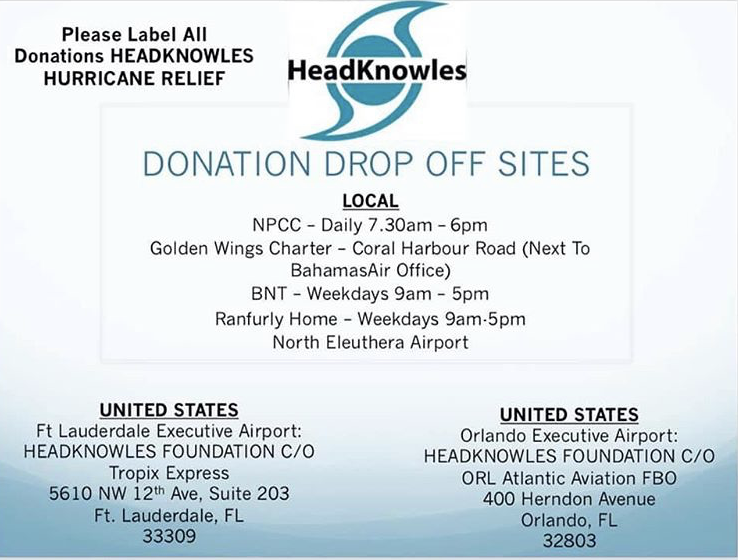
HEADKNOWLES An organization formed in 2015 by Bahamians Lia Head-Rigby and Gina Knowles to provide hurricane relief to the residents of the south and central Bahamas after the devastation of Hurricane Joaquin. Since then, Headknowles provided relief after Hurricanes Matthew and Irma.

You can find out more about the invaluable work of this organization via this link to Amanda Diedrick’s website LITTLE HOUSE BY THE FERRY You will also find there regularly updated information about the present crisis.

DONATIONS                HeadKnowles GO FUND ME page

UPDATES & INFO        Facebook group page
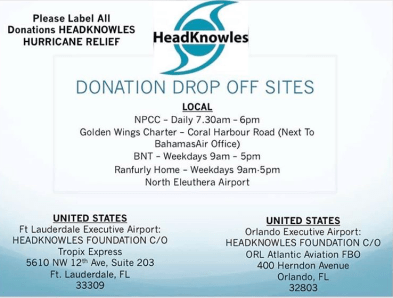
Bahamas Red CrossThe Bahamas branch of the International Red Cross is requesting help with its Dorian-relief program. Specifically, it’s looking for donations of nonperishable goods, water, toiletries, baby products, radios, batteries, candles, bedding, generators, and building supplies (NT)

DONATIONS               BAHAMAS RED CROSS

DONATIONS             ONE ELEUTHERA FOUNDATION

DONATIONS                PERC, Inc.

PERC, Inc. is a not-for-profit U.S. corporation created in 1998 to support the philanthropic work of charitable and community organizations in Abaco, Bahamas (specifically, Hope Town, Man O’ War and Marsh Harbour), and to enable U.S. tax payers make tax deductible contributions to their preferred Abaco charities.

RELIEF NEEDS

LAZY LOCATIONS Excellent list of Hurricane Dorian Relief Efforts including supplies-provision and similar aid in the Abacos, some of which are not yet listed below 

COLDWELL BANKER / LIGHTBOURNE on F/B: Helpful advice, donation links and relief needs (see end of post for list). Their main office on NP is open to accept donations of supplies. For US donors, here are 6 drop-off centres in the States

COMMUNITY& INDIVIDUAL FUNDRAISERS

(GoFundMe unless otherwise stated – PLEASE CHECK VALIDATION)

THE ABACO CLUB ON WINDING BAY

NEW YORK TIMES BAHAMAS RELIEF ADVICE / LINKS

==============================

THE DELPHI CLUB ABACO RELIEF FUND Fundraiser by Robert Ford & Club Members (& my own connection)

HURRICANE RELIEF FOR ELBOW CAY Fundraiser by Matt Winslow.

Please note that this fund, now exceeding $400K of a (raised) target of $500K will have a $ for $ fund match from a private foundation

HOPE TOWN VOLUNTEER FIRE & RESCUE HURRICANE RELIEF  Local Paypal funding

NB  Sep 6 NEW LINK

MESSAGE READS “response to our fundraising efforts has been overwhelming – literally! Your generosity has overtaxed our PayPal account and we are working to find more effective and efficient ways to collect donations. Please hold off on donations through PayPal at this time. We will be providing new funding mechanisms in the next few days. Thank you all for your generosity!!’

Errol Thurston Bahamas Abaco Hurricane Relief Fund  Fundraiser by Errol Thurston 

HOPE 4 HOPE TOWN – ABACO ISLANDS RELIEF FUND Fundraiser by Patrick Davis 

Abaco Strong Hurricane Relief Fund  Fundraiser by Dave Meldeau 

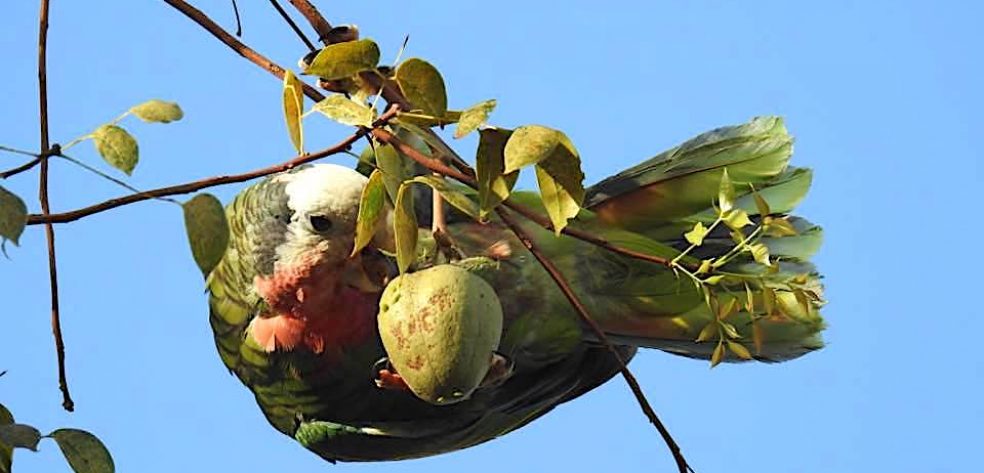
Abaco Parrot post Dorian Food Supplementation Fundraiser by Caroline Stahala 

For the Love of Abaco – Hurricane Relief Fundraiser by Lou Lentine 

Hurricane Dorian Relief Fund for Abaco Fundraiser by Al Lee

Dorian Relief Effort – Bahamas Abaco Islands TCCF Fundraiser by Omar Maissen 

Hurricane Dorian Relief Fund Abacos Fundraiser by Heidi Marie Hill 

MAINSTREAM INTERNATIONAL NGOs

DIRECT RELIEF  Hurricane Dorian Relief

SEP 5: “Luíz David Rodriguez, the programme manager for Direct Relief, an NGO, said the island’s main health clinic, near Marsh Harbour, was being overwhelmed with hundreds of people waiting to be treated”

 GlobalGiving Disaster Recovery Network Hurricane Dorian Relief Fund

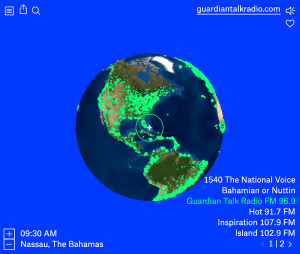
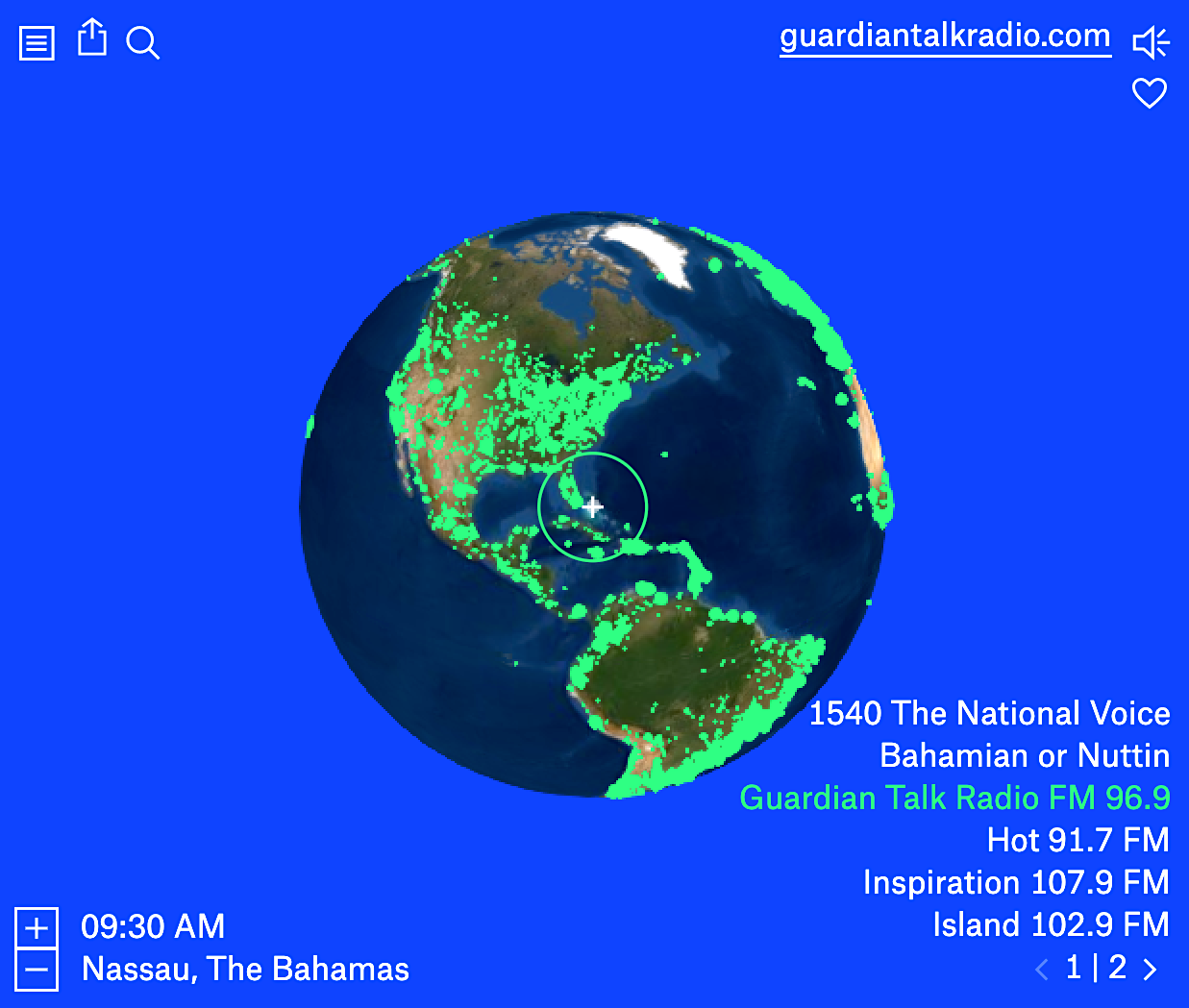
RADIO GARDEN – highly recommended for online or as App – a simple world-wide resource. The link is set take you direct to Guardian Talk Radio. You’ll see other Bahamas stations listed. Every green dot represents a radio station. The globe rotates. You can pinpoint a chosen station anywhere in the world in seconds

ZNS BAHAMAS – varied news formats with rolling updates

ZNS RADIO – news and plenty of online links

TUNE IN BAHAMAS – Stream Radio – more than a dozen stations – App available

LIVE ONLINE BAHAMASStream Radio  – Lots of stations – can headline favourites

CAUTION FOR DONORS

  • Be on guard for a surge of solicitations related to any highly publicized crisis. There will be fraudulent charity solicitations, some involving websites and email links attempting to steal your credit card information for identity theft or insert malware on your computer.
  • Unknown Senders. Do not respond to, or click on any attachments, links or pictures included in, emails or text messages received from unknown senders.
  • Fake Victims. Social media will include many fake victims. Do not donate to unknown individuals purporting to need aid that post on Facebook, GoFundMe, etc. They may be fraudsters, and even if legitimate victims, they may receive an unfairly large amount of aid.
  • Scamming. Scammers may try to use copy-cat names similar to those of well-known charities. Avoid name confusion by independently verifying that the charity is legitimate before you donate. Reputable charities will not pressure you to give immediately.
  • Third-party ‘enablers’. Beware of individuals or others claiming to be third party intermediaries for charities or those in need.
  • Give directly only to the charities that you are confident are legitimate and recognized for providing humanitarian relief on a specific local and / or at international level

CREDITS

Amanda Diedrick / Little House by the Ferry for taking a big lead in collecting and spreading information and advice including the HeadKnowles information shown here

Matthew McCoy for additional suggestions

Sundry online posters of clips and snips

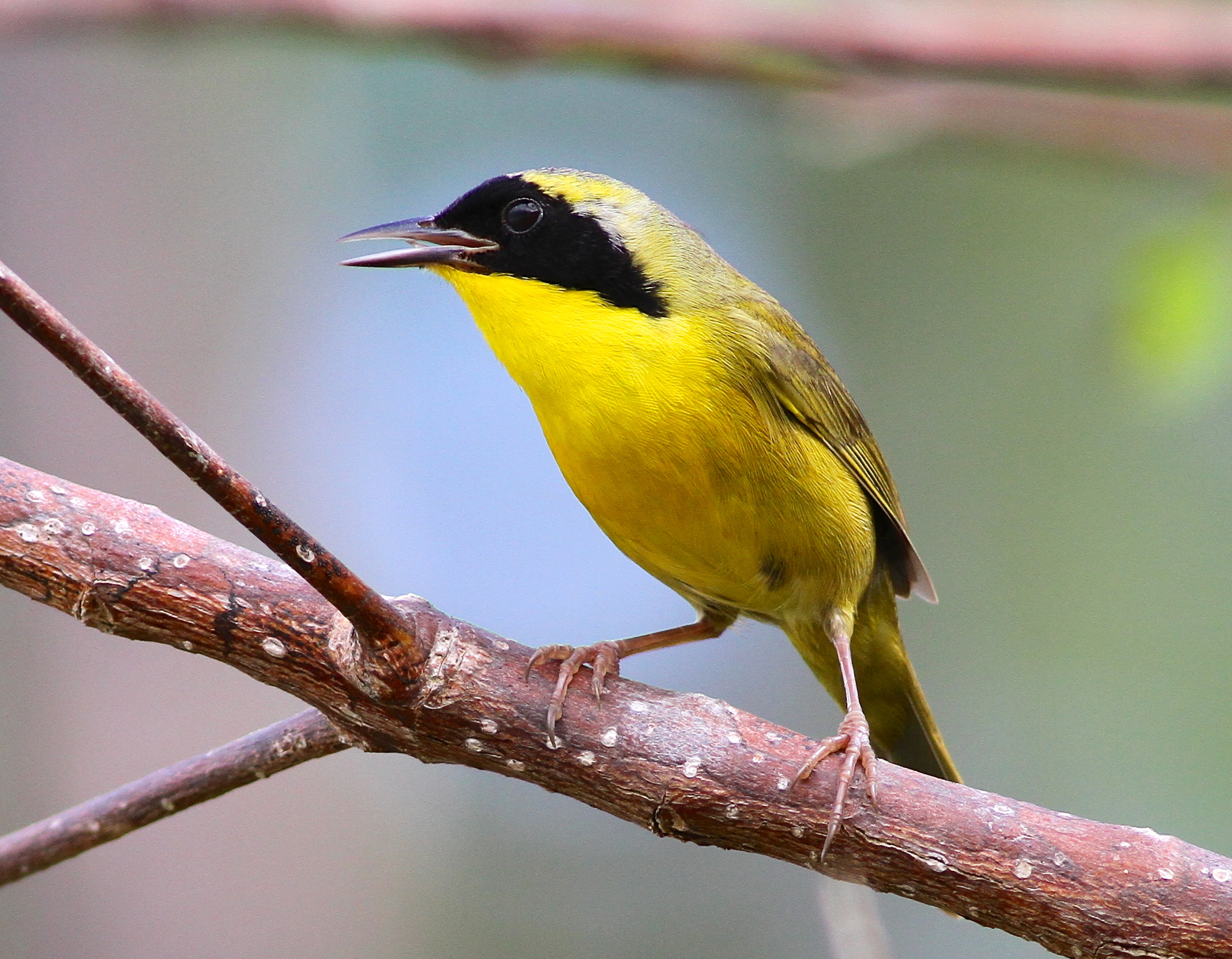
PHOTO CREDIT: Gerlinde Taurer – Bahama Yellowthroat (endemic to the Bahamas)

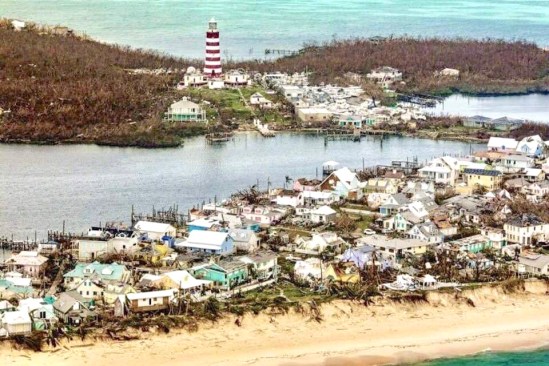
Elbow Reef Lighthouse still standing where Hurricane Dorian made landfall (NYT)

Unknown's avatar

HURRICANE DORIAN: RELIEF CONTACTS & LINKS FOR ABACO BAHAMAS


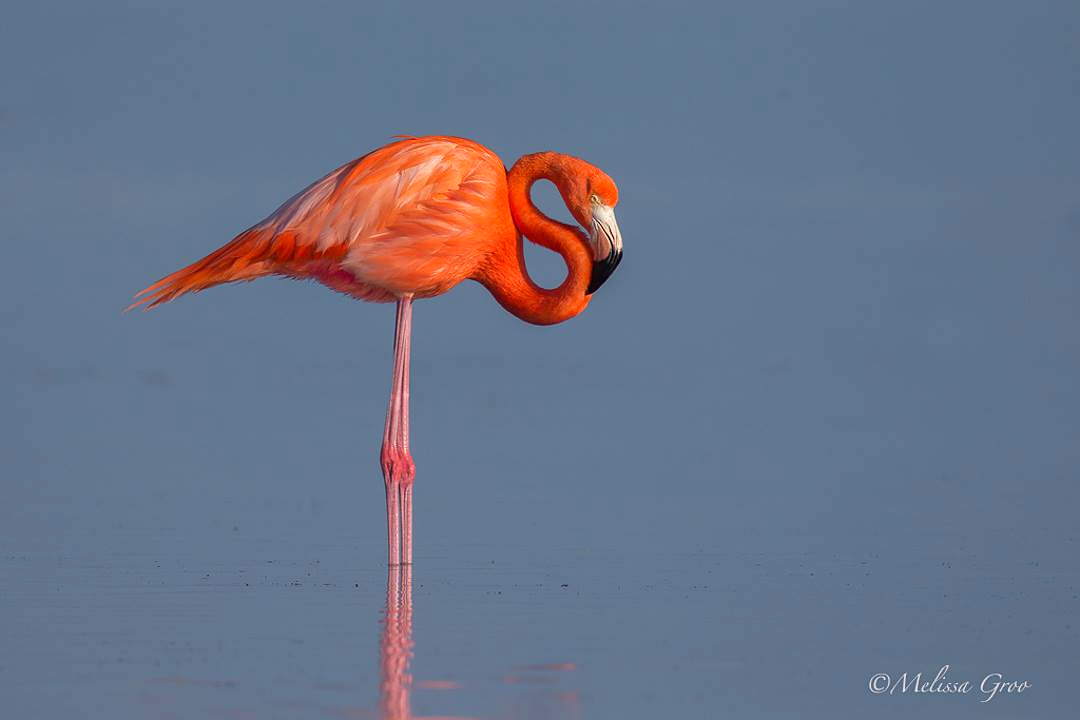
American Flamingo ©Melissa Groo (with kind permission)

HURRICANE DORIAN: RELIEF CONTACTS & LINKS FOR ABACO BAHAMAS

The massive extent of the devastation caused by the unprecedented violence of Hurricane Dorian to the northern Bahamas is, after 2 days, still being revealed only gradually. Overall, the cruel effects of the storm could hardly be any worse. There’s no need to chronicle the horrendous details of the crisis in terms of the people, communities, property, infrastructure, fauna, flora and even geology. Right now, bad news accumulates by the hour. Many people are still unaccounted for. Information about some of the communities is scant.

This is a time when information is valuable, in particular as to the resources available, the urgent needs of the island and its cays, and the ways in which outsiders can help with this dire situation and with funding the recovery. Here are a few suggestions that I hope will be useful. 

LOCAL INFORMATION RESOURCES

The main resources are local / community Facebook groups, or more general Abaco-wide groups. All of them contain local reports and updates, photos, videos and requests for news of family, friends & communities. Events and news are fast-moving, so if you find a group you like, keep checking for up-to-date news, requests for advice or help etc

ABACO COMMUNITY UPDATE

ABACO BULLETIN GROUP

ABACO BAHAMAS – LIVING ON ISLAND TIME

(to be expanded)

I will be reviewing and editing this page daily. I’ll look out for additional fundraisers, but please contact me with any others that you would like to see included, giving the link to it. You can do this by commenting here; via DM on my Rolling Harbour FB page; or email for those that have it.

ROLLING HARBOUR ABACO

NB I am not making personal recommendations here, except in the case of the Delphi Relief Fund and Caroline’s parrot fundraiser, where I have personal connections and concerns. Please check these pages for yourself before you decide to donate

RELIEF DONATION SITES

HEADKNOWLES An organization formed in 2015 by Bahamians Lia Head-Rigby and Gina Knowles to provide hurricane relief to the residents of the south and central Bahamas after the devastation of Hurricane Joaquin. Since then, Headknowles provided relief after Hurricanes Matthew and Irma.

You can find out more about the invaluable work of this organization via this link to Amanda Diedrick’s website LITTLE HOUSE BY THE FERRY You will also find there regularly updated information about the present crisis.

DONATIONS               HeadKnowles GO FUND ME page

UPDATES & INFO        Facebook group page

Bahamas Red CrossThe Bahamas branch of the International Red Cross is requesting help with its Dorian-relief program. Specifically, it’s looking for donations of nonperishable goods, water, toiletries, baby products, radios, batteries, candles, bedding, generators, and building supplies (NT)

DONATIONS               BAHAMAS RED CROSS
DONATIONS               PERC, Inc.

PERC, Inc. is a not-for-profit U.S. corporation created in 1998 to support the philanthropic work of charitable and community organizations in Abaco, Bahamas (specifically, Hope Town, Man O’ War and Marsh Harbour), and to enable U.S. tax payers make tax deductible contributions to their preferred Abaco charities.

RELIEF NEEDS

LAZY LOCATIONS  Excellent list of Hurricane Dorian Relief Efforts including supplies-provision and similar aid in the Abacos, some of which are not yet listed below 

COMMUNITY& INDIVIDUAL FUNDRAISERS

(GoFundMe unless otherwise stated – PLEASE CHECK VALIDATION)

THE DELPHI CLUB ABACO RELIEF FUND Fundraiser by Robert Ford & Club Members (& my own connection)

HURRICANE RELIEF FOR ELBOW CAY Fundraiser by Matt Winslow 

HOPE TOWN VOLUNTEER FIRE & RESCUE HURRICANE RELIEF  Local Paypal funding

Errol Thurston Bahamas Abaco Hurricane Relief Fund  Fundraiser by Errol Thurston 

HOPE 4 HOPE TOWN – ABACO ISLANDS RELIEF FUND Fundraiser by Patrick Davis 

Abaco Strong Hurricane Relief Fund  Fundraiser by Dave Meldeau 

Abaco Parrot post Dorian Food Supplementation Fundraiser by Caroline Stahala 

For the Love of Abaco – Hurricane Relief Fundraiser by Lou Lentine 

Hurricane Dorian Relief Fund for Abaco Fundraiser by Al Lee

Dorian Relief Effort – Bahamas Abaco Islands TCCF Fundraiser by Omar Maissen 

Hurricane Dorian Relief Fund Abacos Fundraiser by Heidi Marie Hill 

OTHER WAYS TO GIVE

NB I know nothing specific about these more widely-based organisations – it’s up to you to check them out

 GlobalGiving’s Disaster Recovery Network Hurricane Dorian Relief Fund

DIRECT RELIEF  Hurricane Dorian Relief

CREDITS

Amanda Diedrick / Little House by the Ferry for taking a big lead in collecting and spreading information and advice including the HeadKnowles information shown here

Matthew McCoy for additional suggestions

PHOTO CREDIT  Melissa Groo, International Photographer with Bahamas ties. Thanks as always for use permission

Unknown's avatar

TROPICAL STORM: THE PICTURE OF DORIAN? GRAY…


Tropical Storm Dorian . Aug 27 . Cloud formation. Aerial view. NOAA NHC NASA

TROPICAL STORM: THE PICTURE OF DORIAN? GRAY…

+ TROPICAL DEPRESSION SIX – SPACE VIEW AND LIGHT POLLUTION

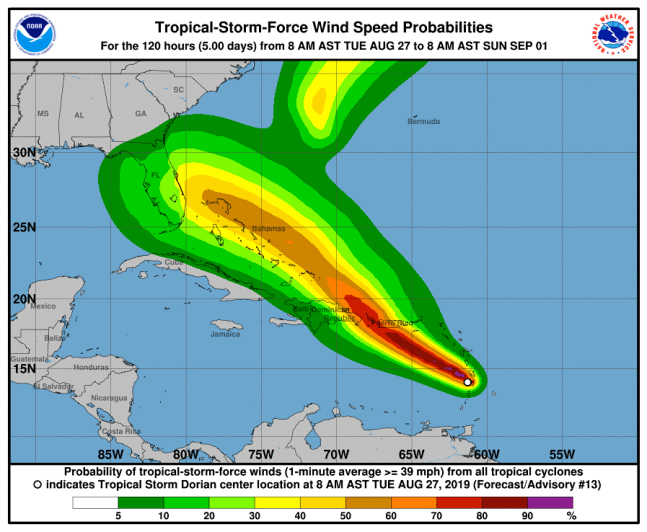
TS Dorian is the 4th tropical storm of the Atlantic season, and the first one to have the northern Bahamas & Abaco in its sights. Right now it is way down south in the area round Barbados, heading for Puerto Rico. I just checked out the NOAA, NHC, NWC & NASA sites to find out the present predictions. Although the direction and force of the storm may be changeable as it moves north, it’s as well to know the currently predicted path. As of this morning, Abaco is directly in it. And TD Six is lurking to the north-west as well.

WIND SPEED

PROGRESS / ETA

Subject to the usual variables, this coming weekend looks potentially the time for some kind of murky weather over Abaco. Maybe it won’t happen like that, but this looks like one to keep a weather eye on.

   STORM CONE

Tropical depression Six, described as ‘poorly organised’, is already making its present felt. This dramatic image of ‘6’ from NOAA has a strange beauty, and interesting not least because of its startling highlighting of light pollution (and check out Freeport and Nassau).

TD SIX LAST NIGHT

TD SIX – VIEW FROM SPACE

CREDITS: the combined resources of NOAA, NHC, NWS & NASA & associates

TS Dorian Path Prediction

Unknown's avatar

URCHIN RESEARCHIN’: SEA HEDGEHOGS OF THE REEF


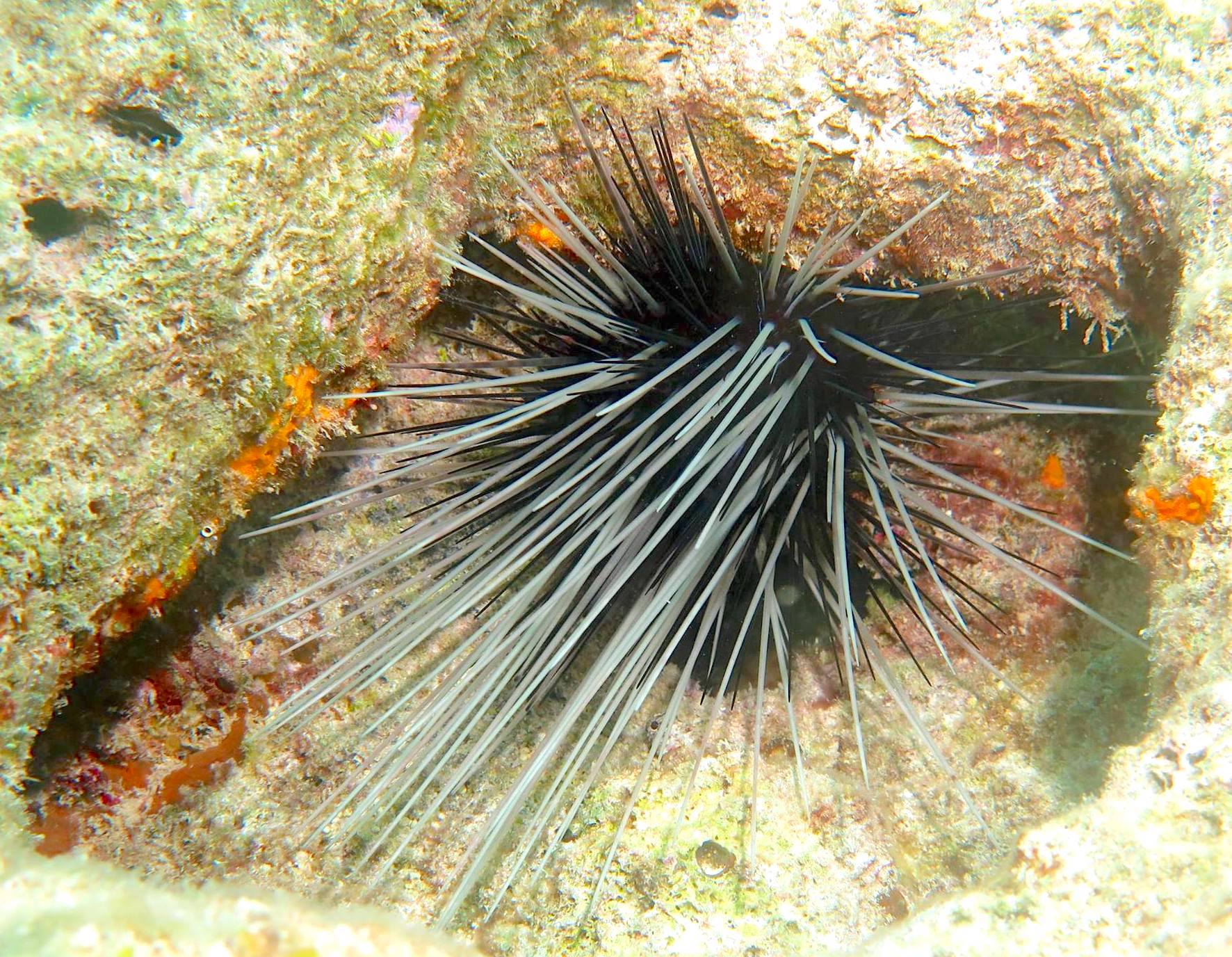
Long-spined sea urchin Diadema antillarum (Melinda Rodgers / Dive Abaco)

URCHIN RESEARCHIN’: SEA HEDGEHOGS OF THE REEF

The long-spined sea urchin Diadema antillarum featured in this post is one of those creatures that handily offers its USP in its name, so you know what you are dealing with. Something prickly, for a start. These are creatures of the reef, and many places in the Caribbean and in the western Atlantic generally sustain healthy populations.

Long-spined sea urchin Diadema antillarum (Melinda Rodgers / Dive Abaco)

These animals are essentially herbivores, and their value to vulnerable coral reefs cannot be overstated. Where there is a healthy population of these urchins, the reef will be kept clean from smothering algae by their methodical grazing. They also eat sea grass.

Long-spined sea urchin Diadema antillarum (Melinda Rodgers / Dive Abaco)

HOW DO THE SPINES OF DIFFERENT KINDS OF URCHIN COMPARE?

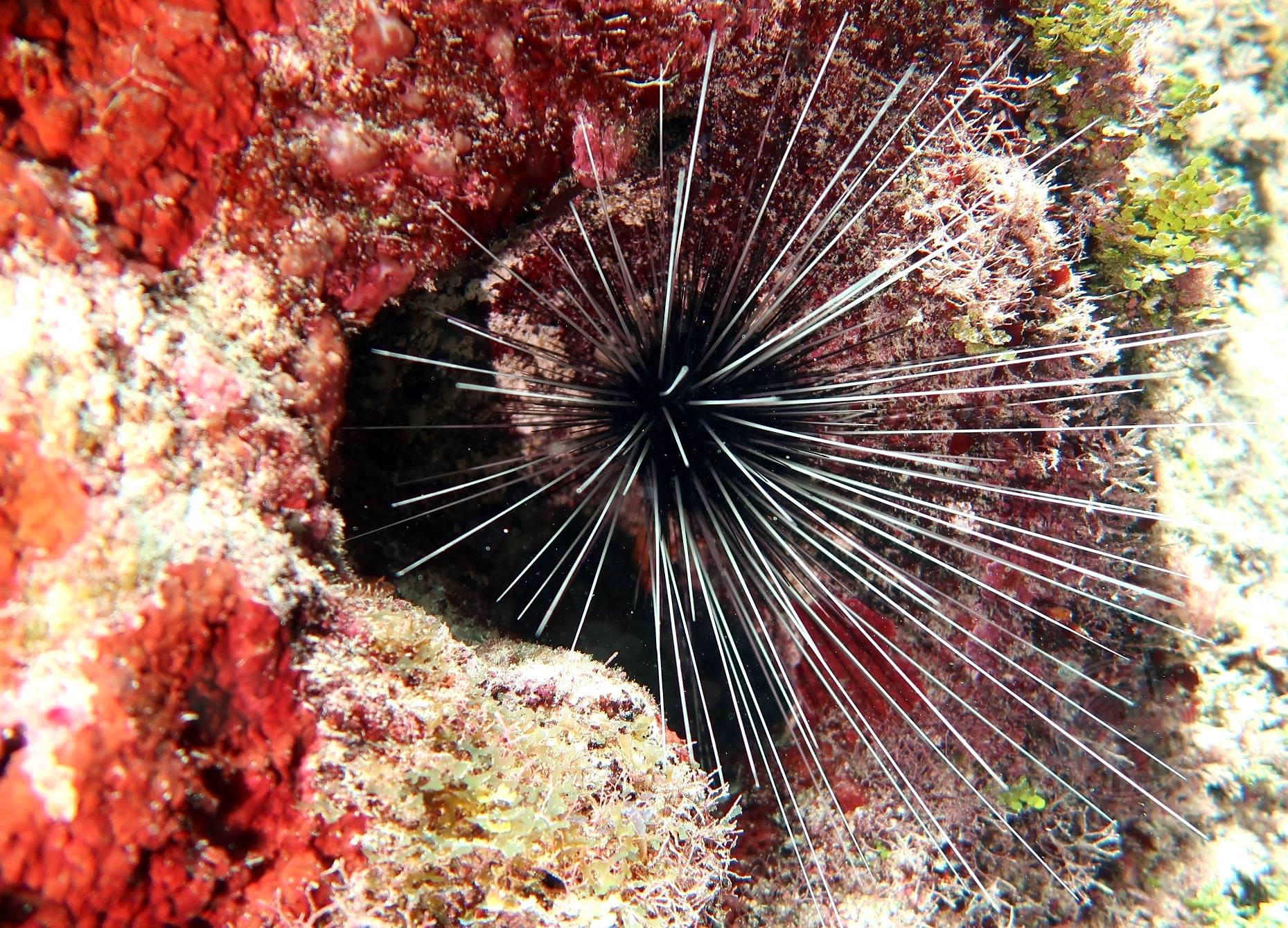
Small sea urchins species have spines a few cms long at most. The long-spine variety exceed 10 cms, and the largest may have spines up to 30 cms (= 1 foot) long. The length, as shown here, means that when the creatures are safely lodged in crevices near their algae supply, their spines remain very visible.
Long-spined sea urchin Diadema antillarum (Melinda Riger / G B Scuba)
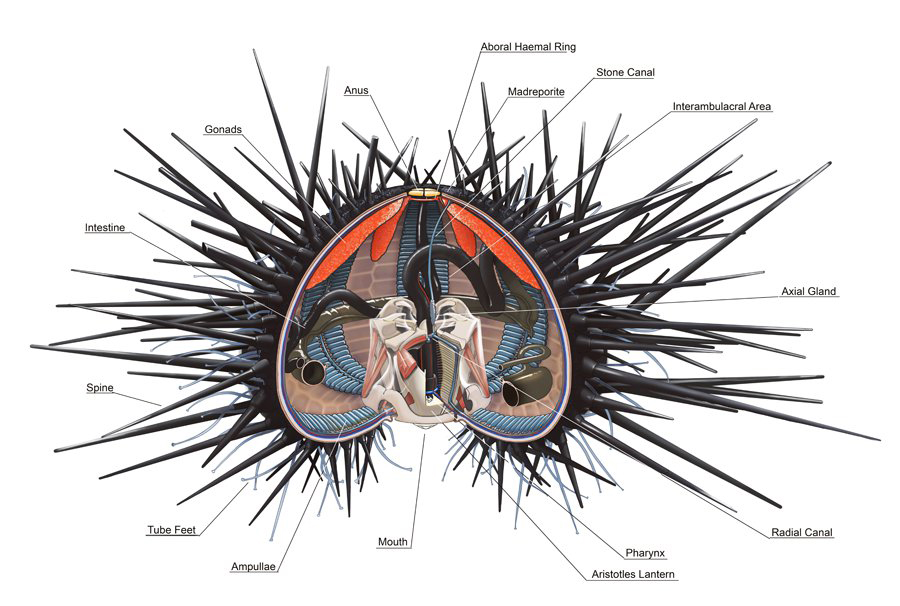
Anatomy of a long-spined sea urchin. You may possess a few of these organs yourself…

Long-spined sea urchin Diadema antillarum anatomy diagram (wiki)

Long-spined sea urchin Diadema antillarum (Melinda Rodgers / Dive Abaco)

CAN YOU GIVE US A TEST, PLEASE?

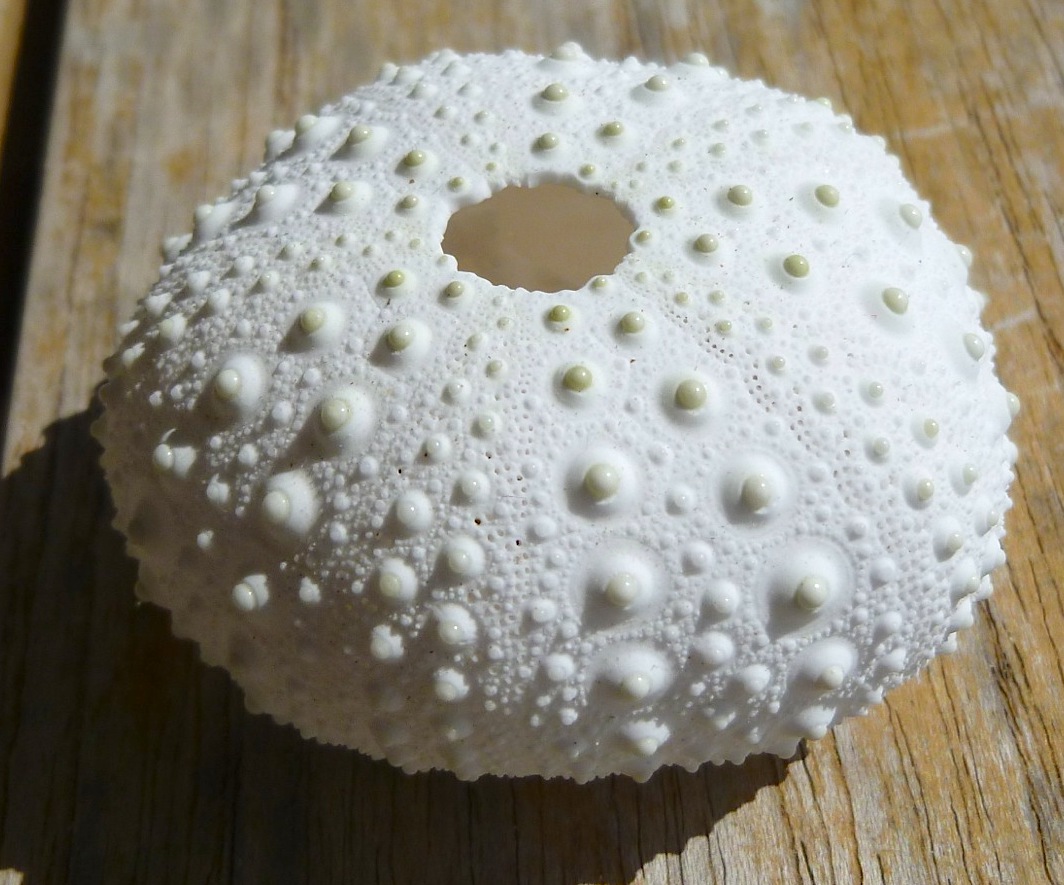
As with SAND DOLLARS and similar creatures, the skeleton of a sea urchin is known as a ‘test’. Urchin tests are remarkably beautiful, especially seen in sunlight. Here are 2 examples I photographed a while ago. You’ll immediately notice the delicate colours and the amazing complexity of the pattern and symmetry. The top one is (or is most like) a long-spined urchin test.
Long-spined sea urchin Test / Skeleton Diadema antillarum (Keith Salvesen / Rolling Harbour) Long-spined sea urchin Test / Skeleton Diadema antillarum (Keith Salvesen / Rolling Harbour)

A BIT ABOUT SYMMETRY

Sea urchins are born with bilateral symmetry – in effect, you could fold one in half. As they grow to adulthood, they retain symmetry but develop so-called ‘fivefold symmetry’, rather as if an orange contained 5 equal-sized segments. The graphic above gives a good idea of how the interior is arranged inside the segments.

Long-spined sea urchin Diadema antillarum (Melinda Rodgers / Dive Abaco)

A FEW FACTS TO HAND DOWN TO YOUR CHILDREN

  • Urchin fossil records date the species back to the Ordivician period, c 40m years ago
  • In the ’90s the population was decimated and still has not recovered fully
  • Urchins feel stress: a bad sign that the spines here are white rather than black
  • Urchins are not only warm water creatures: some kinds live in polar regions
  • Urchins are of particular use in scientific research, including genome studies
  • Some urchins end up in aquariums / aquaria, where I doubt the algae is so tasty
  • Kindest not to prod or tread on them
  • Their nearest relative (surprisingly) is said to be the Sea Cucumber 

Sea Cucumber (Melinda Riger / G B Scuba)

ARE THEY EDIBLE?

Apparently they are eaten in some parts of the world; their gonads and roe are considered a delicacy. As far as I know, they are not generally on the menu in the Bahamas. Correction invited. Personally, I could leave them or leave them.

CREDITS: Melinda Rodgers / Dive Abaco (1, 2, 3, 6, 9) taken Abaco; Melinda Riger / G B Scuba (4, 10, 11) taken Grand Bahama; Keith Salvesen / Rolling Harbour (7, 8) taken Abaco; Wiki graphic (5) taken from internet. RESEARCH Fred Riger for detailed  information; otherwise the usual magpie pickings…

Long-spined sea urchin Diadema antillarum (Melinda Riger / G B Scuba)

Unknown's avatar

INTERNATIONAL SHARK WEEK? IT’S SO OVER… EXCEPT HERE


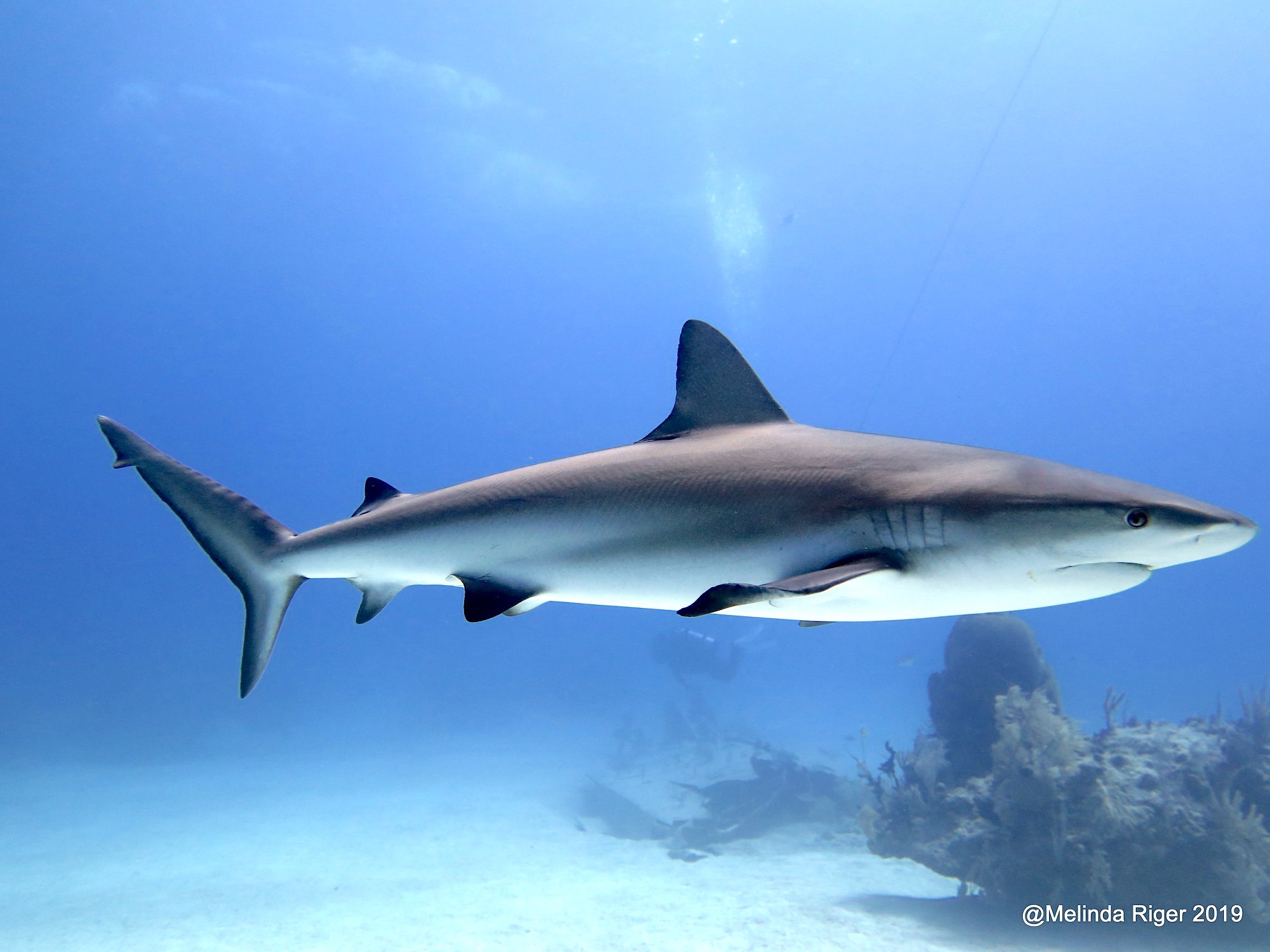
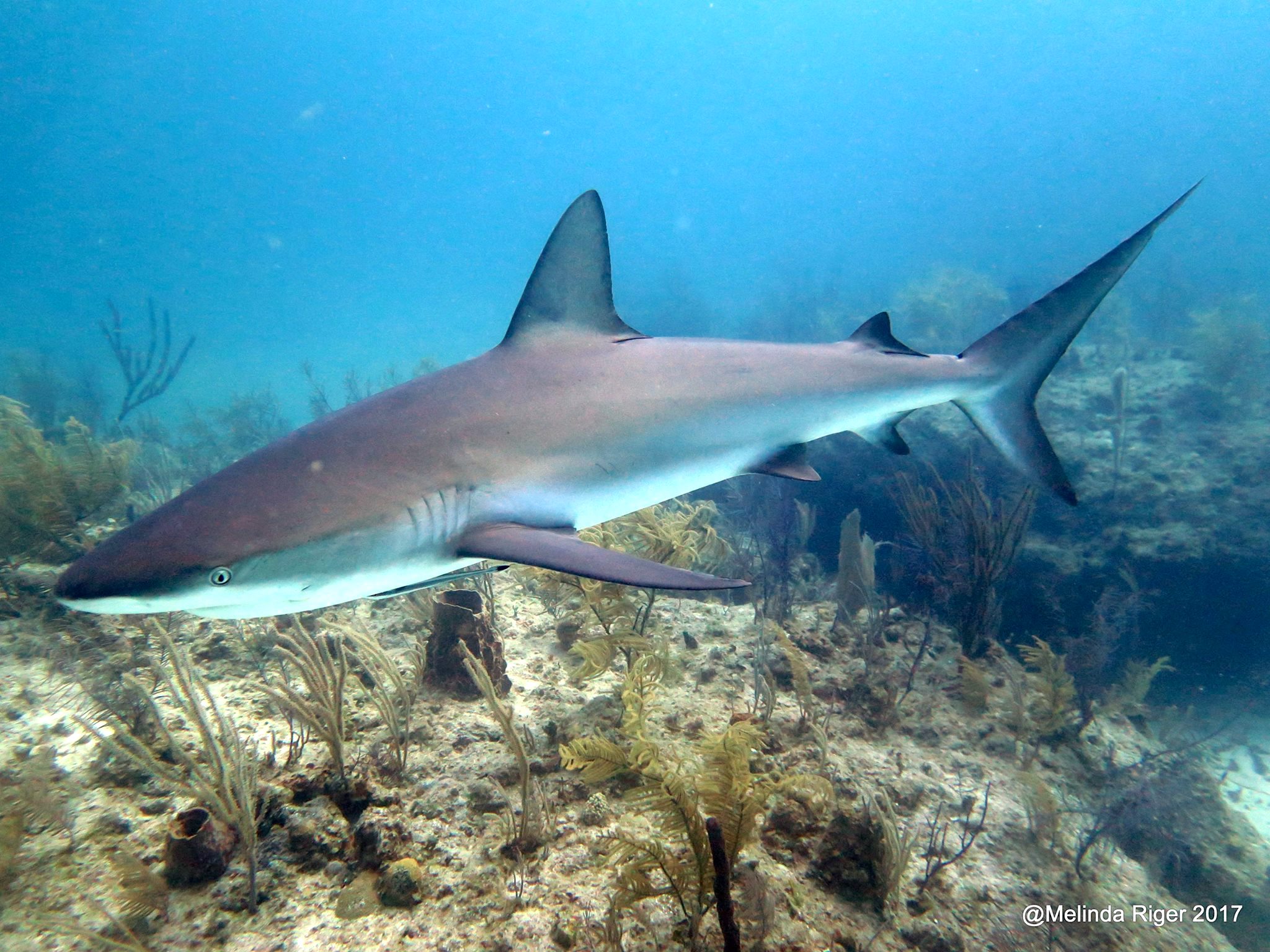
Sharks in Bahamas - Melinda Riger / Grand Bahama Scuba

INTERNATIONAL SHARK WEEK? IT’S SO OVER… EXCEPT HERE

There’s never a day without a ‘Day’, nor a week without a ‘Week’. Almost all creatures under the sun are celebrated in some regular calendar-based time-frame. With the exception of No-see-ums: I’ve checked – there is no national or international Ceratopogonidae Day in any online calendar. 

Sharks in Bahamas - Melinda Riger / Grand Bahama Scuba

By a mere 2 days, I have missed Shark Week, a happening tied in with the Discovery Channel, and heralded by an amusing trailer that features no actual sharks… So, belatedly, here are some cool shark photos to enjoy, in case you didn’t get enough of them last week, or (like me) had other fish to fry.

Sharks in Bahamas - Melinda Riger / Grand Bahama Scuba“I’m so glad we agreed to watch each other’s backs…”

Sharks in Bahamas - Melinda Riger / Grand Bahama Scuba

 Meet Nurse Betty, as she is known to diversSharks in Bahamas - Melinda Riger / Grand Bahama Scuba

MANGROVES: THE SHARK NURSERY

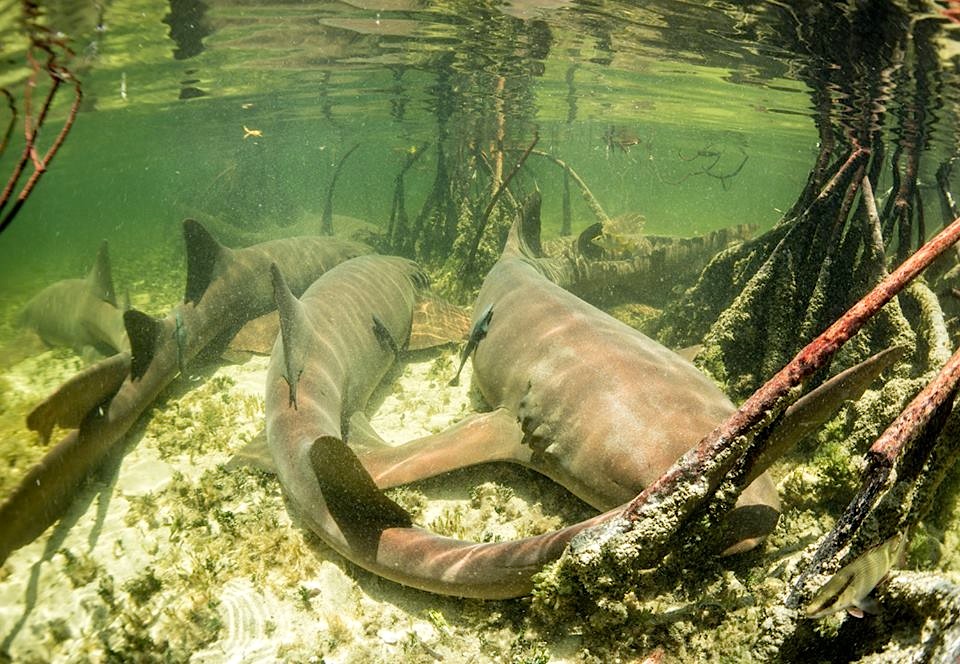
As all children are taught and some adults know, the mangroves that grow in the shallow waters around the islands of the Bahamas are of enormous ecological significance. This isn’t the place to expand on that now, but it is worth mentioning that the mangrove swamps are the nurseries of young sharks (‘pups’) until, as juveniles, they are old enough to leave the safely of their home for deeper waters. Check out the short video below.

Sharks in Bimini Bahamas - biminis-marine-protected-areaSharks in Bimini Bahamas - biminis-marine-protected-area

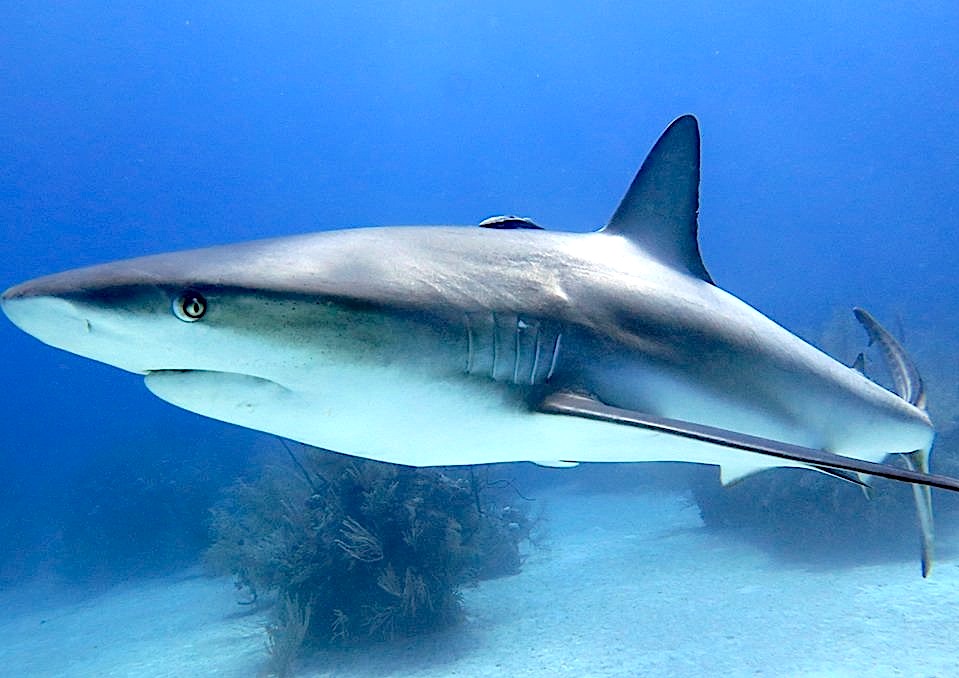
Spot the REMORA hitching a ride on this shark’s backSharks in Bahamas - Melinda Riger / Grand Bahama Scuba

Nurse shark – note the twin barbels (cf recent Goatfish article)Sharks in Bahamas - Melinda Riger / Grand Bahama Scuba

Sharks in Bahamas - Melinda Riger / Grand Bahama Scuba

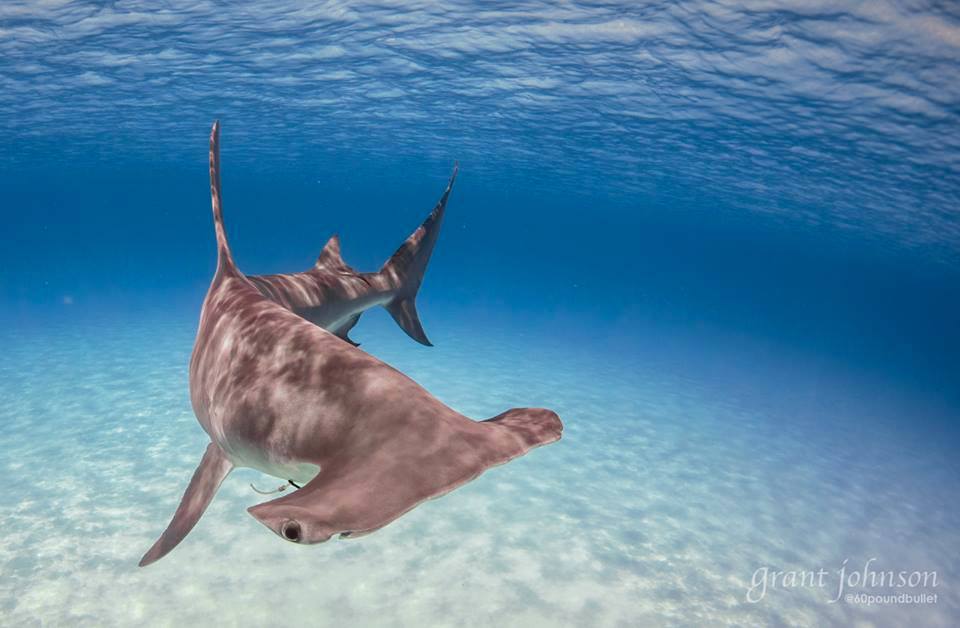
HAMMERHEADS FROM BIMINI Sharks in Bimini Bahamas - Grant Johnson / 60 Pound Bullet   Sharks in Bimini Bahamas - Grant Johnson / 60 Pound Bullet

These wonderful photos were all taken in Bahamian waters. Melinda Riger of Grand Bahama Scuba is, as ever, the star snap-getter of sharks (and indeed all other marine creatures). Special thanks are also due to Grant Johnson / 60poundbullet and Neal Watson / Bimini Scuba Center for occasional use permission of photos – especially of hammerheads – that are, well, eye-popping. Video from ‘ZeroEye’

Sharks in Bimini Bahamas - Grant Johnson / 60 Pound Bullet

Unknown's avatar

PEACOCK FLOUNDERS REVISITED: NOW YOU SEE THEM…


Peacock Flounder (Melinda Riger / G B Scuba)

        PEACOCK FLOUNDERS (Part Deux)

MASTERS OF SUBAQUATIC CAMOUFLAGE

I featured the extraordinary, colour-transforming PEACOCK FLOUNDER Bothus lunatus about 3 years ago in the Bahamas Reef Fish series (No. 21 I think). These really are remarkable creatures, and I am pleased to be able to show some more wonderful illustrative photos. 

Peacock Flounder (Melinda Riger / G B Scuba)

ROVING EYES

In the fish shown here, you’ll see that – surprisingly – both eyes are on the upperside of the fish, above the rather grumpy mouth, whereas the head is horizontal to the ocean floor. Oddest of all, juveniles are constructed conventionally with bilateral eyes, and look like ‘normal’ fish rather than flatfish.

Peacock Flounder (Melinda Rogers / Dive Abaco)

As the fish matures, in some magic way the mechanics of which I can only guess at**, the right eye grows round to the topside and the flounder transforms from a ‘vertical’ fish to a flatfish. For this reason, the PF is known as a ‘lefteye’ flounder. Maybe in other flounder species in the world – the southern hemisphere maybe? – the eye that moves round to the upperside is the left eye.

Peacock Flounder (Virginia Cooper / G B Scuba)

The eyes of this fish have another special trick up their sleeves (so to speak). They operate completely independently. Thus the creature can look left and right, or forwards and backwards, simultaneously. It’s an excellent system for detecting predators coming from any angle. It’s a superpower we might all benefit from.

Peacock Flounder (Melinda Rogers / Dive Abaco)

DO THEY HAVE ANY OTHER TRICKS WE SHOULD KNOW ABOUT?

Yes they do indeed. If you have been admiring the fish shown so far, you’ll have noticed that the colour of each one differs from the others. In addition to the predator-protection that the eyes provide, the peacock flounder can make itself (near) invisible. They can rapidly change colour to match their surroundings. There are 3 reasons for this: to avoid / confuse predators; to conceal themselves on the sea-floor to catch passing prey; and, as dive expert Fred Riger has pointed out, “the male peacock flounder can, and does greatly intensify his colours to declare territory and attract females. When doing this the males will also signal with the left pectoral fin, sticking it straight up and waving it around.” 

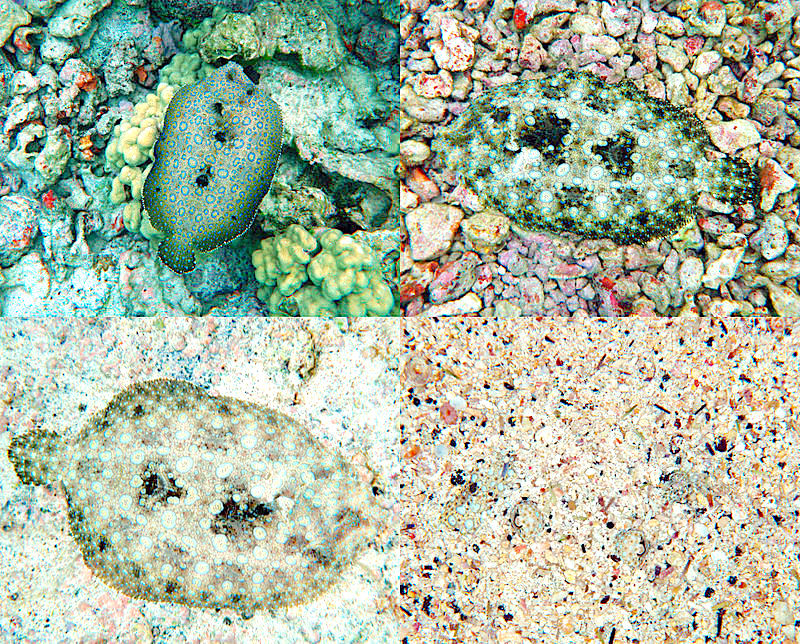
The same fish, photographed over several minutes as it moves over the ocean floorPeacock Flounder (Wiki)

Matching the background happens as the fish swims, and in a few seconds. When they rest on the sea-floor, the camouflage may even become total. In #4 above you can just about make out the eyes. The whole effect is known as ‘cryptic coloration’ or CRYPSIS. In contrast, the image below shows just how adaptable the transformation can be. Note how the fish can even mimic the pinkish tinge of the sand perfectly. If threatened, the fish will bury itself in the sand, with just its eyes showing.

Peacock Flounder (Melinda Rogers / Dive Abaco)

HOW DO THEY MANAGE TO CHANGE COLOUR IN SECONDS?

It’s complicated! A simple answer is: a mix of hormones, pigment-cells and vision, all coordinating rapidly. The colour change works in two ways: pigments are selectively released to the skin cells; and other pignments can be selectively suppressed. An analogy might be image manipulation using variations in brightness, saturation etc. Not convinced? Then watch this short video and prepare to be impressed. Astonished, even.

WHAT IF A FLOUNDER CAN’T SEE CLEARLY FOR SOME REASON?

As with many (all?) superpowers, there is usually some kryptonite-style flaw. A flounder with a damaged eye, or one temporarily covered (by sand, for example) will have difficulty in changing colour – possibly at all, or at any rate with the swiftness it needs to have. 

Peacock Flounder (Melinda Riger / G B Scuba)

THESE SIDEWAYS FISH – HOW DO THEY… YOU KNOW…?

Take a look at the fish above with its top fin raised. It’s a ‘ready’ signal in a harem. Male flounders have a defined and defended territory within which live up to 6 females – a so-called ‘harem.’ I can do no better than borrow the description of the rituals from an article derived from scientific papers by Konstantinou, 1994Miller, et al., 1991 in the website animaldiversity.org/…ounts/Bothus_lunatus To which I can only add, ’15 seconds, eh?’

Peacock Flounder (Melinda Riger / G B Scuba)

“Mating activities usually begin just before dusk. At this time, a male and a female approach each other with the ocular pectoral fin erect. The two fish arch their backs and touch snouts. After this interaction the female swims away, and the male sometimes follows, approaching the female again from the left side. At this point the male pectoral fin is erect and the female pectoral fin moves up and down, possibly signalling willingness to mate. The male then positions himself underneath the female and mating begins. This process consists of a mating rise, during which the female and male rise in the water column together. On average, these rises last about 15 seconds. At the highest point of this rise, usually around 2 m above the substrate, gametes from both fish are simultaneously released, producing a cloud of sperm and eggs. Once the couple returns from the rise, the male “checks” to make sure mating was successful, and the pair separates quickly, swimming away from each other in opposite directions. Not all mating rises are successful, and the process of “checking” is thus important. The exact purpose of the mating rise in these flounders unknown; possible reasons for rising include better dispersal of gametes and predator avoidance.” 

Peacock Flounder – Kim Rody ArtPeacock Flounder (Kim Rody Art))

**This may in fact be through sheer laziness

Credits: Melinda Riger & Virginia Cooper / Grand Bahama Scuba; Melinda Rogers / Dive Abaco; Adam Rees / Scuba Works; Kim Rody; animaldiversity.org; magpie pickings and other credits in the text

Peacock Flounder (Melinda Riger / G B Scuba)

Unknown's avatar

BAHAMAS TURTLES: BE AWARE BUT DON’T BEWARE


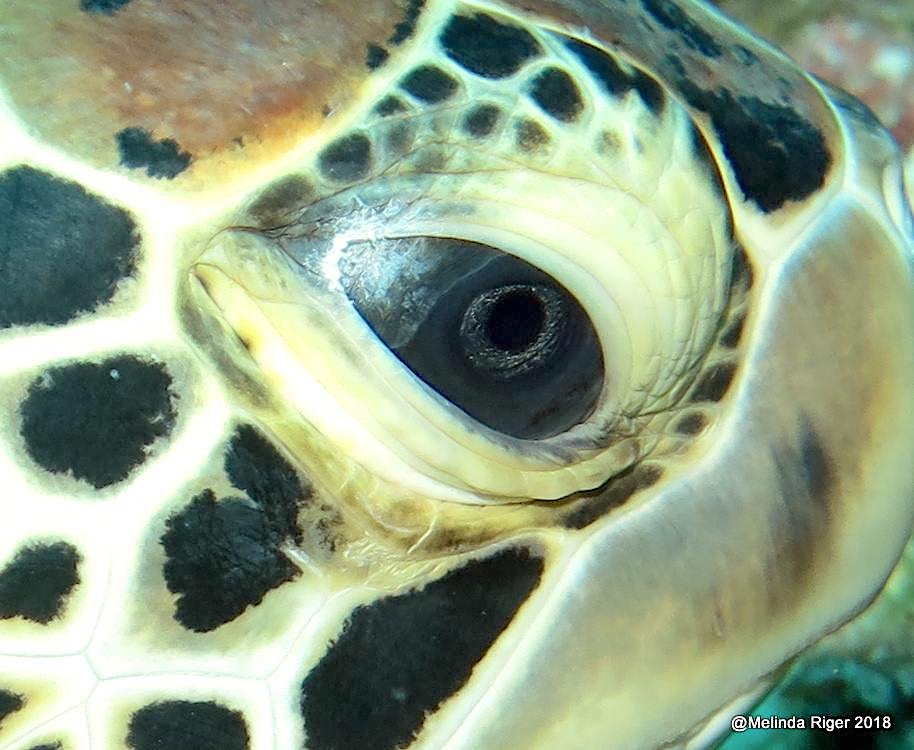
Green Turtle Eye (Melinda Riger / Grand Bahama Scuba)

GREEN TURTLE WATCHING

BAHAMAS TURTLES: BE AWARE BUT DON’T BEWARE

MAY 23 is another one of those ‘species awareness’ days. Somewhere in the world, it seems that every day of the year has a creature to be aware of. As the Sixth Extinction looms (the one we’ve promoted in basically two generations), a state of heightened awareness is where we should all be at. 

TURTLES BY ADAM REES / SCUBA WORKS

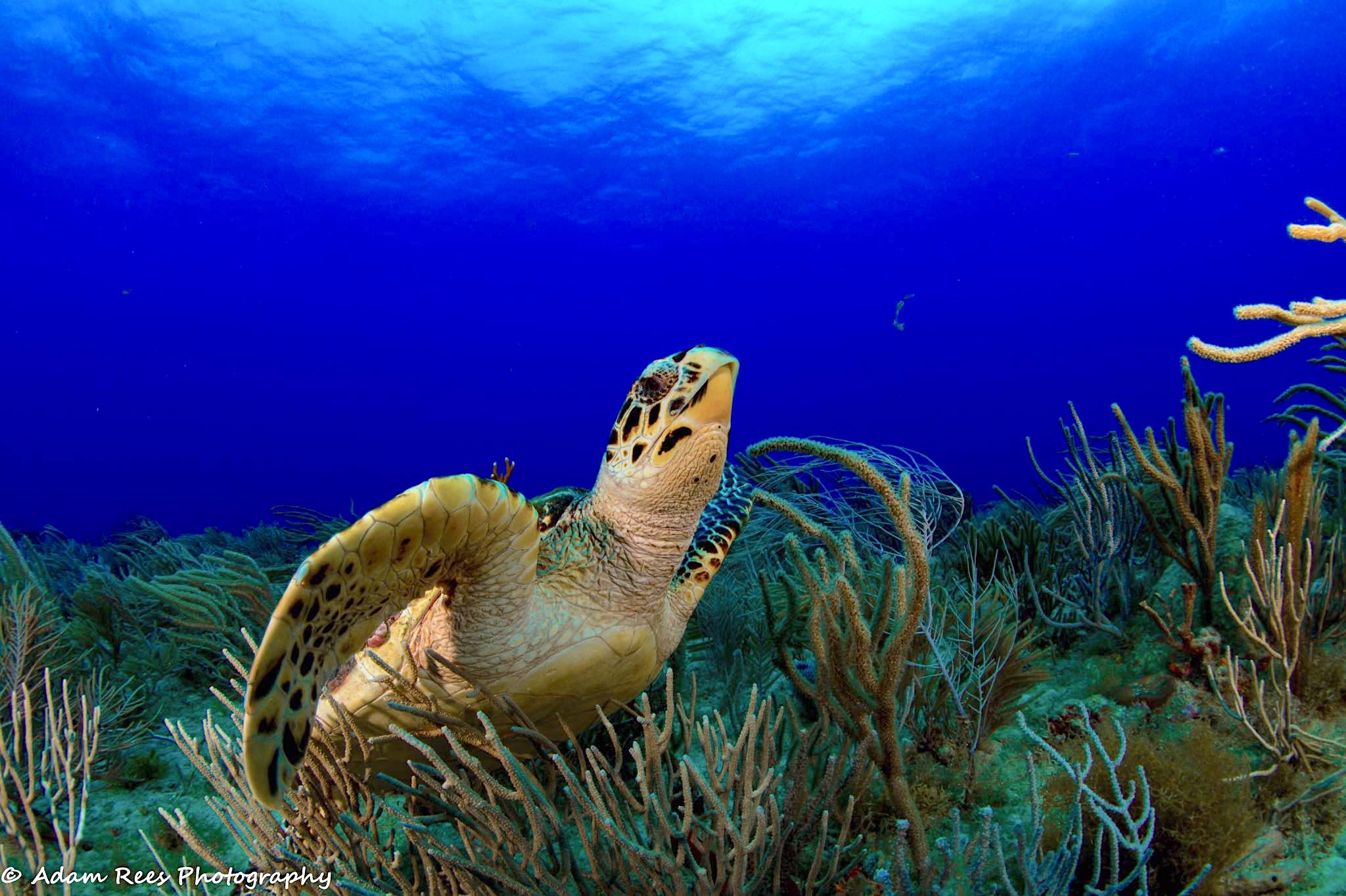
Hawksbill Turtle (Adam Rees / Scuba Works)

Hawksbill Turtle (Adam Rees / Scuba Works)Hawksbill Turtle (Adam Rees / Scuba Works)

That’s not an end in itself of course – it’s merely the first step to doing something about the species in question… and beyond that, every species. We’ve screwed up their world for them. Awareness is just a wake-up call to action. Support a cause. Join an organisation or group. Support campaigns. Sign up. Write stuff. Do stuff. Don’t do other stuff. Even wearing a “Save the Great-crested Newt” T-shirt would be better than nothing.

TURTLES BY MELINDA RIGER / GRAND BAHAMA SCUBA

Hawksbill Turtle (Virginia Cooper / Grand Bahama Scuba) Hawksbill Turtle (Melinda Riger / Grand Bahama Scuba)Hawksbill Turtle (Melinda Riger / Grand Bahama Scuba)

Back to the turtles. I have featured a few great sea turtle photos (none of them mine) to concentrate the mind on today’s special species – one of the most loved and admired of the sea creatures of the Bahamas archipelago. If they go, we humans may not be far behind (but at least we won’t have stomachs full of plastic trash).

TURTLES: HAPPY TOGETHER!

Credits: Melinda Riger, Adam Rees, Virginia Cooper – and to all for their work in revealing the wonderful world beneath the ocean waves

Hawksbill Turtle (Melinda Riger / Grand Bahama Scuba)


Unknown's avatar

WHEN NEW PROVIDENCE WAS OLD: MAPPING BAHAMAS HISTORY


Map of New Providence / Nassau Bahamas (early c18)

WHEN NEW PROVIDENCE WAS OLD: MAPPING BAHAMAS HISTORY

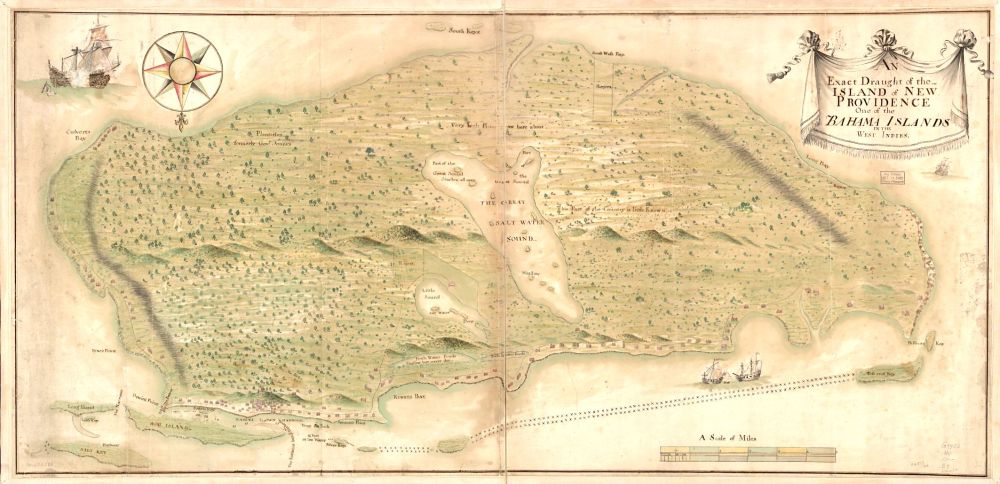
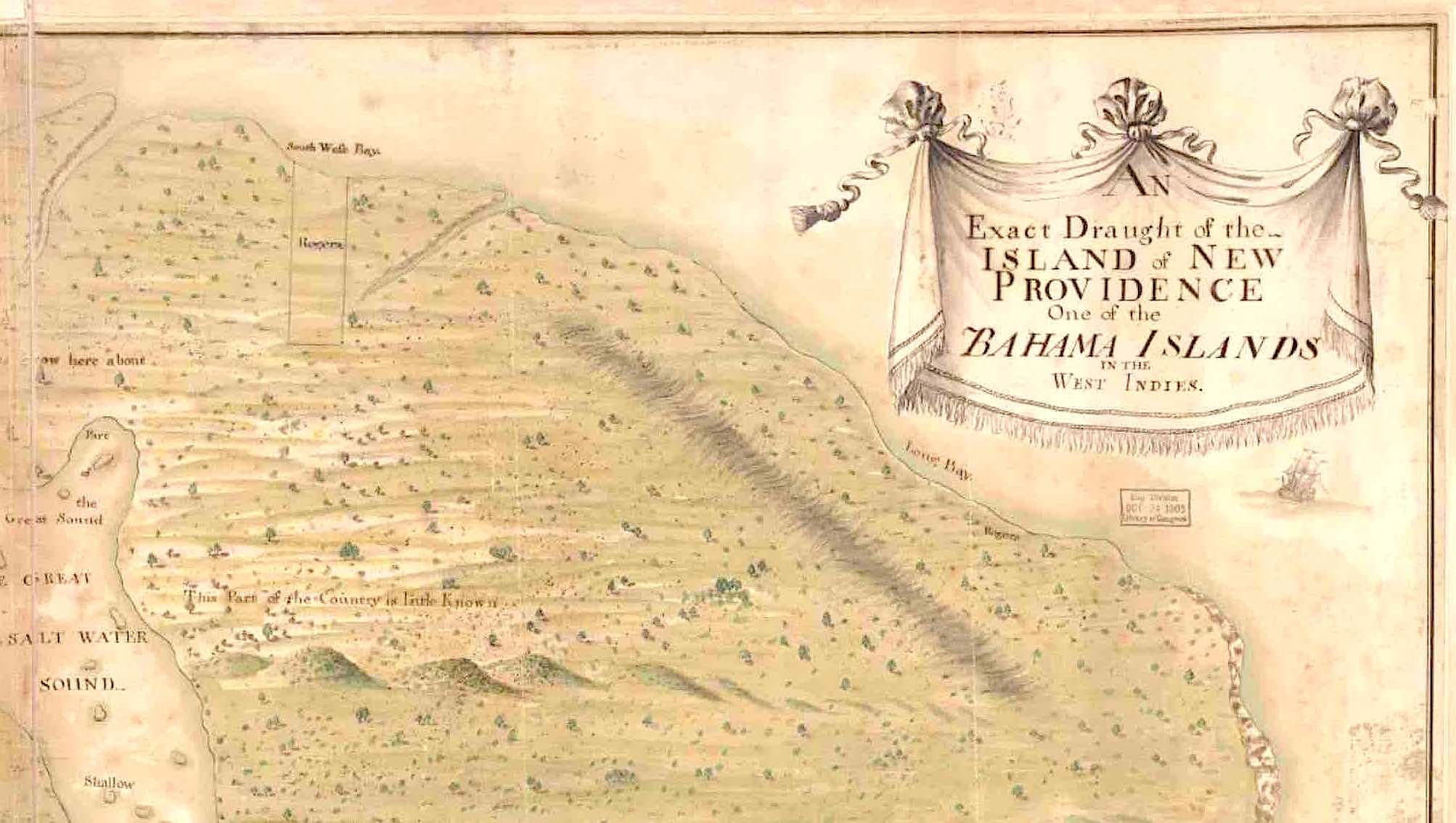
“Exact Draught of the Island of New Providence, One of the Bahama Islands in the West Indies”

Lateral thinking is one thing; topsy-turvy thinking is in another league. The map that graces the top of this page is of New Providence and Nassau in the the early c18. By today’s exacting mapping conventions, which historically were less rigorously  observed, it is upside-down, with Nassau on what we would call the south-west corner. The map is undated on the face of it, and I have found attributed dates of both 1700 and 1750. It could be anywhere in-between. At the time this map was made, New Providence was sparsely populated except for Nassau itself; and little was known about the island’s interior. Contemporary accounts describe a haven for pirates operating around the coastline. Not for nothing was Nassau protected by a battery and a fort. I’ve divided to map into sections to make it easier to take a closer look at each area. You can click each to enlarge.

new-providence-c18-map-part-7-2

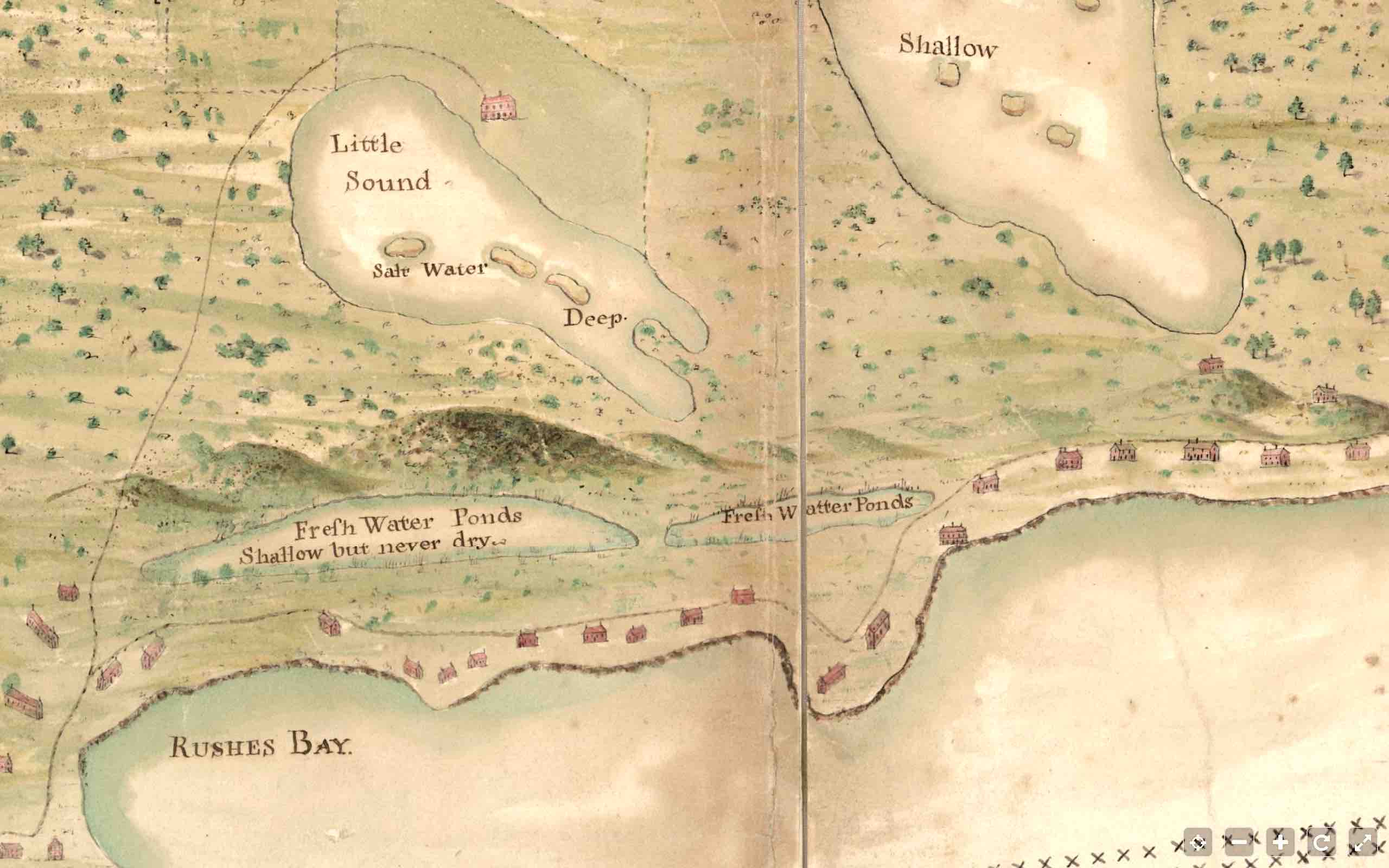
  1. TOP LEFT CORNER (the south-east of NP in actuality), with the compass pointing downwards to the north. A smattering of houses dot the ‘west’ coast. There is one significant property above Little Sound, standing in what looks like a cleared or even cultivated area. I’ll look at that in more detail below. Note the words above The Great Salt Water Sound: “Very High Pines Grow Here Aboue (sic)”, evidence that forests of tall pines familiar even today on Abaco were found on NP 300 years ago. The island is otherwise mostly marked as if the landscape was fairly open.

new-providence-c18-map-part-1

2. TOP RIGHT CORNER (south-west & west), with the confident title in a cartouche proclaiming exactness. This was not uncommon in historic map-making – the cartographical equivalent of today’s boastful product slogans – ‘simply the best’ and so on**. The caption next to the Great Sound, This Part of the Country is little Known, suggests an unexplored and perhaps hostile environment – possibly one of marshes and bogs. This sector of the island appears to have been uninhabited, or at least to having no population centres worth recording.

new-providence-c18-map-part-3-2

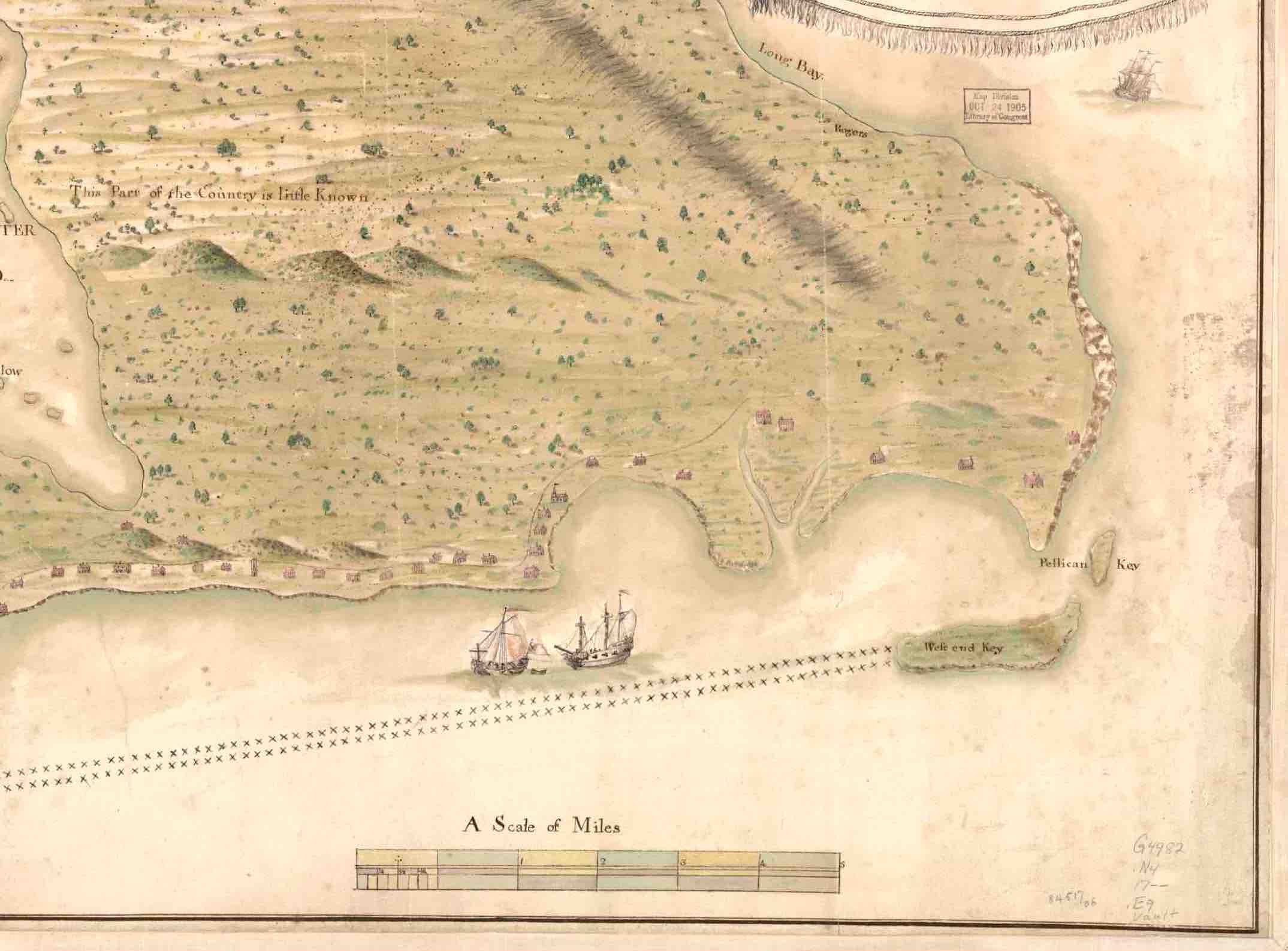
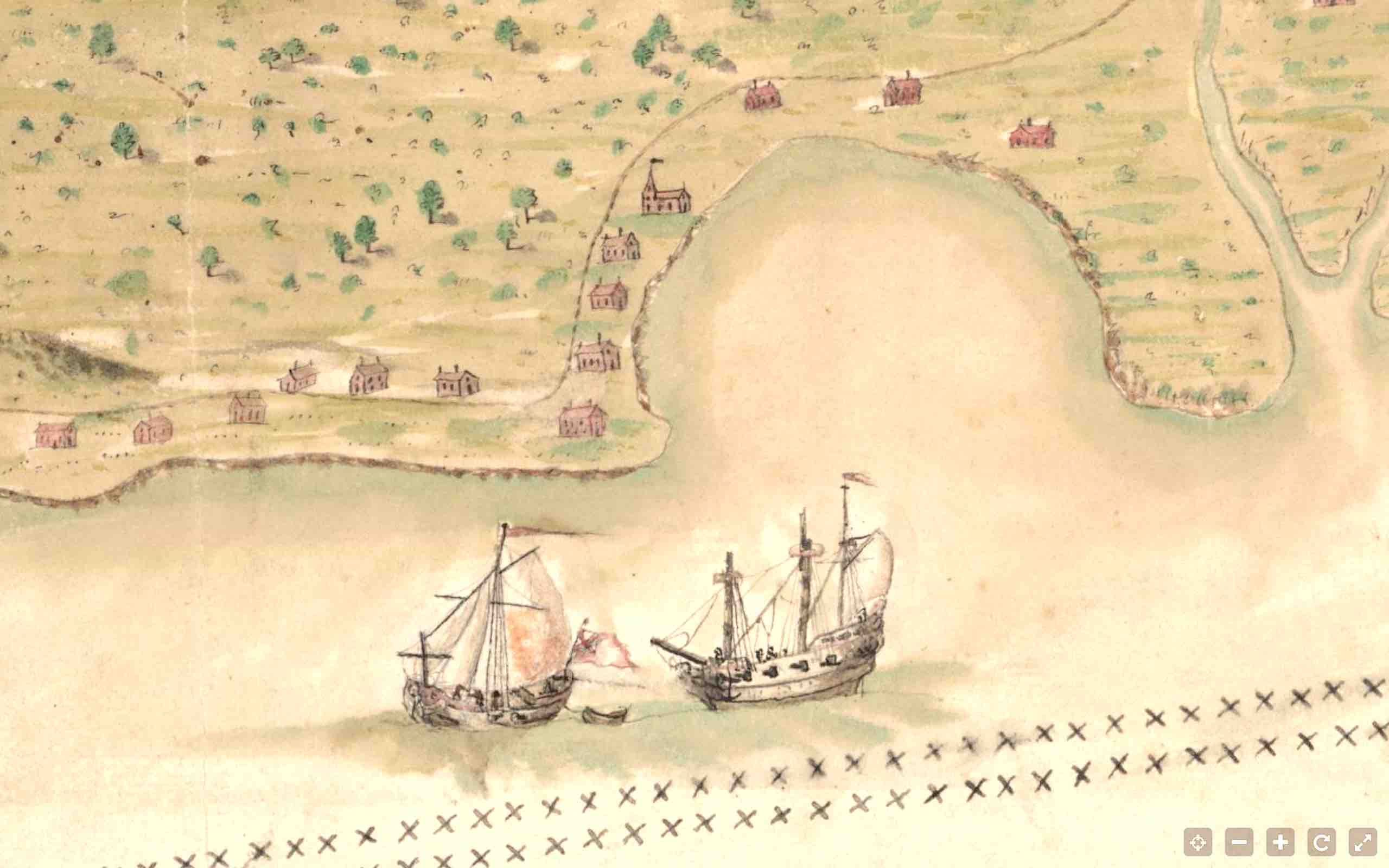
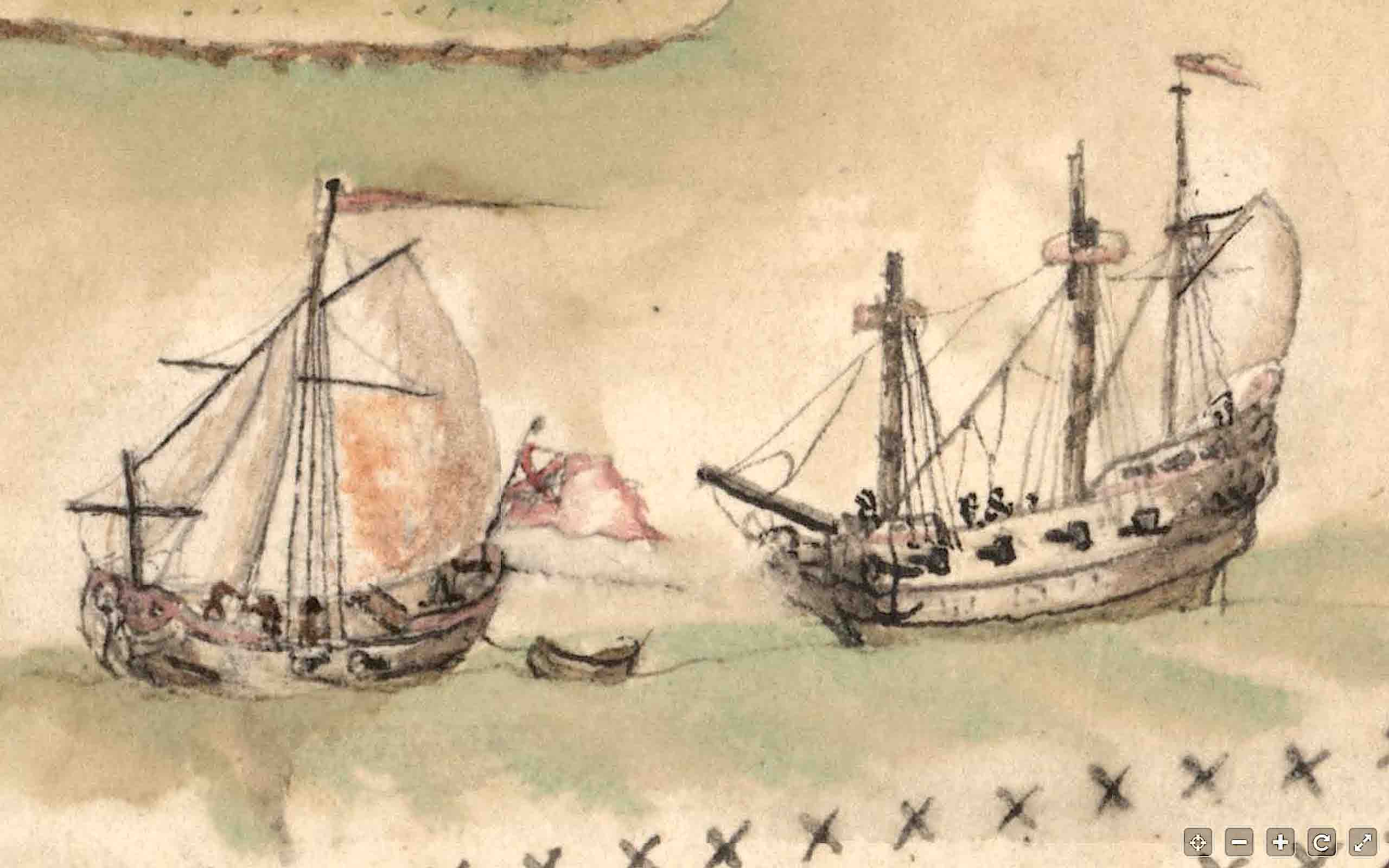
3. BOTTOM RIGHT CORNER (north-west). At last there is more evidence habitation, with a string of dwellings along the coastline. The 2 cays shown have names, West End and ‘Pellican’. And it looks as though the two ships have set out from port. On the left side of the bay above them, a church can be seen. Initially I thought the double row of crosses might indicate an area close to the shoreline that might be safe – or at least safer – from pirate attack. The leading ship – as the detailed crop shows clearly – is a warship. No harm in romantically speculating that it is escorting a trading vessel… More recently an online friend Klausbernd told me that the double crosses on map are in fact a navigational aid indicating cross bearings.

new-providence-c18-map-part-4

new-providence-c18-map-part-5

4. BOTTOM MIDDLE SECTION As we move towards the main – indeed only – town on the island, it is clear that the northern coast was the most desirable place to live. The scattering of houses along the coast continues; and the captions for the ponds show a possible reason why: fresh water, on an island where other areas of water are actually marked as ‘salt’ or which might have been unpleasantly brackish. And now we can see more of the posh establishment I referred to above. Not only did it lie in open (or perhaps cultivated) country, but it was plainly of some importance. It is notably larger that other buildings depicted, for a start; and it has its own very long track that forks off the coastal track.

new-providence-c18-map-part-10

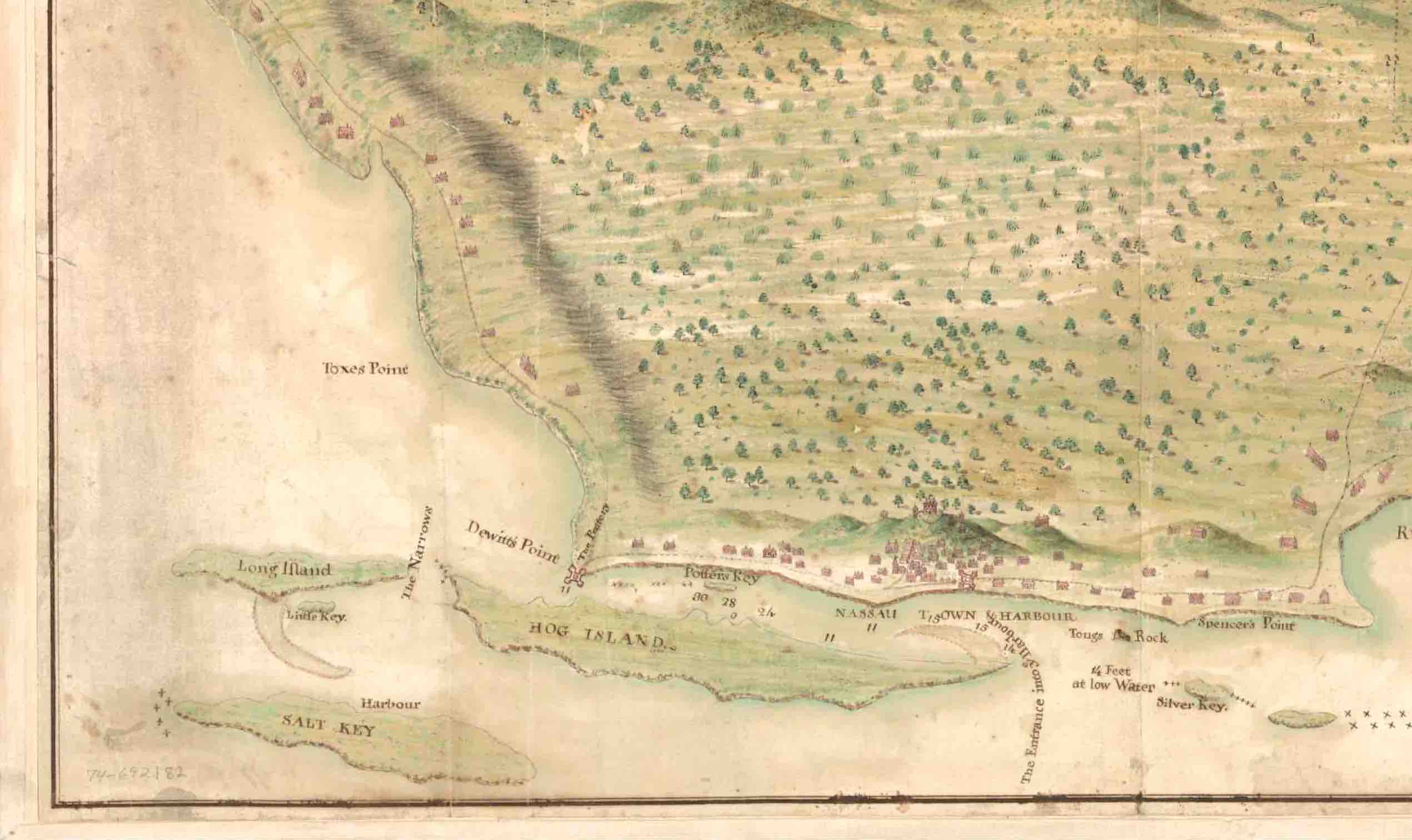
5. BOTTOM LEFT CORNER: NASSAU We have reached the big city, the centre of the population, and the port – with the harbour entrance handily marked. It bore the same name then as now; though the other names marked (as far as I can make out) have mostly if not all changed over 3 centuries. The Baha Mar development and its attendant travails seem light years away from this map. The double line of crosses ends here (bottom right at the first cay). If they marked a safe zone for vessels passing back and forth into Nassau harbour, they did not need to extend further because of the town fortifications (see detailed crop). There is a fort right on the shore; and at the far end of the harbour sound is a battery at Drewitt’s Point. The town is watched over by a substantial building – presumably a Governor’s residence – that is surrounded by a stockade . In the early c18 Nassau put on a show of strength to deter invaders and pirates.

new-providence-c18-map-part-2new-providence-c18-map-part-14

DO WE KNOW THE EXACT DRAUGHT’S EXACT DATE?

The map itself is undated. The Library of Congress, whose map I have chopped up for this post, simply dates it as 17– and notes: 

Manuscript, pen-and-ink and watercolor; Has watermark; Oriented with north to the bottom; Relief shown pictorially and by shading; Depths shown by soundings.

The excellent David Rumsey Historical Map Collection chooses the year 1750, the maker unknown. Another source puts the date at 1700.

Whichever, a clue to establish the map in the first half of the c18 is that the publisher is believed to be ‘William Innys [et al.]’, London. Innys and his brother John (the ‘et al’ presumably) were active at that time. In 1726, for example, they published an edition of Newton’s  Philosophiae naturalis principia mathematica (first published in 1687), indicating that they must already have been well-established.

new-providence-c18-map-part-7-2

WHAT ABOUT THE PIRATES?

The “Deposition of  Capt. Matthew Musson” made on  5 Jul 1717 in London, contains some excellent contemporary  pirate-based material. The middle passage in particular gives an indication how well organised and extremely well-armed the pirates were. And it is clear that piracy was actually driving inhabitants away from New Providence.

  • “On March last he was cast away on the Bahamas. At Harbour Island he found about 30 families, with severall pirates, which frequently are comeing and goeing to purchase provissons for the piratts vessells at Providence. There were there two ships of 90 tons which sold provissons to the said pirates, the sailors of which said they belong’d to Boston”.
  • “At Habakoe one of the Bahamas he found Capt. Thomas Walker and others who had left Providence by reason of the rudeness of the pirates and settled there. They advis’d him that five pirates made ye harbour of Providence their place of rendevous vizt. [Benjamin] Horngold, a sloop with 10 guns and about 80 men; [Henry] Jennings, a sloop with 10 guns and 100 men; [Josiah(s)] Burgiss, a sloop with 8 guns and about 80 men; [Henry?] White, in a small vessell with 30 men and small armes; [Edward] Thatch, a sloop 6 gunns and about 70 men. All took and destroyd ships of all nations except Jennings who took no English; they had taken a Spanish ship of 32 gunns, which they kept in the harbour for a guardship”.
  • “Ye greatest part of the inhabitants of Providence are. already gone into other adjacent islands to secure themselves from ye pirates, who frequently plunder them. Most of the ships and vessells taken by them they burn and destroy when brought into the harbour and oblidge the menn to take on with them. The inhabitants of those Isles are in a miserable condition at present, but were in great hopes that H.M. would be graciously pleas’d to take such measures, which would speedily enable them to return to Providence their former settlement, there are severall more pirates than he can now give an accot. of that are both to windward and to leward of Providence that may ere this be expected to rendevous there he being apprehensive that unless the Governmt. fortify this place the pirates will to protect themselves”. Signed, Mathew Musson. Endorsed, Read 5th July, 1717. 1½ pp. [C.O. 5, 1265. No. 73.]

new-providence-c18-map-part-11

CAN I BUY THIS MAP FOR MY WALL?

You certainly can. Well, not an original obviously. But you can find prints of it on eBay and elsewhere – just google the map title. You can get a modern copy for around $20 + shipping

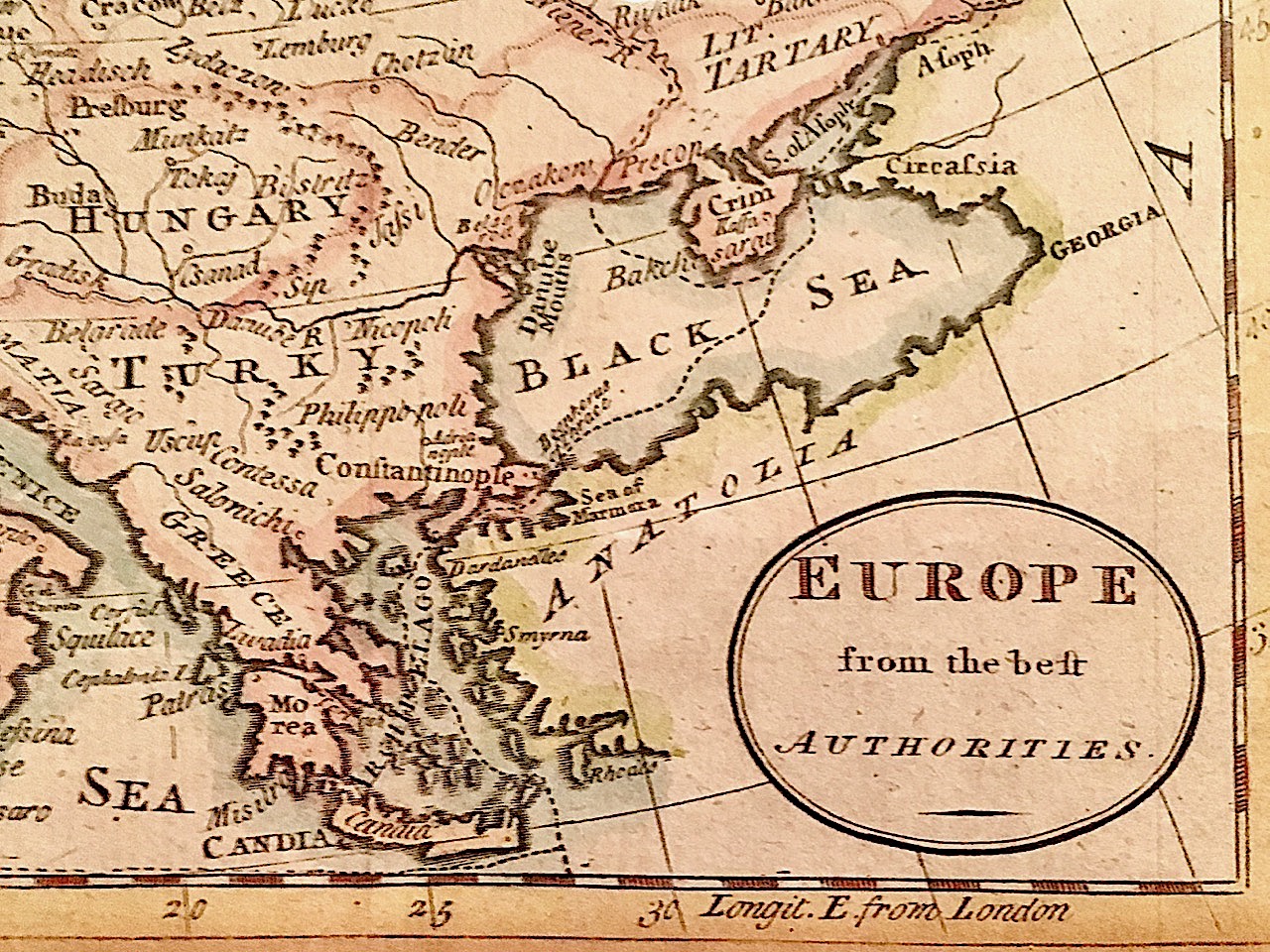
** I have an enjoyable example of this tendency on a William Guthrie map of Europe dated c1800 that I own. A map from “the beft authorities” could surely have no serious rival!img_4771

Credits: Library of Congress Online Catalog (Geography and Map Division); David Rumsey Historical Map Collection; Baylus C Brooks, Professional Research & Maritime Historian, Author, & Conservator / “America and West Indies: July 1717, 1-15,” in Calendar of State Papers Colonial, America and West Indies: Volume 29, 1716-1717, ed. Cecil Headlam (London: His Majesty’s Stationery Office, 1930), 336-344; Bonhams (Auctioneers)

Map of New Providence / Nassau Bahamas (early c18)

Unknown's avatar

ROCK BEAUTY: BAHAMAS REEF FISH (52)


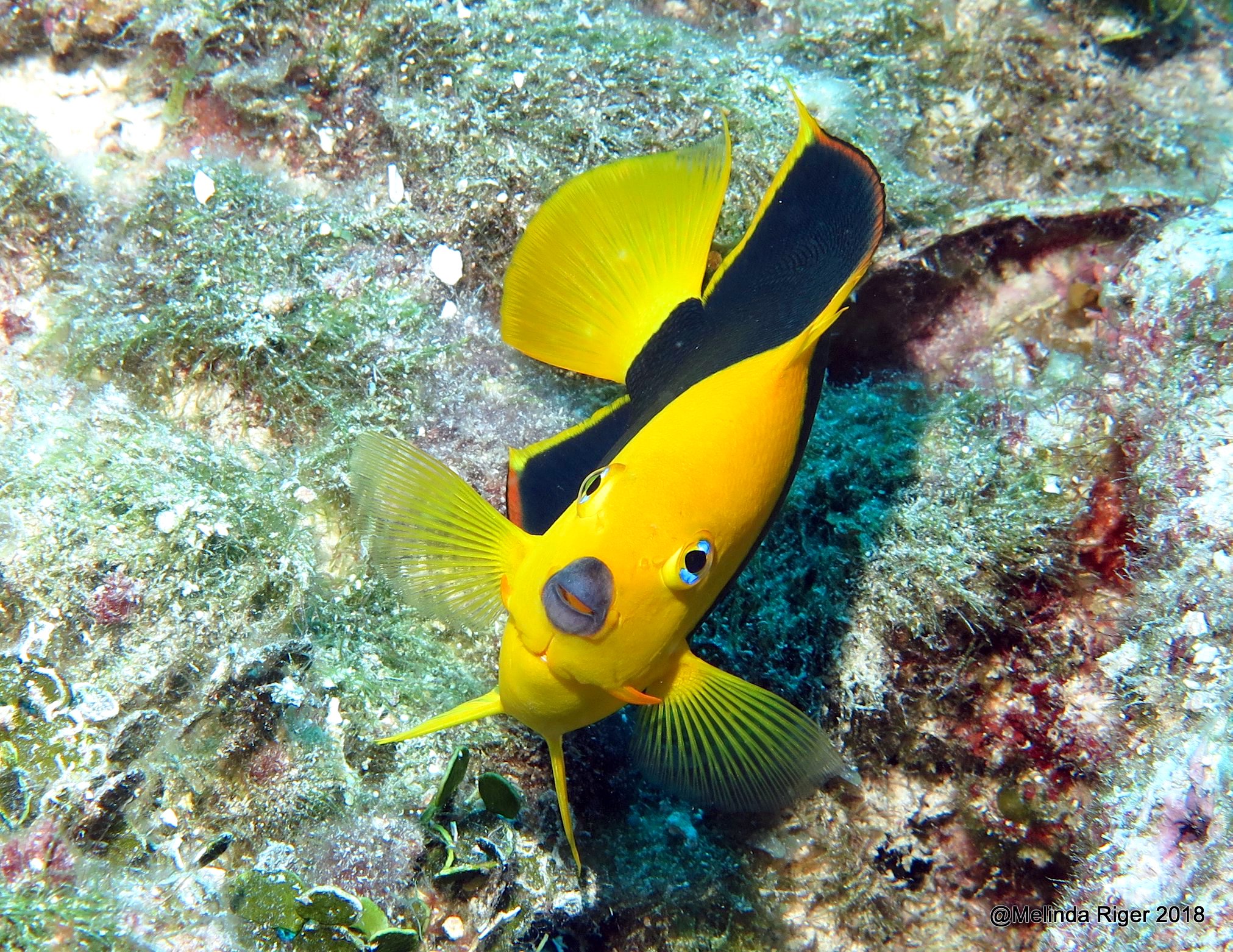
ROCK BEAUTY: BAHAMAS REEF FISH (Melinda Riger / GB Scuba)

ROCK BEAUTY: BAHAMAS REEF FISH (52)

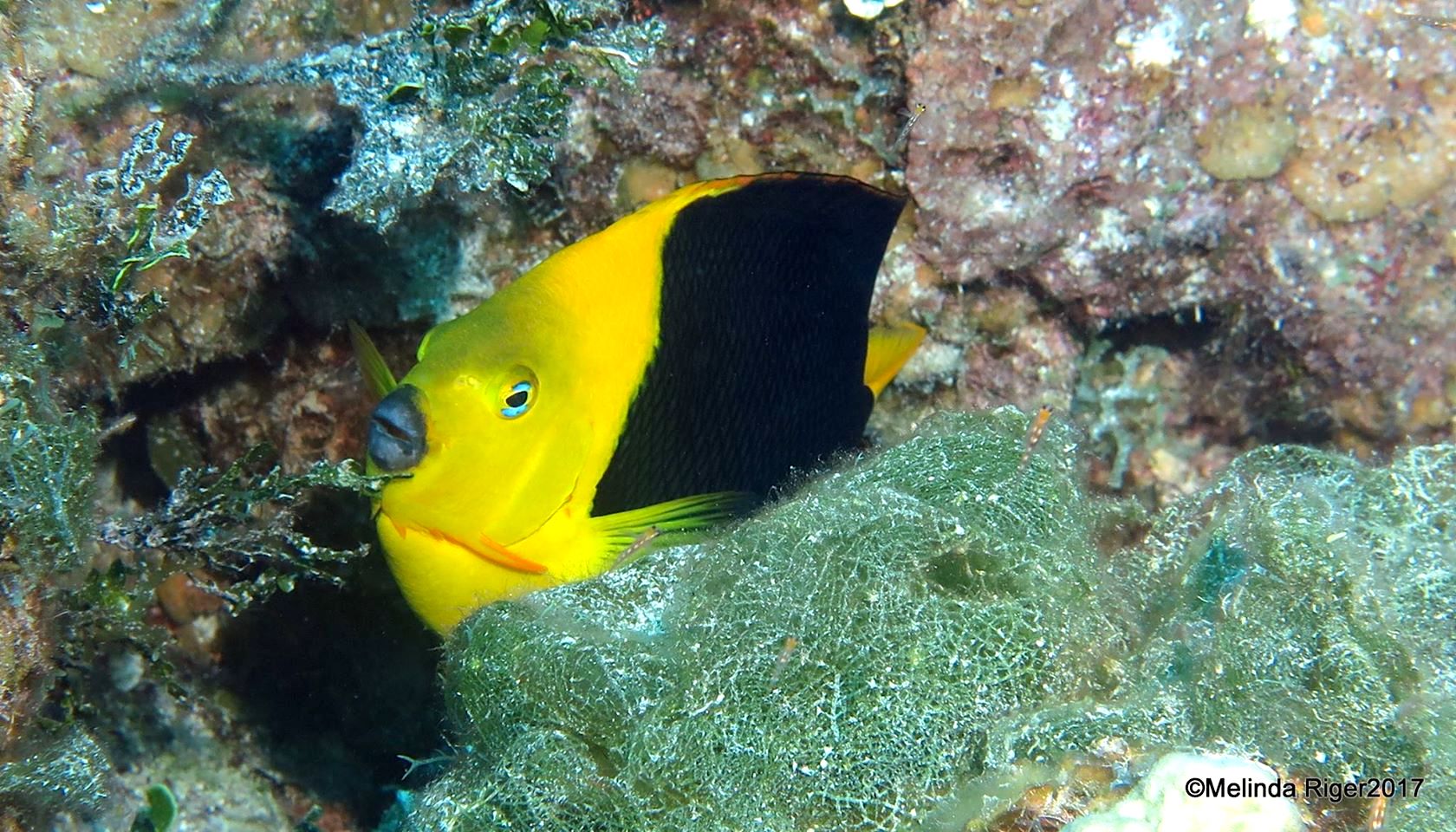
I last featured the cheerfully-coloured Rock Beauty Holacanthus tricolor 2 or 3 years back. Time has passed; new photos exist; new people have signed up to follow this eclectic menagerie (thank you both). Time for another look at these beauties, which also happen to be cuties.

ROCK BEAUTY: BAHAMAS REEF FISH (Melinda Riger / GB Scuba)

Look at the little guy above –  posing for Pixar, adorably hoping to star in Part 3 of the Nemo / Dory trilogy

ROCK BEAUTY: BAHAMAS REEF FISH (Melinda Riger / GB Scuba)

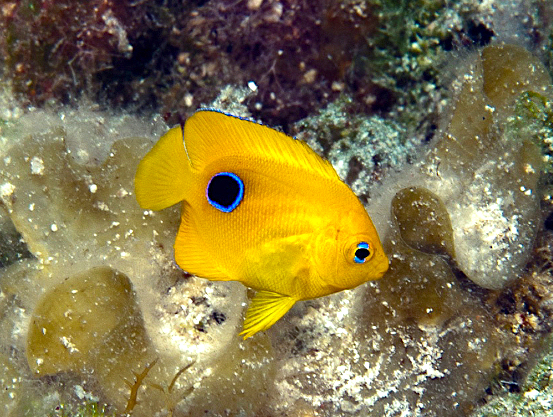
These fish are a small species of angelfish. Seen swimming around the reefs they are unmistakeable, not least because of their bright yellow hi-viz jackets, remarkable blue eyeliner and blue-black lippy. 

ROCK BEAUTY: BAHAMAS REEF FISH (Melinda Riger / GB Scuba)

Rock Beauties look like prime candidates for anyone’s aquarium, but their picky dietary requirements and tendency for aggression make them unsuitable.

ROCK BEAUTY: BAHAMAS REEF FISH (Melinda Riger / GB Scuba)

They are highly specialised feeders, needing marine sponge in their daily diet. They are also prone to chase their tank-mates and nip them. On balance, they look more fetching nosing about the coral anyway.

ROCK BEAUTY: BAHAMAS REEF FISH (Melinda Riger / GB Scuba)

WHAT DO JUVENILES LOOK LIKE?

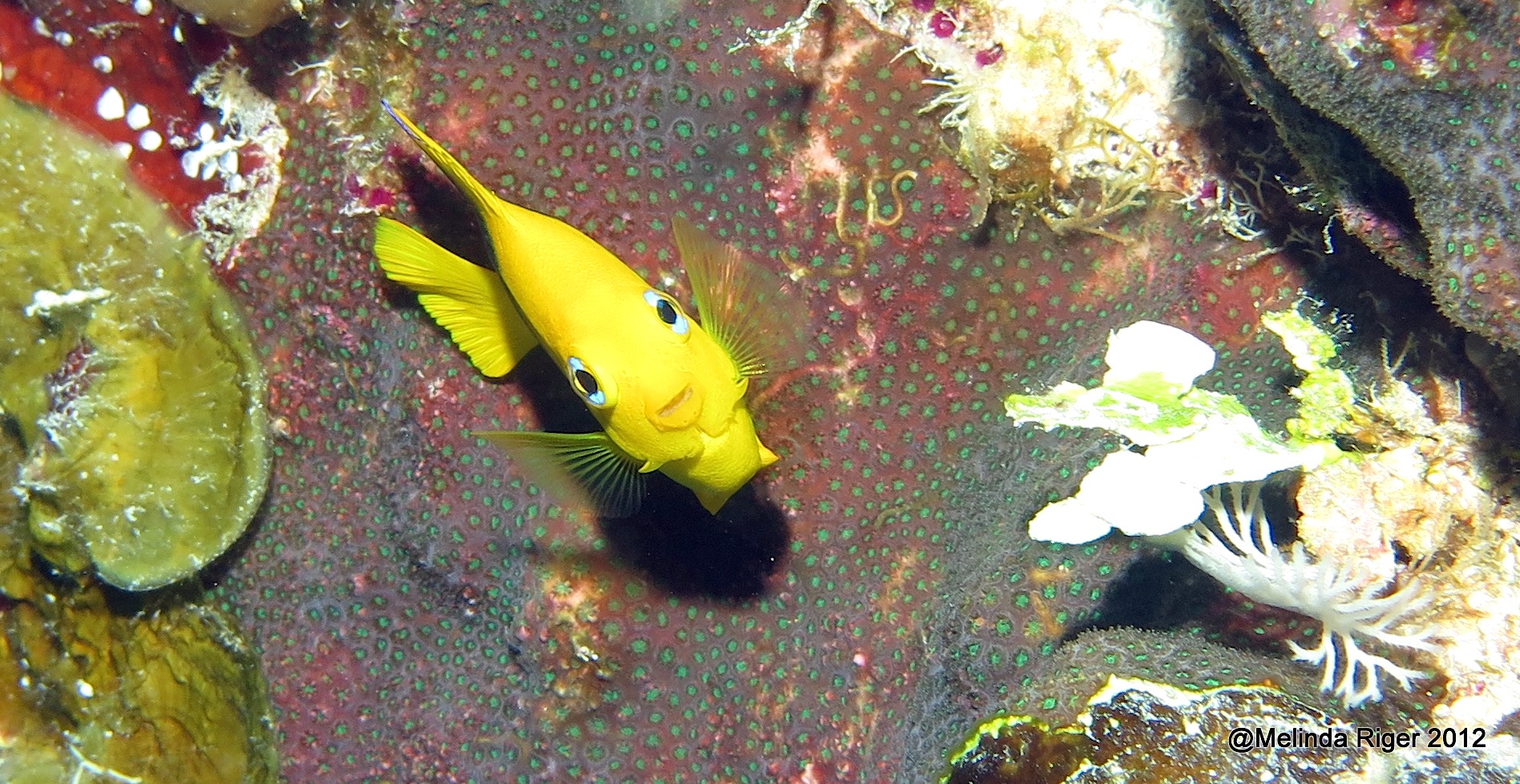
Juvenile rock beauties are cute mini-versions of the adults, only more yellow and with yellow lips. In some development stages, they have a smart blue circle around the dark patch on their sides (bottom image).

ROCK BEAUTY: BAHAMAS REEF FISH (Melinda Riger / GB Scuba)

Rock Beauty, Bahamas (Living Oceans Foundation))

NOTE Rock Beauties have no known kinship with Chrissie, Debbie, Lita, Joan, Jennifer, Stevie, Madge and the rest of the accredited ‘Rock Beauties aka Chicks’ 

NOT A TRUE ‘ROCK BEAUTY’ (no offence, Lita)

A TRUE ROCK BEAUTY

Credits: Melinda Riger, Grand Bahama Scuba; WP

Unknown's avatar

FLAMINGO TONGUE SNAILS: DECORATIVE CORAL-DWELLERS


Flamingo Tongue Snails (Melinda Rogers, Dive Abaco, Bahamas)

FLAMINGO TONGUE SNAILS: DECORATIVE CORAL-DWELLERS

FLAMINGO TONGUE SNAILS Cyphoma gibbous are small marine gastropod molluscs related to cowries. The living animal is brightly coloured and strikingly patterned, but that colour only exists in the ‘live’ parts – the so-called ‘mantle’. The shell itself is usually pale, and characterised by a thick ridge round the middle. These snails live in the tropical waters of the Caribbean and the wider western Atlantic. Whether alive or dead, they are gratifyingly easy to identify.

Flamingo Tongue Snails (Melinda Rogers, Dive Abaco, Bahamas)

THE IMPORTANCE OF CORAL

Flamingo tongue snails feed by browsing on soft corals. Often, they will leave tracks behind them on the coral stems as they forage (see image below). But corals are not only food – they provide the ideal sites for the creature’s breeding cycle.

Flamingo Tongue Snails (Dive Abaco, Bahamas)Flamingo Tongue Snails (Melinda Rogers, Dive Abaco, Bahamas)

Adult females attach eggs to coral which they have recently fed upon. About 10 days later, the larvae hatch. They eventually settle onto other gorgonian corals such as Sea Fans. Juveniles tend to live on the underside of coral branches, while adults are far more visible and mobile. Where the snail leaves a feeding scar, the corals can regrow the polyps, and therefore the snail’s feeding preference is generally not harmful to the coral.

The principal purpose of the patterned mantle of tissue over the shell is to act as the creature’s breathing apparatus. The tissue absorbs oxygen and releases carbon dioxide. As it has been (unkindly?) described, the mantle is “basically their lungs, stretched out over their rather boring-looking shell”

Flamingo Tongue Snails (Melinda Rogers, Dive Abaco, Bahamas)

THREATS AND DEFENCE

The species, once common, is becoming rarer. The natural predators include hogfish, pufferfish and spiny lobsters, though the spotted mantle provides some defence by being rather unpalatable. Gorgonian corals contain natural toxins, and instead of secreting these after feeding, the snail stores them. This supplements the defence provided by its APOSEMATIC COLORATION, the vivid colour and /or pattern warning sign to predators found in many animal species.

Flamingo Tongue Snails (Melinda Rogers, Dive Abaco, Bahamas)

MANKIND’S CONTRIBUTION

It comes as little surprise to learn that man is now considered to be the greatest menace to these little creatures, and the reason for their significant decline in numbers. The threat comes from snorkelers and divers who mistakenly / ignorantly think that the colour of the mantle is the actual shell of the animal, collect up a whole bunch from the reef, and in due course are left with… dead snails and “boring-looking shells” (see photos below). Don’t be a collector; be a protector…

Flamingo Tongue Snails (Melinda Rogers, Dive Abaco, Bahamas)

The photos below are of nude flamingo tongue shells from the Delphi Club Collection. Until I read the ‘boring-looking shell’ comment, I believed everyone thought they were rather lovely… I did, anyway. You decide!

Flamingo Tongue Snail Shell, Keith Salvesen AbacoFlamingo Tongue Snail Shell, Keith Salvesen Abaco

Image Credits:  Melinda Rogers / Dive Abaco; Keith Salvesen / Rolling Harbour

Flamingo Tongue Snails (Melinda Rogers, Dive Abaco, Bahamas)

Unknown's avatar

PILOT WHALES: “DIVIDED BY A COMMON SEA”


Pilot Whales, Abaco Bahamas (BMMRO / Rolling Harbour)

PILOT WHALES: “DIVIDED BY A COMMON SEA”

You know the thing about Britain and the US being ‘two Nations divided by a common language’? Among the many august people credited with first coming up with this remark, the leading contenders are Oscar Wilde, George Bernard Shaw and Winston Churchill. Generally, Wilde seems to be considered the winning author**. Whichever, the saying is intended to be lightly and amusingly rude, probably to both nations.

Pilot Whales, Abaco Bahamas (BMMRO / Rolling Harbour)

Well, pilot whales are in a similar position. They are found on both sides of the Atlantic (and many other places of course). As acoustic analysis of the sounds made by marine mammals becomes increasingly sophisticated, the evidence suggests that a pilot whale in The Canary Islands saying “Hey guys, meal approaching 11.00 o’clock, moving right, 30 feet” will use different sounds from its counterpart in the Bahamas.

A pilot whale with a recent injury to its jaw. Chief suspect: a COOKIECUTTER SHARK?Pilot Whales, Abaco Bahamas (BMMRO / Rolling Harbour)

Short-finned pilot whales (Globicephala macrorynchus) are also known as blackfish or potheads (though some may reserve this last term for – ahem – higher species). As with MELON-HEADED WHALES, they are in fact a species of large dolphin. They can grow to nearly 20′ long and weigh accordingly.

Pilot whales live in large pods of 50 or more. These are so-called ‘matrilineal’ groups, meaning that they consist of 2 or even 3 generations of related females. When the sea is calm, they sometimes adopt a behaviour known as ‘logging’, in which they will spend a long time – maybe hours – lying on the surface in tight groups.

Pilot Whales, Abaco Bahamas (BMMRO / Rolling Harbour)

In The Bahamas, pilot whales are seen year-round but are more common during the spring and summer months. Some are resident, but Bahama pilot whales appear to have large ranging patterns. Pilot whales tagged in The Bahamas have travelled as far north as North Carolina suggesting they are part of a population located in the US southeast .

HOW DO RESEARCHERS RECOGNISE EACH ANIMAL?

The first place to look is the dorsal fin. There are (at least) two reasons for this. First, it’s the part of the dolphin / whale that is most visible through binoculars; secondly, it is the part that tends to acquire nicks, ragged edges, and scar patterns that are unique to that animal. When a new cetacean is sighted, it is logged and assigned an ID. This will usually be kept simple and scientific: “look, there’s AL16 again” and so on; how unlike birds, where banders assign names such as Felicia Fancybottom, Bahama Mama and Harry Potter.  

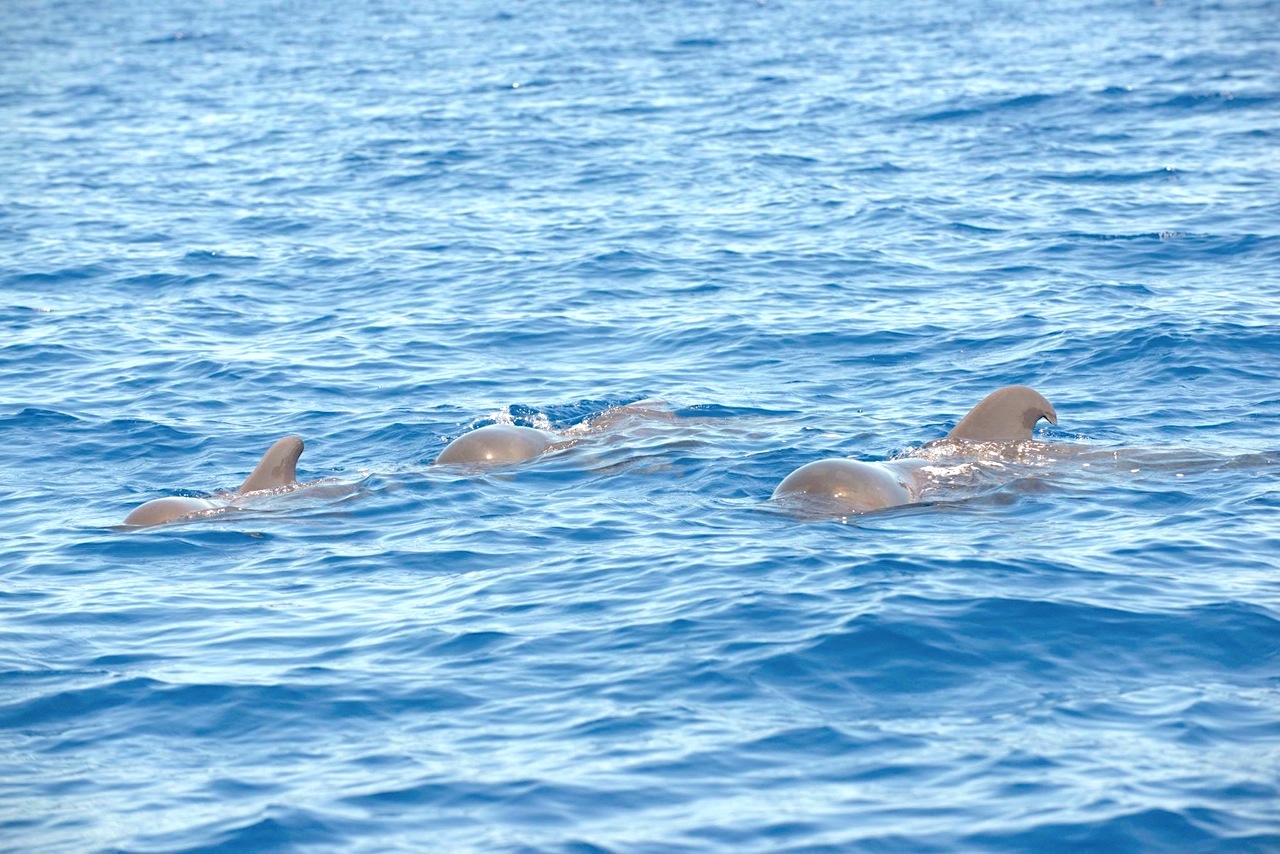
If you look at #2 above, notice the distinctive hooked dorsal fin of the right-hand pilot of the trio. An easy ID for future sightings. And see below for nicks and scarring.

Pilot Whales - dorsal fin ID, Abaco Bahamas (BMMRO / Rolling Harbour)

MEANWHILE, 3643 MILES EAST ACROSS THE ATLANTIC

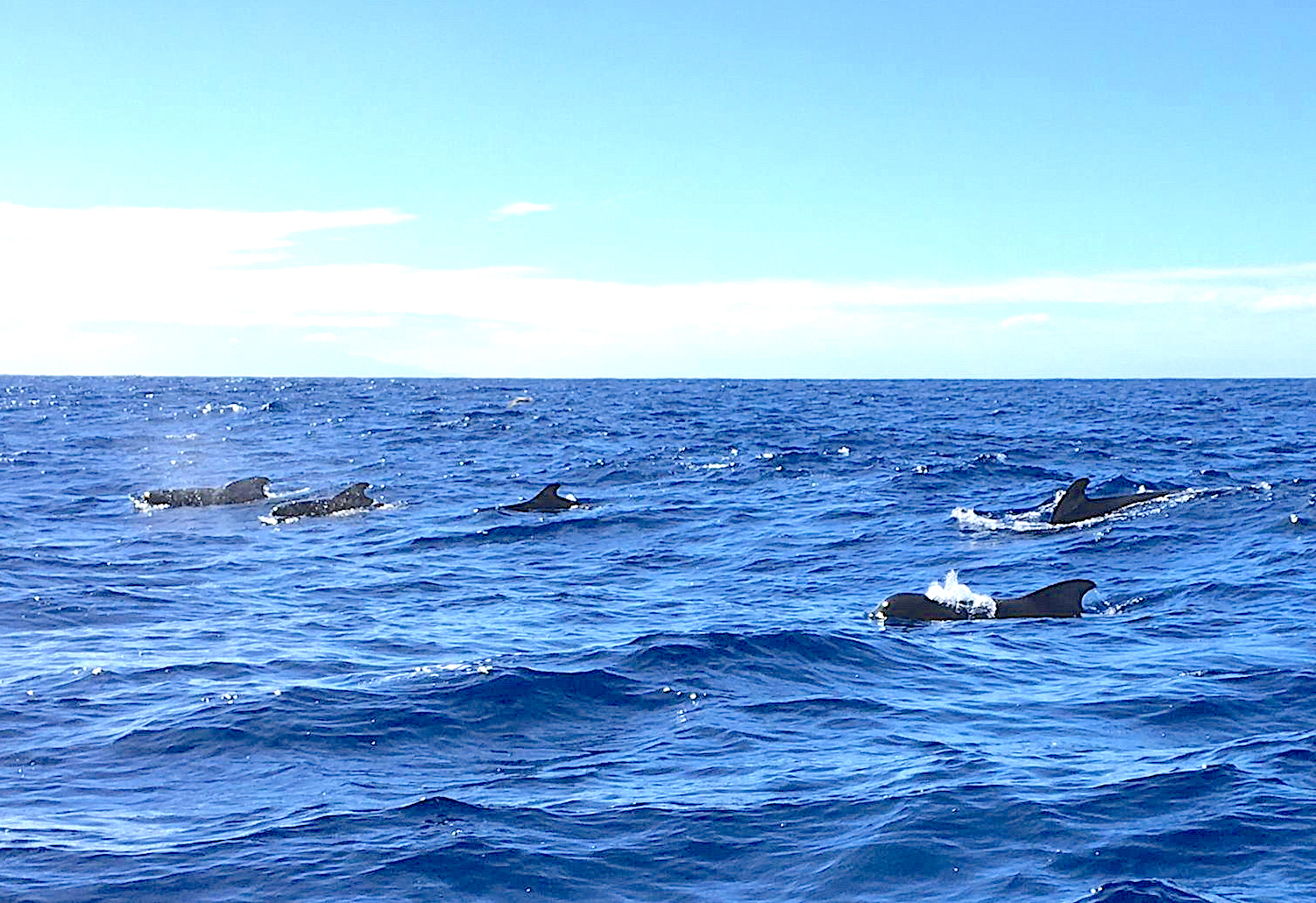
Last Autumn my niece and her family went to La Gomera, a small volcanic island in the Canaries. They all went on a whale / dolphin watching trip and were delighted to encounter a group of pilot whales. My great nephew, not yet a teenager, had an iphone with him and in the circumstances of standing on a moving platform photographing creatures swimming fast through the water, he did a very good job. A couple of them even have a bonus shearwater.

Pilot Whales, La Gomera, Canary Isles (Rolling Harbour / YN) Pilot Whales, La Gomera, Canary Isles (Rolling Harbour / YN) Pilot Whales, La Gomera, Canary Isles (Rolling Harbour / YN) Pilot Whales, La Gomera, Canary Isles (Rolling Harbour / YN) Pilot Whales, La Gomera, Canary Isles (Rolling Harbour / YN)

The west and east Atlantic pilot whales shown here are almost exactly on the same latitude

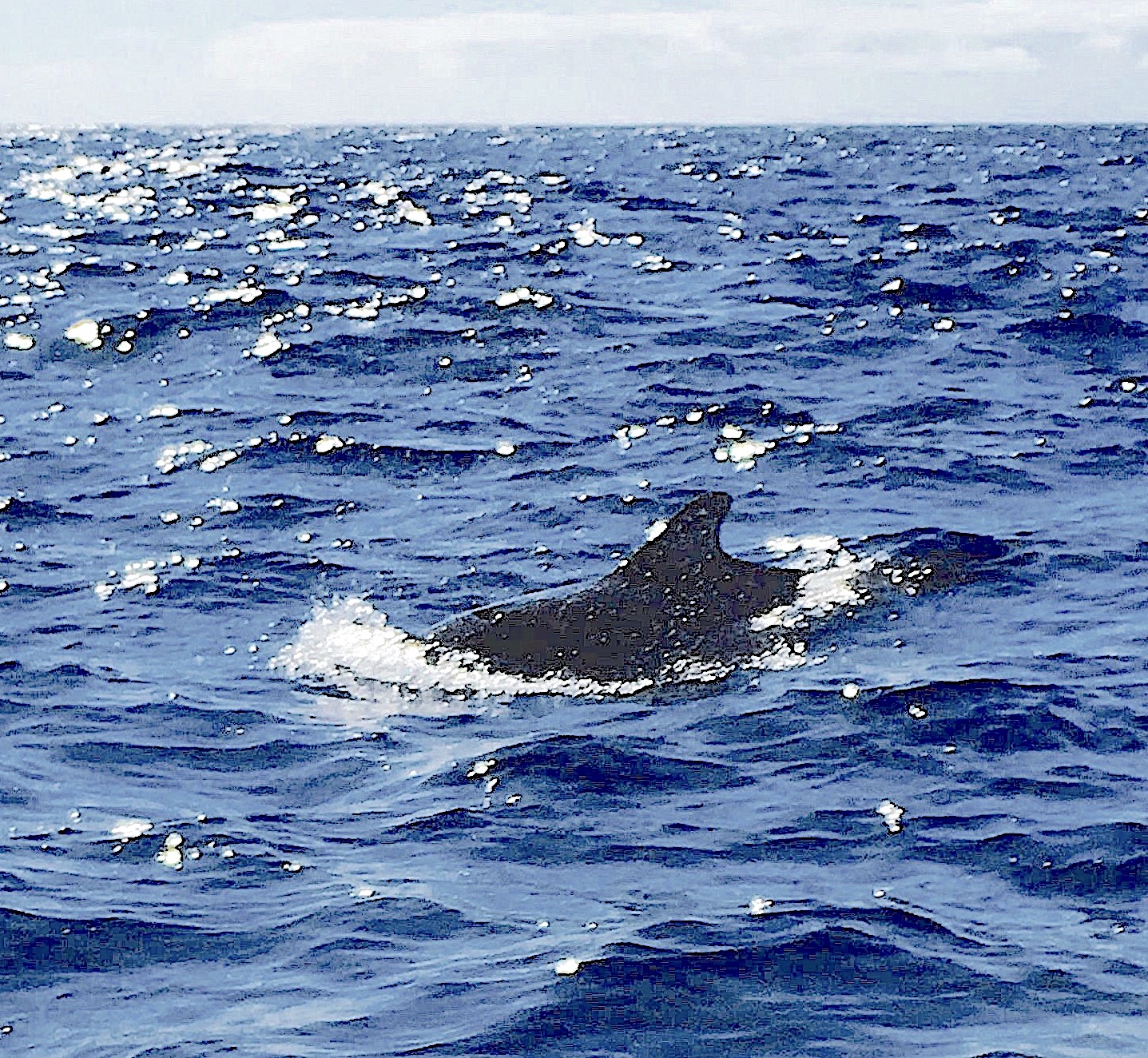
I’m not particularly bothered by my lack of photographic eptitude, but even I feel that my own shot of a pilot whale  in the Sea of Abaco rates high in the list of epic fails

The identity of the photographer is protected under the Official Secrets Act 1989

** ‘We have really everything in common with America nowadays except, of course, language’ Oscar Wilde The Canterville Ghost (1887)

Photo Credits: 1 – 5, BMMRO / Rolling Harbour; 6 – 10, my naturalist nephew Yarin; 11, name withheld by order of the management; 12, Marina Nolte / Wiki. General thanks: Diane, Charlotte, BMMRO

Pilot Whale (Marina Nolte / Wiki)

Unknown's avatar

BREADFRUIT: NATURE’S BOUNTY (WITH ADDED MUTINY)


Artocarpus altilis - breadfruit (Hans Hillewaert)

BREADFRUIT: NATURE’S BOUNTY (WITH ADDED MUTINY)

Capt. William Bligh achieved fame for all the wrong reasons. Despite a distinguished and wide-ranging seafaring career he is widely remembered for just two things: (1) The Bounty and (2) Mutiny On. In 1787, he was dispatched to Tahiti to collect specimens of BREADFRUIT (a fruit of the Pacific islands, in particular Polynesia) to help provide food for the British colonies in the West Indies. To be clear, the breadfruit was intended to be a basic and cheap staple food not just for settlers but also for the indigenous population. I think we can all guess the status of the latter at that time.

Breadfruit 2

‘BLIGH’S BLIGHT’ – MUTINY!

Capt. Bligh’s Bounty crew unfortunately mutinied – possibly to do with the amount of water the breadfruit required in transit, compared to their own meagre rations. So they threw overboard the hundreds of breadfruit plants that were in transit. Then they set Bligh with his loyal officers and crew adrift… He was later court-martialled but cleared of culpability for provoking a mutiny by his conduct. 

Mutiny on the HMS Bounty (Robert Dodd)

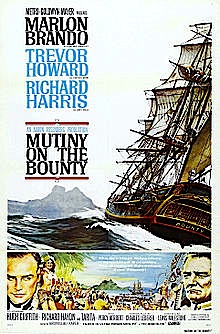
This isn’t the place for a disquisition on the Mutiny. You can read all about it HERE. Or better still, watch one of the rollicking all-star-cast films based loosely on the episode for a careful and accurate historical record of the events that will buckle your swash…

Mutiny_on_the_Bounty_Poster (1935) 220px-Poster_for_Mutiny_on_the_Bounty

BLIGH’S SECOND CHANCE

Following that skirmish, and indeed blemish, on his record, in 1793 Capt. Bligh was yet again charged with the task of shipping breadfruit trees from their origin to the Caribbean. His heart must have sunk, yet finally he succeeded, only for those on the eating end to express considerable distaste for such a bland, starchy fruit. It took a long time to catch on, and its culinary versatility was only discovered many decades later. By which time slavery had thankfully been abolished anyway.

 Breadfruit image (Pacific site)

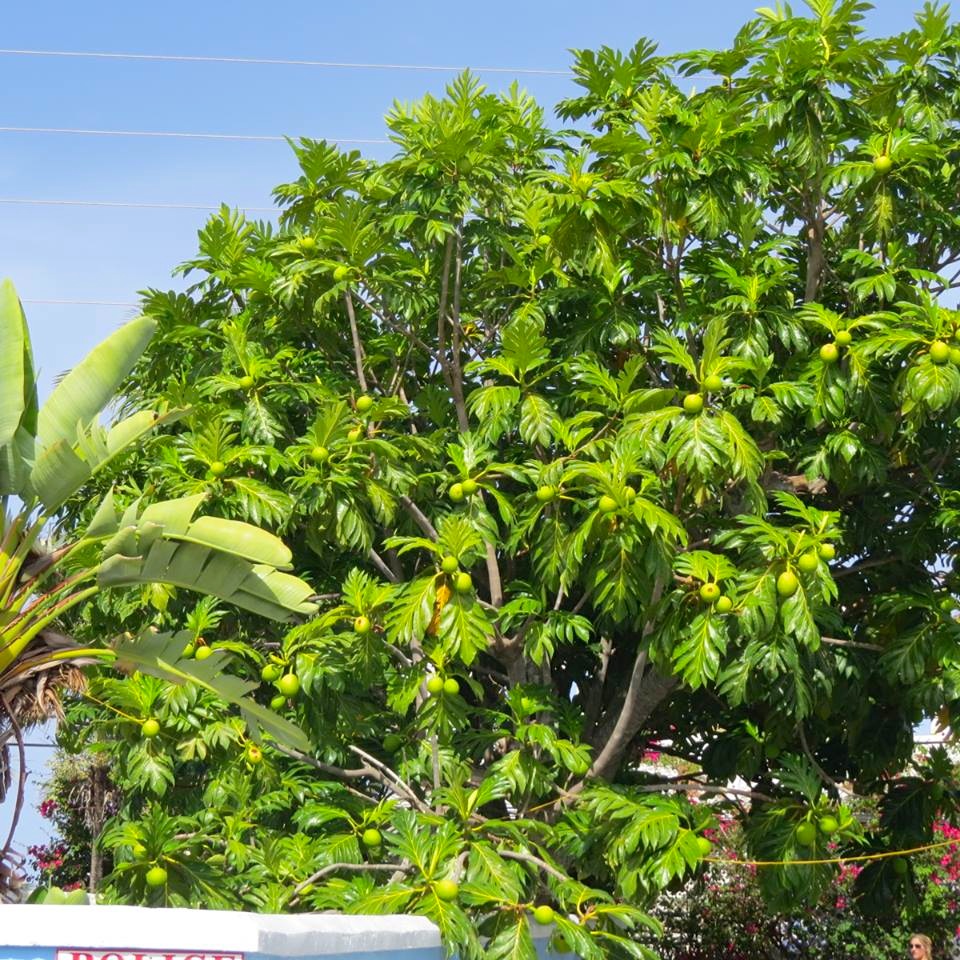
The most famous breadfruit tree in all Abaco is to be found in Hope Town, on Elbow Cay. I can do no better than display the notice that proudly proclaims the historic significance of the tree and its eponymous fruit.

Breadfruit Tree Notice, Hope Town Abaco (Dp PatersonBreadfruit Tree, Hope Town Abaco (Dp Paterson)

Unusually for a fruit plant, a true breadfruit Artocarpus altilis does not produce seeds. It is propagated by removing the suckers that grow at at the base of the tree.

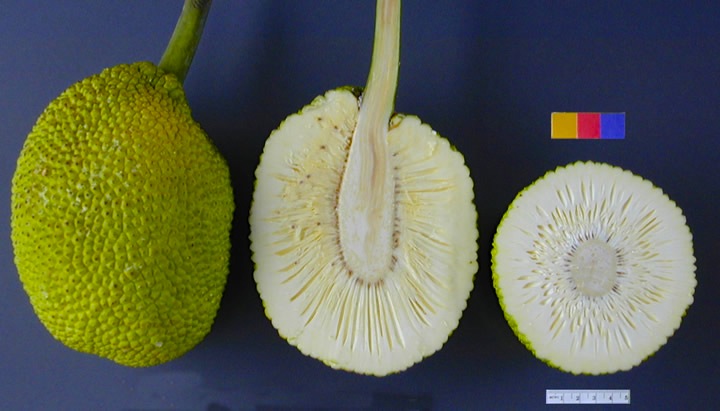
For those unfamiliar with the fruit and its interior, here it is in both slice and cross-sectionBreadfruit sliced (US Pacific Basin Agricultural Research Center)

BREADFRUIT IN ART

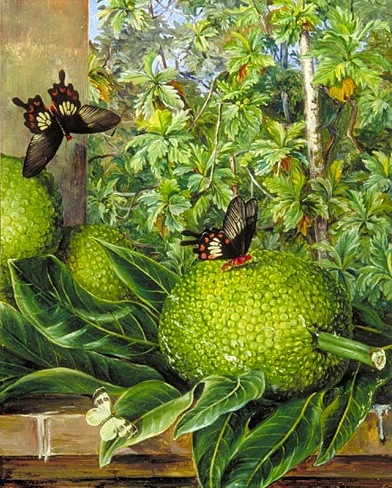
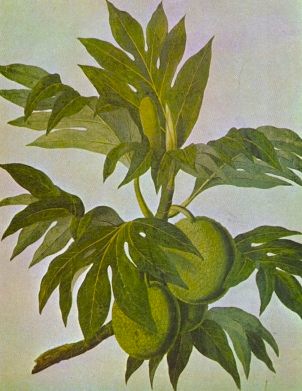
Breadfruit has (somewhat surprisingly?) received some artistic recognition over the years. Here are a few examples. The first, very jolly, includes early representations of the Polydamus Swallowtail butterfly; the second is quite dull; the third is instructional (oddly equating breadfruit with tea, coffee and chocolate); and the fourth, frankly not at all appetising to look at…

Breadfruit with butterflies (Royal Botanic Garden, Kew)Breadfruit (Royal Botanic Gardens, Kew)

                                 Breadfruit (John Frederick Miller)                                  Breadfruit drawing John Frederick Miller

      Breadfruit & related plants used as food (William Rhind (1841)     Breadfruit etc William Rhind (1841)

Breadfruit - Bahamas Stamp

SO WHERE DOES BREADFRUIT GROW NOW?

Breadfruit will flourish only within a certain latitude range where the rainfall and temperature suit it, as this map shows. I include this information in case you ever find yourself in the awkward position of being socially stranded with someone whose conversation has become soporific. Be armed with some useful worldwide breadfruit stats for just such an occasion – the fact that Madagascar is a suitable yet not a very good location, for example (not enough rainfall). You will soon find yourself alone…

Breadfruit - the world propagation range

A CULINARY TREAT

Breadfruit is sometimes thought to be a dull and untasty, at least compared with many other fruits. I thought I’d include a recipe or two that rather appealed to me – the second because even I could do that… it’s within my shamefully limited culinary skill-set.

Breadfruit Recipe (myrecipefriends.com)

BAKED BREADFRUIT

Large, ripe breadfruit 1 cup water Butter 1 lime or lemon

Heat oven to 350 degrees F. Put the water in a shallow pan and place the whole breadfruit in the water. Bake in oven for three hours. Remove from oven, allow to cool slightly, peel, removing the large core and stem. Cut the fruit into sections and place in a serving dish. Cover with butter and a squeeze of lime or lemon juice.

A PERFECT HOPE TOWN BREADFRUIT
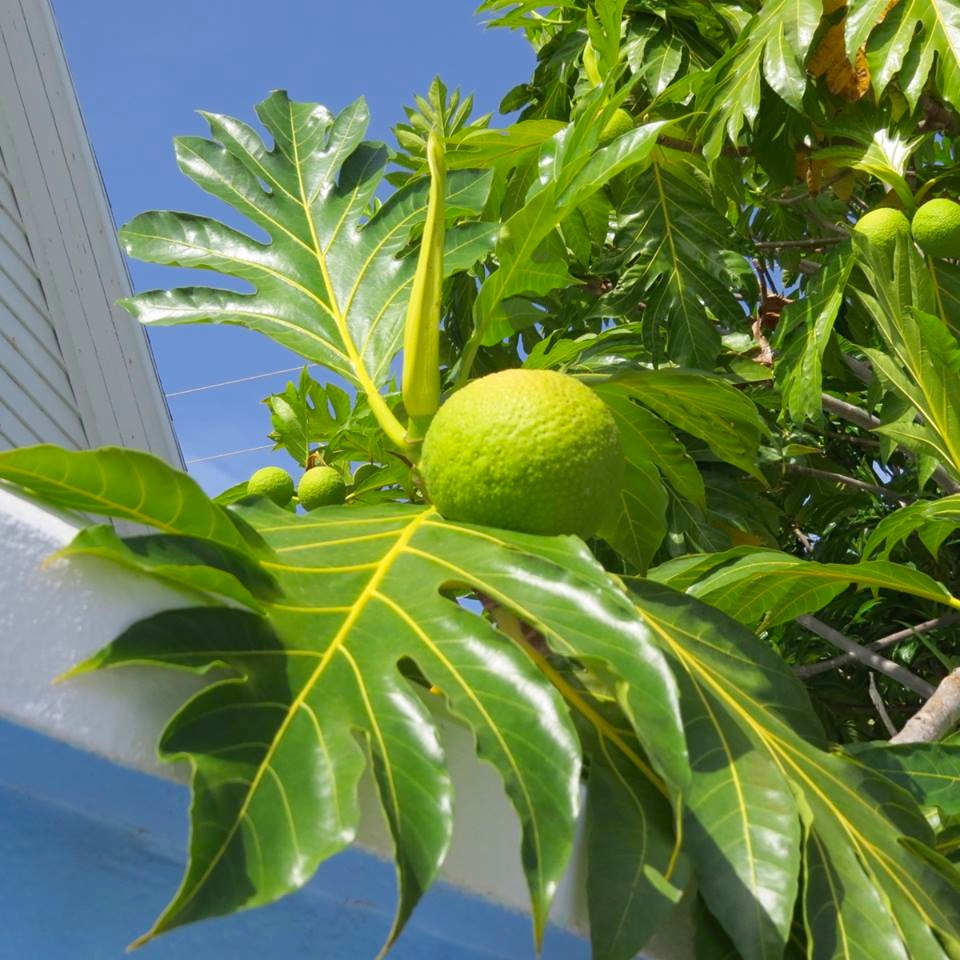
Breadfruit, Hope Town Abaco (Dp Paterson)

This post was inspired by an article on breadfruit and the Hope Town tree by local historian Deb ‘DP’ Patterson, who will be known to many for her committed involvement with the Wyannie Malone Historical Museum in Hope Town. I’m grateful to her for permission to use her idea and indeed some of her material, in particular her photos of the tree and its notice. I originally posted this about 4 years ago, and have dusted it off for the benefit of new (thank you!) followers who might also have breadfruitphilia.

If you do visit this delightful little town, the museum is a treasure house of Abaconian history that deserves a visit. You can check out its website HERE and the FB page HERE.

Wyannie Malone Museum Crest, Hope Town, Abaco

BLIGH’S END

Capt. Bligh managed to put his breadfruit adventures and the mutiny behind him. He continued a distinguished naval career with successive command of an impressive number of  ships. He ended up a Vice-Admiral, and (on his death in 1817) in a grave in Lambeth, London.

V-A William Bligh (1814)

Grave of William Bligh, Lambeth, London (Geograph, Commons Media

HMS BOUNTY II (Full Sails). A 1960 reconstruction (Dan Kasberger)HMS_BOUNTY_II_Full_Sails 1960 reconsrtuction (Dan Kasberger)

Credits: First and foremost, Deb Patterson; Magpie Pickings including Hans Hillewaert, US Pacific Basin Agricultural Research Center, Royal Botanic Garden Kew, myrecipefriends, M Kwek, whatsonbahamas, Wyannie Malone Historical Museum, ‘Geograph’, Dan Kasberger, and Wiki; and anyone else I have omitted…

Unknown's avatar

CUBAN PEWEE: ‘NATURE’S LEAST SCARY TYRANT’


Cuban Pewee, Contopus caribaeus bahamensis, Casuarina Abaco Bahamas (Keith Salvesen Photography)

CUBAN PEWEE: ‘NATURE’S LEAST SCARY TYRANT’

The small bird featured here is a CUBAN PEWEE Contopus caribaeus bahamensis (sometimes called the Crescent-eyed Pewee – see image for why this is so). It is without a doubt a tyrant. At barely 6″ long, it is the smallest tyrant you are likely to encounter in the Bahamas or indeed anywhere else. However it does happen to be a member of the family Tyranidae. These are the flycatchers, and on Abaco they include the larger LA SAGRA’S FLYCATCHERthe still larger LOGGERHEAD KINGBIRD and (a summer visitor only) the GRAY KINGBIRD (this last link explains the difference between the two kingbirds).

Cuban Pewee, Contopus caribaeus bahamensis, Casuarina Abaco Bahamas (Keith Salvesen Photography)

The Cuban Pewee is permanently resident on Abaco, and can be found in both pine woods and coppice. When returning to its perch after a fly-catching sortie – ‘hawking’ on the wing – this wee bird gives a characteristic flick of the tail. The bird featured here was in the rough scrub behind the beach of the beautiful bay at Casuarina. It became a favourite of mine simply by being completely unafraid of me, and accepting my extremely slow approach (3 inches at a time) with apparent interest mixed in with an endearing willingness to pose, even when I could almost have reached out and touched it.

Cuban Pewee, Contopus caribaeus bahamensis, Casuarina Abaco Bahamas (Keith Salvesen Photography)

Unlike many creatures, it did not seem concerned by eye-contact. It responded when I made a faint clicking sound by rather sweetly putting its head on one side. However, as I got as close to it as I dared, it began to fidget slightly (possibly feeling camera-shy). So I shuffled slowly back, so as not to disturb it in its own territory, where it was the resident and I was the intruder.

Cuban Pewee, Contopus caribaeus bahamensis, Casuarina Abaco Bahamas (Keith Salvesen Photography)

These close-ups clearly show the tiny hooked tip at the end of the upper beak, which (as in other tyrant species) relates to the business of catching flies. Also like other flycatchers, the Cuban Pewee has very distinctive whiskers around the base of the beak. In fact, these are not whiskers as such – not hairs so much as feathers that have modified into bristles. These act as ‘tactile sensors’ to assist the detection and targeting of aerial insects as the bird darts from a perch to intercept some passing tasty winged morsel. 

Cuban Pewee, Contopus caribaeus bahamensis, Casuarina Abaco Bahamas (Keith Salvesen Photography)

The range of the Cuban Pewee is limited almost entirely to Cuba and the Bahamas, so it is very region specific. And how lucky we are to have these cute little specimens on Abaco. I note that the Audubon site calls them drab, which I think is a little unfair. Merely because a bird is not decked out like a PAINTED BUNTING or startlingly marked like a male RED-WINGED BLACKBIRD does not make it drab. I prefer the word ‘subtle’.  I like GRASSQUITS too, for the same reason: too often maligned as ‘dull’.

Cuban Pewee, Contopus caribaeus bahamensis, Casuarina Abaco Bahamas (Keith Salvesen Photography)

It is sometimes tempting to anthropomorphise such close encounters in terms of imputed human / creature empathy. It is probably best to try to resist that attitude (‘inter-species condescension’, as you might term it). But as I withdrew, leaving this little bird undisturbed on its branch, I did experience a strange feeling of mutual understanding and… [I must interrupt myself here. I’m a lawyer, so that’s quite enough of that sort of emotive nonsense]

All photos: Keith Salvesen; Range Map, Cornell

Cuban Pewee, Contopus caribaeus bahamensis, Casuarina Abaco Bahamas (Keith Salvesen Photography)

Unknown's avatar

ROCKET MAN: MORE MUSKY GIFTS TO ABACO’S PRISTINE BEACHES


Falcon 9 SpaceX Rocket Debris Sandy Point Abaco Bahamas (Charlotte Dunn / BMMRO)

ROCKET MAN: MORE MUSKY GIFTS TO ABACO’S PRISTINE BEACHES

THE STORY SO FAR

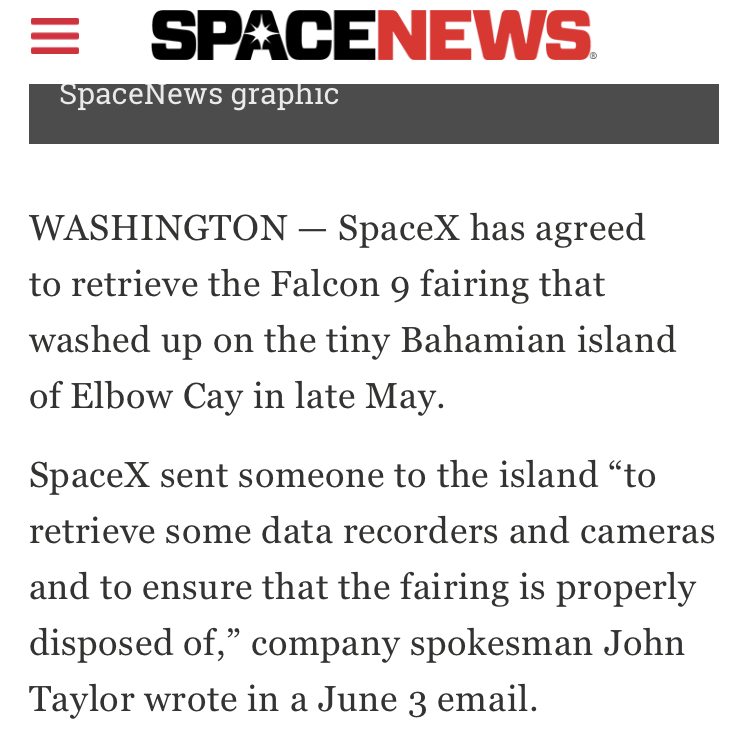
In early December a SpaceX (prop. E. Musk) Falcon 9 rocket was launched from Cape Canaveral. As it sped off purposefully into Space, the usual associated bits and pieces were jettisoned to fall with great precision into (a) open ocean and (b) a part where shipping was fortuitously absent. In due course (very quickly in fact), chunks of rocket debris turned up on the peaceful shores of Abaco. This is not unheard of: for example in 2012 we had a 12-foot fairing from the Curiosity Mars launch on the beach at Delphi (HERE); and in 2015 other space debris was found on Elbow Cay:

A CHUNK OF SPACE HISTORY, ELBOW CAY, ABACO, BAHAMAS (2015)   

The latest space-debris festival on Abaco’s shorelines in December was first discovered at Bahama Palm Shores. ID was established from the partial red SpaceX / Musk logo visible in the below. The new arrival added to the ongoing excitement there of a huge 50′ and (sadly) dead sperm washing back onto the beach in a state of unattractive and ‘stay-upwind-at-all-costs’  decomposition…

Falcon 9 Rocket Fragment on the beach at Bahama Palm Shores, Abaco (2018) Falcon 9 SpaceX Rocket Debris, Bahamas Palm Shores, Abaco Bahamas Falcon 9 SpaceX Rocket Debris Bahama Palm Shores Abaco

This was quickly followed by a report from Tahiti Beach, Elbow Cay. You can read the details of these 2 events as follows: BPS HERE and Elbow Cay HERE

Falcon 9 Rocket Fragment on Tahiti Beach, Elbow Cay Abaco BahamasFalcon 9 SpaceX Rocket Debris Sandy Point Abaco Bahamas (Mary McHenry)

As I mentioned in the Tahiti Beach post, a report from the west side of Abaco had just reached me from Charlotte Dunn, Director of the Bahamas Marine Mammal Research Organisation (BMMRO) at Sandy Point, Abaco. This was a surprising location because – with space-junk washing up on both sides of Abaco – an inference might be that the ‘drop’ area for nose-cones, fairings and the like might be somewhat wider than expected. Possibly wide enough to include a direct hit on land? Anyway, as promised, Charlotte has now had time to take some photos of Sandy Point’s involvement in the saga. 

Falcon 9 SpaceX Rocket Debris Sandy Point Abaco Bahamas (Charlotte Dunn / BMMRO)

Falcon 9 SpaceX Rocket Debris Sandy Point Abaco Bahamas (Charlotte Dunn / BMMRO)   Falcon 9 SpaceX Rocket Debris Sandy Point Abaco Bahamas (Charlotte Dunn / BMMRO) Falcon 9 SpaceX Rocket Debris Sandy Point Abaco Bahamas (Charlotte Dunn / BMMRO)

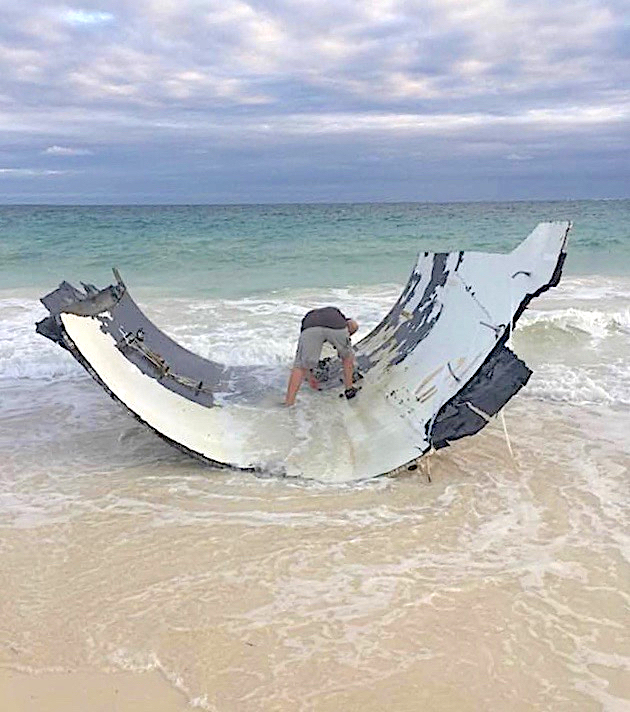
The top photo shows a long strip of space rocket, curving at one end. It’s obviously part of a larger part that was ejected after launch. In the Falcon 9 image below (note the logo matching the BPS part), the eye is drawn to the booster rocket fairings. Maybe it’s part of one of those. It’s not my area, so correction is invited, and probably welcomed if polite…

A SpaceX Falcon 9 rocket on the launch padFalcon 9 rocket - Space Debris - Elon Musk - SpaceX - Abaco Bahamas

WHERE ARE THE LOCATIONS IN RELATION TO EACH OTHER? 

WILL THERE BE ANYMORE SPACE TREASURE WASHED UP ON ABACO?

With 3 sites now involved, and on both sides of the island, it seems very likely that more has washed up. However, there is so much unfrequented or inaccessible shoreline on Abaco that there may be no further reports from this launch. High tides will most likely take debris back out to sea and relocate it elsewhere.. We’ll have to see…

CAN I ‘BORROW’ A BIT OF ROCKET TO JOIN MY SEA GLASS COLLECTION?

That’s a very interesting question, thank you for raising it. We are in a grey area here, somewhere between things that (seem to) have been thrown away / discarded / abandoned by their owner (res nullius), which may be fair game; and items where it is safest to assume that – despite the careless and indeed haphazard nature of their ‘loss’ – they might still be of value, use or significance to the owner. Each case has to be looked at on its merits; overall, I suspect Mr Musk would like his parts back; alternatively that he may not want anyone else to take possession of them… He is litigious. Your call! In the UK people are bidden to take lost property to a Police Station. You could try that.

Falcon 9 SpaceX Rocket Debris Bahama Palm Shores Abaco

WHAT OTHER SPACE-X FLIGHTS OVER / NEAR ABACO ARE PLANNED?

Thanks to Jack Bowers who sent me the link to the SpaceX schedule. Here are some recent completed missions. Note the top one, a launch on 11th January. Now check your local beach…

DO YOU HAVE ONE OF YOUR MUSICAL DIGRESSIONS?

CREDITS: Jack Bowers & others at BPS; Mary McHenry (Elbow Cay); Sandy Walker (Delphi); SpaceX / Space News + Spaceflight Now (unclassified) online material; random debris from OS material

Mars Curiosity Launch: fairing on Delphi beach, Abaco 2012 (Sandy Walker)Mars Curiosity Launch: fairing on Delphi beach, Abaco (Sandy Walker)

Unknown's avatar

HAWKSBILL TURTLES: ENJOY THEM WHILE YOU CAN


Hawksbill Turtle Bahamas (Melinda Riger / G B Scuba)

HAWKSBILL TURTLES: ENJOY THEM WHILE YOU CAN

Pliny the Elder (CE 23–79) was one of the earliest naturalists, besides being a philosopher, author and military commander. He wrote Naturalis Historia (Natural History), a wide-ranging work that became a model for later scholarly works, including forms of Encyclopedia. And, as he so nearly wrote, ‘si non amas testudines, vacua anima tua est’ (he that loves not sea turtles, has an empty mind)*

Hawksbill turtle grazing while a French angelfish looks onHawksbill Turtle with French Angelfish, Bahamas (Melinda Riger / G B Scuba)

There can be few better ways to start the New Year than with some gorgeous Hawksbill Turtles  Eretmochelys imbricata, plus a sprinkling of turtle facts to give 2019 a good push into orbit. Fortunately still available in Bahamas waters, the continued existence of Hawksbills is under serious threat. Make the most of your opportunities.

Hawksbill Turtle Bahamas (Adam Rees / Scuba Works)

  • Guesstimates of the world Hawksbill Turtle population suggest that there are 5 main groups in the oceans, with few enough individuals – especially breeding females – to warrant an IUCN listing of the species as critically endangered
  • I doubt that many will forget that the next IUCN category is… extinct (≠ ‘fun fact’)
  • The largest Hawksbill colony in the world nests on an island in Queensland Australia
  • Turtles leave the sea to lay eggs in a hole dug on the beach, before returning to the sea.
  • The eggs hatch after c60 days… the turtlings emerge and are then on their own
  • Hawksbills are omnivorous, mainly eating sponges (& immune from sponge toxins)
  • They also eat sea anemones, mollusks, and jellyfish
  • Their grazing lifestyle is an important component of a healthy coral reef ecosystem

Hawksbill Turtle Bahamas (Adam Rees / Scuba Works)

  • Though their shells are hard, Hawksbills are prey for sharks, crocodiles, octopuses and the biggest predator of all, humans“.
  • Despite international Hawkbill protection and conservation measures, they continue to be illegally hunted – including, in some places, for food.
  • Their lovely shells – tortoiseshell – are illegally traded for use for ornaments and jewellery
  • Japan makes its own rules (as with whales) for traditional & no doubt research purposes
  • ‘Tortoiseshell’ is the illegal item most frequently confiscated by custom officials
  • Reef and beach degradation, development, light pollution (confuses the baby turtles trying to paddle to the sea), ocean pollution / marine debris, and illegal practices are among the greatest dangers to the survival of the species. All are caused, directly or indirectly, by you and indeed me

Hawksbill T ©Melinda Riger + G B Scuba copy.jpg

Credits: wonderful photos by Melinda Riger / Grand Bahama Scuba (1, 2, 5) & Adam Rees / Scuba Works (3, 4, 6); Widecast; Nature Conservancy; OneKind Planet

Hawksbill Turtle Bahamas (Adam Rees / Scuba Works)

* Do not believe this – I invented it. The pretentious quote that props up the other stuff, that is – all the rest is true…

Unknown's avatar

ROCKET SCIENCE ON ABACO (2) / ELON-GATE: MORE SPACE DEBRIS


ROCKET SCIENCE ON ABACO (2) / ELON-GATE: MORE SPACE DEBRIS

Having seasonally gifted Bahamas Palm Shores the benefit of the debris from his recent Falcon 9 rocket launch (see last post from BPS HERE) it turns out that Mr EM has spread his munificence rather wider on Abaco. And there may be still more to come.

I pressed the ‘publish’ button re BPS a couple of days ago. Within hours, a further report was posted on the resulting FB thread. From Elbow Cay came the news that more space-related debris had washed up on beautiful Tahiti Beach. Mary McHenry posted 2 photos of a strange chunk of junk. I think we can reasonably assume that is from a rocket; and the timing is consistent with it being related to EM and his recent SpaceX program activities.

Mary’s photos show both sides of the gently curved item. I’ve no idea what part this is or what it does, but I hope that we can find out. It looks like a bit of fuselage, and presumably it is one of the parts that detach in the aftermath of a launch and falls back to earth to make an attractive and thought-provoking addition to the ocean and to whichever beach it turns up on.

In this case, it was Tahiti Beach (above), one of the most beautiful locations on Abaco. It is a beach in which I have a particular interest, because each year rare piping plovers hang out there in singles and pairs. It doesn’t seem to be their home, more like a little short-break destination for some quality foraging away from their usual stamping grounds. And to check out any space-based embellishments, of course.

Piping Plover, Abaco Bahamas (Bruce Hallett)

A SpaceX Falcon 9 rocket on the launch padFalcon 9 rocket - Space Debris - Elon Musk - SpaceX - Abaco Bahamas

ANY MORE ASTONISHING ABACO SPACE HQ REVELATIONS IN THE PIPELINE?

Yes indeed. Within a few more hours I was contacted by Charlotte Dunn, Director of the Bahamas Marine Mammal Research Organisation (BMMRO) at Sandy Point, Abaco. They too had found some space stuff on their beach. This is interesting because, whereas Bahama Palm Shores and Tahiti Beach are on the east side of mainland Abaco, Sandy Point is on the west side. Somehow the debris seems to have spread surprisingly far and wide to both sides of Abaco

I’m waiting for some photos from Charlotte, then I’ll post Part 3 of what may be quite a long sequence. I say that in particular, because yesterday day there was news that another SpaceX Falcon 9 had been launched from Cape Canaveral carrying military hardware into space. I think we can guess where some of the components of this enterprise may wash up – those large pieces that detach over the ocean as the rocket ascends through the earth’s atmosphere into space. Keep your beach-combing shoes** handy… and a camera, maybe.

Tahiti Beach (drone’s-eye view)Tahiti beach, Elbow Cay, Abaco Bahamas (David Rees)

CREDITS: Mary McHenry (1, 2); Samantha Regan; Bruce Hallett (bird); SpaceX + Spaceflight Now (unclassified) online material; David Rees (drone view); cartoon, OS; festive Christmas Tree Worms, the wonderful Melinda Riger (without whom… etc etc)

** Mmm. I don’t think these are a ‘thing’ at all; in this context I probably just mean ‘feet’

FINALLY, A VERY HAPPY XMAS TO ALL THOSE THAT TOLERATE THIS BLOG AND KINDLY COME BACK FOR MOREChristmas Tree Worms, Bahamas (Melinda Riger)

Unknown's avatar

SPACE DEBRIS ON ABACO: YES, IT IS ROCKET SCIENCE


Falcon 9 rocket shroud - Space Debris - Elon Musk - SpaceX - Abaco Bahamas

SPACE DEBRIS ON ABACO: YES, IT IS ROCKET SCIENCE

December has seen two remarkable events on Abaco. First, a huge dead sperm whale (estimated 50′ long) washed up at Bahama Palm Shores. Sharks had already had a go at it, and it was beginning to putrefy. An autopsy was unable to determine the cause of death (ship-strike is presumably a contender). It continued to decompose on the shoreline, becoming extremely… well, best kept at a distance. And upwind of it. I’ll post about the sad end of this magnificent creature – the largest marine mammal in the Bahamas – in a couple of weeks, after the festivities at Rolling Harbour Towers have calmed down.

———————————

STOP PRESS 🚀 you haven’t even reached the rocket part of this yet, but just to say that a few hours after posting this article, other reports of bits of Mr Musk’s rocket debris washed up on beaches are coming in  – Tahiti Beach EC, and just now from BMMRO at Sandy Point. I’ll update tomorrow. 🚀

————————————

Falcon 9 rocket shroud - Space Debris - Elon Musk - SpaceX - Abaco Bahamas   Falcon 9 rocket shroud - Space Debris - Elon Musk - SpaceX - Abaco Bahamas

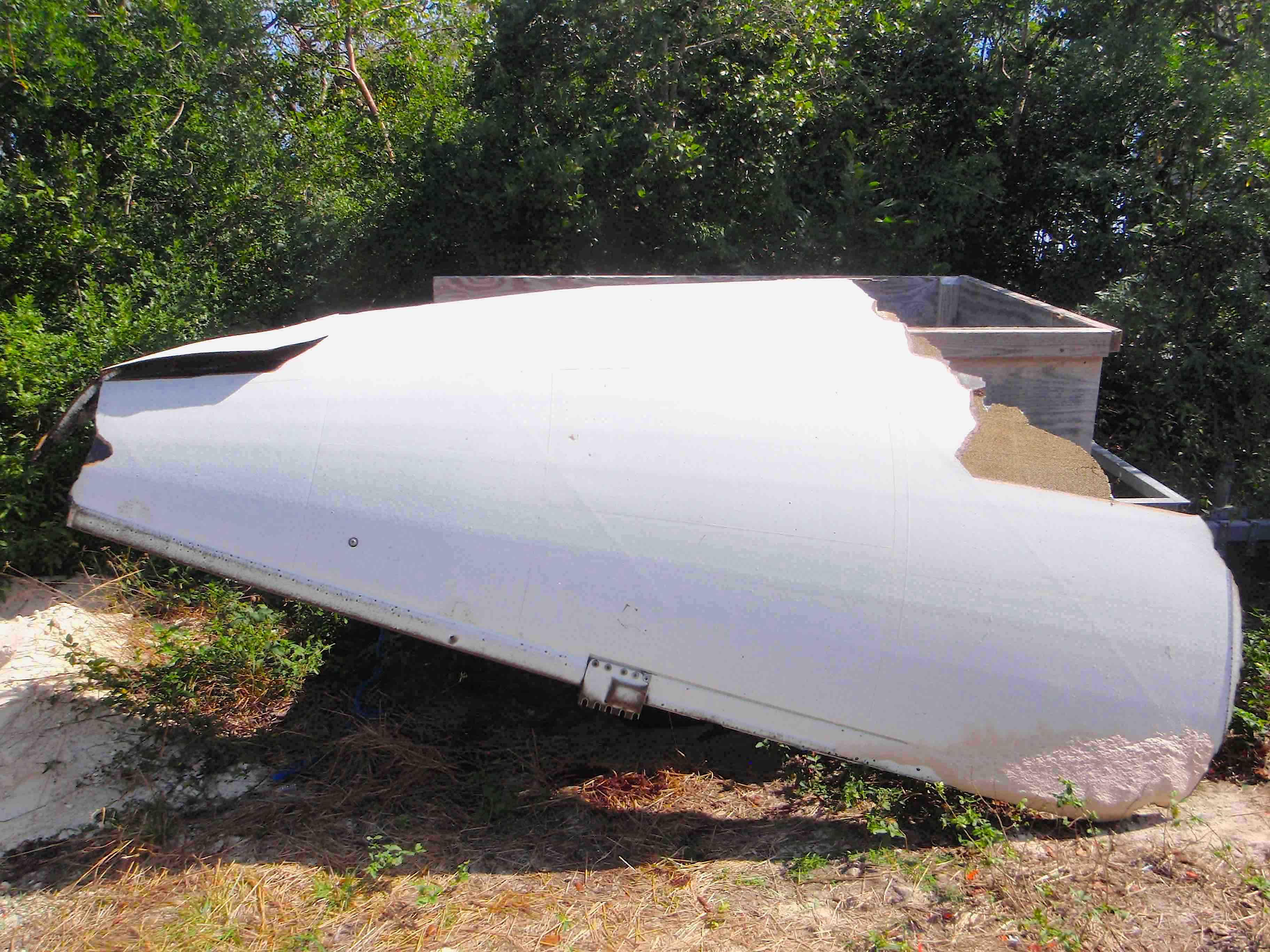
The second big news event for South Abaco was the discovery of a massive piece of (formerly) airborne debris drifting onto the BPS beach. Everyone was hoping the item wasn’t part of a plane fuselage, as it initially appeared to be. From the initial photos it looked to me like something from a rocket launch, maybe part of a booster rocket. It reminded me of the 12 foot part of a booster rocket fairing from the Atlas 5 rocket which launched Curiosity on its Mars mission, that washed up on the Delphi beach in early 2012. The men in black eventually came to reclaim it… More on that HERE

THIS REALLY IS ROCKET SCIENCE THEN?

Quite soon the mystery of the object’s purpose and origin began to get clearer. Luc Lavallee was quick to recognise the red external markings as matching Elon Musk’s logo, as used by his SpaceX venture. Events moved quickly. Contact with Musk’s operation confirmed that this was indeed “one of theirs”, a part from the latest launch a few days before.

AFTER a large chunk of strange space debris of (initially) unknown originFalcon 9 rocket shroud - Space Debris - Elon Musk - SpaceX - Abaco Bahamas

BEFORE Elon Musk’s complete Falcon 9 Rocket – note the red identFalcon 9 rocket - Space Debris - Elon Musk - SpaceX - Abaco Bahamas

SO WHAT ON EARTH* WAS THIS CHUNK OF SPACE DEBRIS?

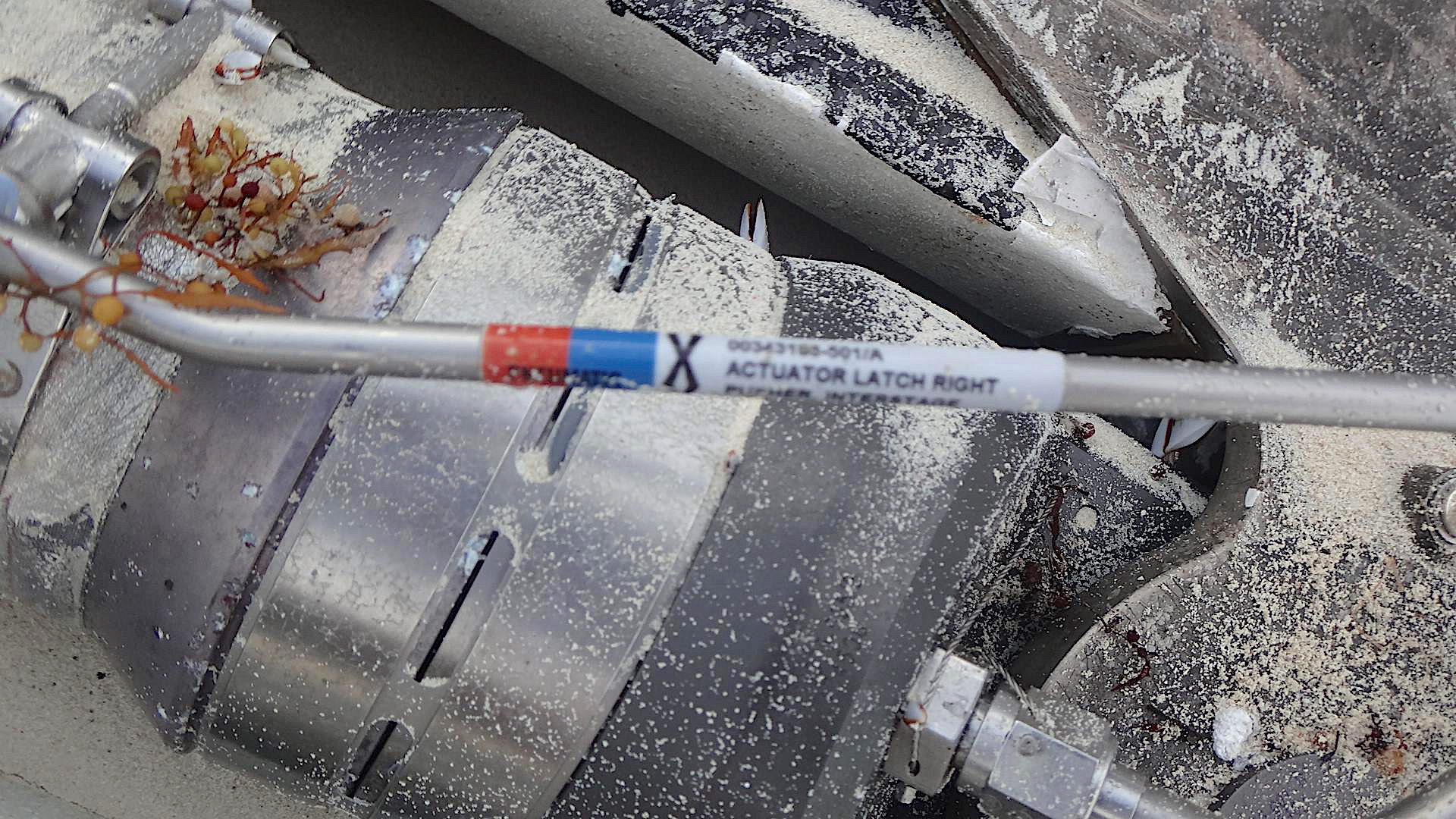
In the end the item was identified as part of the shroud from a Falcon 9 rocket. There was plenty of opportunity to take a good look at some of the workings. There’s potential here for some quality beach-combing (who would not want an ‘Actuator Latch Right’ rod in their living room?). There are interesting legal considerations in this type of situation… [Worried reader: please, no, I beg you]. Moving on, here’s a selection of rocket bits for contemplation.

Falcon 9 rocket shroud - Space Debris - Elon Musk - SpaceX - Abaco Bahamas  Falcon 9 rocket shroud - Space Debris - Elon Musk - SpaceX - Abaco BahamasFalcon 9 rocket shroud - Space Debris - Elon Musk - SpaceX - Abaco Bahamas  Falcon 9 rocket shroud - Space Debris - Elon Musk - SpaceX - Abaco Bahamas

More info was gathered, including the discovery of an astounding video from a camera fastened to a Falcon 9 rocket’s payload fairing, showing the nose cone spinning through space after its separation on a satellite launch earlier this year.

WHAT DOES A ROCKET SHROUD DO?

The nose shroud shields satellites during final preflight preparations and the early stages of launch. Once the rocket reaches space — an altitude above 100 kms / 62 miles — it jettisons the payload fairing to fall back into the ocean. The Falcon 9’s fairing is released in two halves, like a clamshell.

* This is the sort of occasion when people write ‘no pun intended’, though in fact they generally intend one, just rather a feeble one. Like mine, in fact. 

CREDITS: Jack Bowers and others from the BPS community for photos, info and investigative acumen; SpaceX + Spaceflight Now (unclassified) online material + videos generously posted on YT; USA Today 

Falcon 9 rocket shroud - Space Debris - Elon Musk - SpaceX - Abaco Bahamas

Unknown's avatar

PURPLE VASE SPONGES: BAHAMAS REEF ORNAMENTS


Purple Vase Sponge, Bahamas (Melinda Riger / G B Scuba)

PURPLE VASE SPONGES: BAHAMAS REEF ORNAMENTS

The Purple Vase is an unmistakeable sponge, a colourful reef creature (for they are animals, of course) that stands even out amongst the bright corals that surround it. And like corals, sponges are vulnerable to all the usual threats (mainly human-generated).

Purple Vase Sponge, Bahamas (Melinda Riger / G B Scuba)

Catch them while you can in the clear waters of the Bahamas while stocks last. I say this because as study after study concludes, the prospects of reef-mageddon get closer each year. When the corals die off, so in all probability will the sponges and anemones…

Purple Vase Sponge, Bahamas (Melinda Riger / G B Scuba)

After such a depressing intro, let’s move on to take a positive look at the purple vase sponge. As with all sponges, once a newborn sponge is wafted by the current to a place on the reef, it takes root there throughout its life. There, these attractive sponges exist by filtering the water that surrounds them, separating out plankton to feed on. Static filter-feeders, if you will.

Purple Vase Sponge, Bahamas (Melinda Riger / G B Scuba)

You’ll notice that in some of the photographs, the sponges have guests. These are BRITTLE STARS, and they are often found on – and indeed in – purple vases. This is a form of symbiotic relationship known as commensalism, in which one species benefits and the other is neither benefitted nor harmed. The brittle star gains a shelter and a safe base for feeding; the vase gets a harmless companion. Small fishes benefit from the vases in a similar way.

Purple Vase Sponge, Bahamas (Melinda Riger / G B Scuba)

Besides the impact of damaging human interventions (which may be permanent), extreme weather events also affect reef life and the static inhabitants adversely. Storms and hurricanes can cause localised havoc, but the damage is not necessarily permanent. The reef can in time repopulate naturally and flourish again. Humans can even promote this recovery. The photograph above shows a purple vase sponge that was detached from the reef by Hurricane Matthew in October 2016. Melinda Riger in effect replanted it on the reef and it reattached itself and grew. In due course it even acquired its brittle star occupant. 

Purple Vase Sponge, Bahamas (Melinda Riger / G B Scuba)

*JIMI AND ‘PURPLE VASE’ – A VOLUNTARY MUSICAL DIGRESSION

In an interview with NME Hendrix is reported to have said that Purple Haze “was about a dream I had that I was walking under the sea.” Originally the song was intended to be ‘Purple Vase’, and reflect the psychedelic experience of life on a coral reef. Realising he was getting bogged down by sub-aquatic imagery (he was a non-swimmer), he toked for a while and then ‘Purple Haze’ emerged almost fully formed. He was always far happier kissing the sky than wandering about under the waves. Most covers of the song are pale imitations of the original, but here’s a rather unusual take that succeeds by trying a different approach…

Credits: Melinda Riger / Grand Bahama Scuba for all great photos; magpie pickings for bits and pieces, with a shout-out to ‘Critter Squad’ for its informative site aimed at kids. And amateur grown-ups can benefit too… commensalism in humans; Friend ‘n’ Fellow audio

Purple Vase Sponge, Bahamas (Melinda Riger / G B Scuba)

Unknown's avatar

FOLLOWING DOLPHINS IN THE BAHAMAS…


Following Dolphins (SailorDolphin / BMMRO)

FOLLOWING DOLPHINS IN THE BAHAMAS…

The Bahamas Marine Mammal Research Organisation (BMMRO) is based at Sandy Point, Abaco. The principals Diane Claridge and Charlotte Dunn with their team cover not only Abaco waters but the whole of the Bahamas. Their research work is complex, and some of it is carried out in conjunction with partners on specific projects or more generally.

Following Dolphins (SailorDolphin / BMMRO)

Which brings me to SailorDolphin Research, a project that involves the meticulous mapping, photographing, and recording of the details of each sighting. Much of the work is carried out in the Bahamas in partnership with BMMRO. The link will take you to the homepage, which notes “This website provides a list of Dolphins that I have documented on the US East coast and the Bahamas. It includes details (with photos & notes) for each dolphin and lists of their sightings from my personal database.” If you have an interest in dolphins (and who does not?), it will repay exploration – and you will see some awesome photographs. Here are a few of them to admire. 

Following Dolphins (SailorDolphin / BMMRO)

Now imagine yourself in the water, with these wonderful creatures cutting through the water in front of you, working their sleek bodies just below the surface, jostling and cavorting, occasionally letting a fin cut through the water. Hold that thought… Right, get back to work!

All photos courtesy of SailorDolphin / BMMRO

Following Dolphins (SailorDolphin / BMMRO)

Unknown's avatar

LETTUCE SEA SLUGS: SOLAR POWERED ‘CRISPY BLISSFUL HEAVEN’


Lettuce Sea Slug, Bahamas (Melinda Riger / G B Scuba)

LETTUCE SEA SLUGS: SOLAR POWERED ‘CRISPY BLISSFUL HEAVEN’

The Lettuce Sea Slug Elysia crispata (transl. ‘Crispy Blissful Heaven’) was No.3 in the ‘WTF’ ‘What’s That Fish’ series (despite not actually being a fish at all). It is not by any means the weirdest creature featured so far but it is nonetheless an animal whose appearance excites curiosity. Unless you see one moving, it could easily be mistaken for a plant. Maybe even lettuce. It is in fact a SACOGLOSSAN.

Lettuce Sea Slug, Bahamas (Melinda Riger / G B Scuba)

The name ‘sacoglossan’ literally means ‘sap-sucker’. This group (or ‘clade’) comprises small gastropod mollusks that ingest the cellular content of algae (which isn’t really sap).

WHY WOULD THEY DO THAT?

Because they are… SOLAR POWERED slugs

Lettuce Sea Slug, Bahamas (Melinda Riger / G B Scuba)

WHAAAAA…..?

As I mentioned when I last visited these remarkable creatures, this isn’t a technical forum and too much science hurts my head. This species primarily lives off algae. May I give you the word KLEPTOPLASTY to drop lightly into your conversation? In a couple of sentences, algae / algal content is eaten but only partially digested. Certain elements are stored to produce photosynthesis by which light is converted to energy (cf plants) and the slug can in effect live and move around without food. You could entertain your neighbour at dinner (or maybe on public transport, why not?) by summarising the process as “chloroplast symbiosis”. Meanwhile, I’m fetching a beer. Two beers.

Lettuce Sea Slug, Bahamas (Melinda Riger / G B Scuba)

HOW DO THEY REPRODUCE?

This topic doesn’t seem to have excited much investigative interest, and there’s not much specific information about it. What there is sounds unnecessarily complicated, so I am just going to say authoritatively ‘they do it like many other slug species’ and hope that covers it. The pair shown below may be exploring the possibilities, or at least trying to work out which end is which. One is easy to tell, but the other? Time to make our excuses and leave…

Elysia_crispata_(Lettuce_Sea_Slug_pair) Nick Hobgood

HOW FAST, EXACTLY, DOES A LETTUCE SEA SLUG MOVE?

This rather beautiful video from ‘CORAL MORPHOLOGIC STUDIO’ will reveal all. You’ll soon see that progress is very slow. I recommend watching the first 30 seconds and you’ll get the idea. If you choose to persist, you will see the slug sort of turn and move off to the left.

DO SAY:        What an intriguing creature. It’s a true wonder of marine nature.

DON’T SAY:  Any good in a mixed salad?

Lettuce Sea Slug, Bahamas (Melinda Riger / G B Scuba)

Credits: Melinda @ Grand Bahama Scuba, Nick Hobgood, Coral Morphologic Studio, Laszlo Ilyes wiki

Lettuce Sea Slug (Laszlo Ilyes)