Unknown's avatar

A MAP OF HURRICANES WORLDWIDE SINCE 1851: THE PLANET’S HOT-SPOTS


HURRICANE PATHS ON PLANET EARTH

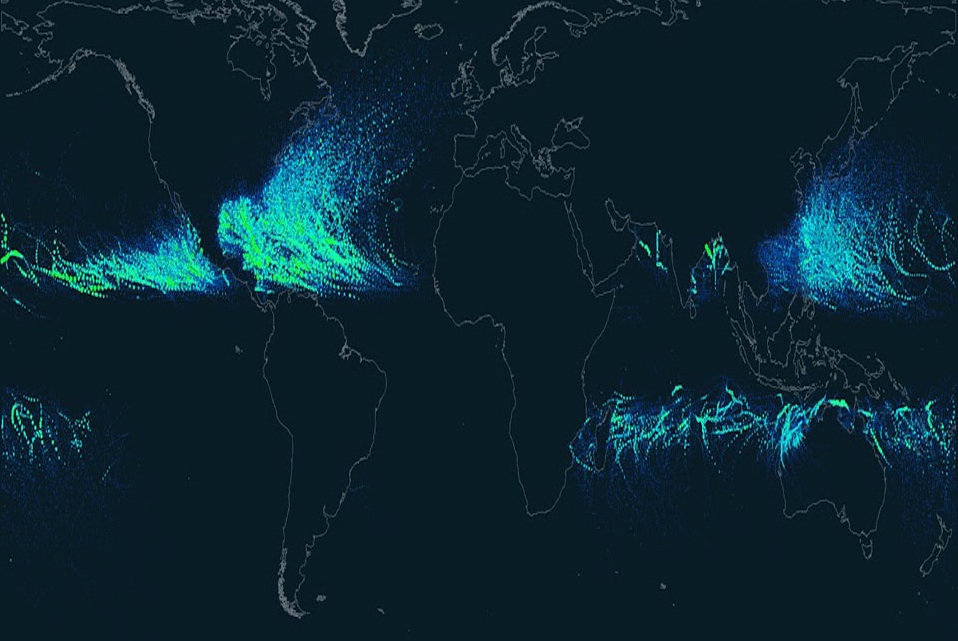
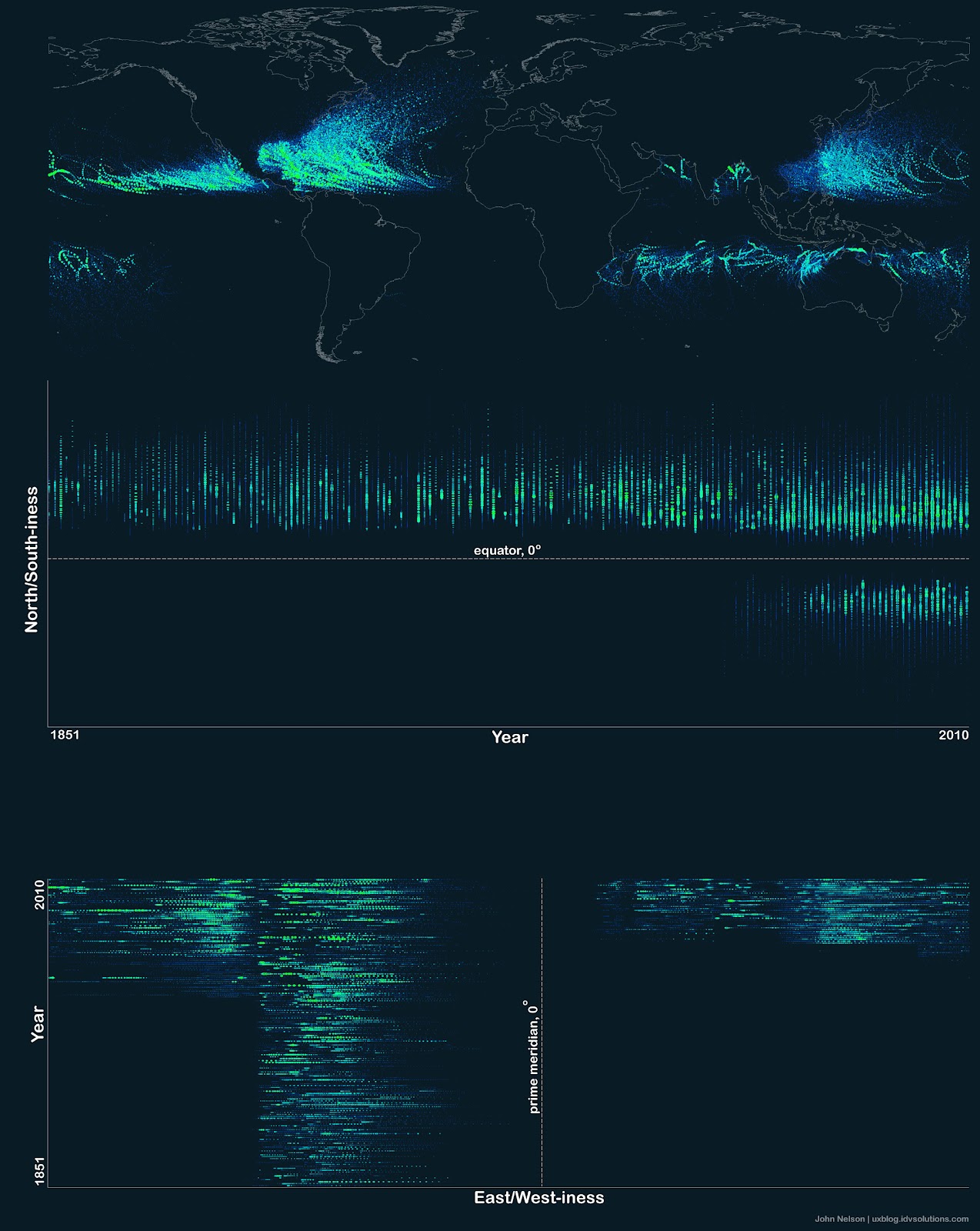
Hurricanes. Extreme weather events that can strike anywhere in the world’s vulnerable zones. But where are these to be found? And in those zones, is there any historical evidence demonstrating that particular areas of the world are more vulnerable than others? A recent post on the very informative ABACO SCIENTIST website includes a comprehensive map of all hurricanes recorded since 1851. This map gives a clear picture of the hot-spots and danger areas. 

Delphi Club Abaco 25 Aug 2011 / Hurricane Irene: Looking south from the balcony

The source is NASA and the article may be found HERE. I reproduce the map and explanation, with acknowledgement to John Nelson and IDV Solutions. Each blue link in the explanation below will take you to a new source of hurricane information, so the article is a valuable resource as a gateway to further hurricane knowledge.

EXPLANATION AND WORLD MAP

“Should you be worried about hurricanes? To find out, it is useful to know where hurricanes have gone in the past. The Earth map shows the path of every hurricane reported since 1851, Although striking, a growing incompleteness exists in the data the further one looks back in time. The Earth map graphically indicates that hurricanes — sometimes called cyclones or typhoons depending on where they form — usually occur over water, which makes sense since evaporating warm water gives them energy. The map also shows that hurricanes never cross — or even occur very near — the Earth’s equator, since the Coriolis effect goes to zero there, and hurricanes need the Coriolis force to circulate. The Coriolis force also causes hurricane paths to arc away from the equator. Although incompleteness fogs long term trends and the prevalence of hurricanes remains a topic of research, evidence is accumulating that hurricanes are, on the average, more common and more powerful in the North Atlantic Ocean over the past 20 years.”

Image Credit & Copyright: John Nelson, IDV Solutions

The eye of Hurricane Irene passes directly over the Delphi Club, Abaco 26 August 2011

The image below was shared on Facebook, but I don’t have the inventor’s name. I’m sorry not to be able to identify the originator of this ingenious hurricane warning. Every home should have one… 

Unknown's avatar

ABACO & HOLE-IN-THE-WALL, BAHAMAS: A SHORT HISTORY IN MAPS


Bahamas van Keulen Map clip copy 2

ABACO & HOLE-IN-THE-WALL, BAHAMAS: A SHORT HISTORY IN MAPS

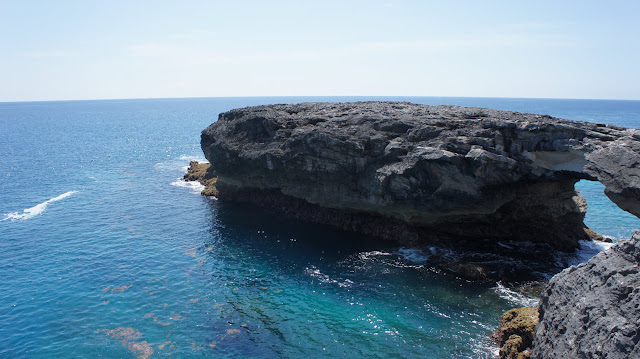
To begin with, here is a fabulous recent photograph of the actual Hole-in-the-Wall taken by well-known Abaco nature tour guide Ricky Johnson. This picture inspired me to delve into the history of Abaco and its the southernmost extremity, to see how far back it can be traced; and how the island’s recorded history has evolved since the Columbian era.

STOP PRESS March 2017  Thanks to the many people currently viewing this post & sharing it around. It was written, of course, before Hurricane Sandy converted the Hole into a Gap. There are links at the bottom of the page to some posts relating to the new ‘Gap-in-the-Wall’. In 2015 I went on the BMMRO research RHIB close to the hole / gap. If you are interested in the story and close- up photos, you’ll find them at HITW UNIQUE PERSPECTIVES ONE (past) and TWO (present & future).
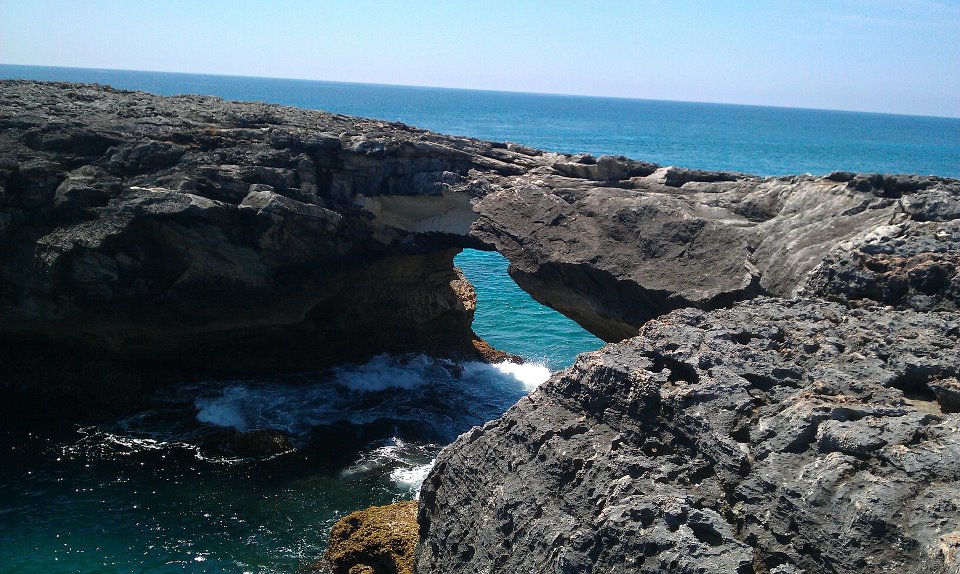
(Photo Credit: Ricky Johnson)

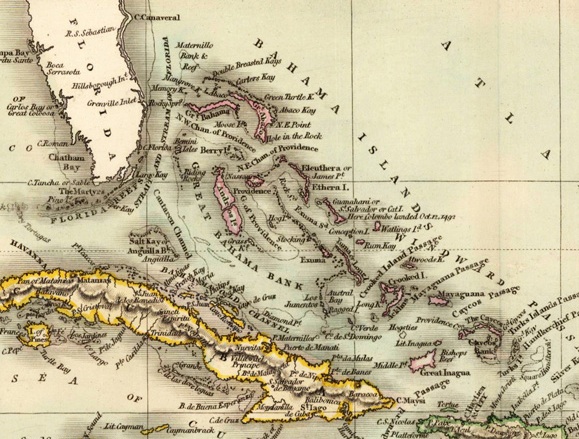
I started by trying to establish the earliest map, and the earliest mention of Hole-in-the-Wall. I don’t have access to written archival material, so I looked instead at historic maps of the Caribbean / Bahamas / Lucayas. The very earliest, from the late c16, simply depict the Bahama Islands / Lucayas as rather random-looking blobs which bear little relation to their actual geographical location or their shape. The islands mostly have quite different names, or variants of familiar spellings. Over the course of 5 centuries, one can trace the progress of place names to those used today – including of Abaco itself. The gradual development of settlements can also been seen – at Little Harbour, Crossing Rocks and ‘Cheeric Sound’, for example, as well as on the ‘Keys’.

The trail starts in the c16. The earliest map I have so far found is the Abraham Ortelius map of 1592, which is a good example of the rather basic map-making of the time. It is quite hard – near impossible – to relate the position of ‘Haraco’ to the other islands depicted.
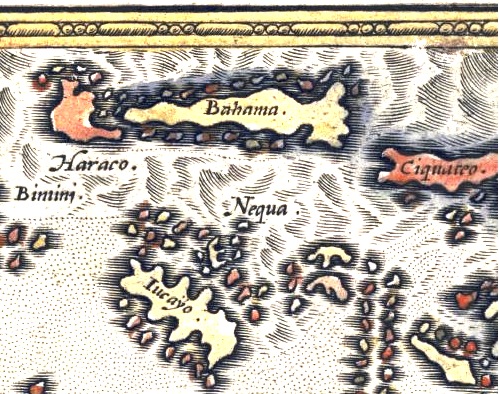
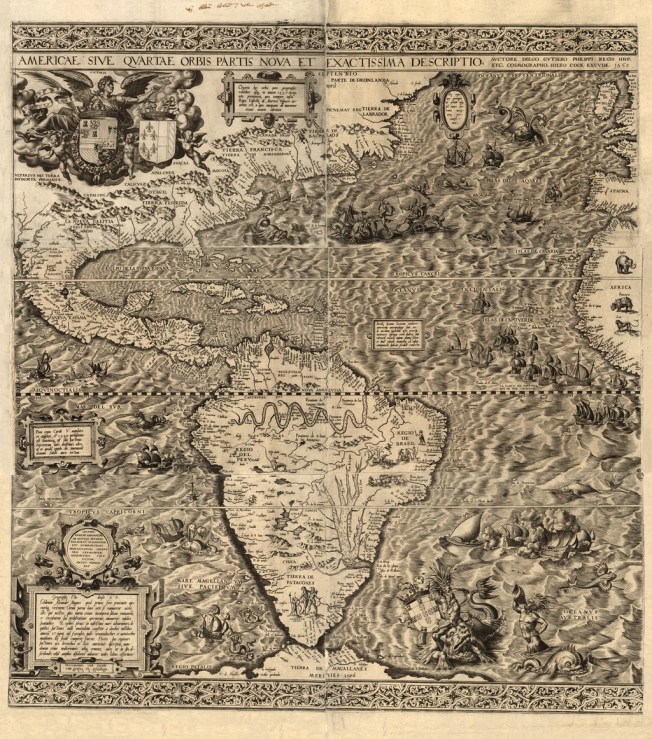
ADDENDUM I have now uncovered an even earlier and far more ambitious map published in 1550 by the Spanish cartographer Diego Gutiérrez. His incredibly intricate map, for the period, is decorated with volcanos, mermaids, monkeys, and variety of fantastical sea creatures. The first image is a detail of the whole map, showing the Bahamas, a sea monster, and a graphic shipwreck. I have also included an image of the whole map so that the extraordinary range and complexity of this early map can be seen in its entirety.
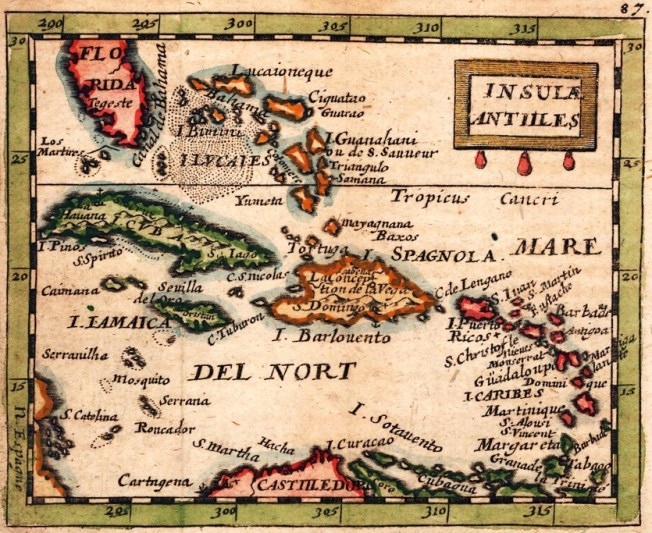
This colourful and charming 1679 map shows that a very basic style of mapping was still common in the c17
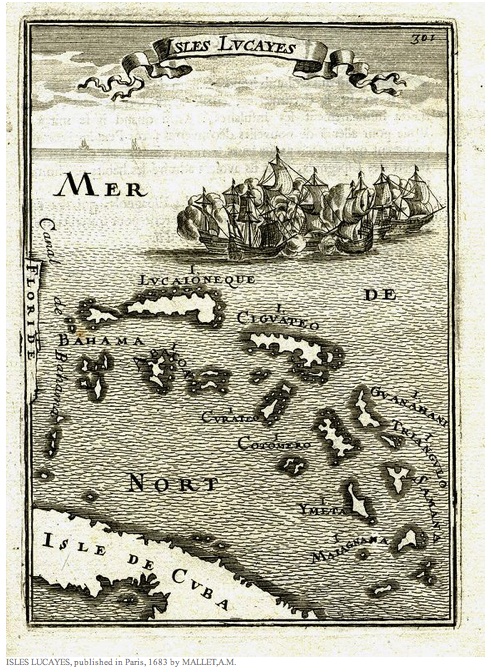
This famous map by A.M.Mallet from 1683, with its enjoyable sea battle vignette, is another good example of the very general nature of the maps, although the design and draftsmanship has advanced considerably

Things become much clearer and more detailed in the c18. The relationship of the islands to each other is shown in geographic reality; and many more details and place names are included. The earliest specific reference to Hole-in-the-Wall (as it now is) that I have so far found is in a 1738 map by Johannes Couvens & Cornelius Mortier. ‘Abaco’ is now spelled as we know it, with ‘Hole in the Rock’ clearly marked. Little Harbour is mentioned, as are 2 ‘Keys’, presumably indicating settlements. 

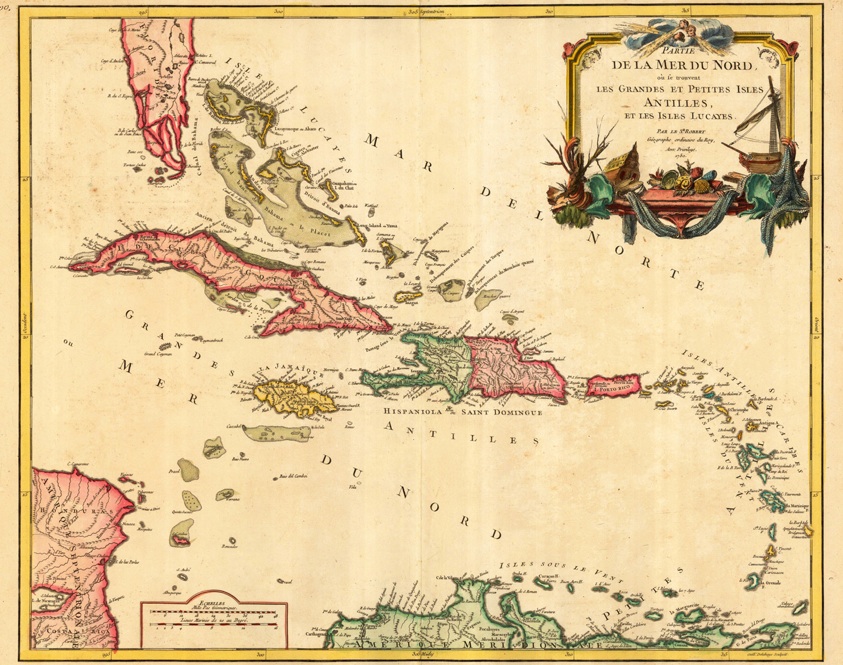
A 1750 map by Robert of Paris shows the southern tip of Abaco as ‘Trou dans le Roc’. You’ll have to trust me on this – the writing is tiny and impossible to enlarge legibly. The French name is not just because the map maker was French, but probably because it was the name given by French settlers who are believed to have lived in that part of Abaco in the c18 (and quite possibly earlier). Many more settlements are shown, especially on the Cays.

The Cartographer Jacques-Nicolas Bellin, in a 1764 map, also used the french name, though in the plural ‘Trou dans les Roches’, as this much enlarged portion of his ‘Cartes des Isles Lucayes’ shows. Little Harbour – ‘Petit Havre’ – is again included as a distinct settlement, and a few Cays are also named.

John Blair’s map of 1779, below, shows clearly ‘the Hole in the Rock’ – indeed, it is the only named place on Great Abaco. The southern end of Florida looks worryingly fragmented…

For the new century, a map by George Cook dated 1800 shows the first appearance of Little Abaco as a separate entity. Again, Hole in the Rock is the only place on Great Abaco that is marked. Maybe this evidences a continuing significance as a navigation aid.

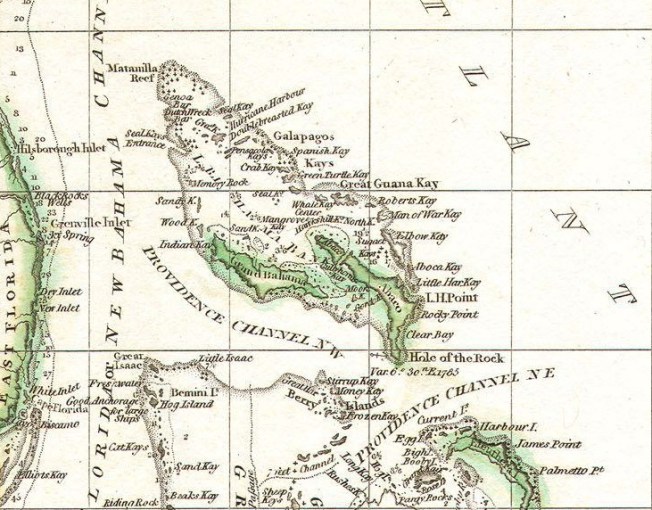
The good clear map by Thompson dated 1815 provides plenty of excellent detail hitherto lacking in maps of the northern Bahamas. Another name for Hole-in-the-Wall has crept in, shown as ‘Hole of the Rock’. There are some oddities here. A ‘Rocky Point’, usually associated with the south west coast below Sandy Point, is marked on the east coast. Little Harbour is shortened to L.H., indicating perhaps that it had become a familiar enough settlement to warrant abbreviation – unless it stands for Light House, referring to the long-defunct lighthouse there… The word ‘Kay’ is used, a half-way house between the earlier ‘Key’ and the later ‘Cay’. The positions of the Kays seems (now) amusingly off-cay – indeed the relative scales to the main island are quite strange. Green Turtle Cay is some way nor’-nor’-west of Little Abaco…
Harrison’s much simpler map in 1818 also uses ‘Hole of the Rock’, which is the only place shown.                              
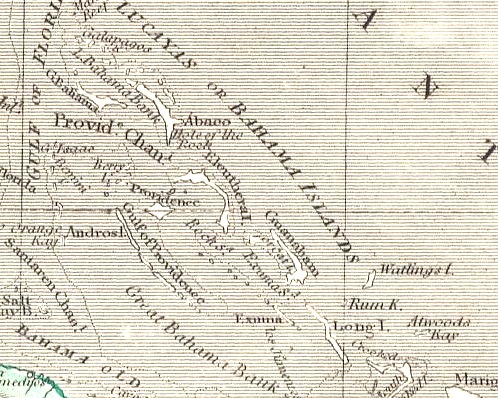
As the  c19 progressed, far more sophisticated and detailed map-making – including nautical charts – was undertaken. This extract from a much larger chart by Edmund Blunt from 1827 is the first mapped reference I can find of the name change from ‘Rock’ to ‘Wall’. It is also the earliest I have found Crossing Rocks mentioned on a map, though apparently as a shipping warning rather than an indication of a viable settlement. Walt Disney has yet to visit ‘Key Gorda’.

A new name for the southern extremity entered the scene in 1833 on Thomas Starling’s map of the West Indies. The tip is simply called ‘Light Ho. Pt’, with no reference to Holes, Rocks or Walls – an interesting variation (see below). I have found no other instances of this name.
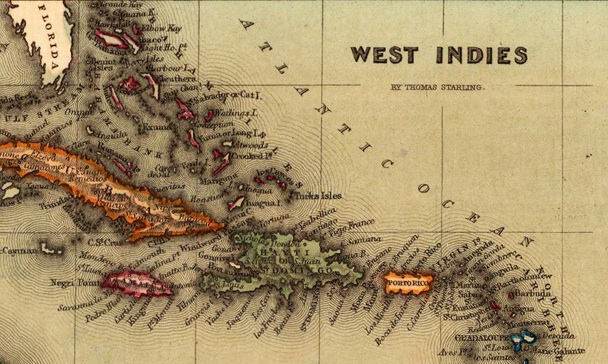
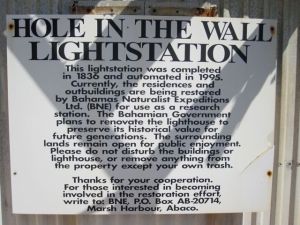
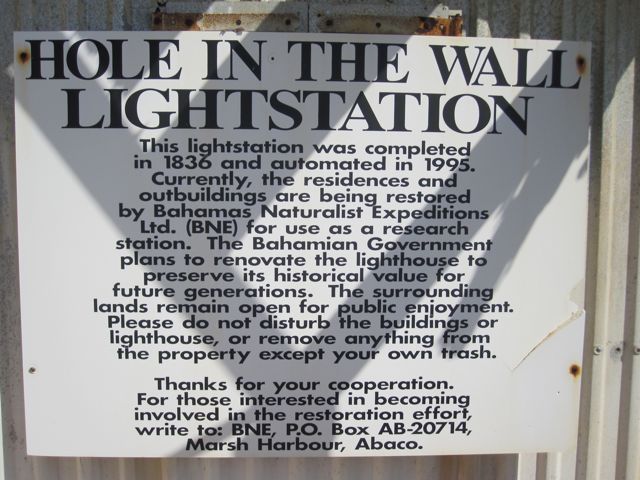
The interest lies in the fact that the evidence suggests that the Lighthouse at Hole-in-the-Wall was not actually completed until 1836, yet Starling was specifically referencing it 3 years earlier. One could deduce that there was already a basic lighthouse of some description there, soon to be superseded; or perhaps that construction of the Lightstation had already commenced in 1833, and Starling was confident of its eventual completion and wanted to be ahead of the competition… On the left is the notice at the lighthouse station today.

——————————————

For a time, maps continued to use ‘Rock’ rather than ‘Wall’ – the 1843 Findlay map has reverted to ‘Hole in the Rock’. Great and Little Abaco are again separately named.

In 1857, a very detailed nautical chart of the area was published. The survey seems to have been carried out by the British Navy for the French, and now detailed depth measurements enter the picture. It seems that new techniques have recently been discovered. I have used only one of the 3 areas mapped, a detail of the southern tip of Abaco. Here, in french, we are back to ‘Wall’ rather than ‘Rock’. For the first time, the lighthouse and associated lightstation buildings have been included, but I haven’t been able to decipher the words in brackets under ‘Phare’.

Mitchell, in a far more basic (pretty border though) 1872 map,reverts to ‘Hole in the Rock’
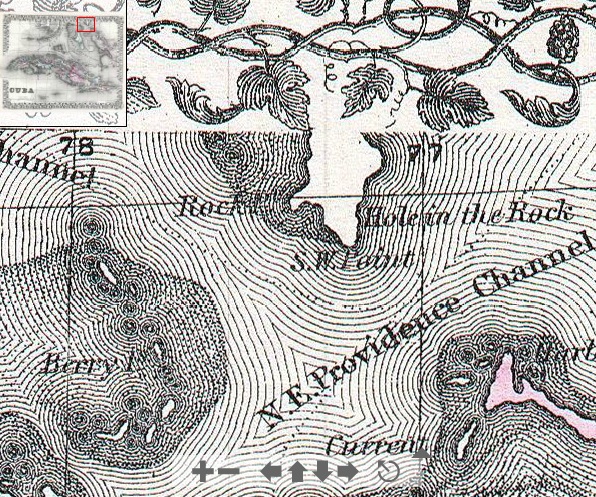
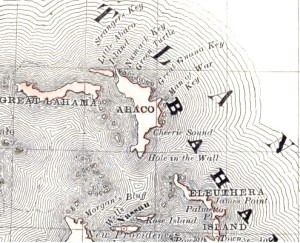
Two near-identical maps were published in the late c19: the first, by Hardesty, New York, in 1884; the second, by Rand McNally, in 1890. Extracts are shown below, side-by-side. This time, both clearly show ‘Hole in the Wall’. Cay is still spelled ‘Key’. And for the first time I have seen, Cherokee gets a mention as ‘Cheeric’ or ‘Cheerie’ Sound.
      

In the final year of the c19, George Cram of Chicago pubished the most ambitious map of the region so far. By 1899 shipping routes were so well-established that they could be added to maps, increasing their usefulness and therefore sales. He’s back to ‘Hole in the Rock’, though. The names of the Cays are more familiar here, and Pelican Harbor is now included. Cherokee is still in its early form.

The c20 saw the use of the name ‘Hole in the Wall’ becoming predominant, as shown on this Waterlow’s map from 1919. The map also uses the modern-day ‘Cherokee Sound’; and surprisingly this is the first map I came across that names Marsh Harbour (and also Wilson City). The map also marks all Bahamas lighthouses (oddly, although ‘Hole in the Wall’ is marked on a similar map from that period by Harrison & Sons, the red dot for the lighthouse is missing there – presumably in error, since the lighthouse was well-established and functioning at that time). I am left wondering when the hyphens became included in ‘Hole-in-the-Wall’. They are not universal, I have noticed, but seem to be the preferred usage nowadays, making the place a lot more niggly to type!

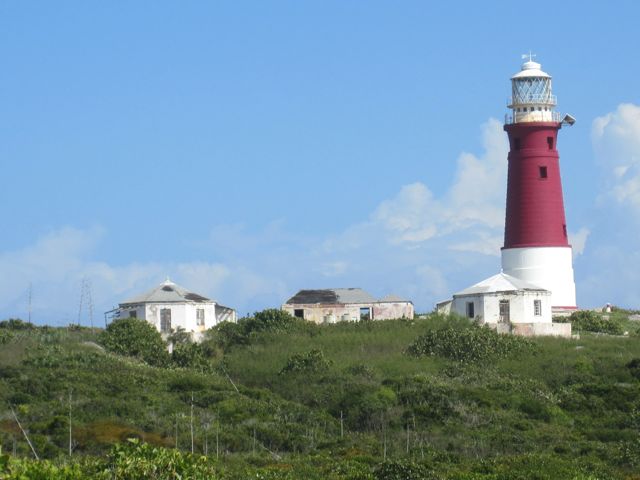
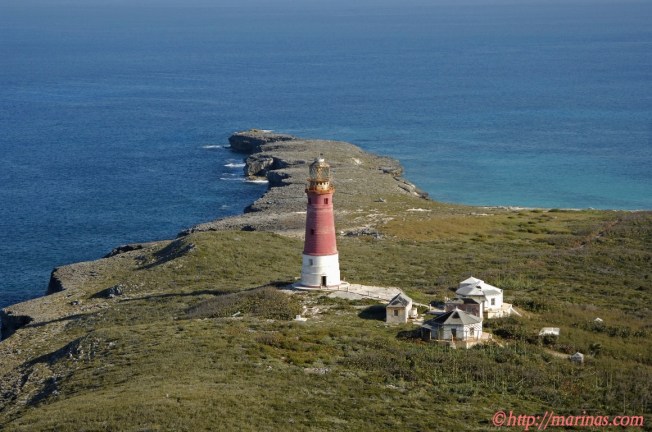
To end with, a photo of the lighthouse (now automatic) and some of the abandoned buildings. For an account of an intrepid trip to this part of South Abaco CLICK ===>>> ‘TO THE LIGHTHOUSE…

  • This post is by no means exhaustive, and any suggestions, additions or corrections are welcome by way of the COMMENT box or by email to rollingharbour.delphi@gmail.com
  • Apologies for the very small writing on many of the maps, but in most cases it was not possible to enlarge the image further without also making the written details illegible. 
  • The photos, apart from Ricky’s, are mine. Acknowledgement is given to the variety of sources used for the map extracts, which come mainly from catalogues / sales advertising or open online archives. Any problems? Let me know!

POST SCRIPT: I am very grateful to Marinas.com for permission to download this wonderful aerial image of Hole-in-the-Wall lighthouse and its outbuildings, looking towards the southern tip of Abaco. They have generously enabled a completely cost and watermark-free download. I have added the © detail. Thanks, guys. 
AFTERTHOUGHT I have received a query as to exactly where the eponymous Hole in the Wall, or Rock, can be found in relation to the lighthouse. At the foot of the page is an annotated map which I should no doubt have provided in the first place. The consensus of those who have walked to it (I haven’t yet) is that you’d be well advised to wear walking shoes / boots. Mary Wallace Chamie in a recent POST (check out the link for her VG photos, of which I have included 2 small tasters) says this:

“At first the hike was easy as we followed a cement path through a maze of sea grapes and then hiked further down until we reached the beach.  We took a left at the beach and started hiking across limestone that was full of potholes and sharp edges.  We walked carefully through the maze until we reached a point where we could finally see the Hole in the Wall.


We then headed back across the limestone craters and up the hill to the lighthouse.  One suggestion I have to any beach comber who takes this hike.  Wear your walking shoes! ” 

To which I can now add this ‘distance shot’ from the sea, which makes it all completely clear. I have contacted the photographer via Panoramia but had no reply. Credit as annotated. If you are the photographer, Hi!. And if you object to its inclusion, please let me know and I’ll remove it…

LINKS TO OTHER HOLE-IN-THE-WALL POSTS

ABACO HISTORY: SHIPS, MAPS & HOLE-IN-THE-WALL

HOLE-IN-THE-WALL ABACO: HISTORIC 1803 DESCRIPTION & AQUATINT

HOLE-IN-THE-WALL TO GAP-IN-THE-WALL: HURRICANE SANDY SMASHES ABACO LANDMARK 

HOLE-IN-THE-WALL BEFORE SANDY DEMOLITION: FIRST & LAST EVER IMAGES

HOLE-IN-THE-WALL, ABACO: THE ‘HOLE’ THAT’S NO LONGER A WHOLE

HOLE-IN-THE WALL ABACO: “MIND THE GAP” – A NEW ISLET IS BORN
Unknown's avatar

A NEW LOOK, AN EARLY SPRING CLEAN, & SOME TEETHING PROBLEMS


I’ve taken the plunge with a new look for the blog. Name change from Lower to Upper Case (no idea why I chose the former – I didn’t really understand  how the thing worked, and thought it had to match the online ID, email etc). Less cluttered. More stylish. Larger images. That’s the idea, anyway. Typically, however, it’s not as straightforward as I optimistically thought it might be. There are some problems to iron out, and I see that in places the original formatting has gone walkabout, or has had “artistic differences” with its successor… and what’s this going on here? Whoa! Most images will need to be resized individually… I think we’ll all get along in the end, with a bit of tolerance and patience on all sides. Thanks for bearing with it.

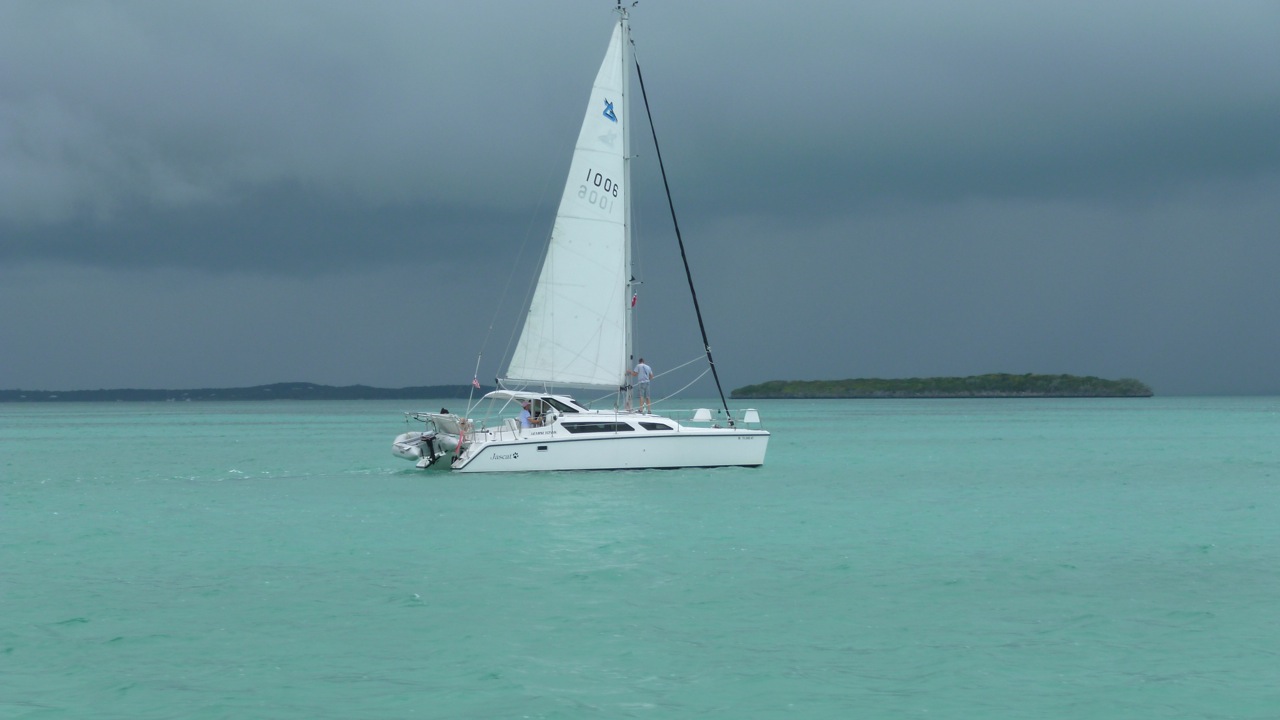
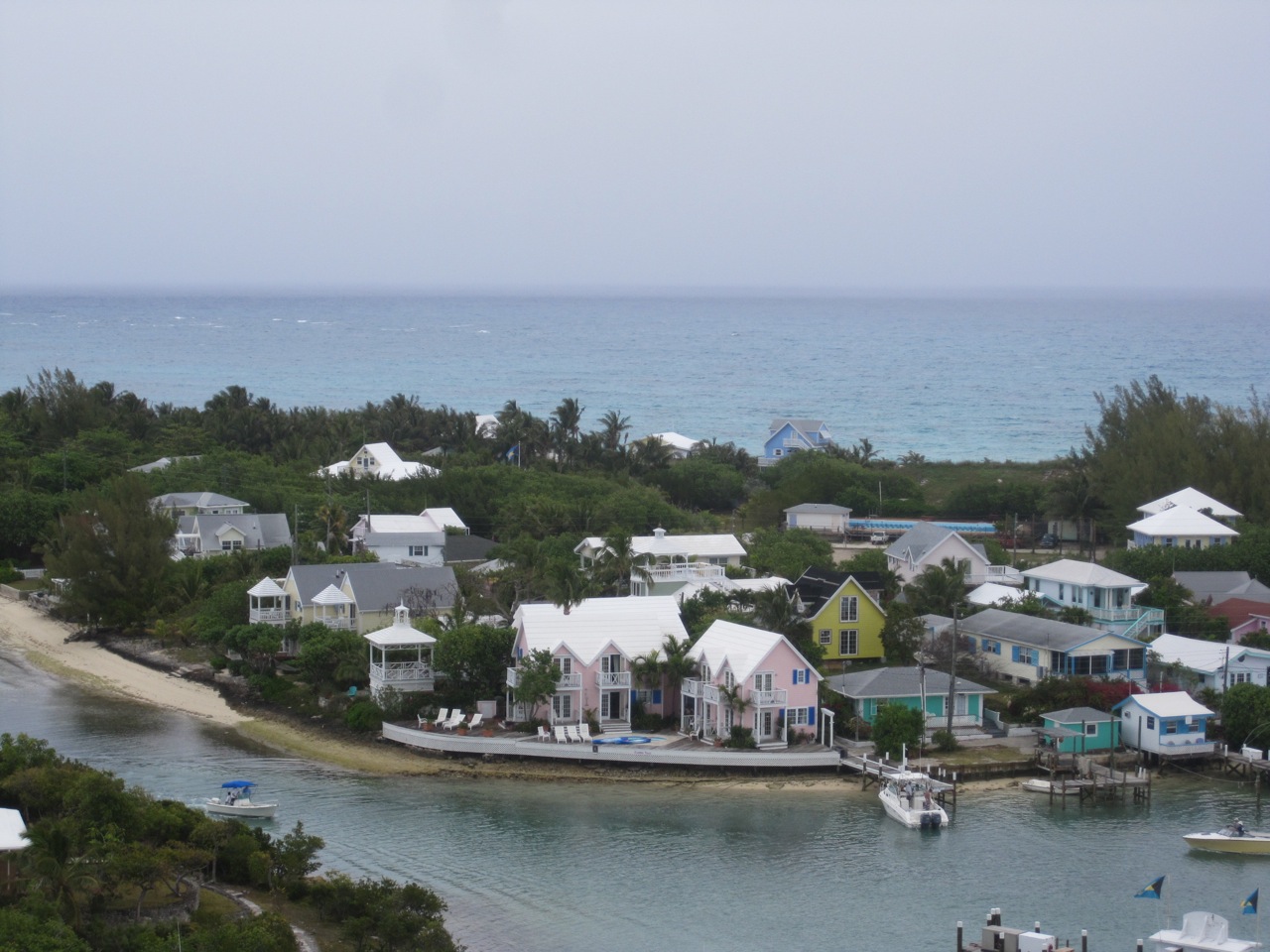
Here’s an image that doesn’t really fit anywhere else, so I’ll use this space for it. Taken just off Elbow Cay on a wet (very) day, but somehow there’s a touch of magic in the colours (nb no rejigging has been done) 

Unknown's avatar

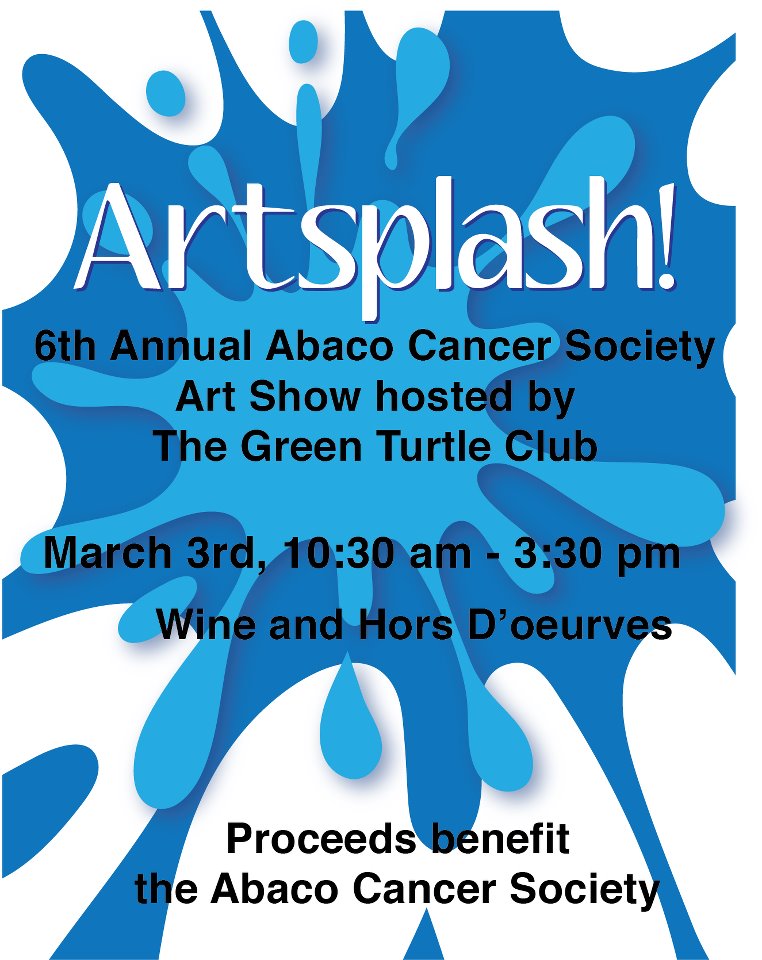
ARTSPLASH! 6th ACS ART SHOW – GREEN TURTLE CAY MARCH 3rd


A quick ‘heads up’ for the forthcoming Abaco charity event at the Green Turtle Club, GTC in aid of the Abaco Cancer Society. Party for 5 hours in congenial company amidst the artworks, and all in an excellent cause

Unknown's avatar

NEWS & WEATHER REPORT FROM LONDON TO ABACO


We were due to come out to Abaco next weekend, Feb 11, until I stupidly fell and broke a wrist, cracked ribs etc. Sadly we’ve had to cancel. For now I can’t fish, can’t swim / reef snorkel, can’t take photos. I’m a bit… moody about it.

Quite right. You’re not even faintly interested in ‘poor me’ business. However, imminent plans for these pages have had to be postponed to May. Finding more and different birds, ditto flowers and trees; a beachcombing trip; a trip with Kay at Abaco Above & Below to reef snorkel at Fowl Cay (with improved camera technique this time);  a cays trip; a blue-hole expedition; and – oh goodness, is that the time? We need to pack and fly home, and I haven’t even been out for some bones yet… 

In the meantime, there will plenty of contributions, including from Kasia and other Delphi denizens. Anyone else is welcome to join in with Abaco-related material via the Comment boxes or via email at CONTACT

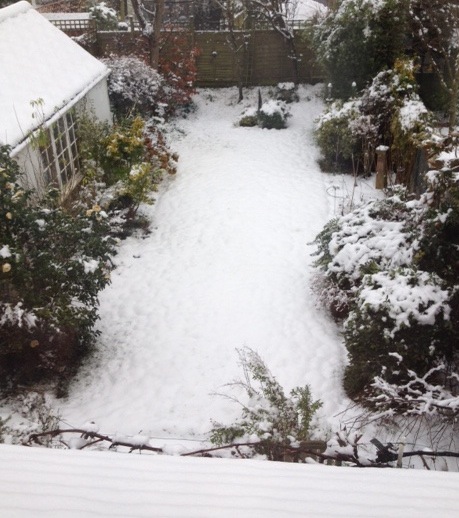
And the Weather? Well this was what happened overnight, on the edge of central London… not exactly extreme in the Abaconian sense of the word, I know, but enough to throw the nation’s entire transport system out of kilter for a week

Unknown's avatar

BEACHCOMBING ‘CURIOSITY’ ON ABACO: OUT OF THIS WORLD TO THE RED PLANET


Sandy's Mystery Object

More news about the the space rocket debris washed up on the Delphi Club beach, Abaco. The booster rocket fairing found by Sandy fortunately had a serial number on it. Various inquiries have been made and a definitive explanation of the item has now been given by the NTSB. It turns out that the fairing was not, after all, from the Ariane 5 launch in French Guyana. More exciting than that – it comes from a Mars Program launch to put the Space Rover Curiosity on Mars. There’s an excellent Wikipedia article on the mission to be found at WIKIMARS

NTSB - An Independent Federal AgencyBob Swaim at the NTSB has emailed Sandy to say   “The serial number of the fairing fragment is from a part that was on a Delta V [sic – it was in fact an Atlas V, see comments] rocket launch of November 26, 2011. In August, a new car-sized rover will touch down on Mars and you’ll have something from the mission!”  He has kindly provided a link to the launch – see image below and direct link HERE  He has also given a direct link to the NASA MARS PROGRAM site from which I have taken the screen clip below. You will see an image of the Mars Rover Curiosity, and the time countdown until touch-down at the exact moment I took the shot…

I contacted Bill Ailor, Principal Scientist/Engineer, Center for Orbital and Reentry Debris Studies, The Aerospace Corporation AERO CORP thinking a booster fairing might be of interest for their rocket debris database. He writes

Thanks for the notification (and for your excellent web page – looks like a wonderful spot). On the website, we catalog debris that has reentered from orbit and don’t include payload fairings, solid and first stage rocket boosters, and other “range” debris, since these are suborbital and the launch is designed so that the debris impacts is in known safe areas.  That debris can sometimes float outside of the safe area and wash ashore.I should mention that we recently reentered a small device that might one day float to your beach.  I’ve attached a description.  Let us know if you see that one

Although the device he mentions may have in fact have landed a long distance away (the South Pacific even), best keep an eye out for this…REBR Fact Sheet   By a strange coincidence in a huge world, the Aerospace Database shows that in 1965 reentry debris was recovered from a beach on Abaco:

In early 1965 an object having the appearance of a space fragment was reported washed ashore on Abaco Island in the Bahamas Possibly from the Atlas-Mariner I booster which was destroyed by the range safety officer shortly after launch on 22 July 1962, and landed in the designated ocean impact area

Apologies if I have got sidetracked from normal beachcombing duties – shells and stuff – but wildlife blogging doesn’t get more exciting than this – well, unless they find a colony of Abaco parrots on Mars…

Unknown's avatar

DISCOVER LIFE: AN EXCELLENT NATURAL WORLD ONLINE RESOURCE


DISCOVER LIFE: AN EXCELLENT NATURAL WORLD ONLINE RESOURCE

I have just come across the website DISCOVER LIFE which could be very helpful with identifying or finding information on particular species. It covers land and sea, animals, birds and plants worldwide, and it looks as though it is constantly updated and expanded. I haven’t done more than scratched the surface, but already I feel that it could be a very useful resource. See what you think…


Unknown's avatar

ROLLING HARBOUR ABACO – SEEN IN A GOOD LIGHT


Many thanks to Nassau-based  WEBLOG BAHAMAS for giving such a positive recommendation on its eclectic site. Much appreciated. The site, by a small collective of independent bloggers, covers a multitude of mainly Bahamas-related topics including books, current affairs, economy, eduction, environment, food & drink, government, health, media, music, politics, religion and society, sport, and travel. An excellent place to spend some online exploration time…

To reach the rollingharbour review CLICK===>>> REVIEW                                 To reach the Home Page CLICK===>>> WEBLOG BAHAMAS 

Unknown's avatar

THE DELPHI CLUB, ABACO – TROUT & SALMON MAGAZINE ARTICLE


                   THE DELPHI CLUB, ABACO, BAHAMAS                    TROUT & SALMON MAGAZINE ARTICLE

Trout & Salmon Magazine is essential reading for the freshwater game- fisherman. However, it occasionally spreads its net wider than rivers and lakes, and this month’s issue trails important news for the Delphi Club: an article in the December issue to be published on 24 November 2011 entitled BONEFISH DELPHI STYLE – Michael Shortt finds hard-fighting fish in a Bahamian home from home. I expect further details will appear on the Club website but I mention it in passing before turning to another feature in this month’s T&S issue. For DCB website CLICK ===>>> DELPHI CLUB ABACO

TROUT & SALMON NOV 2011: WATERPROOF CAMERAS REVIEW    You’ll find details of an early version of a cheap and cheerful Kodak underwater camera at the end of the rollingharbour GADGETS page. This straightforward little camera is now into its third version at much the same price, and in due course I will update my original post.

T&S has now reviewed 3 other waterproof cameras, all in a higher price bracket. They may be of interest for those planning a stay in 2011–12. For a fishing trip on a skiff a waterproof camera is not really a necessity. However, it is highly desirable if you are planning a scuba or snorkelling trip, for example with Kay Politano’s excellent ABACO ABOVE AND BELOW – see FOWL CAY REEF posts.

There’s always the Rolling Harbour beach to investigate at the Delphi Club, where there are areas of sea grass that shelter numerous small species. I haven’t yet used my little Kodak there, but I’ll get the chance in early 2012 – who knows what’s to be found? In theory you (but not me – I don’t get very far out of my depth before turning turtle) could take a Club kayak out to deeper water, which could be very interesting… Anyway, here is the review: © Trout & Salmon Magazine, reproduced without express permission  yet but in the hope that they will approve of the publicity, and not cancel my sub…

AFTERTHOUGHT: if you arrived on this page via a G**gle search for Trout & Salmon Delphi Club / Abaco / Bonefishing, and all you got ‘was a lousy camera review’, bad luck – this is the unruly younger sibling of the main DCB website, to which the correct re-directions are CLICK ===>>> DELPHI CLUB ABACO
Unknown's avatar

PRAYING MANTIS FOUND AT THE DELPHI CLUB, ABACO


Sandy Walker has emailed with some news in the “Delphi Club Creatures (Non-Guest)” category. It is the first report I have seen / heard of a sighting…

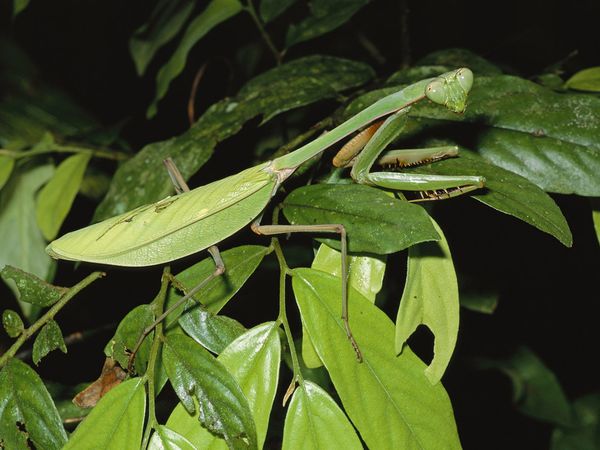
“Just thought that you might like to add the fact that there are praying mantises here on Abaco. There was one on my staircase today. 4 inches long and bright green. I did take pics but they just didn’t work as I was in a rush…”

We’ve all been there with photos and rushes, have we not? So here  is one such below  (Image credit: animals.nationalgeographic.co


There isn’t much specific info about these in the Bahamas, let alone on Abaco, other than the fact that Eleuthera is said to resemble one. I think I’d need to have a few Kaliks first. See what you think…

Accordingto the Indolent Bloggers’ Bible (Wiki) Mantodea (or Mantises) is an order of insects with approximately 2,200 species in 15 families worldwide in temperate and tropical habitats… Technically the term only refers to one family, meaning the other 14 families are not true mantids. Tough on them. The colloquial name ‘praying mantis’ is sometimes misspelled as ‘preying mantis’, since mantises are predatory. They are related to cockroaches & termites; and are not to be confused with stick/leaf insects, cicadas, grasshoppers or crickets. As if! 

Unknown's avatar

GREEN TURTLE CAY, ABACO 6 WEEKS AFTER HURRICANE IRENE


Michelle, a resident of Green Turtle Cay who contacted me just after Irene had hit, has emailed this update of the situation there. I’m still getting searches from people asking for news on GTC, so I’m posting this now – there may be some images to add in due course. I have a feeling that many people outside Abaco / Bahamas have no idea that the comms are still down over many areas 6 weeks later, and that the great repair and clean up continues

“Thankfully everyone is fine except for the continuous cleaning up and trying to restore the phone service.  I hear BATELNET has been sold by the gov. So there is now one hapless phone line repairman scampering around trying to get all the lines drained of water and serviceable… Irene came in on both sides and on high tide (as usual… remember Floyd?). It would have been good to have been able to receive news in the US while Irene was approaching the chain, but typical that unless it directly concerns [the US], you have to have other news sources. The patience of Bahamians is simply amazing!”

Although I have stood down from temporary hurricane-watch commentary, I will continue to post with news from individual areas for as long as I am getting online queries. All credit to WordPress for the detailed daily stats breakdowns…

 ©rh

Unknown's avatar

BAHAMAS WORLD CUP DARTS 2011 TEAM RESULTS


Click Board for World Cup Darts 2011 Results

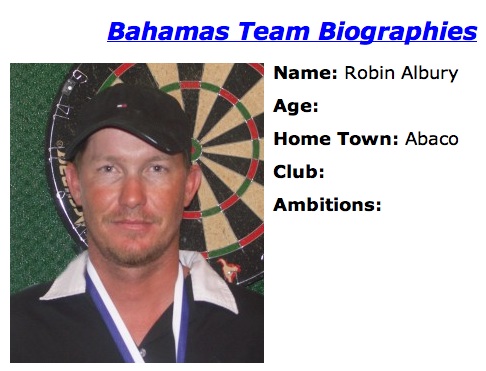
The World Cup is over, with England cleaning up in almost every arrows category. The Bahamas teams were up against the cream of world’s oche-meisters, and although none progressed to the final stages both Robin Albury and his partner got through to the last 32 in the men’s pairs; and Trudy Johnson made the last 32 in the women’s singles.

Overall, the Bahamas men finished at 29 out of 38 participating countries; and the Bahamas women at 18 out of 30. A moment spent looking at the competing countries and simply comparing populations indicates that the Bahamas teams made an excellent showing on the world stage. And let’s hope they all enjoyed the craic while they were in Ireland…

And if you are getting a weird ad for some kind of cosmetic witchery here, apologies. I’ve no idea what it’s doing, and it’s not the usual Google-based blurb… I’m hoping it will just vanish suddenly. Or the whole blog will.


Unknown's avatar

WORLD DARTS FEDERATION WORLD CUP: SUPPORT BAHAMAS!


                                                                                                                   GOOD LUCK TO ROBIN AND THE TEAM 

This post has little – ok, nothing at all – to do with wildlife on Abaco. It’s just a reminder of an imminent international event I posted about a while ago. Robin Albury (renowned and excellent Abaco and Delphi Club fishing guide) and his team-mates will be battling it out at Castlebar, Rep. of Ireland from behind the OCHE for the Darts World Cup between Sept 20 – 24                                                            For  web-link & team details CLICK LOGO===>>>       Continue reading

Unknown's avatar

A DAY AT CHEROKEE SOUND (ABACO) by TRISH FINDLATER


A MEMORY OF A DAY BONEFISHING ON CHEROKEE SOUND

First I thought it best to look up in the dictionary the meaning of the word ‘Sound’ in relation to ‘Cherokee Sound’ – it has such a poetic name. Sound: a long arm of the sea forming a channel between the mainland and an island or islands; or connecting two larger bodies of water.

“No one knows for sure where ‘the place’ got its name but one theory is that it was named after a local wild cherry tree and according to some old-English sailing charts was identified as ‘Cherry Cay’ (cay pronounced ‘key’ locally). Another story about the first settler being an old Indian woman who was supposed to have come from the Cherokee Nation in North Carolina during the American Revolution, and she named the settlement after her ancestors.”          By Lee Pinder, Cherokee Sound, Abaco.

About 40 kilometres or 25 miles south of Marsh Harbour, capital of Abaco, is the seaside settlement of Cherokee Sound. It is only fifteen minutes from the superb Delphi Fishing Club at Rolling Harbour where we were based. We set off for a day’s fishing at Cherokee, the home to fewer than 150 families, where most make their living fishing for crawfish, bonefish guiding and taking parties out deep sea fishing. Some of the finest bonefish guides live at Cherokee and none better than young Dana Lowe, daughter of Delphi’s senior guide Donnie Lowe. She has learnt since childhood from her experienced father and knows every inch of the complex waters, and where best to fish under various tide and cloud conditions (perish the thought, it is almost always gloriously sunny).

Dana has developed her own relaxed approach to guiding, and takes a missed opportunity in her stride, seldom getting upset by a client’s failure to engage with the incredibly spooky fish in the Sound. She calls clearly to the fisherman on the bow from her poling platform high above the 40 horse-power Yamaha at the stern of the 14 ft skiff: Fish 40 yards off, prepare to cast (and a minute later) give me 40 (feet) at 11 (o’clock, the bow is always 12). The angler has sufficient line stripped from the reel and with one false cast and a slight single haul lands the fly in the fish’s path.

After a momentary pause she quietly asks (with reference to the line): ‘strip, strip, stop, strip, raise the tip, GOT IT’ as the fish yields to the temptation of the inviting fly – and in a moment, like a bat-out-of-hell is 100/120 yards off, heading for the horizon! Then it pauses and turns which is the start of a real good angling experience until it gives up and is released from the barbless hook to rejoin its pals and recount the experience, often being honoured with leadership of the shoal. Such is the order of nature!

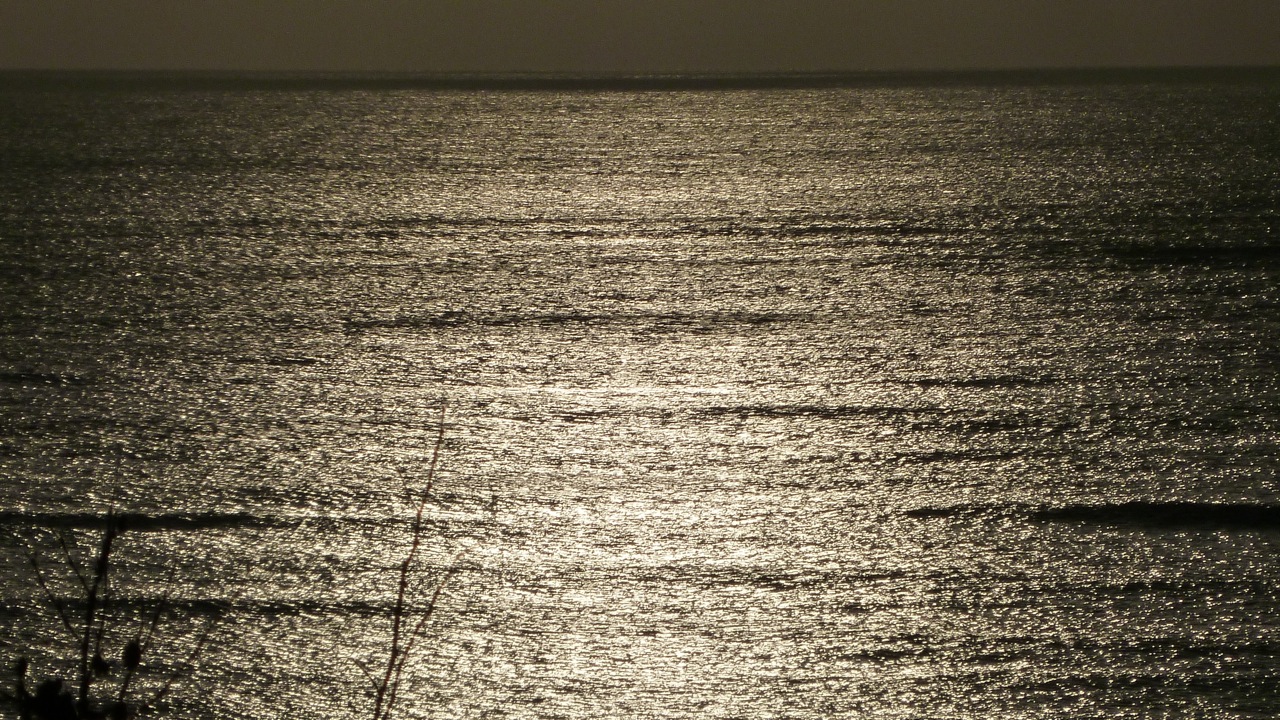
Dana is at one with her surroundings and encourages her guests to take in all that Cherokee has to offer. At low tide she loves to have her guests wade in bare feet on the silvery golden flats, sand as far as the eye can see, and cast to the occasional meandering fish or even a shoal of them. Easy to visualise the silvery sand, the blue green of the water, and the royal blue sky off set by soft fluffiness of the pure white clouds and almost uninterrupted sunshine. I love the lunch stops on a little mangrove island under the limited shade of a coconut tree, and the opportunity to collect a few shells for my nieces. I particularly like the sand dollars that have the appearance of engraved roman coinage, but are transparent porcelain white. And the various shades of pink of the conch shells are much liked by our local jeweller for engraving most appealing cameos. From the boat again she can show you, in season, the Ospreys nesting in their very square constructions of straw and wattle, green turtles snorting, and a plentiful number of ray, shark and barracuda cruising sinisterly around and with no evil intent to the peaceful anglers! As the evening draws in we call it a day and say our goodbyes to Cherokee Sound. Dana brings us back to the little jetty where our jeep from Delphi is awaiting us and we wave our fond farewell for another year and watch as Dana punts quietly out into the bay to her lovely home further along the shore line. The slow-paced tranquil daily life here feels as if it has not changed for many years and we hope, if that is fair to the residents, that it remains so for years to come.
Trish Findlater June 2011

AND FINALLY… unknown to Trish, rh was on the other skiff with a camera. For an independent view of what was going on in this idyllic place CLICK HERE

Unknown's avatar

HOPE TOWN LIGHTHOUSE, ELBOW CAY, ABACO – A BEACON ICON


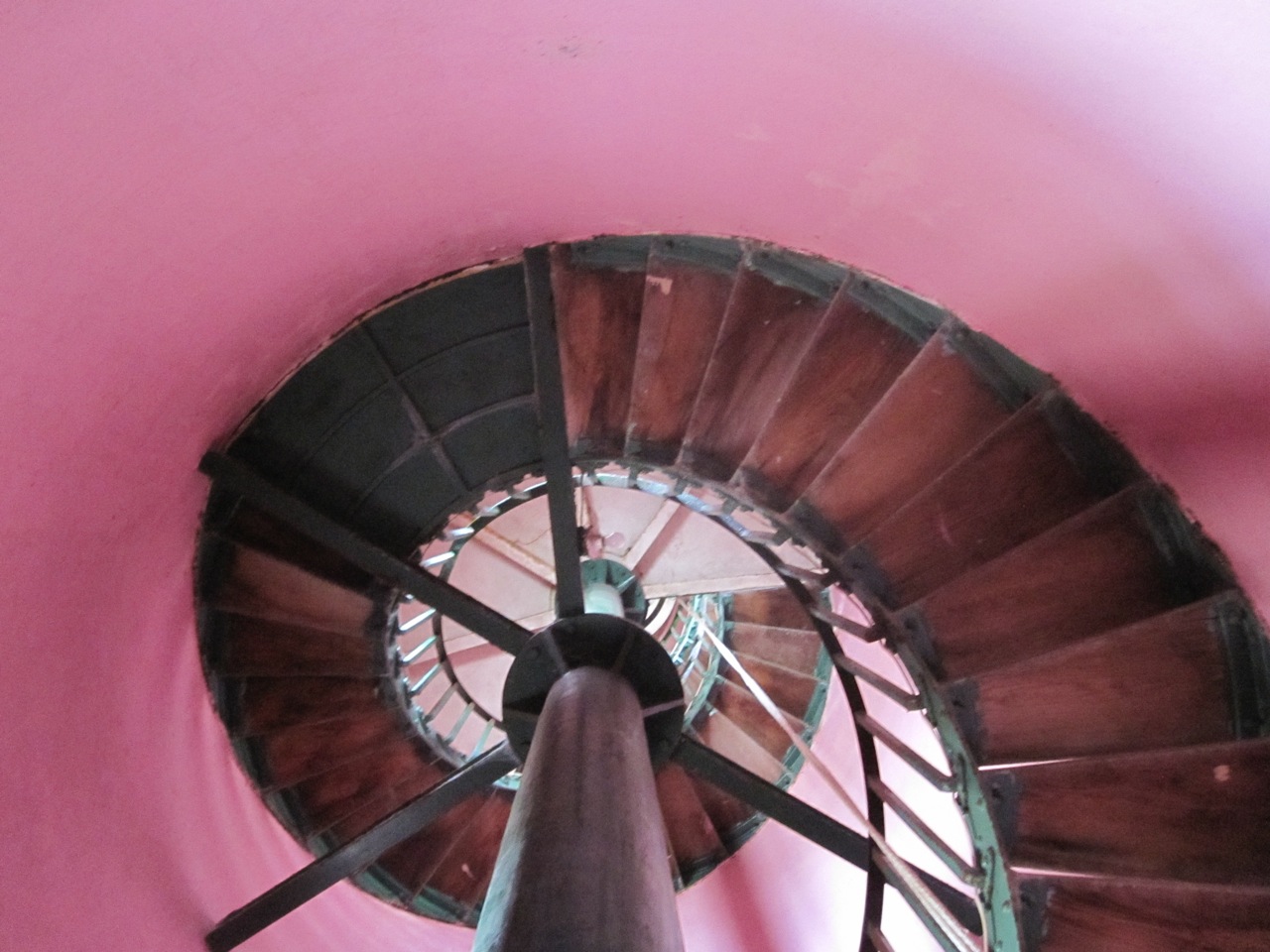
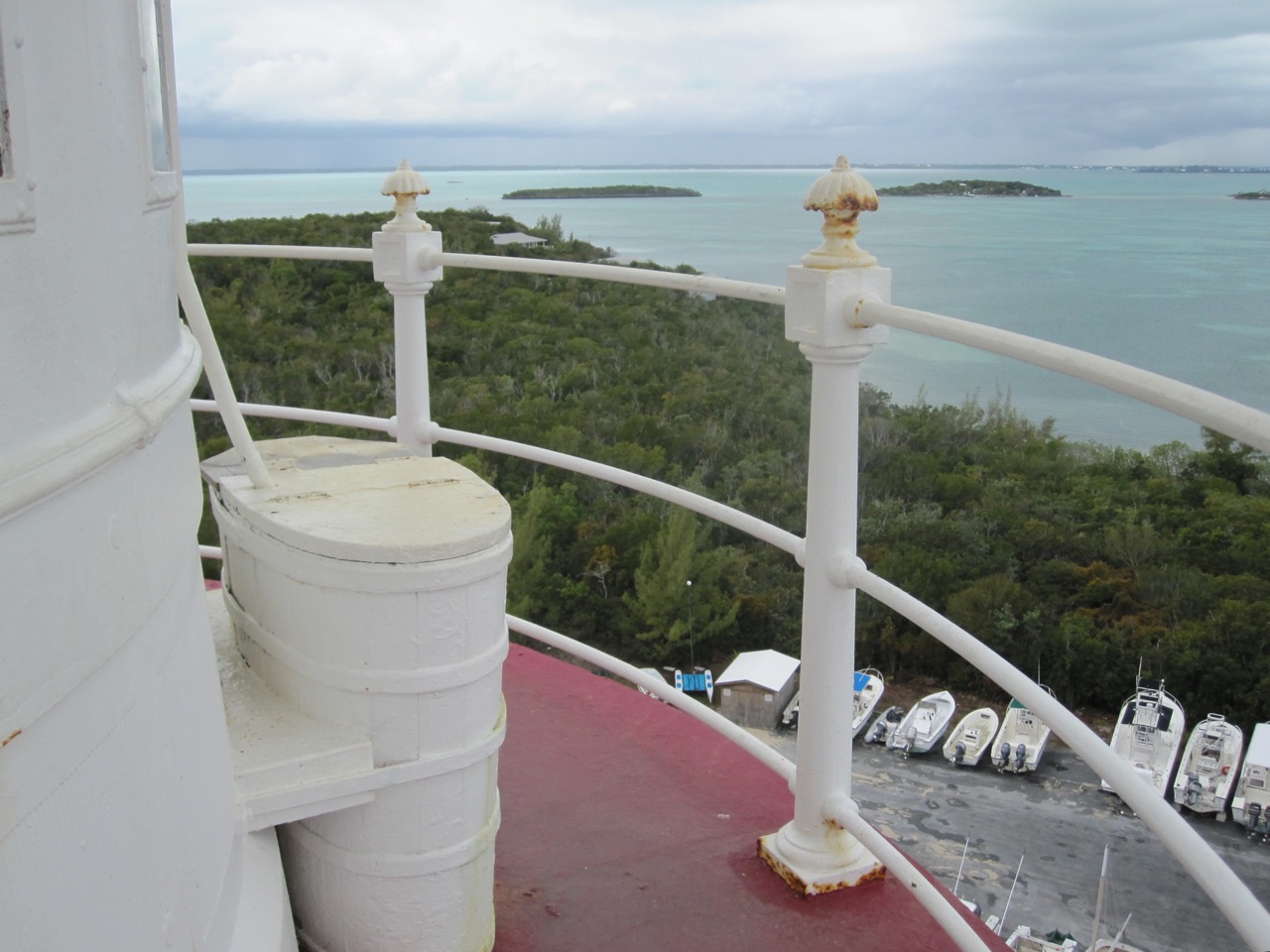
Our visit to Elbow Cay was one part of our day’s Island Hopping / Reef Snorkelling expedition with Kay Politano. In Hope Town, while most of the party wandered round the streets (and shops…) Mrs Rolling Harbour took the boat across the harbour to the Hope Town Lighthouse. This must be the best known landmark of Abaco – ‘iconic’, perhaps, in the modern sense of the word. The weather on the day was pretty poor, with thick cloud and intermittent rain and drizzle. Which is a pity, because the photos would have looked even better with sunshine and blue sky…


  All Photos: Mrs Rolling Harbour


HOPE TOWN LIGHTHOUSE FACTS

(click on Coordinates below for position and Hope Town info)

Location: Elbow Cay, port of Hope Town
Coordinates 26.539421°N 76.958840°WCoordinates
Year first constructed: 1862
Year first lit: 1864
Construction: Masonry
Tower shape: Conical
Markings/Pattern: Red and white bands
Focal Height: 37 m (121 ft)
Original lens: First order Fresnel
Range: 23 nmi
Characteristic: Fl(5) 15s
Admiralty number: J4572
NGA number: 11800
ARLHS number: BAH-010

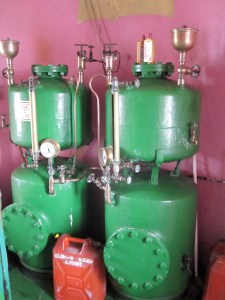
The Hope Town Lighthouse is one of only three Manual Lighthouses left in the World. It has a spring mechanism that has to be hand cranked every few hours to maintain the sequence of five white flashes every 15 seconds. The lamp burns kerosene with a wick and mantle. The light is then focused as it passes through the optics of a first order (largest size) Fresnel lens which floats on a bed of mercury. 

A Fresnel lens (pron. ‘Fray-nel’) is a type of lens originally developed by a French physicist Augustin-Jean Fresnel specifically for lighthouses.Compared to conventional bulky lenses, the Fresnel lens is much thinner, larger, and flatter, and captures more oblique light from a light source, thus allowing lighthouses to be visible over much greater distances. Fresnel’s lighthouse lenses ordinarily fell into six orders based on their focal length, first order being the largest (wiki-assist) 

Logo of the World Lighthouse Society


Unknown's avatar

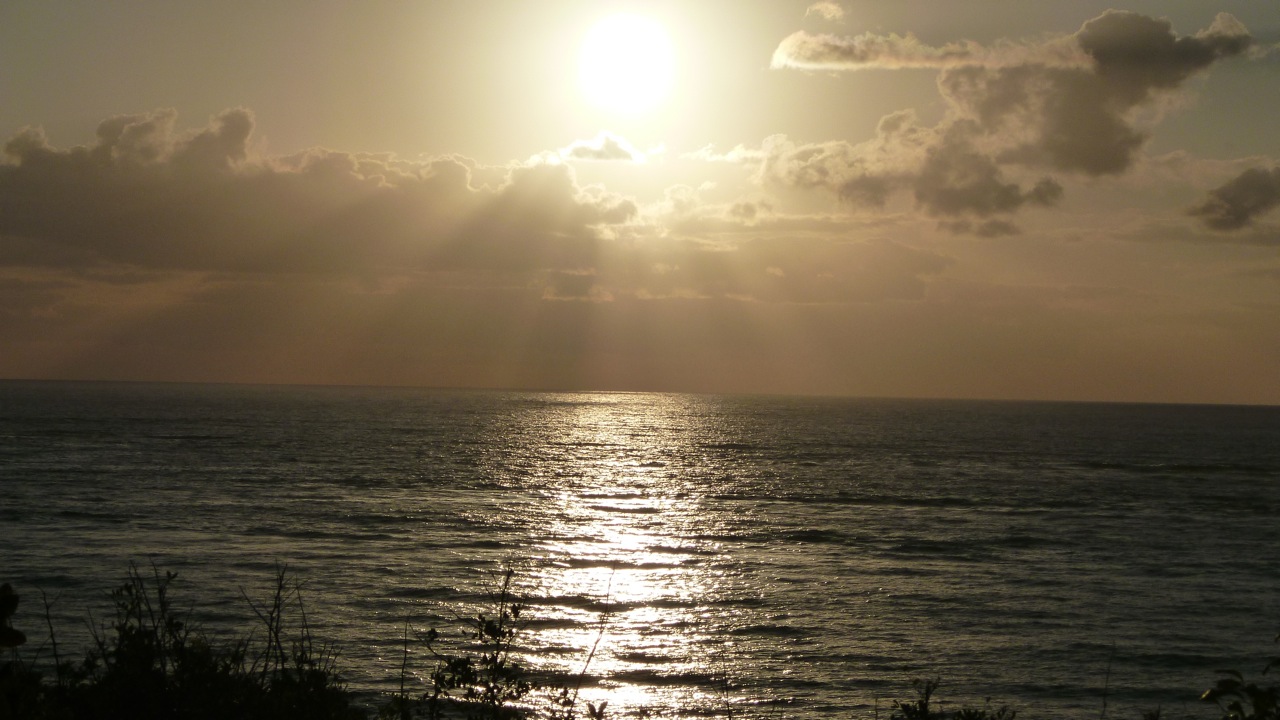
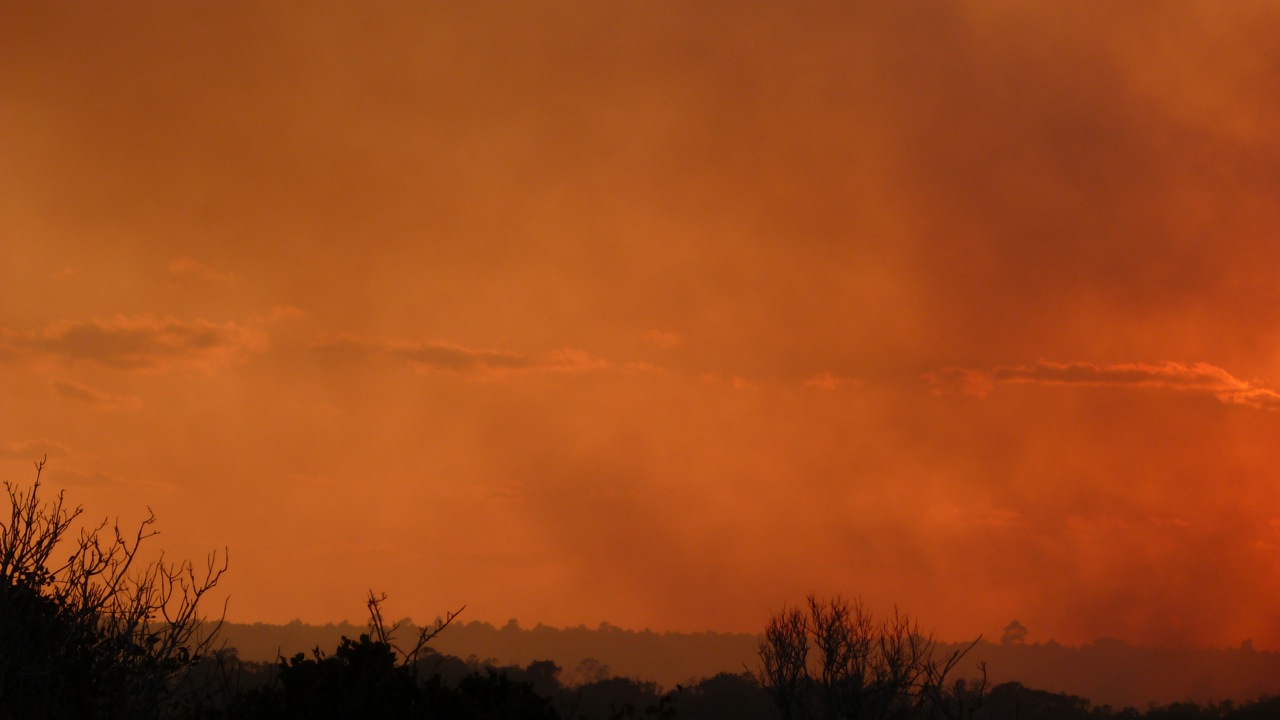
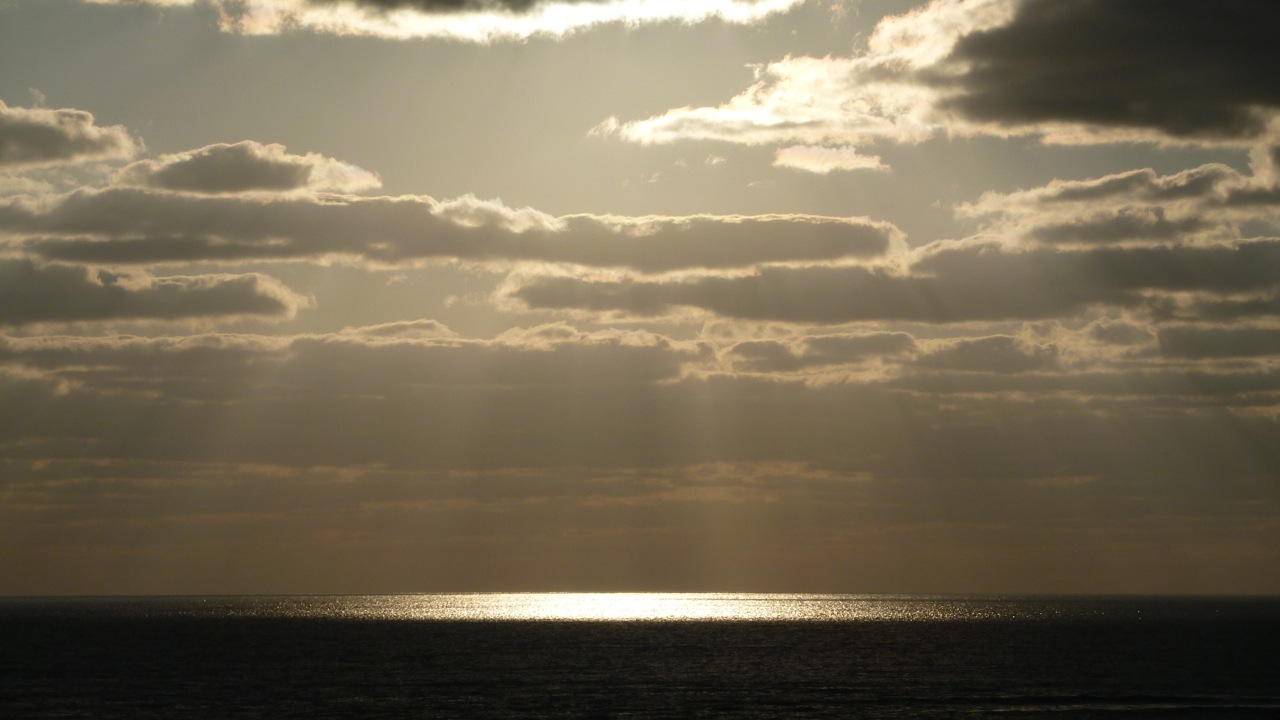
“HERE COMES THE SUN…” – SOLARY CLIPS AT DELPHI, ABACO


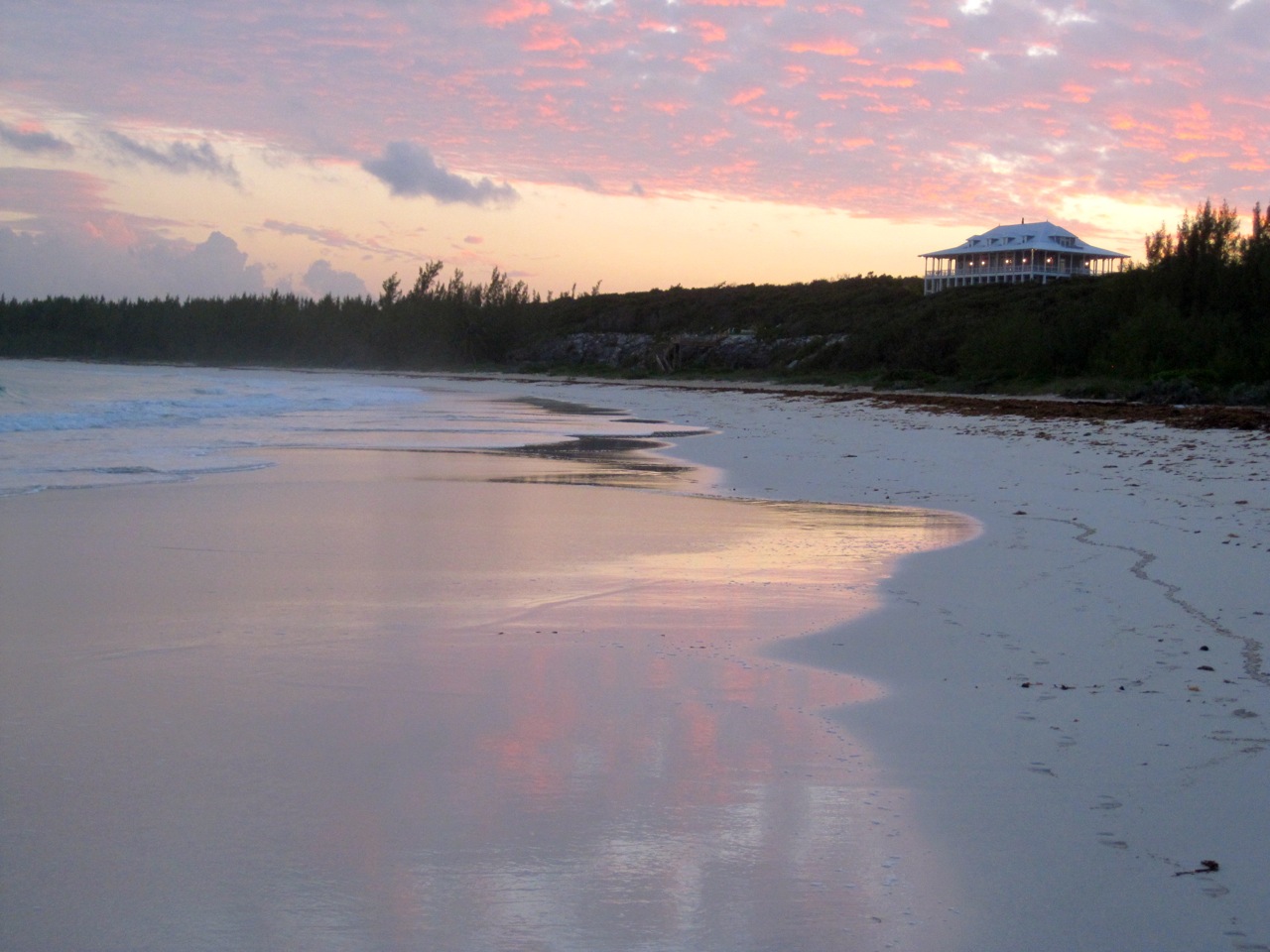
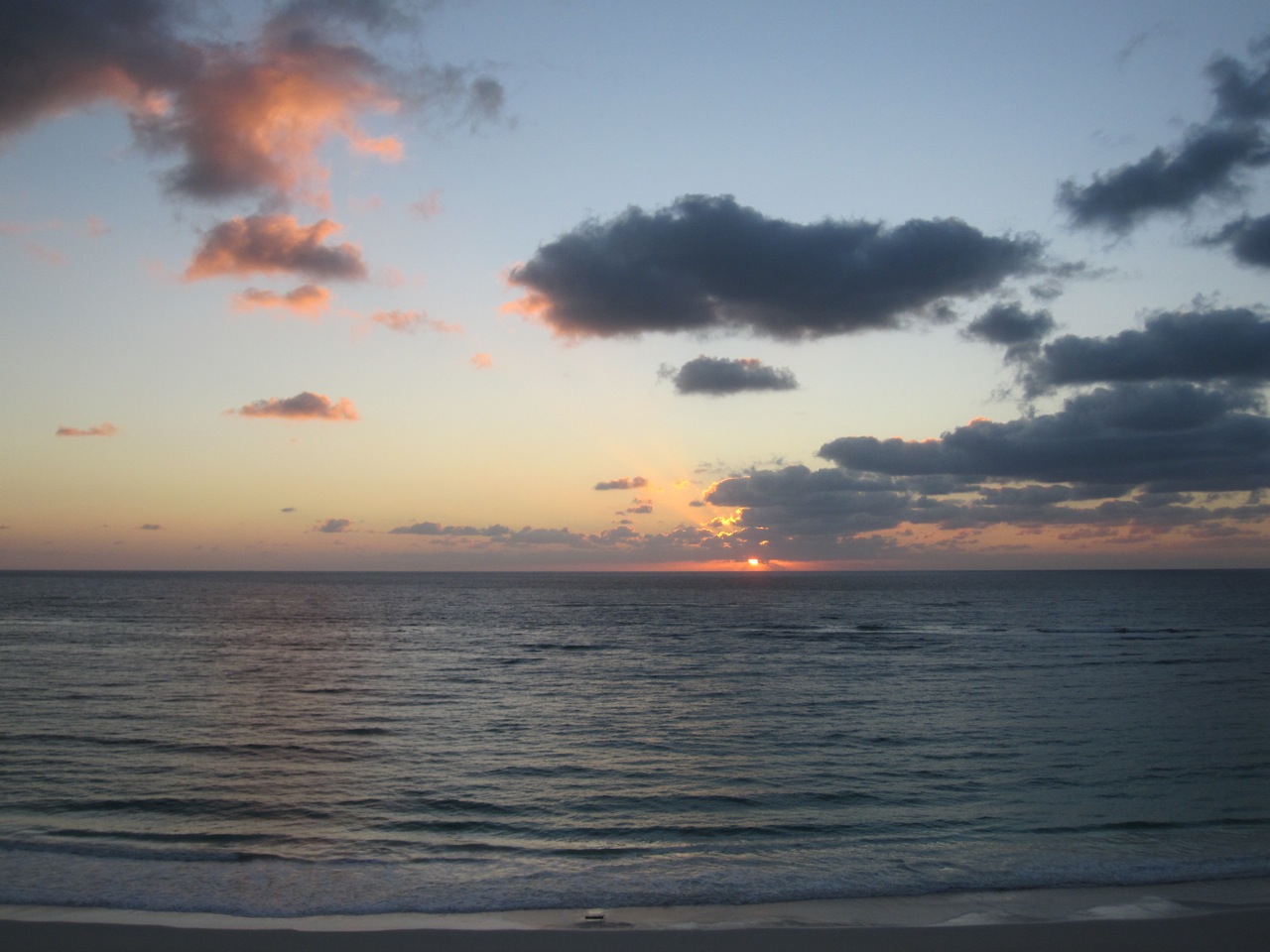
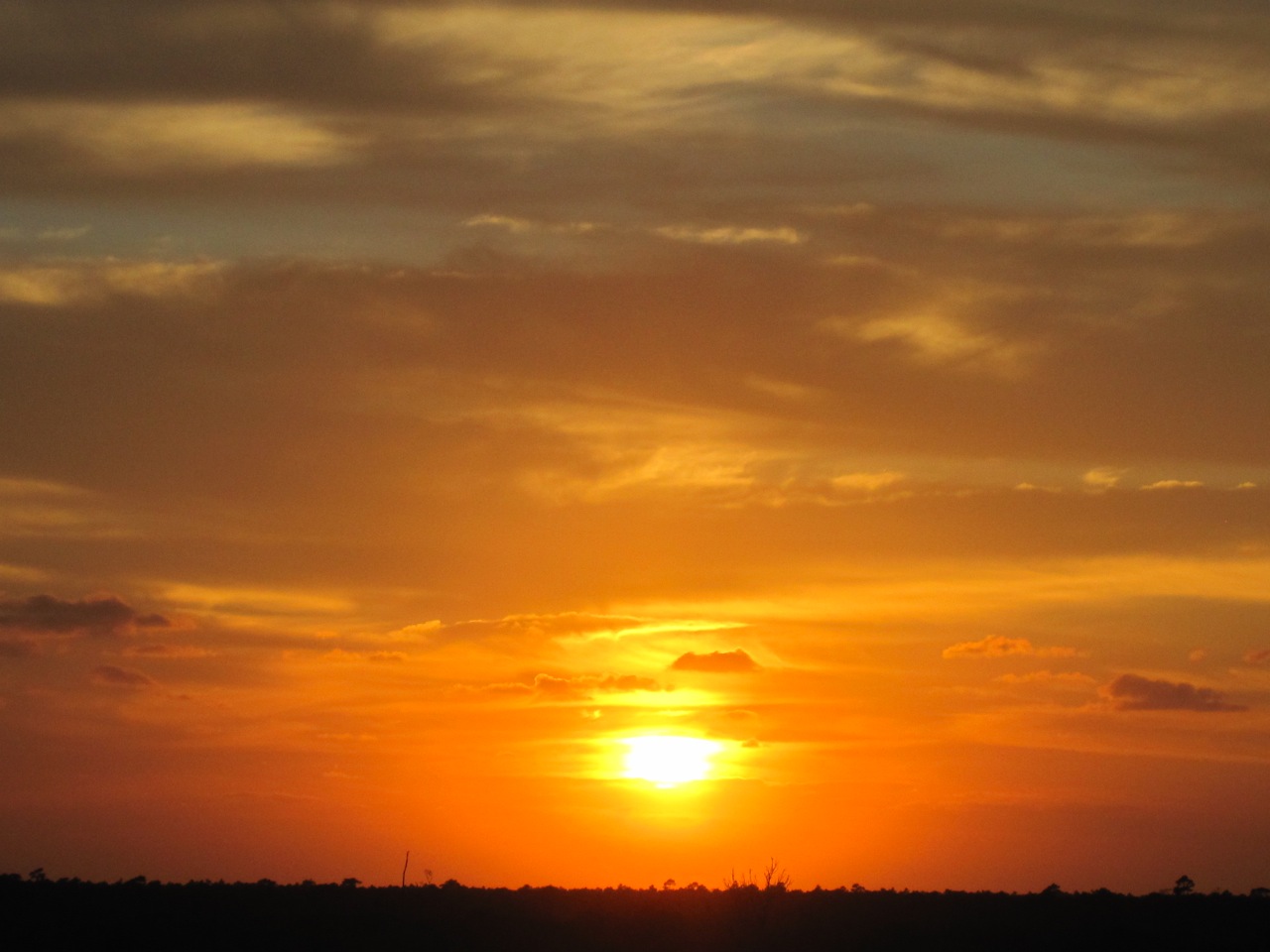
DELPHI. ROLLING HARBOUR. Gorgeous sunrises. Sumptuous sunsets. Impossible to take a really bad photo. None of the images below has been photoshopped or iPhoto’d in any way. The only modifications are natural, i.e. from forest fire smoke on a couple of them.