Unknown's avatar

A-PIPIN’ & A-PLOVIN’ ON ABACO: PIPL POWER


piping-plover-delphi-beach-Abaco-peter-mantle-11-16

A-PIPIN’ & A-PLOVIN’ ON ABACO: PIPL POWER

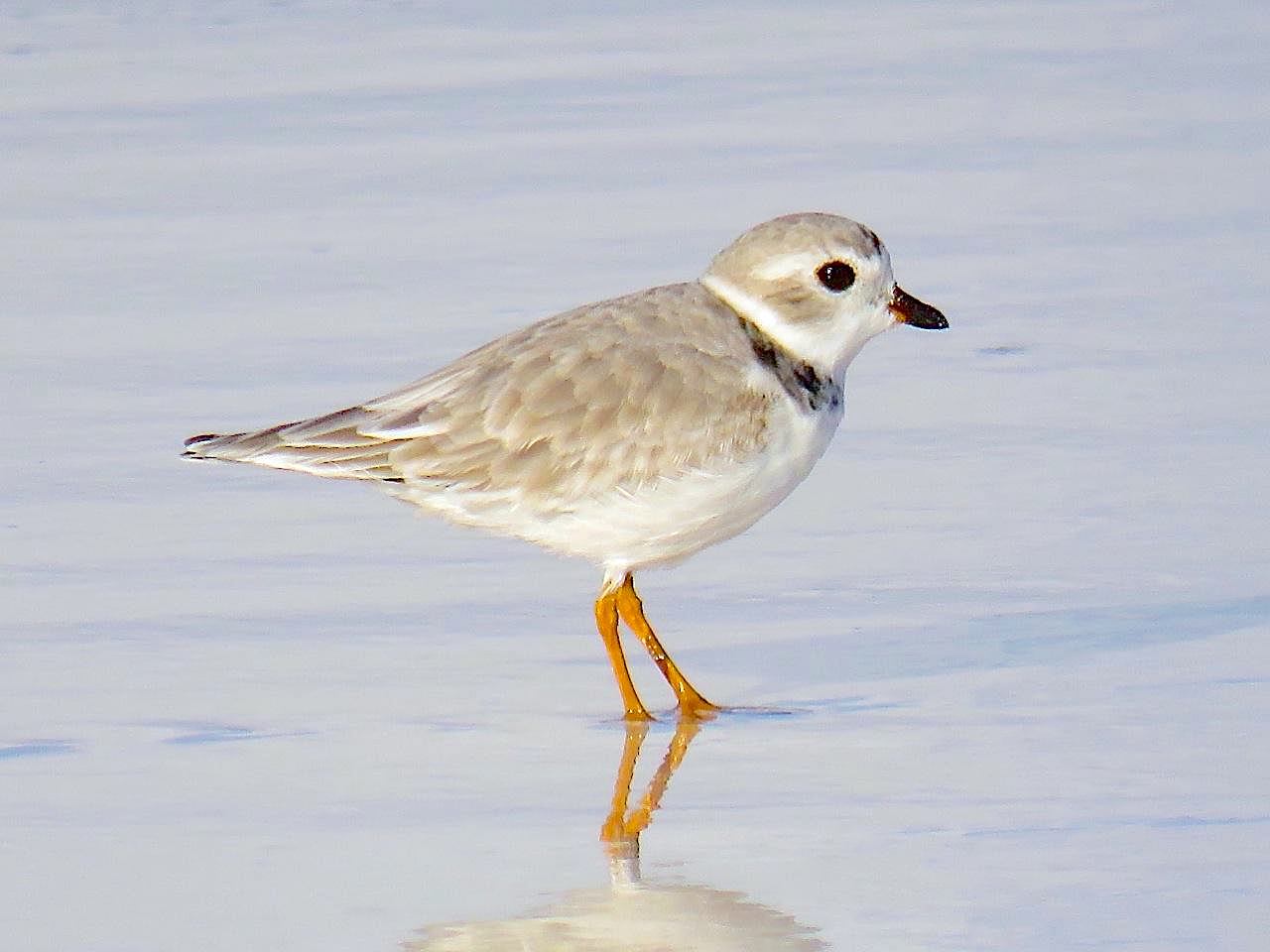
Last year someone kindly reported a lone piping plover sighting on ABACO PIPING PLOVER WATCH. I like to get a few details, so I asked what it was doing (meaning: sleeping / mooching / foraging / flying?). She replied – and I knew exactly what she meant – “Oh, a-pipin’ and a-plovin’ about on the beach”. A very evocative description of how these tiny scuttling birds pass their days!

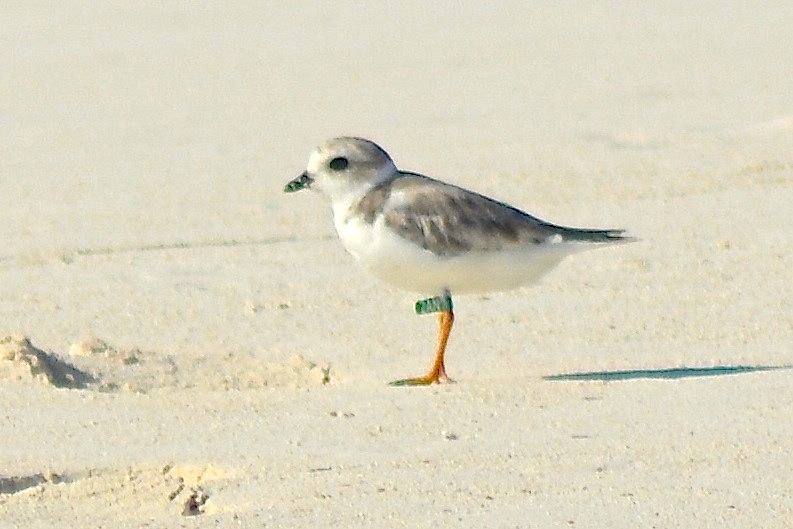
Green Flag YLO, renamed Coco for short
Piping Plover 2-aug-4-long-beach-Abaco-5-birds-inc-ylo

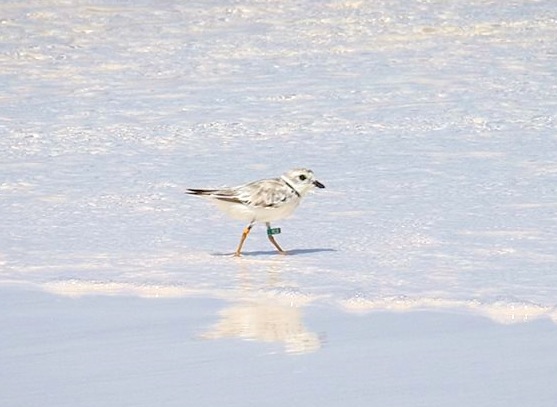
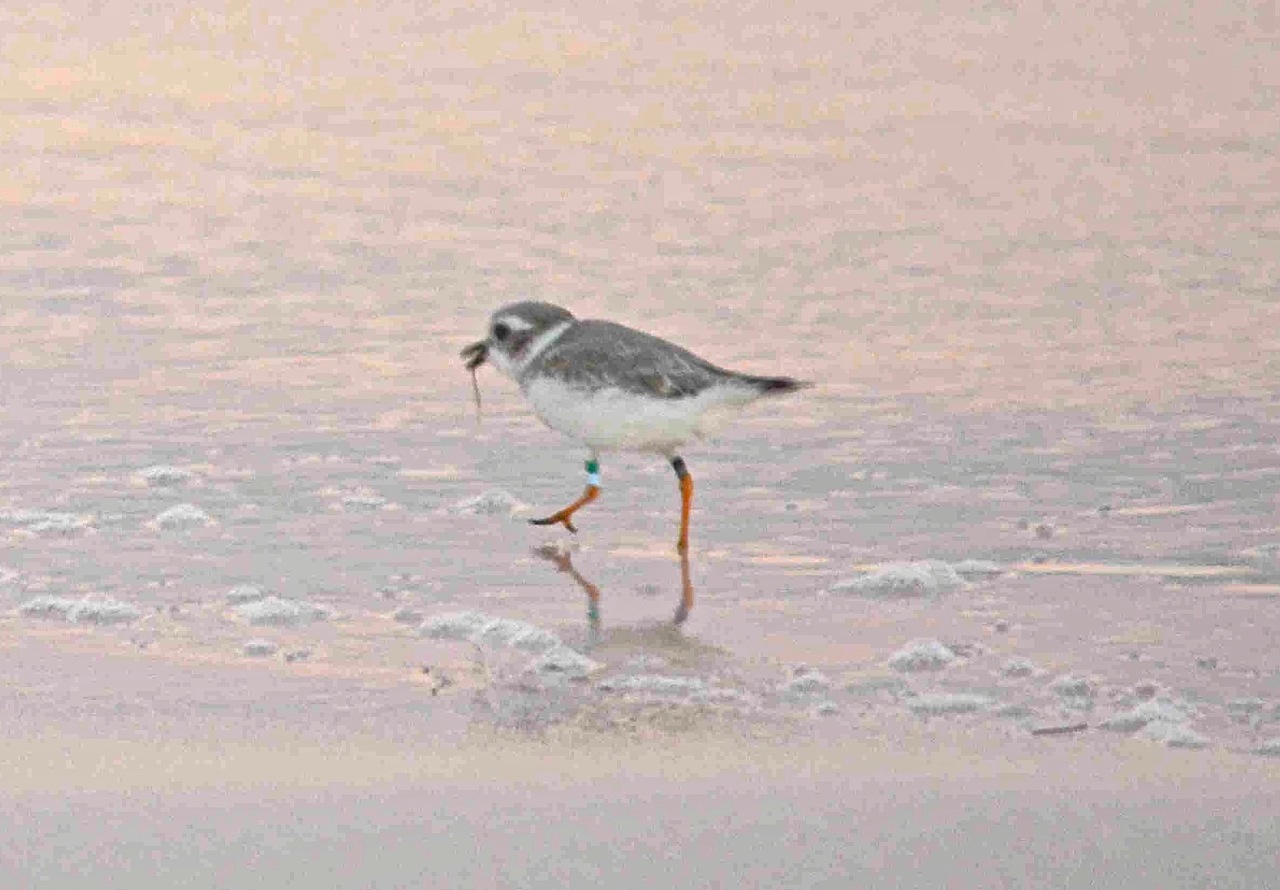
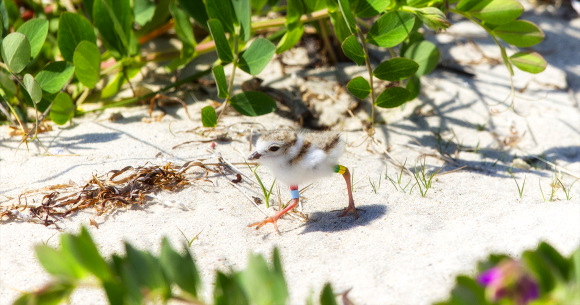
The A P P Watch is now into its 4th month. The earliest reported arrival for the fall winter / winter season was as early as July 30. The first banded bird was reported on August 4, in a small group of 5. The leg bands (upper right Green Flag coded YLO; upper left Orange Band) at once confirmed the bird as an unnamed returner originating from Fire Island National Seashore NY – to the very same beach where it was sighted last December. That is known as ‘beach fidelity’, and is a most important piece of conservation data, because it is evidence that the beaches of Abaco provide a safe and unspoilt winter habitat for this vulnerable and threatened species. YLO was renamed Coco to reward his contribution to empirical conservation study.

piping-plover

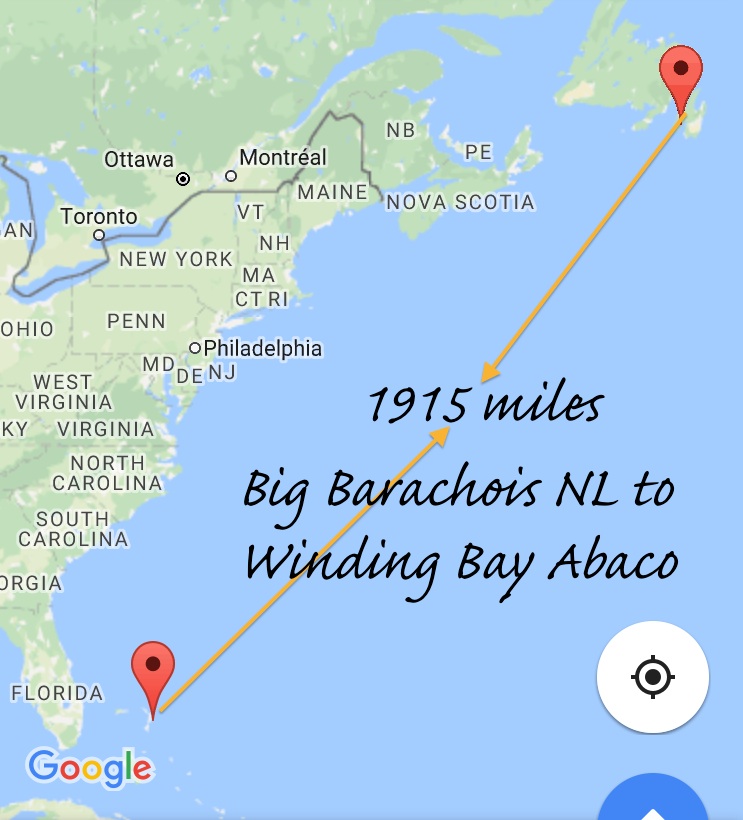
We didn’t have to wait long for the next banded bird, one that had undertaken the longest journey we have yet come across, nearly 2000 miles (direct) from Big Barachois, Newfoundland. Black Flag 58 was soon traced to his origin and details of his adventurous life were uncovered – two summers on the same breeding beach, and a spring sighting on Long Island, NY. 

Piping Plover from Newfoundland: 4-aug-6-winding-bay abaco -keith kemp-jpgnewfoundland-to-abaco-map

The next find was a precious ‘Bahama Pink’ on Long Beach, known simply as… Pink Flag #50. She was banded on the same beach in 2014; resighted there in December 2015; and had returned for her third visit before the end of August 2016. The perfect example of ‘beach fidelity’.

Piping Plover, Abaco Bahamas: pink flag 50 (Keith Kemp)

In the same group that day was another exciting find, this time a new bird Green Flag 2AN originating from the same place as Coco above: Fire Island National Seashore, NY. Piping Plover, Abaco, Bahamas, Green Flag 2AN-aug (Keith Kemp)13880178_343177786027819_6547752228912195883_n

There was a bit of a lull with banded bird sightings until October, when ‘Taco’ from the Holgate Unit, Edwin B. Forsythe NWR, NJ showed up. We had two other birds from the same location last season. 

Piping Plover "Taco", Abaco, Bahamas 2016

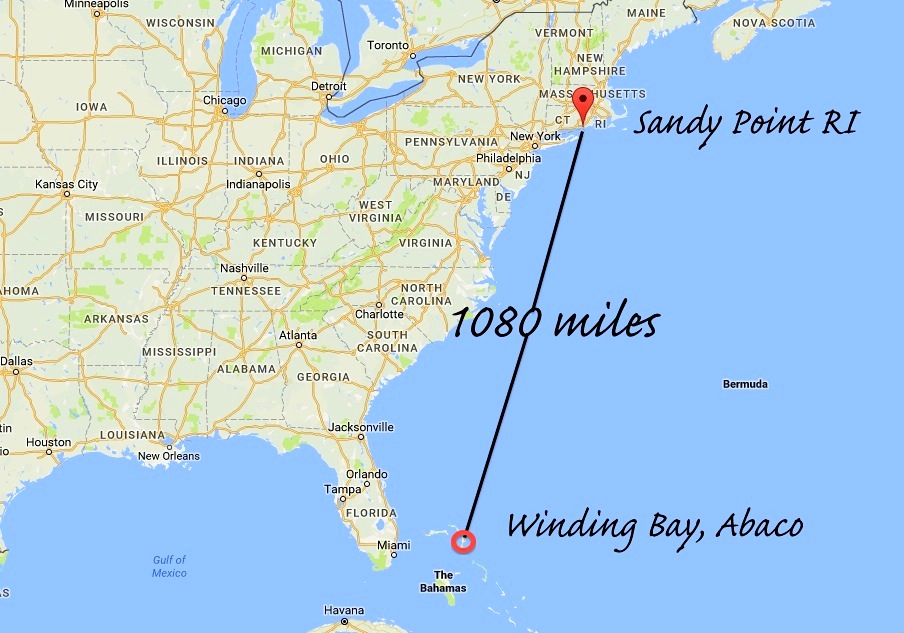
Soon after, a returner from last season arrived back on his same beach to join Taco. Jonesy was originally ‘Mrs Jones’, as in the song, until he was identified as a male and had to be renamed. He originated from the Ninigret NWR, R.I. He and Taco are still keeping company – they were seen together only yesterday.

Piping Plover Jonesy, Abaco, Bahamas 2016 (Keith Kemp)sandy-point-ri-to-winding-bay

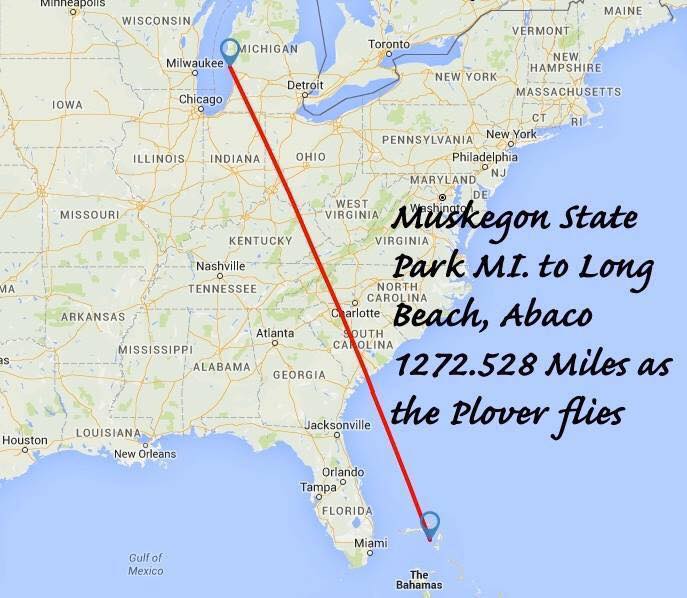
Finally, a warm Abaco welcome please to the aptly named Bahama Mama, a rare Great Lakes bird from Muskegon State Park, MI, resighted in early November.  She was found on the same beach in December last year. Bahama Mama - Great Lakes Piping Plover on Abaco, Bahamas (Keith Kemp)15027859_392958301049767_8409742050501259206_n

So far this season, all the banded birds have been positively identified except one – a tantalising possible sighting of last year’s ‘Bird of the Season’ Tuna on ‘his’ beach.  From a distance shot the bands on one leg looked right… but all-in-all the image is simply not clear enough (and heavily pixellated with onscreen adjustments) to be certain. 

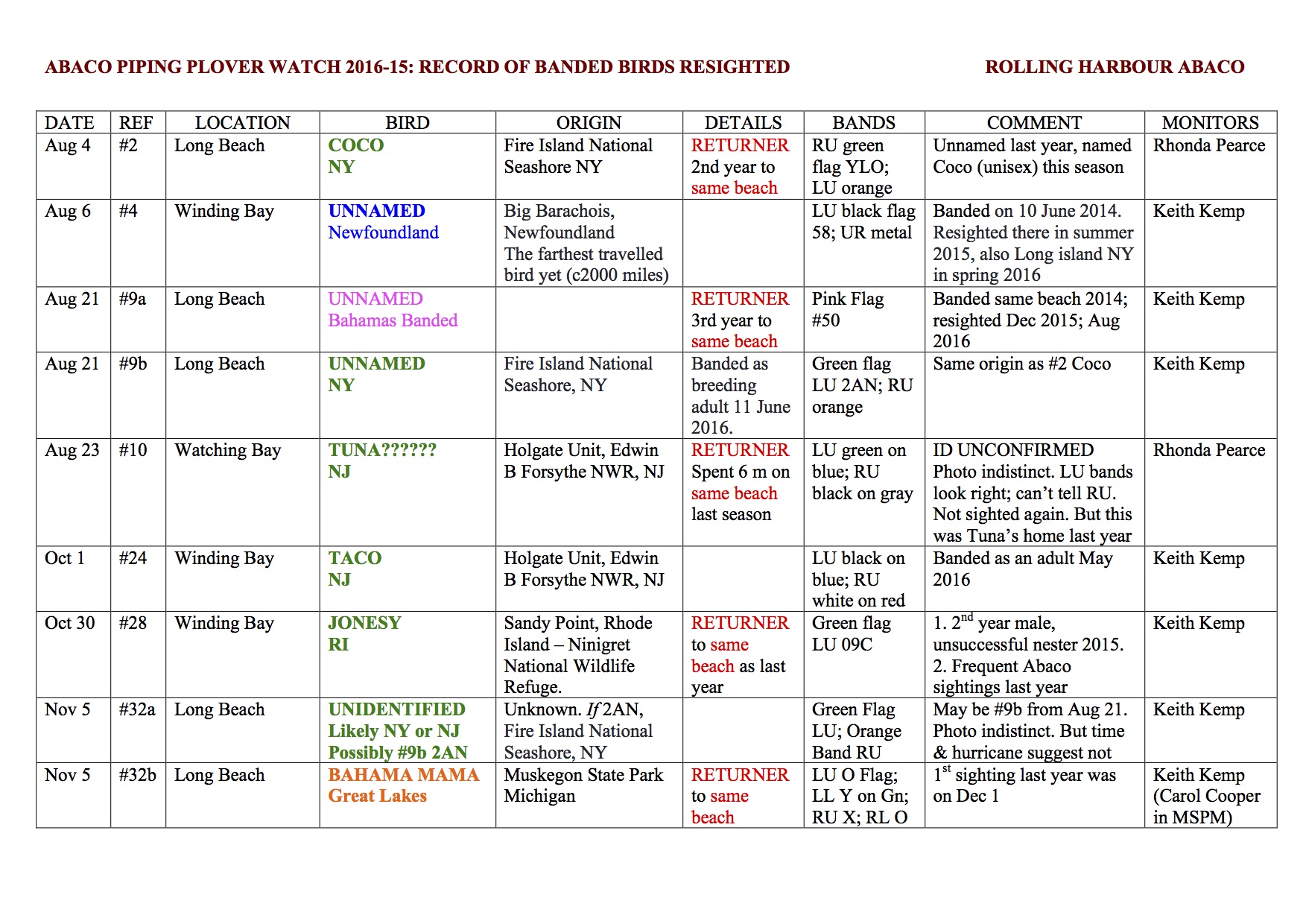
If it is indeed Tuna, then five of the banded birds so far are returners, in each case to the same beach as last year. The chart below is a draft (there’ll no doubt be some tidying up as the season progresses)

Piping Plovers on Abaco-id-chart-2-p-1-jpg

Credits: Peter Mantle (header image); Keith Kemp; Rhonda Pearce – and with thanks to all monitors

Unknown's avatar

PREHENSILE TALES FROM THE REEF (2): HIPPOCAMPI


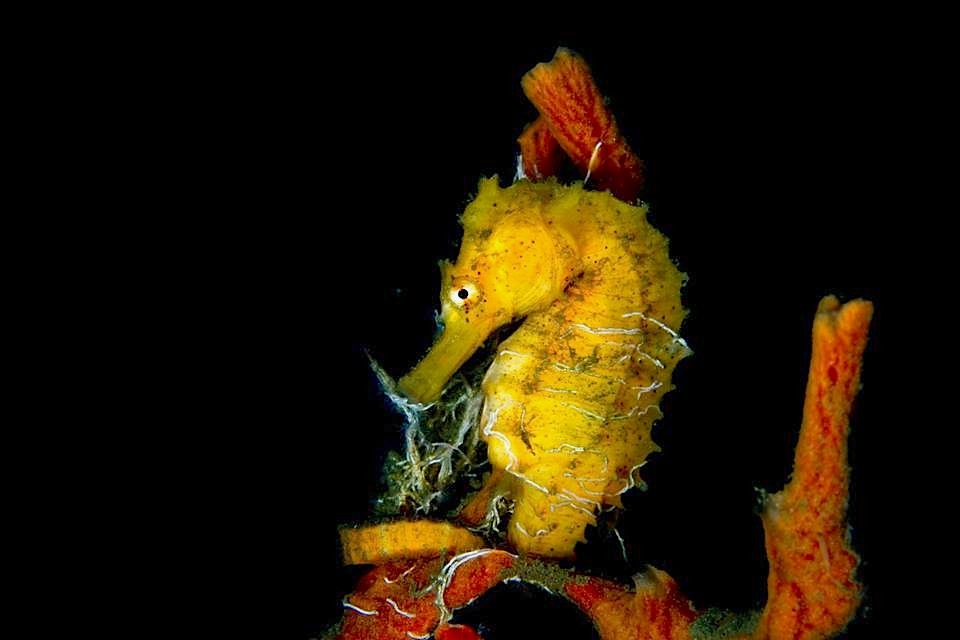
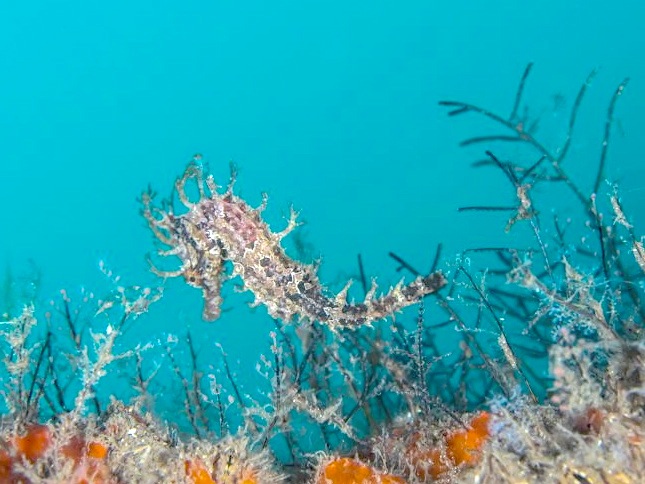
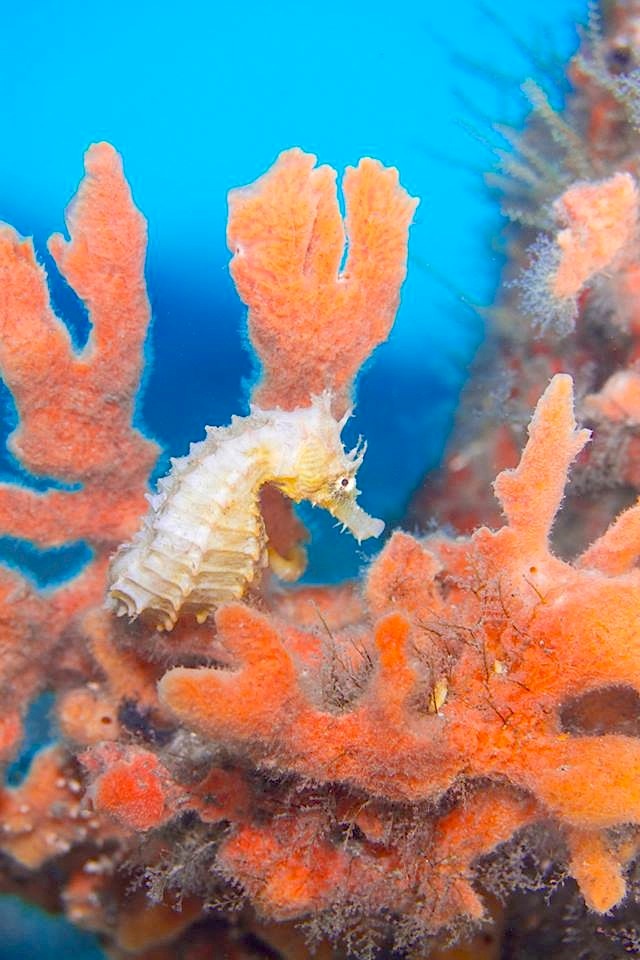
Seahorse (© Adam Rees / Scuba Works)

PREHENSILE TALES FROM THE REEF (2): HIPPOCAMPI

It is a statistical fact that no one in the world – not even the meanest despot or cruellest tyrant – fails to love seahorses. It would be fair to add that in certain parts of the world, some people love them too much. In more than 65 countries. To the tune of an estimated 150 million a year that are used in the ‘traditional medicine’ trade. An attrition rate that is unsustainable in the long or even the medium term – with the bleak consequence that it won’t be long before people must look elsewhere for their source for Genital Tonic Pills. 

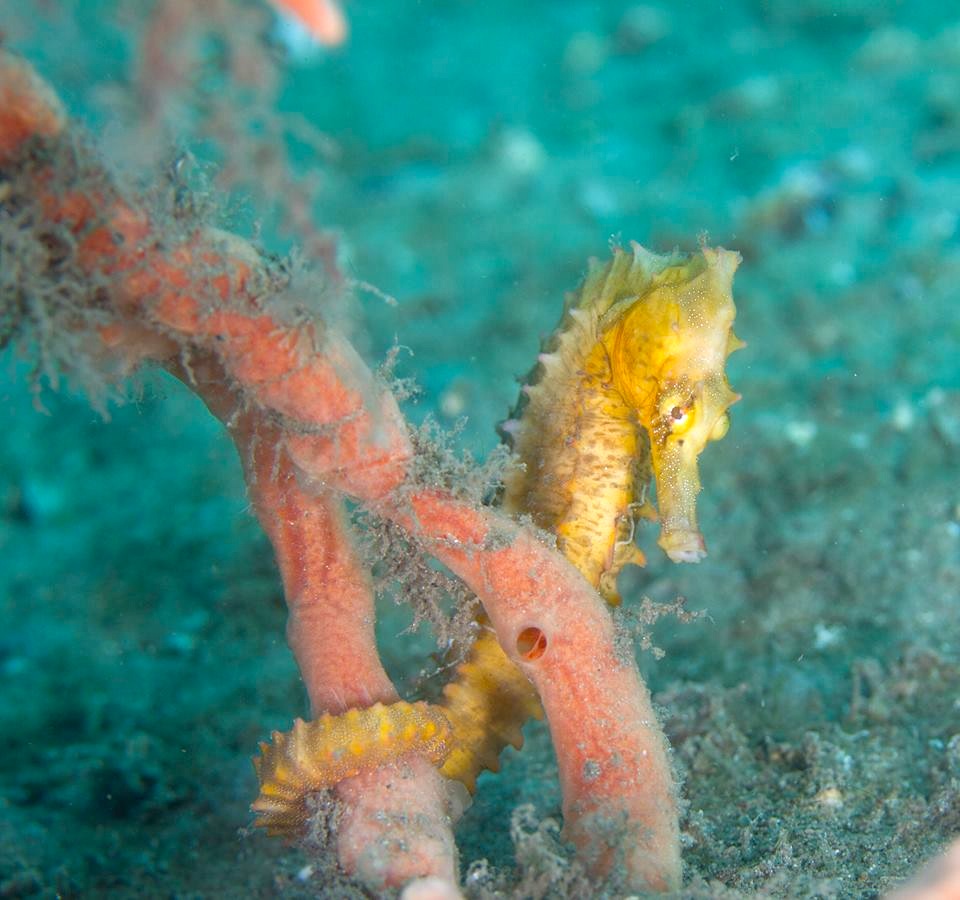
Seahorse (Adam Rees / Scuba Works)Seahorse (Adam Rees / Scuba Works)

Medicinal use – of empirically vague benefit to its enthusiasts – is joined by the aquarium trade in accounting for the removal of very large numbers of seahorses from their accustomed surroundings. At least these creatures live on (rather than being dried out alive), though research suggests that the survival rate of seahorses in captivity is low. 

Seahorse (Adam Rees / Scuba Works)

Do you sometimes hanker for a plastic brooch or paperweight with a tiny seahorse embalmed inside it? It would be good to resist the temptation to buy such things in seaside shops or online. Your little specimen will be one of a million or so souvenir seahorses sold each year, alongside seashells, starfish, sponges and (protected) corals. 

Seahorse (Adam Rees / Scuba Works)

As you contemplate your purchase, you may be reassured to find that the product is labelled ‘environmentally friendly’, ‘responsibly sourced’ or ‘from a sustainable source’. You can make up your own: ‘lovingly harvested from the bluest oceans’, maybe. In the words of the SEAHORSE TRUST: 

“Nothing could be further from the truth; there is nothing sustainable about this exploitation of the seas. You can make change by not buying them. If there was no market there would be no trade.”

Seahorse (Adam Rees / Scuba Works)Seahorse (Adam Rees / Scuba Works)

USES FOR SEAHORSES: MEDICINE OR (WITH SCORPIONS) STREET FOOD  images-1 seahorses_scorpions_skewer

seahorse-adam-rees-scuba-worksSeahorse (Adam Rees / Scuba Works)

RELATED POSTS AND ONLINE RESOURCES

HIP HIP HIPPOCAMPUS!

PREHENSILE TALES 1

SEAHORSE TRUST

SEAHORSE TRUST FB GROUP

SEAHORSES: NAT GEO

                   Sustainable Seahorses

s-l225-2      s-l225-1

Credits: Adam Rees / Scuba Works for more stunning photos; Seahorse Trust for material; Wiki & open source for the random thumbnails

Unknown's avatar

SEABIRDS, SHOREBIRDS & WADERS: 30 WAYS TO DISTINGUISH THEM


Sanderling Trio, Delphi Beach, Abaco (Keith Salvesen) 5

SEABIRDS, SHOREBIRDS & WADERS: 30 WAYS TO DISTINGUISH THEM 

While putting together “The Birds of Abaco” I looked at and archived hundreds of photos of birds, many with aquatic or semi-aquatic lives. These can be broadly categorised as seabirds, shorebirds or wading birds. But with some bird breeds, there can be doubt as to which category applies (and in different parts of the world the categories themselves may be named differently). There is the strict Linnaean ordering of course, but in practice there is a degree of informal category overlap and some variation in the various bird guides. This is especially so between shorebirds and the smaller wading birds. Shorebirds may wade, and wading birds may be found on shores. Then I remembered a past blog post by the estimable BEACH CHAIR SCIENTIST that I thought deserved another outing here. Even if you have no problem distinguishing birds in the 3 categories, there are avian characteristics within each list that are interesting observations in themselves. 

10 CHARACTERISTICS OF SEABIRDS 

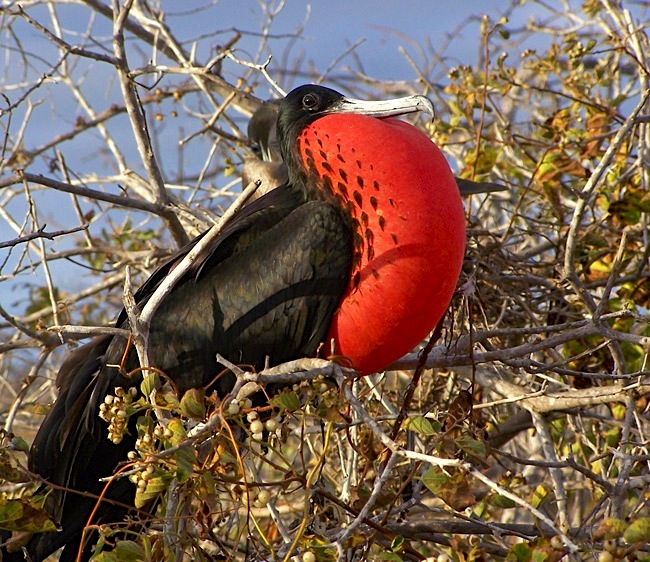
Magnificent Frigatebird (inflated-throat) (Michael Vaughan)

(Examples include albatross, auk, booby, frigatebird, fulmar, gannet, penguin, petrel, puffin, shearwater, and tropicbirds)

1. Seabirds are pelagic, spending most of their lives far out at sea.
2. Seabirds move toward to coastal areas to breed or raise young for a minimal amount of time.
3. Seabirds are light on their undersides and dark on top (an adaptation known as countershading).
4. Seabirds have more feathers than other types of birds for more insulation and waterproofing.
5. Seabirds have flexible webbed feet to help gain traction as they take off for flight from the sea.
6. Some seabirds have unusually sharp claws used to help grasp fish under the water.
7. Some larger seabirds (e.g. albatross) have long, slim wings allowing them to soar for long distances without getting tired.
8. Some smaller seabirds have short wings for maneuvering at the surface of the water.
9. Seabirds have specialized glands to be able to drink the saltwater and excrete salts.
10. Some seabirds (e.g. gannets) have a head shape that is usually tapered for more efficiency in plunge diving.

10 CHARACTERISTICS OF SHOREBIRDS 

American Oystercatcher, Delphi, Abaco (Tom Sheley)

(Examples include avocet, black skimmer, oystercatcher, plover, sandpiper, and stilt)

1. Shorebirds have long legs, pointed beaks, and long pointed wings.
2. Most shorebirds are migratory (impressively, some shorebirds fly non-stop for 3-4 days, equivalent to a human running continuous 4-minute miles for 60 hours).
3. Shorebirds wade close to the shore and poke their bills into the ground in search of food.
4. Shorebirds are small to medium size wading birds.
5. Shorebirds tend to frequent wetlands and marshes and are biological indicators of these environmentally sensitive lands.
6. Shore birds are of the order Charadriiformes.
7. Shorebirds are very well camouflaged for their environment and their appearance may vary from place to place as plumage (feather colors) are gained or lost during breeding.
8. Shorebirds typically range in size from 0.06 to 4.4 pounds.
9. Oystercatchers have a unique triangular bill that is a cross between a knife and a chisel.
10. The black skimmer is the only native bird in North America with its lower mandible larger than the upper mandible, which helps the bird gather fish as it skims the ocean surface.

10 CHARACTERISTICS OF WADING BIRDS 

Great Egret, Abaco - Tom Sheley

(Examples include crane, egret, flamingo, herons, ibis, rail, spoonbill, and stork)

1. Wading birds are found in freshwater or saltwater on every continent except Antarctica.
2. Wading birds have long, skinny legs and toes which help them keep their balance in wet areas where water currents may be present or muddy ground is unstable. Also, longer legs make it easier for them to search for food (forage) in deeper waters.
3. Wading birds have long bills with pointed or rounded tips (depending on what is more efficient for the types of food the bird consumes).
4. Wading birds have long, flexible necks that can change shape drastically in seconds, an adaptation for proficient hunting.
5. Herons have sophisticated and beautiful plumes during the breeding season, while smaller waders such as rails are much more camouflaged.
6. Wading birds may stand motionless for long periods of time waiting for prey to come within reach.
7. When moving, their steps may be slow and deliberate to not scare prey, and freeze postures are common when these birds feel threatened.
8. Adult wading birds are quiet as an essential tool for hunting. Wading birds may be vocal while nestling or while in flocks together.
9. Many wading birds form communal roosts and breeding rookeries, even mixing flocks of different species of wading birds or waterfowl.
10. Wading birds fully extend their legs to the rear when flying. The neck may be extended or not while in flight, depending on the species.

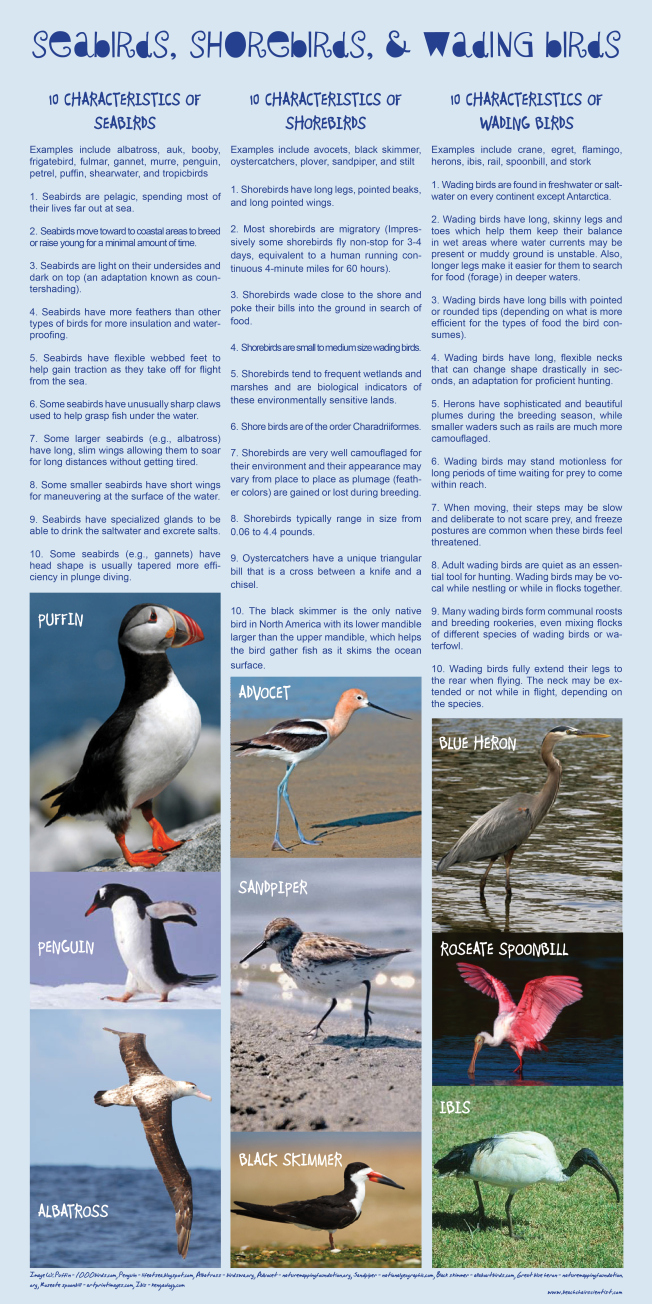
These lists were put together in useful chart form. Please check with BCS (link above) if you want to ‘borrow’ itseabird shorebird wading bird chart ©beachchairscientistImage Credits: Table – ©Beach Chair Scientist; Pics – Keith Salvesen, Michael Vaughn, Tom Sheley

Unknown's avatar

GETTING THE MEASURE OF TURTLES ON ABACO


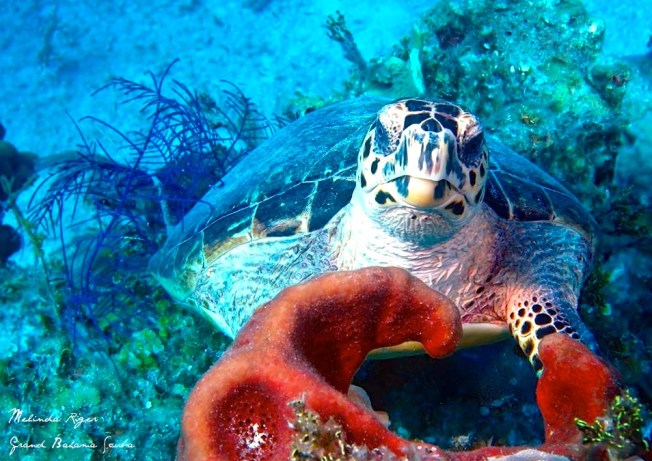
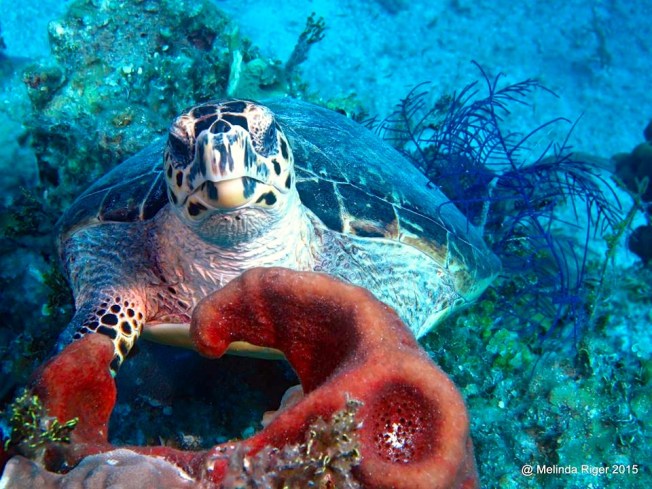
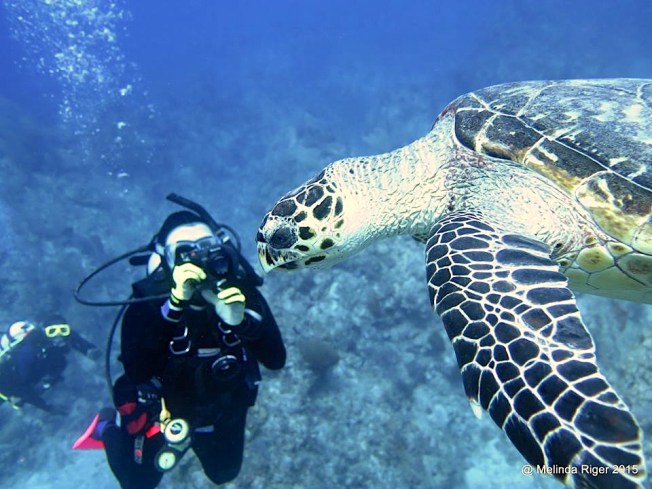
Hawksbill Turtle ©Melinda Riger @ G B Scub 4

GETTING THE MEASURE OF TURTLES ON ABACO

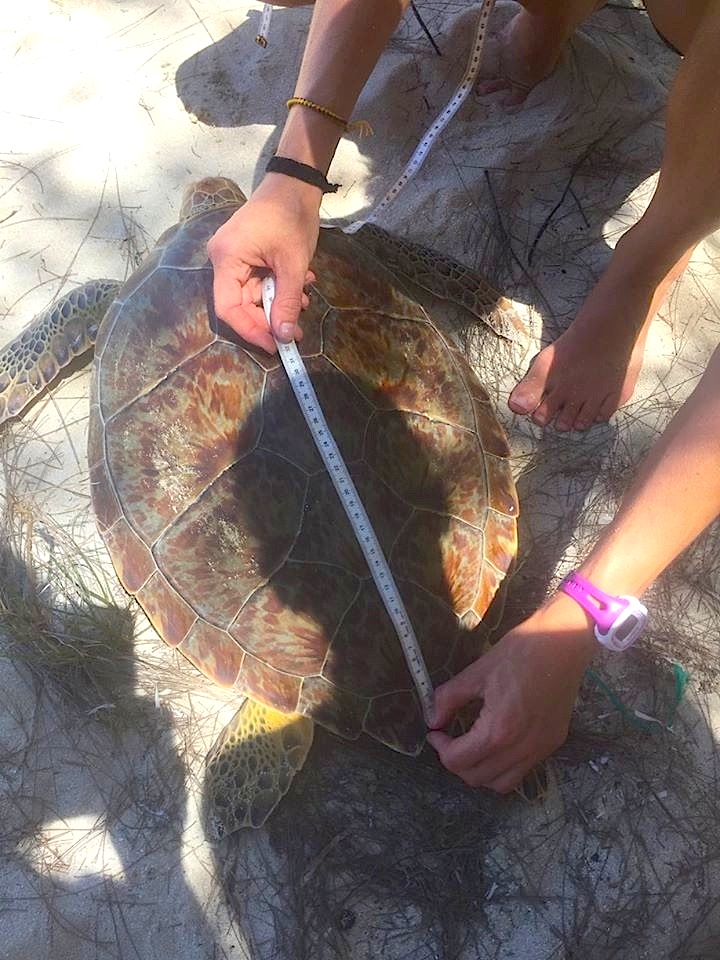
A recent summer course on Abaco was held in partnership between Elizabeth Whitman (Florida International University) and Friends of the Environment/Frank Kenyon Centre. Participants learned about sea turtle biology and ecology, and discussed potential threats to the vulnerable population. After a classroom session, the team headed out to Snake Cay Creek to carry out a field survey. The turtles caught were measured, weighed, tagged (if not already), and given a general health assessment. Each turtle was then released.

The data captured by such courses is invaluable in the continuing assessment of the health of the local turtle population. In addition, such projects provide a valuable opportunity for people to become involved in a fascinating and rewarding local conservation project – with a literally hands-on experience.

Turtle measuring project, AbacoTurtle measuring project, AbacoTurtle measuring project, AbacoTurtle measuring project, AbacoTurtle measuring project, AbacoTurtle measuring project, Abaco

Credits: Beth Whitman, Friends of the Environment, Jacque Cannon, Maureen Collins, Melinda Riger

Unknown's avatar

HAWKSBILL TURTLES: A RARE FIND & SWIMMING WITH ANGELS


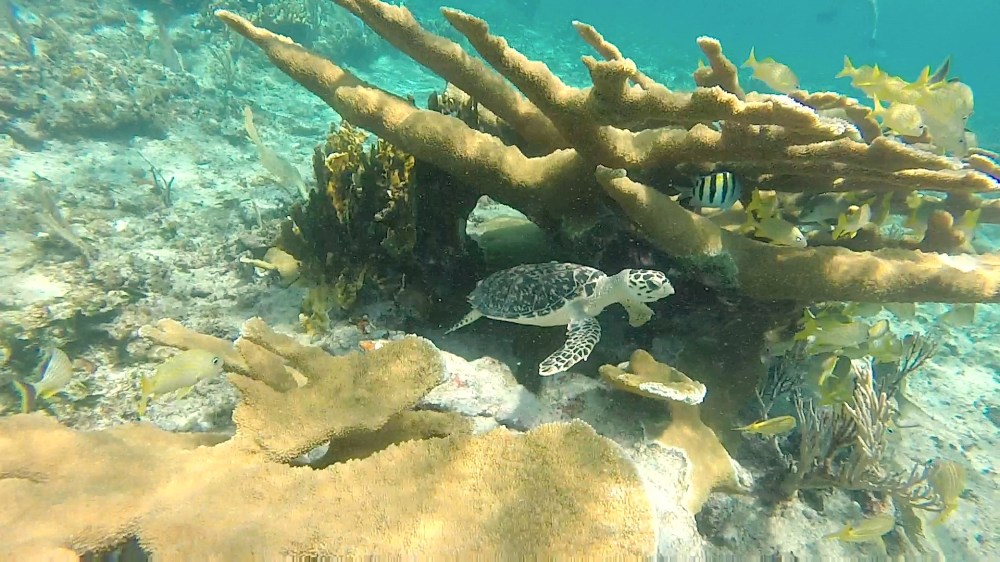
Hawksbill turtle (juv), West End Grand Bahama

HAWKSBILL TURTLES: A RARE FIND & SWIMMING WITH ANGELS

There is something unusual about this juvenile hawksbill turtle peacefully noodling round some impressive elkhorn coral with the grunts and sergeant majors. He’s a rarity. He was found at West End, Grand Bahama (just 67 miles swim from West Palm Beach Fl.), a place where hawksbills are very scarce. Loggerheads, they have. And there are plenty of hawksbills elsewhere in Grand Bahama waters. But not at the western tip. So finding this little guy and getting some good photos was a particular pleasure for Linda Cooper. And maybe the presence of a juvenile is a sign that hawksbills may begin to populate the reefs of West End, as perhaps they did historically.Hawksbill turtle (juv), West End Grand Bahama

Linda and her husband Keith run West End Ecology Tours. They have a comprehensive website HERE and a Facebook page HERE. Check it out to see how much there is to explore at West End. The birds, the corals and reef life, the starfish – and a speciality, swimming with rays. To which can now be added the chance of seeing a hawksbill turtle…Hawksbill turtle (juv), West End Grand Bahama

A DOZEN HAWKSBILL FACTS TO CHEW OVER

  • All sea turtles are classed as reptiles (something that always surprises me, somehow)
  • The top shell (carapace) consists of scales that overlap like roof shingles
  • The yellowish bottom shell is called the plastron
  • Adult hawksbills weigh around 100 pounds
  • Sea turtles sleep at night, and can stay underwater for a hours without breathing
  • Hawksbills are omnivorous, eating algae and seagrass but also sponges, urchins and small fish
  • Females lay about 100 eggs like ping-pong balls, and then at once return to the sea for good
  • The sex of baby turtles is determined by relative nest warmth – females from the top eggs
  • Baby turtles hatch almost simultaneously: all must work to dig their way out.
  • They tend to hatch at night and head straight for the sea’s phosphorescence…
  • …except that artificial lights confuse them & lead them away from the sea to likely death
  • Threats: predation, coastal development & habitat destruction, pollution, & illegal collection

SWIMMING WITH ANGELS

As I was writing this, another fact about hawksbills popped into my head. I checked through my archive – mainly Melinda Riger’s wonderful shots from elsewhere on GB – and yes, it is true. There seems to be some sort of symbiotic relationship between the turtles and angelfish. They are often found feeding together. A bit of research confirms this general observation, without giving a clear cause for it. Maybe it is simply that they eat some of the same food; and that there is plenty of it on healthy reefs so there is no cause for aggression on either side. It’s fine for a hawksbill to share with an angel.

10245Green Turtle, Gray Angelfish ©Melinda Riger @GB Scuba copyTurtle with Gray Angelfish ©Melinda Riger @ G B Scuba copyHawksbill Turtles, French Angelfish eat sponge ©Melinda Riger @ GB Scuba copyHawksbill Turtle eats sponge ©Melinda Riger @ GB Scuba copy

NOTE The Hawksbill is listed as Critically Endangered by the IUCN red list of Threatened species as its populations have declined dramatically throughout the world and especially in the Caribbean region. It is listed in Appendix I of the Convention on the InternatIonal Trade of Endangered SpecIes (CITES) meaning that Hawksbills are near extinction or very endangered. All marine turtles are now protected under Bahamian law, as is the taking of eggs.

Credits: West End Ecology Tours / Linda & Keith Cooper (photos 1, 2, 3); Melinda Riger / Grand Bahama Scuba, all other images; BAHAMAS NATIONAL TRUST  for their very useful fact-sheet (one of many) which I have adopted and adapted; Aquoflite for the vid.

Unknown's avatar

WHALE-WATCHING: THE APPLIANCE OF SCIENCE


Blainville's Beaked Whale, Sandy Point, Abaco 14 (Keith Salvesen

WHALE-WATCHING: THE APPLIANCE OF SCIENCE

The Bahamas Marine Mammal Research Organisation has just celebrated its 25th year of existence. It was formed in 1991. The omnivorous leviathan Amazonus giganticus emerged in 1994 and the invasive species Megacorpus googleii not until 1998. A full 10 years later the first garbled recordings of Sarahpalinus illogicus were made. And all the while, a watchful eye was being kept on the cetaceans of the Bahamas – researching, counting, measuring, identifying, recording, poop-scooping, analysing samples, tagging, comparing, protecting and conserving. 

Blainville's Beaked Whale, Sandy Point, Abaco 20 (Keith Salvesen

As the years passed, so the science and technology evolved and became more sophisticated. Researching became at the same time easier, yet more complex as the organisation’s remit expanded to accommodate the vast increase in data collection now made possible by refined techniques. Here are two very recent examples – 25th anniversary projects, in fact – with thanks to Charlotte, Diane, their team and their colleagues in linked organisations.

TAGGING BLAINVILLE’S BEAKED WHALES

Last month, a tagging project started, involving suction cups being attached to the backs of BLAINVILLE’S BEAKED WHALES. The purpose of the research is to compare the foraging efficiency of the whales in Abaco waters with those of Andros, the second part of the project. I imagine this will provide valuable insights into the whale movements and behaviours in each location as well as such issues as the comparative availability of the food supply, and other factors that may affect expected foraging patterns. 

The tag is moved towards an adult male. Note the aerial (antenna?) at the back of itTagging a Blainville's beaked whale with a suction cup 1

Planting the tag on the whale’s backTagging a Blainville's beaked whale with a suction cup 2

Successful suction!Tagging a Blainville's beaked whale with a suction cup 3

The tag in placeTagging a Blainville's beaked whale with a suction cup 4

The tag is tracked for 18 hours, after which it is retrieved and the recordings can then be analysed back at BMMRO HQ in Sandy Point. So far, an adult male, a young male and two adult females have been tagged. Each female had a calf, but these were not tagged.

Female beaked whale with her calfBlainville's beaked whale female and calf

AERIAL PHOTOGRAMMETRY USING A HEXACOPTER

Drone technology is rapidly expanding as new uses for them are devised. BMMRO in conjunction with NOAA have used a sophisticated HEXACOPTER to take the first  PHOTOGRAMMETRY images of Blainville’s beaked whales. These aerial photographs were taken from approximately 100ft altitude. But note: not just anyone with a $50 drone can do this: the project required flight clearance from the Bahamas Department of Civil Aviation and a permit for research on marine mammals granted by the Bahamas Department of Marine Resources.

 Blainville’s beaked whale photogrammetry image – adult male (note ‘erupted’ teeth) Blainville's beaked whale photogrammetry image - adult male (note 'erupted' teeth) BMMRO

 Blainville’s beaked whale photogrammetry image – female and calf Blainville's beaked whale photogrammetry image - female and calf BMMRO

STOP PRESS Two additional images from the latest batch Blainville's beaked whales photogrammetry image - BMMRO  Blainville's beaked whales photogrammetry image - BMMRO

Photogrammetry: the science of making measurements from photographs. Applications include satellite tracking of the relative positioning and alterations in all Earth environments (e.g. tectonic motions etc), research on the swimming of fish, of bird or insect flight, and other relative motion processes. The results are used to guide and match the results of computational models of the natural systems. They help to invalidate or confirm new theories, to design novel vehicles or new methods for predicting or/and controlling the consequences of earthquakes, tsunamis etc, or to understand the flow of fluids next to solid structures, and many other processes. (Wiki-précis)

Hexacopter (6 rotors)Hexacopter_Multicopter_DJI-S800_on-air_credit_Alexander_Glinz

Tag Team: BMMRO, University of St Andrews (Scotland), Woods Hole Oceanographic Institution

Hexacopter: BMMRO, NOAA

Photo Credits: top two, moi (from BMMRO research vessel); remainder except for last, BMMRO; last, Wiki

Unknown's avatar

WORLD OCEANS DAY 2016: “STASH THE TRASH”


View from a Skiff, the Marls, Abaco, Bahamas

WORLD OCEANS DAY 2016: “STASH THE TRASH”

Today the NOAA and other worldwide ocean guardian organisations are celebrating World Oceans Day. Looking at the websites and FB pages, one message is clear: People Are Rubbish. To put it another way, the global pollution of the oceans is caused solely by humans. The pristine seas and beaches of the world were unsullied until, say, the last 200 years. In 4 or 5 generations, all that has changed irreversibly.

Leave only Footprints - Delphi Beach, Abaco

My rather (= very) negative intro is counterbalanced by some more positive news: there are plenty of good guys out there working hard to make a difference to the rising tide of filth polluting the oceans. Clearing seas and beaches of plastic and other debris. Collecting tons and tons of abandoned fishing gear. Rescuing creatures trapped, entangled, injured and engulfed by marine debris and pollutants. Educating adults and – far more importantly – children and young people by actively involving them in their campaigns. Conducting research programmes. Lobbying and protesting. And a lot more besides.

A marine garbage patch: the sea creatures’ view (NOAA)Marine Garbage Patch from below (NOAA)

Abandoned fishing gear: a monk seal that was lucky; and a turtle that wasn’t (NOAA)Monk Seal in discarded fishing nets (NOAA)Sea turtle trapped in abandoned fishing gear (NOAA)

Four shearwaters killed by a cone trap. A fifth was rescued (NOAA)13138799_1188762361142231_1433873125345242619_n

The NOAA and sister organisations carry out massive programmes of clearance of marine debris, with working parties of volunteers who do what they can to deal with an intractable problem.Clearing Beach Debris (NOAA) Clearing Beach Debris (NOAA)

But you don’t need to be on an official working party for a large organisation. In the Bahamas and on Abaco, the BAHAMAS PLASTIC MOVEMENT, FRIENDS OF THE ENVIRONMENT  and BAHAMAS NATIONAL TRUST among others, do wonderful work on a more local level.
Childen collecting beach debris, Abaco (FotE)

HOPE  FOR  THE  FUTUREYoung conservationist on Abaco, Bahamas

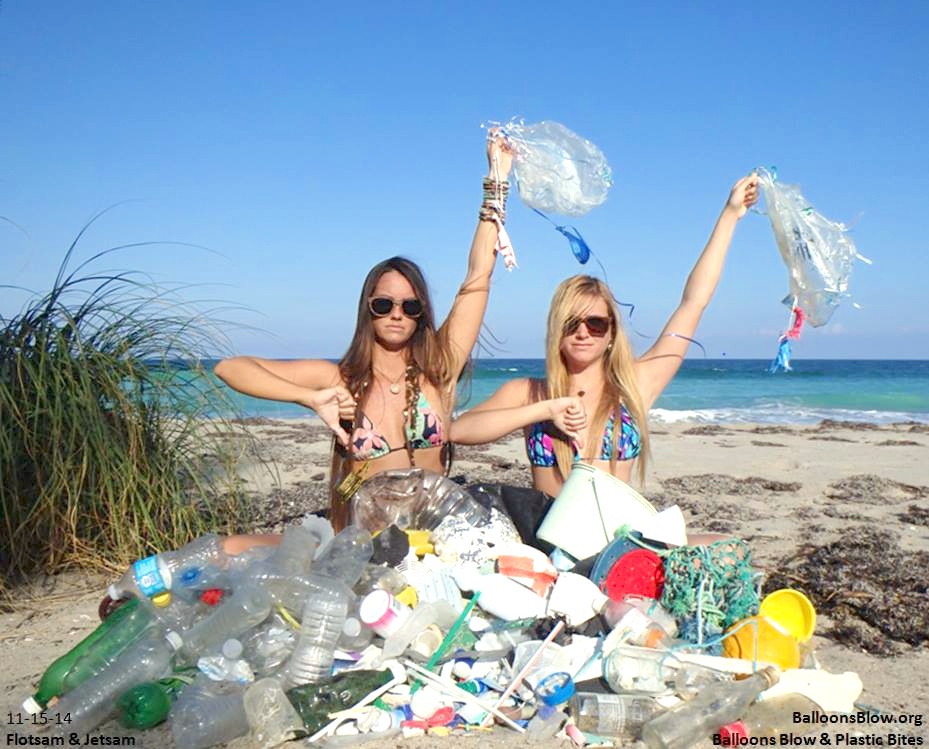
Elsewhere, some tackle the problems caused by particular types of trash, balloons being an excellent example. I have posted before about BALLOONS BLOW, the brainchild of two sisters who learnt of the serious consequences to wildlife caused by mass balloon releases. Their work has been so effective that increasing numbers of mass releases are being cancelled in favour of other forms of celebration. A minus for balloon-makers of course, but a big plus for wildlife. The BB sisters also keep their own beach clear of the junk brought in on every tide.

Balloons Blow - Beach Debris (http://balloonsblow.org) Balloons Blow - Beach Debris (http://balloonsblow.org)

And on an individual basis, any old fool can make a tiny difference to a local beach. Here is one such doing just that…

A tangle of balloon strings on Delphi beachBalloon Strings, Delphi Beach (RH)

Guinea Schooner Bay: little visited, rarely cleaned. Plastic crap from a 10 foot radiusRH & trash, Guinea Schooner Bay

Credits: NOAA, FOTE Abaco, BPM, Balloons Blow, RH, Mrs RH

Unknown's avatar

“TEACH YOUR CHILDREN WELL”: WHERE CONSERVATION BEGINS


Young conservationist on Abaco, Bahamas

“TEACH YOUR CHILDREN WELL”: WHERE CONSERVATION BEGINS

“Catch ’em young”. The perfect plan with children. On Abaco, wonderful work is continually being done with young children on the mainland and on each cay to teach them how precious their environment is, how fragile, and how important it is to take good care of it. The huge enthusiasm of the youngsters casts a beam of light onto the rather dark global picture of habitat destruction, pollution and ecological neglect that we have become depressingly accustomed too.

Young conservationists on Abaco

Education and training is carried out in schools; field work is done involving children of all ages; and camps are organised. FRIENDS OF THE ENVIRONMENT carries out this invaluable and rewarding task on an almost daily basis, offering students an astounding range of environment-based activities. Even the very youngest are catered for: the “Sea Beans Club”  is an after-school club for ages 3-5, which introduces young minds to their environment through educational activities and outdoor play.

Students and researchers from CWFNJ survey the beach to make sure that their activities will not disturb any plovers feeding in the areaYoung conservationists on Abaco

Students and volunteers selectively remove small invasive Casuarinas, which were encroaching on plover roosting habitat. By removing the invasive plants, native plants will be able to flourish and help stabilize the beach.Young conservationists on Abaco

The BAHAMAS NATIONAL TRUST, too, plays its part in educating children about the fascinating yet frail world around them. For example, Scott Johnson’s snake protection work, in which he demonstrates to small kids that Bahamas snakes are completely harmless and to be respected not feared, is a wonder to behold.

BNT’s Scott Johnson visits a school with his non-scary snakesScott Johnson - BNT - Bahamas Snakes - Children's Education

In addition there are strong partnerships with organisations many miles away from the Bahamas, of which the CONSERVE WILDLIFE FOUNDATION OF NJ is the prime example. Todd Pover, Stephanie Egger and the team take their remit beyond their well-known piping plover conservation work by engaging with the pupils of Abaco’s schools each year and inspiring them.

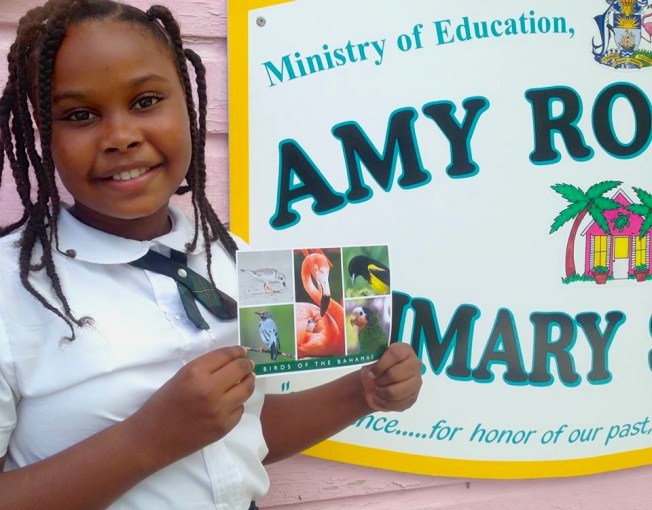
Amy Roberts Primary School CWFNJYoung conservationists on AbacoYoung conservationists on AbacoYoung conservationists on Abaco

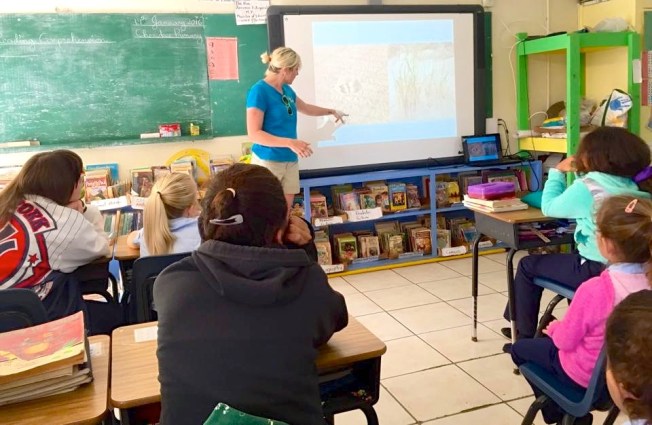
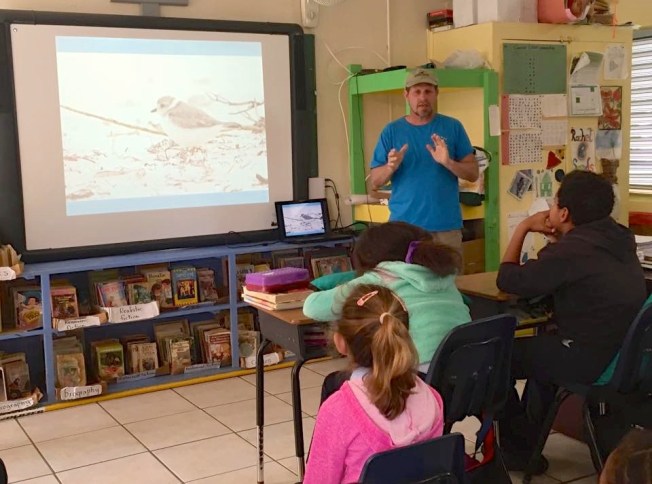
Much of the work is done in the field, getting the children interested in birds, the shoreline, the vital ecological role of mangroves, and the problems of marine debris. Other important work can be done in the classroom.

Young conservationists on Abaco Young conservationists on Abaco(A quick shout-out to Tom Reed, who I know took the piping plover photo!)

The clear message being sent out to the schoolchildren on Abaco is this: you are never too young to learn how to appreciate, respect and look after your environment. And they are responding with intelligence and enthusiasm. We are lucky that these kids are the future.

IMG_7390

Stephanie Egger of CWFNJ writes: “This year, we’ve reached over 120 students through the Shorebird Sister School Network Program, both from the Bahamas and in the United States. We hope to foster a greater appreciation for wildlife, especially for the Piping Plover and its habitat, and inspire students to help now — and later on in their lives as adults — ensuring the recovery and survival of the bird for years to come”.

VOLUNTARY MUSICAL DIGRESSION

“Teach your Children” is the second track of Déja Vu, the 1970 CSNY album. Nash wrote it much earlier, when still with the Hollies, then stored it in his musical lumber room. Just as well: it fits perfectly with the rather fey hippy vibe of the rest of Déja Vu.

Young conservationist on Abaco

Credits: huge thanks for general use permission for material to FotE, BNT and CWFNJ; and to all the individual photographers concerned

Unknown's avatar

BAHAMAS REEF CORAL: A COLOURFUL GALLERY


Orange Cup Coral ©Melinda Riger @ G B Scuba copy

BAHAMAS REEF CORAL:  A COLOURFUL GALLERY

The reefs of the northern Bahamas, as elsewhere in the world, are affected by two significant factors: climate change and pollution. Stepping carefully over the sharp pointy rocks of controversy, I’ve avoided the term ‘global warming’ and any associated implication that humans (oh, and methane from cows) are largely to blame for the first factor; but on any view, ocean pollution is the responsibility of mankind (and not even the cows). 

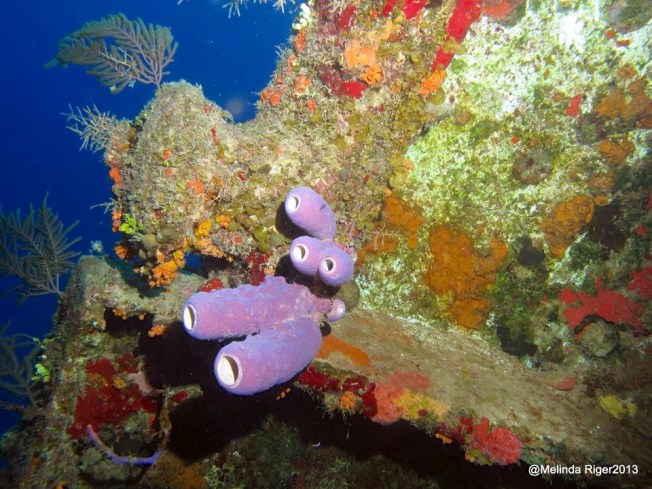
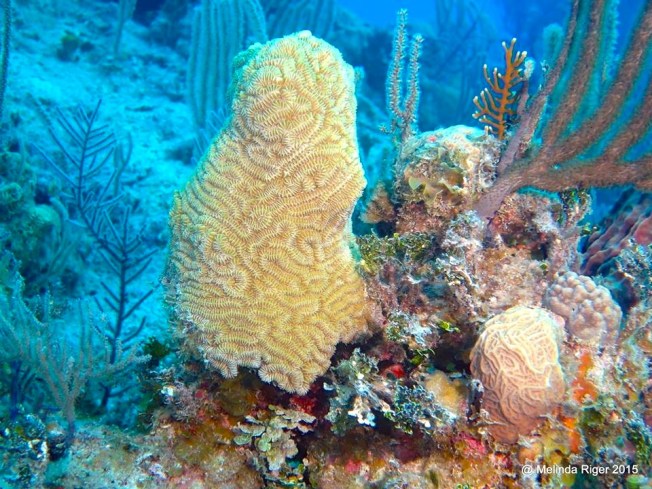
That said, an exploration of the reefs of Abaco or Grand Bahama will reveal not just the astounding variety of mobile marine life but also the plentiful and colourful static marine life – for example the beautiful and Christmassy orange cup coral in the header image. Here are some more corals from the reefs, with a mix of sponges added in. 

Giant Star Coral & Rope Sponge ©Melinda Riger @ GB Scuba copyCorals ©Melinda Riger @ G B Scuba copy 2Corals ©Melinda Riger @ GB Scuba copySea Fans & other corals ©Melinda Riger @ Grand Bahama Scuba copy

This rather intriguing photo shows a hermit crab’s conch home that presumably the occupant grew out of and left behind in the delicate coral branches as it went search of a more spacious shell dwelling.Coral & conch ex crab home 1380179_645156602172399_300806994_n copy

Credits: All these wonderful photos are by Melinda Riger of Grand Bahama Scuba; tendentious reef health observations are mine own…

Unknown's avatar

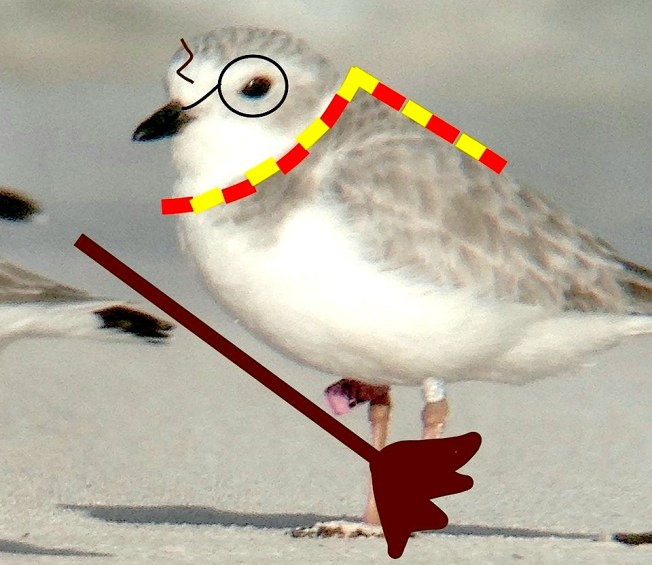
“HARRY POTTER & THE MAGIC BAND” (A PIPING PLOVER STORY)


PIPL PINK22 Harry Potter π Stehanie Egger copy

“HARRY POTTER & THE MAGIC BAND” (A PIPING PLOVER STORY)

by ROWLING HARBOUR

It was a bright sunny morning and the sand on the beach was warm under Harry Potter’s bare feet. Although by now a very experienced flyer, his recent adventures during his epic 1000-mile journey had left him very tired. All his friends that had undertaken the same long flight were tired too. Now they were enjoying a quiet, peaceful time away from all the dangers they had somehow survived during their scary expedition (see Harry Potter and the Migration of Fear). It would be a long time, Harry said to himself – maybe as long as 6 months – before he wanted to have another experience like that. He wondered when Ron Piper and Hermione Plover would arrive. He hadn’t even found them yet… 

_Piping_Plover_on_the_Fly (USFWS Mountain-Prairie wiki)

But the little group on a remote shoreline on Abaco were not as safe as they thought. Unknown to the happy, sleepy plovers on the beach, they were already being stalked by two creatures. This determined pair had one sole aim – to find plovers, to catch them and to carry out scientific experiments on them. That’s three aims, in fact. The editor would surely fix that error later (No – ed.). Would Harry and his friends soon find themselves in mortal peril from these formidable adversaries, these beasts with huge brains, armed with the latest technology? What magical powers would be needed to combat the imminent danger creeping stealthily towards them? The male definitely had a spine-chilling look about him; the female appeared less daunting – but might therefore be all the more dangerous…

TOPO & STEG PIC JPG   piping-plover

Suddenly, Harry felt a sense of danger. Fear ruffled his neck feathers and his little left foot started drumming impatiently on the sand. He’d felt like this several times before, like that time the Dark Lord had driven a SUV straight at him on that nesting beach many miles away, the one where he cracked out (see Harry Potter and the Vehicle of Dread). And when the massive dog came and sniffed round the nest when he was a tiny chick (see Harry Potter and the Hound of Horror). Instinctively, he grabbed a magic meat-string from the damp sand, ate it, and took to the air… only to be caught up in some sort of fearsome spider’s web (a mist net – ed.). He was trapped. He struggled bravely, peeping out his anger at this cruel trick. But it was no good – he was caught fast, and wriggling only seemed to make it even worse. The massive creatures were running towards him fast, shouting in triumph – they had got Harry exactly where they wanted him – at their mercy…

A Mist Net (if unsuccessful, A Missed Net)Mist Net jpg

Just as Harry had started to believe that his last moment had arrived, an amazing thing happened. Instead of dispatching him with a swift blow to head, as the Dark Lord might have done, he was gently removed from the net and softly held in the female’s hands. His instant fear that she might crush him to a horrible mangled pulp rapidly lessened. Why, she was even talking to him. And those voices. They sounded not so much fearsome as friendly. But were they lulling him into  false sense of security, only to wreak an evil vengeance upon him? (*Spoiler Alert* No – ed.).

The Steph of Egger with captive Harry Potter, & wearing the cap of the mysterious ‘Delphi Club’1484646_10205144305680789_2528266936610237451_n

Then suddenly things got worse. Much worse. Harry was slowly wrapped in a large white blanket and laid on something that wasn’t sand. Something hard. What were they planning to do with him now. He heard the male – Harry had now concluded that he must be dealing with the Avian Overlord himself, the infamous Todd of Pover, first cousin of Severus Snipe – mutter an incantation: “54 grams. Pretty good. 54 grams. Have you got that”. Yes, they’d taken his dignity and his weight but there had been no pain. Yet. Harry began to relax a little.

10957577_10205144275960046_8670418050291183808_n

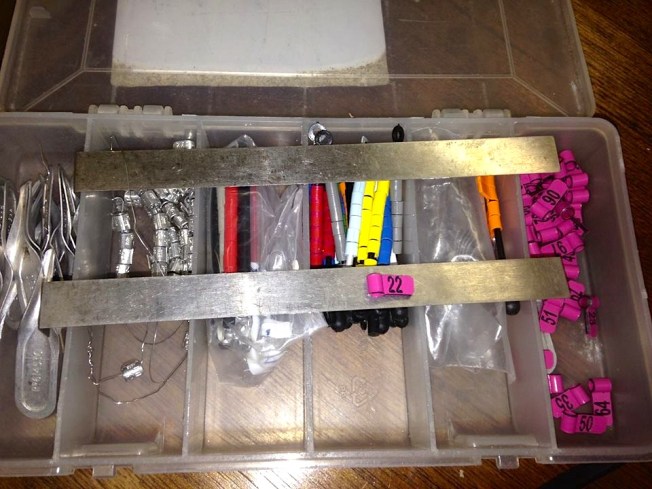
Meanwhile, Steph the Egger was making a strange rattling sound. As Harry was unwound from his shroud he suddenly saw a box filled to the brim with exotic jewels of the most opulent colours glistening in the sunlight. At once, he knew he had to have one of them. A beautiful pink one. One to wear on his leg. One that he could keep for ever. One that would always mean ‘Harry Potter’. That very one on the top. Just there. With the magic number 22 on it in black writing. And Harry started to breathe a special silent Piping Spell: ‘Please pick me up… in your hand… and fit the Magic Two-Two Band…’ 
10953155_10205138160647167_6364662204306663309_n

And, miraculously, the spell began to work. First, Harry was gently held as the Magic Band was put round his right leg. At the top, just where he wanted it. Harry shut one eye and repeated the spell.18265_10205144276640063_342488571243728001_n

Then despite an awful wound from an earlier battle, the Todd of Pover made sure the band was secure and would never come off. It would be there forever – the Harry Potter ID band. By this time Harry didn’t even mind the indignity of being turned upside down.1688061_10205144276200052_1782966976770605282_n

Finally, it was done. Really, the jewel was more like a flag than a band. But Harry knew instinctively that it would take a massive effort for his story to be rewritten to make this clear from the start, so he decided to let it pass. Band. Flag. What did it matter. It was his prize, gloriously his. 

And then he was passed to Steph the Egger. Harry presumed she got her name for her ability to find nesting birds in that other place he had flown South from. And now, here she was, holding him tenderly, talking to him and telling him how cool he looked. Even her bright red claws did not seem so frightening now. Except… WHAT WOULD HAPPEN TO HIM NOW?

10169303_10205144274240003_5908333687210042239_n

Suddenly, Steph the Egger stood up and Harry found himself several feet above the safe warm sand. Steph held him out in front of her and then, in an instant, he was free… Free to fly away with his beautiful pink jewel band, his special number, and an intuition that wherever he might be, and whoever saw him, they would always know that he was Harry Potter for as long as he lived. Against all odds he had gained… THE MAGIC BAND.

10931116_10205144276720065_5757419875474692020_n

piping-plover

POSTSCRIPT

No one knows when Harry Potter left Abaco last spring, nor where he spent his Summer. All that can be said with certainty is that 12 months later he was found again on the same beach, Long Beach Abaco, in the same place. 5 other PIPL were pink-banded with him last year by the National Audubon, Virginia Tech, BNT, and CWFNJ team (pink being the colour used for Bahamas birds). Of those 6, 5 have been resighted on the same beach in the last few days. They migrated north last Spring, spent the Summer probably in different locations yet found their way back to the same place on Abaco to overwinter together again.

GENDER NOTE In fact it isn’t clear if HP is male or female (see below). He might be Harriet Potter. But I have played safe and stuck with the gender implied by his given name…

Harry Potter Pink 22 UR on Long Beach Abaco, 3 Dec 2015, a year after he was banded therePIPL PINK22 Dec 3 2015 Long Beach Abaco 1 (Stephanie Egger) copy PIPL PINK22 Dec 3 2015 Long Beach Abaco 2 (Stephanie Egger) copy

STEPH THE EGGER EXPLAINS THE NAME, NUMBER & QUIDDITCH PIC

“I helped band this piping plover last winter, and called him “Harry Potter.” I know 22 isn’t Harry’s quidditch number (07), but 22 is for my birthday when I mostly seem to be down in Abaco. We don’t know where Harry Potter bred this year as no reports came in for him (or her). Maybe next season!

DISCLAIMER RE HEADER IMAGE I don’t suggest making silly photos of all “named” birds as this is an endangered species that we should certainly take very seriously. That said, I do think that names help people connect to the species and it also aids the researchers in id’ing (my personal opinion)”.

piping-plover

Credits: Stephanie Egger, Todd Pover, Conserve Wildlife Foundation of New Jersey & co-banding teams, USFWS Mountain-Prairie (PIPL in flight), Birdorable, Rowling Harbour, and star of the show Harry Potter Pink 22 UR. Apologies to JKR for feeble pastiche.

Unknown's avatar

HAWKSBILL TURTLES: WONDERFUL… & CRITICALLY ENDANGERED


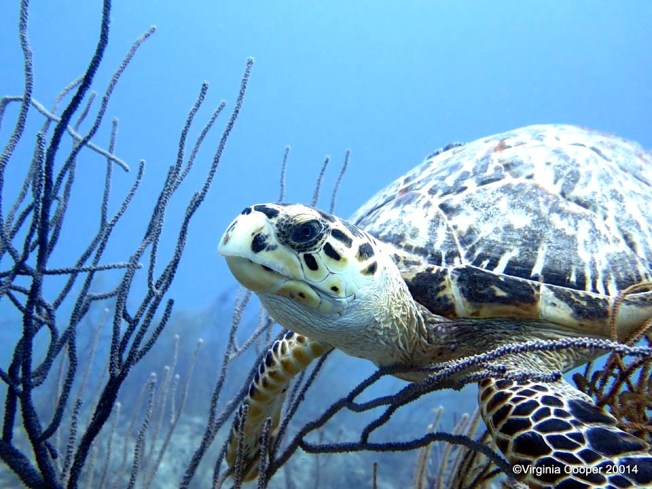
Hawksbill Turtle ©Virginia Cooper @ G B Scuba

HAWKSBILL TURTLES: WONDERFUL… & CRITICALLY ENDANGERED

Hawksbill Turtle ©Melinda Riger @ G B Scuba copy 3

Hawksbill turtles are found throughout the tropical waters of the Atlantic, Pacific, and Indian Oceans. They avoid deep waters, preferring coastlines where sponges are abundant and sandy nesting sites are within reach. They are normally found near reefs rich in the sponges they like to feed on. Hawksbills are omnivorous and will also eat molluscs, marine algae, crustaceans, sea urchins, fish, and jellyfish. 

Hawksbill Turtle Range (Nat Geo)map-hawksbill-turtle-160-cb1447865323

Turtle with Gray Angelfish ©Melinda Riger @ G B Scuba

WHY ARE HAWKSBILLS CRITICALLY ENDANGERED?

  1. Despite the protection of their shells, turtles are predated on by large fish, sharks, octopuses, and (unlawfully) humans.
  2. Hawksbills are slow breeders, mating only every 2 or 3 years, which is the first drawback to species survival.
  3. Having laid the resulting eggs on a beach, the female returns to the sea. The eggs hatch after a couple of months. Unless, of course, some creature – and that includes humans – has got to them first…
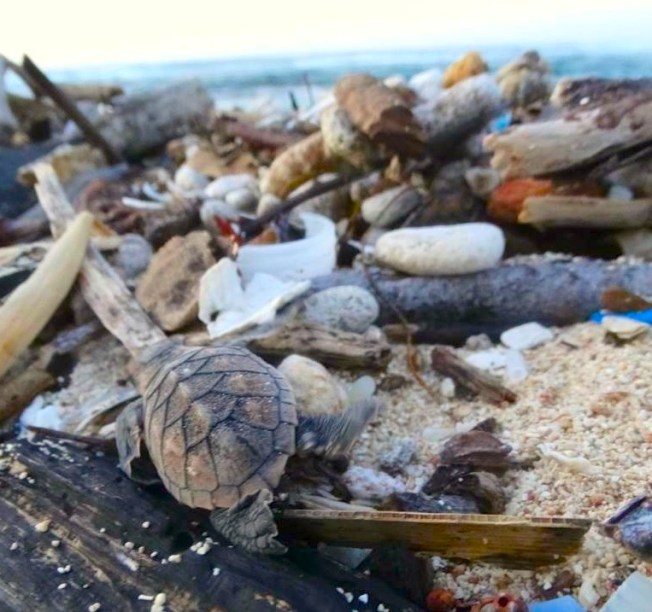
  4. Hatchlings are hugely vulnerable as they make their way from the nest site to the sea. However fast they scurry along, crabs and in particular flocks of gulls are faster. Also, they may have to negotiate impossible obstacles washed up onto the beach  (see below). The attrition rate of  tiny turtles at this stage is very considerable.

Hawksbill Turtle ©Melinda Riger @ GB Scuba copy

SO, HUMANS ARE BASICALLY IN THE CLEAR, RIGHT?

Humans can take most of the credit for the turtles plight leading to their IUCN ‘critically endangered’ listing, in these mostly illegal ways:

  • Killing adult turtles for food or…
  • …for their beautiful shells
  • Digging up turtle nesting sites to take the eggs as food
  • Catching turtles in fishing nets as unintended but often inevitable BYCATCH
  • Providing a rich stew of plastic, styrofoam & other dietary or physical hazards in the ocean
  • Degrading or destroying the nesting sites, & indeed the reefs on which turtles depend

A hatchling tries to clamber over beach rubbish to get to the seaTurtle traps - Melissa Maura copy

A straw is extracted from a turtle’s nostril (small pics on purpose – I spared you the long video)Turtle & straw 1 (Nathan Robinson : Chris Figgener) Turtle & straw 2 (Nathan Robinson : Chris Figgener) Turtle & straw 3 (Nathan Robinson : Chris Figgener)

This poor creature was found just in timeHawkbill Turtle Plastic breathecostarica copy

Assorted plastic effects (the turtle trapped in the beach chair was off Man-o-War Cay) Sea Turtle tied up in balloon string (Blair Witherington : NOAA) copyphoto copy 7 This turtle, which was found floating in North Man-O-War Channel, died as a direct result of being entangled in human trash(in this case, a lawn chair) copy IMG_1346 copy

PLEASE CAN WE GO BACK TO HAPPY PICTURES?

Healthy hawksbills happily living the northern Bahamas reef lifeHawksbill Turtle (m) (Melinda Riger @ G B Scuba) Hawksbill Turtle (flipper damage) ©Melinda Riger @ GB Scuba

RELATED POSTS

TURTLEY AMAZING

SEA TURTLE THREATS

BABY TURTLES WITH PHIL LANOUE

Hawksbill Turtle & photo ©Melinda Riger @ G B Scuba

Credits: Melinda Riger & Virginia Cooper of Grand Bahama Scuba for the main photos; Melissa Maura, Nathan Robinson, Friends of the Environment and other FB sharers for the small images; National Geographic for range chart and information

Unknown's avatar

BAHAMAS MANATEES: GINA’S CALF NEEDS A NAME!


Gina the Bahamas Manatee (pregnant) Eleuthera (BMMRO)

Gina the Manatee, Eleuthera – expectant mother (BMMRO)

BAHAMAS MANATEES: GINA’S CALF NEEDS A NAME!

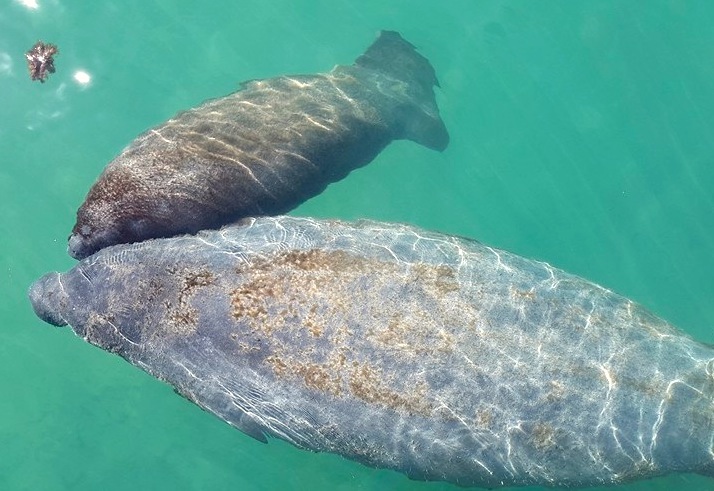
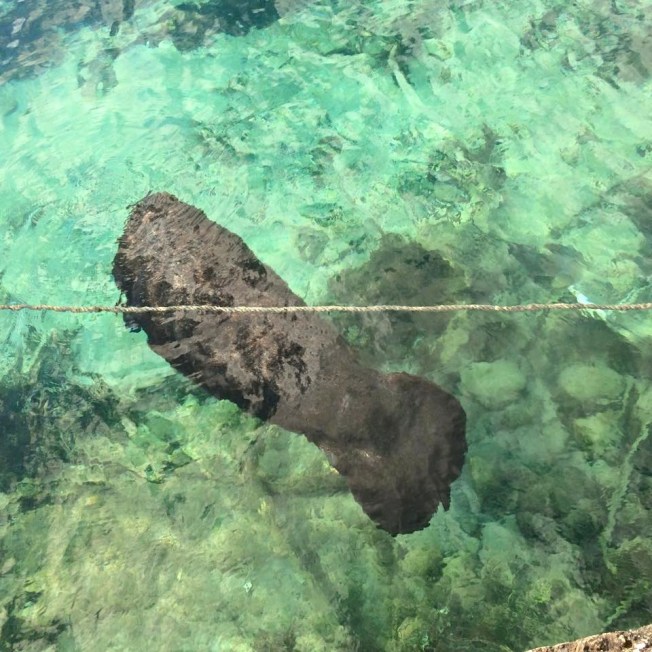
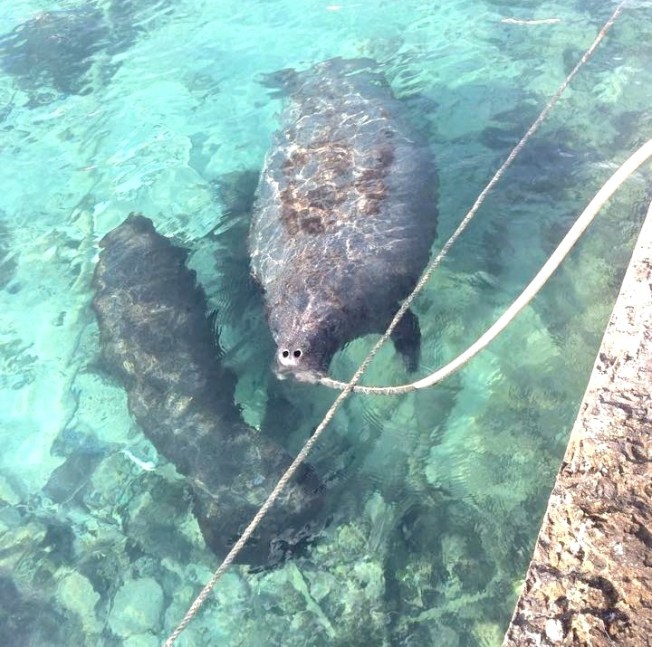
Earlier this year I posted the welcome news that Bahamas manatee Gina was beyond any doubt pregnant. You can read about it HERE. Gina has been living for some time in Eleutheran waters, under regular observation by the BMMRO. At the turn of the year, she was re-tagged in Harbour Island, Eleuthera, when her pregnancy was discovered. I promised to give an update and this is a perfect moment. Gina’s calf was safely born and is growing fast. The pair have spent a lot of time in and around Spanish Wells, Eleuthera. Recently they have begun to move further afield, and there have been several sightings with some great photos shared on FB and in particular on Felice Leanne Knowles’s terrific BAHAMAS MANATEE CLUB page, some of which are included here duly credited.

Gina the Bahamas Manatee (pregnant) Eleuthera (BMMRO)

Gina’s calf is currently just called “Gina’s calf”. Its gender is unknown, and it will take a close inspection from below to ascertain from its… I don’t have to go on with this, do I? The point being that the chosen name will need to be unisex because it may take a while until there is sufficient development of the… I don’t have to go on with this either, do I? Let’s see the nameless calf at once! Details of the competition at the end of this post…

Gina with her newborn calf, July 27 (BMMRO) (note apparent prop scars on Gina)11209341_1012183408800885_310154952620912454_n

Spanish Wells, October 26 (π Junea Pinder / BMMRO) Gina the Bahamas manatee and her calf (Junea Pinder / BMMRO) Gina the Bahamas manatee and her calf (Junea Pinder / BMMRO)

Gregory Town, November 5 (Lynne Hirzel / BMMRO)12188935_10156306821645195_3509772562942760375_n 12219637_10156306821330195_1471887362053804519_n

Hatchet Bay, November 13    (π Jeffrey Louis / BMMRO)  10425501_1042928762405755_7163144254688618862_n 12108239_1042928735739091_6064773734031487371_n

November 18: Now you see it… (π Norma Roberts / BMMRO)Gina & Calf Norma Roberts 1 copy

…and now you don’t…Gina & Calf Norma Roberts 2 copy

THE COMPETITION

ATTENTION TEAM MANATEES!!! Due to a consistent influx of sighting information and photos, we would like to add Gina’s calf to our catalogue. It would be nice for it to have a NAME!! We cannot monitor these manatees without your help and it is only fitting that  YOU name the manatee. The deadline for name suggestions is November 29th, 2015 and the winning name will be revealed on November 30th, 2015. The member with the winning name suggestion will receive an official manatee club T-Shirt!!

RULES

1. The name must be submitted on the Club Page Bahamas Manatee Club as an individual post – DO NOT comment your suggestion.
2. The name must be unisex – we do not know the sex of the calf yet.
3. A meaning or description must be submitted along with the name.
4. Please do not submit any derogatory or explicit “names.”
5. If you are submitting on behalf of a child who is not on Facebook, please add their name to the post as well.

Spread the word! Tell your friends and families to join the club and help us with a name!! The name will be selected on it’s meaning or description as it relates to marine mammals OR The Bahamas. The amount of “likes” per post will also go into consideration during the selection process.

Regretful Note: I made the stupid mistake of being amongst the very first to post my suggestion, meaning that after a day or two I’d get no likes at all, as more people got involved and my offering sank slowly. But there’ve been plenty of much better ones since, so probably just as well!

Bahamas Marine Mammal Research Organization

Bahamas Manatee Club

For more information about West Indian manatees, you can visit the MANATEE PAGE. There are several links there to specific manatee stories.

Finally, here is a great manatee map that Felice has recently made, showing which of the increasing number of manatees is where at the moment. Just think, only 4 or 5 were known about four years back. Now look!

12241226_298174587019969_1571890190333376929_n

Credits: primary founts of Bahamas manatee knowledge Felice & BMMRO; Photos BMMRO, Junea Pinder, Lynne Hirzel, Jeffrey Louis, Norma Roberts

mantsw~1

Unknown's avatar

SEABIRDS, SHOREBIRDS & WADERS: 30 WAYS TO TELL THEM APART


Reddish Egret, Crossing Rocks, Abaco (Keith Salvesen)12

Reddish Egret male in breeding plumage, Crossing Rocks, Abaco

SEABIRDS, SHOREBIRDS & WADERS: 30 WAYS TO TELL THEM APART

This weekend is Wader Conservation World Watch weekend, promoted by WADER QUEST. This is the perfect moment to help with the vexed question: “See that bird? Over there. No, THERE! Is it a seabird, shorebird or a wader?” 

Publication1

There is plenty of scope for confusion, since in practice there is a degree of informal category overlap and even some variation between the various bird guides. And after all, shorebirds may wade. And wading birds may be found on the shore*. Here is a reminder of 30 infallible rules to sort out which is which, courtesy of the estimable BEACH CHAIR SCIENTIST blog. 

*STOP PRESS Rick Simpson of Wader Quest has kindly added a comment pointing out the marked difference in the categorisation on either side of the Atlantic: “What you in the USA call shorebirds we here in the UK call waders (peeps, sandpipers, plovers oystercatchers etc – but not skimmers). Shorebirds to us can be any bird that lives on a shore, ie egret, herons, gulls. To add more confusion some seabirds such as Gulls, Skuas (Jaegers) Terns and Auks are also all in the group called Charadriiformes, not just the waders… er I mean shorebirds, or do I? [So] should any of you decide to participate in our world watch it is your shorebirds (but not skimmers) that we are interested in and we call them waders. Anyone want to know the rules of cricket? It is easier to explain!”

magnificent-frigatebird

10 CHARACTERISTICS OF SEABIRDS 

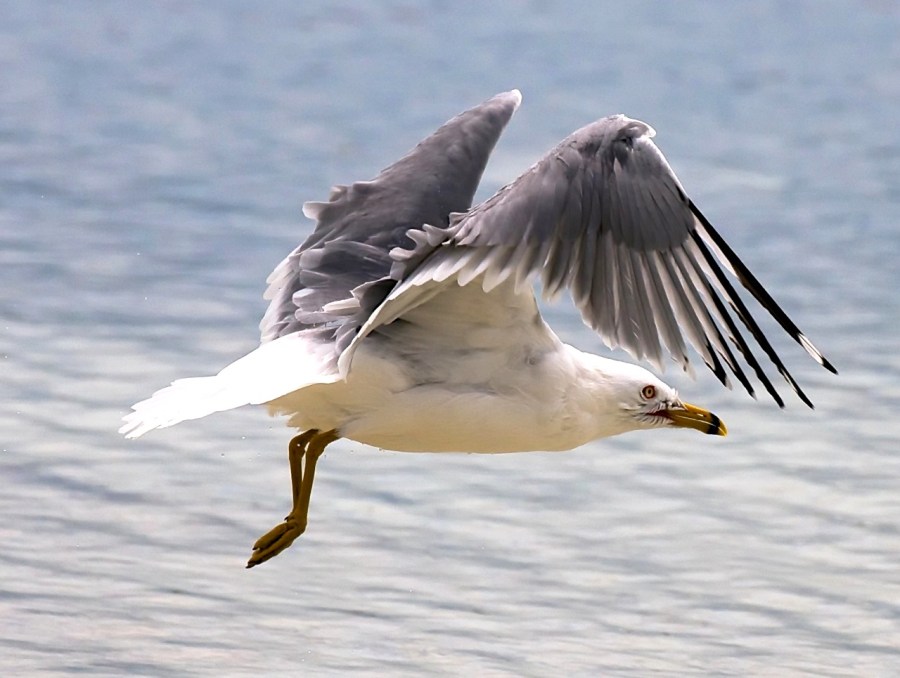
Ring-billed gull, AbacoRing-billed Gull (Nina Henry : DCB)

Examples include frigatebirds, petrels, shearwaters, gulls, terns and tropicbirds

1. Seabirds are pelagic, spending most of their lives far out at sea.
2. Seabirds move toward to coastal areas to breed or raise young for a minimal amount of time.
3. Seabirds are light on their undersides and dark on top (an adaptation known as countershading).
4. Seabirds have more feathers than other types of birds for more insulation and waterproofing.
5. Seabirds have flexible webbed feet to help gain traction as they take off for flight from the sea.
6. Some seabirds have unusually sharp claws used to help grasp fish under the water.
7. Some larger seabirds (e.g. albatross) have long, slim wings allowing them to soar for long distances without getting tired.
8. Some smaller seabirds have short wings for manoeuvering at the surface of the water.
9. Seabirds have specialized glands to be able to drink the saltwater and excrete salts.
10. Some seabirds (e.g. gannets) have a head shape that is usually tapered for more efficiency in plunge diving.

piping-plover

10 CHARACTERISTICS OF SHOREBIRDS 

Ruddy Turnstone, AbacoRuddy Turnstone Abaco Bahamas. 2.12.Tom Sheley copy 2

Examples include oystercatchers, turnstones, knots, plovers and sandpipers

1. Shorebirds have long legs, pointed beaks, and long pointed wings.
2. Most shorebirds are migratory (impressively some shorebirds fly non-stop for 3-4 days, equivalent to a human running continuous 4-minute miles for 60 hours).
3. Shorebirds wade close to the shore and poke their bills into the ground in search of food.
4. Shorebirds are small to medium size wading birds.
5. Shorebirds tend to frequent wetlands and marshes and are biological indicators of these environmentally sensitive lands.
6. Shore birds are of the order Charadriiformes.
7. Shorebirds are very well camouflaged for their environment and their appearance may vary from place to place as plumage (feather colors) are gained or lost during breeding.
8. Shorebirds typically range in size from 0.06 to 4.4 pounds.
9. Oystercatchers have a unique triangular bill that is a cross between a knife and a chisel.
10. The black skimmer is the only native bird in North America with its lower mandible larger than the upper mandible, which helps the bird gather fish as it skims the ocean surface.

roseate-spoonbill

10 CHARACTERISTICS OF WADING BIRDS 

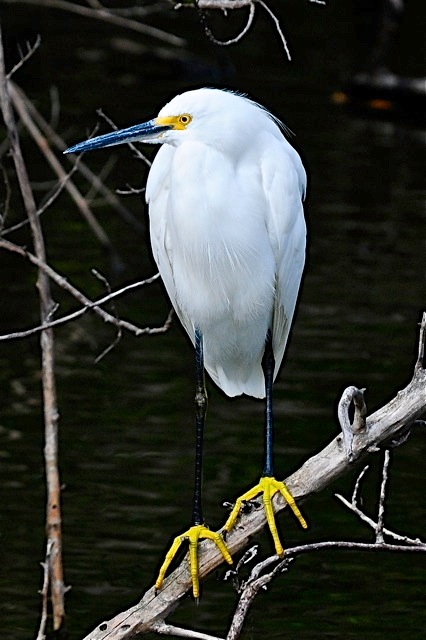
Snowy Egret, Abaco
Snowy Egret ?NP_ACH1409 copy

Examples include egrets, herons, flamingos, ibis, rails, and spoonbills

1. Wading birds are found in freshwater or saltwater on every continent except Antarctica.
2. Wading birds have long, skinny legs and toes which help them keep their balance in wet areas where water currents may be present or muddy ground is unstable. Also, longer legs make it easier for them to search for food (forage) in deeper waters.
3. Wading birds have long bills with pointed or rounded tips (depending on what is more efficient for the types of food the bird consumes).
4. Wading birds have long, flexible necks that can change shape drastically in seconds, an adaptation for proficient hunting.
5. Herons have sophisticated and beautiful plumes (‘bridal plumage’) during the breeding season, while smaller waders such as rails are much more camouflaged.
6. Wading birds may stand motionless for long periods of time waiting for prey to come within reach.
7. When moving, their steps may be slow and deliberate to not scare prey, and freeze postures are common when these birds feel threatened.
8. Adult wading birds are quiet as an essential tool for hunting. Wading birds may be vocal while nestling or while in flocks together.
9. Many wading birds form communal roosts and breeding rookeries, even mixing flocks of different species of wading birds or waterfowl.
10. Wading birds fully extend their legs to the rear when flying. The neck may be extended or not while in flight, depending on the species.

Green Heron, AbacoGreen Heron, Gilpin Point, Abaco (Keith Salvesen)11

These lists were handily put together in useful chart formseabird shorebird wading bird chart ©beachchairscientist

Credits: Table – ©Beach Chair Scientist; Pics – Nina Henry (RBG), Tom Sheley (RUTU), Tony Hepburn (SNEG), Keith Salvesen (REEG & GRHE) ; Cartoons – Birdorable

Unknown's avatar

“I GET AROUND”: PIPING PLOVER TUNA’S GUEST POST (3)


Piping Plover Tuna. Abaco. Oct 10. Rhonda Pearce

“I GET AROUND”: PIPING PLOVER TUNA’S GUEST POST (3)

Hi again, readers of Mr Harbour’s blog. Tuna here. This is part 3 of my diary.  I’m 4½ months old now, and getting on famously here on Abaco. Especially now the big wind and waves have gone away [Hurricane Joaquin – ed]. Someone called me ‘Abaco’s favourite plover’, which really fluffed up my feathers. I’ve started to explore a bit and meet more birds just like me*. Turns out they are all Travellers from the North too – what are the chances? [100% – ed]

Piping Plover Tuna. Abaco. Rhonda Pearce 1

*How do I know what I look like? Well it’s easy. When I am chomping meat strings in the sunshine on the edge of the water, there’s a picture of me in the water doing the exactly same thing at the same time only upside down. Like these two friends of mine here.

PiPl 5x WB 23.10.15 min

I do a lot of running about on the beach. Back and forth. Up and down. Into the water and out again. It’s a busy life. And I’ve only got little legs. In case anyone worries that Michelle’s 4 smart rings hurt me or get in the way, I never feel them. They are just a part of who I have always been since she picked me up the day after I cracked out. Piping Plover Tuna. Abaco. Rhonda Pearce 2

I’ve met lots of birds that are different from me, too. Some live here all the time, others are Travellers from the North too. I’m relying on Mr H here to show you some of the guys I hang out with these days. We all kind of mix up and if you don’t try to find meat strings where the bigger birds want to find them, it’s very friendly. Actually they are all bigger than me!

Sandpiper, Semipalmated Plover, Ruddy Turnstone, Wilson’s Plover (all on Abaco)Sanderling, Abaco (Craig Nash) Semi-palmated Plover, Abaco (Tony Hepburn) Ruddy Turnstones at Delphi, Abaco (Keith Salvesen)  Wilson's Plover, Abaco (Keith Salvesen)

I’ve made my first trip to a different beach. I decided to fly round and explore, and I saw lots more sand so I flew there and stayed a couple of days. Like a little holiday. A nice man [Keith Kemp] saw me there and told Mr H about my coloured bands. That’s how he knew I’d moved and he told my watcher Rhonda so she didn’t go looking for me on my home beach and get worried that I wasn’t there. Then I flew back there after a couple of days and Rhonda found me there again yesterday.

Tuna on his vacation from Watching Bay to Winding Bay. Note meat string in #1PiPl l band wb 22.10.15 b - V2 copy PiPl r band wb 22.10.15 b V2 copyWatching Bay : Winding Bay Map

                                                     piping-plover                   piping-plover                  piping-plover

I’ve got a new game I’ve been playing when Rhonda comes to see me. She sits down on the beach and puts shells all round her in the sand. So I come over and have a look at them (once I pecked the cloth thing she sits on. Urrch! It wasn’t food). Then she uses that thing that makes a plover noise [the focus sound on her camera – ed] and I put my head on one side to listen. Piping Plover Tuna. Abaco. Rhonda PearcePiping Plover Tuna. Abaco. Rhonda Pearce 1Piping Plover Tuna. Abaco. Rhonda Pearce 1

There’s another reason I put my head on one side. Sometimes really really big birds fly over the beach. Huge dark ones. I like to keep an eye on them. I think they may be trouble. So I put my head on one side so I know exactly where they are in the sky until I feel safe.

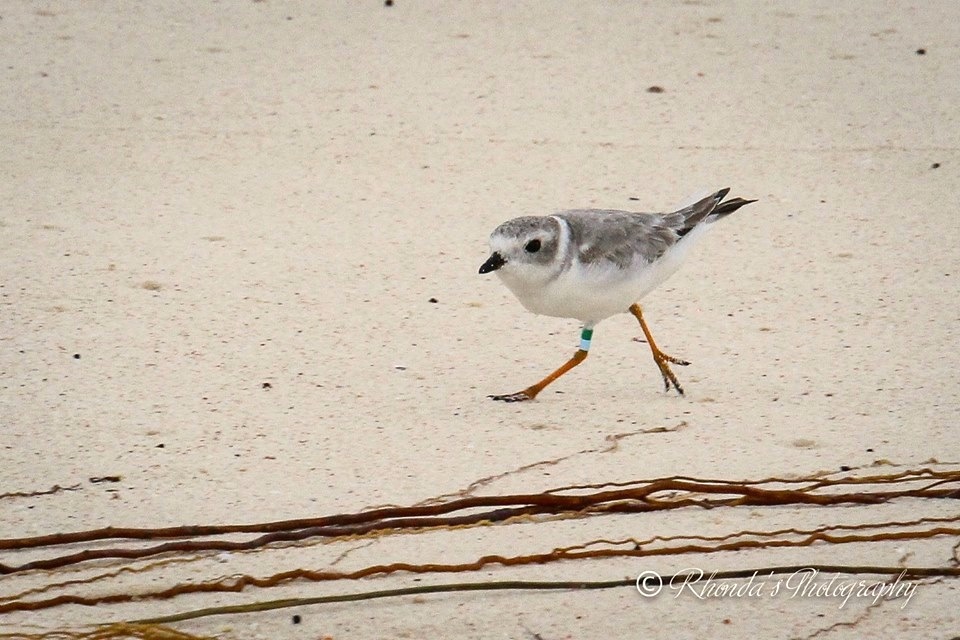
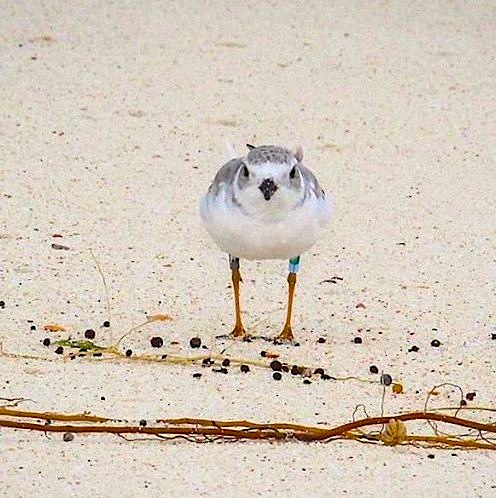
This is me back on my beach after my trip. Green on Blue (L); Black on Grey (R) = TUNAPiping Plover Tuna. Abaco. Rhonda Pearce 1

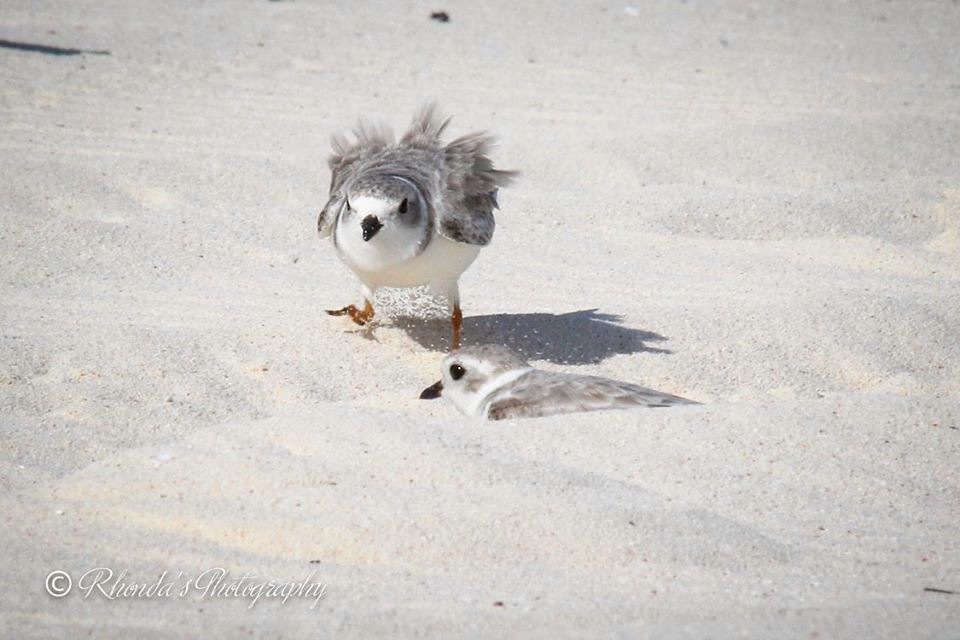
This is a New Friend on my beach, one of 3. They don’t have any bands but they are Travellers from the North like me. In this game I lie low in a hole in the sand and my NF rushes at me kicking sand up like a crazy bird. Fun, huh?Piping Plover Tuna. Abaco. Rhonda Pearce 1

More news from me soon. Cheeps from Tuna.

Watching Bay, Cherokee, Abaco jpg

TUNA’S FIRST 4½ MONTHS

  • JUN 10        Hatched Edwin B. Forsythe NWR (Holgate Center), New Jersey
  • JUN 11         Banded & measured by Michelle Stantial
  • JUL 05         Fledged
  • AUG 28       First sighted on Abaco – preliminary ID
  • SEP 16         Seen again on the same beach – ID confirmed
  • SEP 22         Last sighting before Hurricane Joaquin
  • SEP 28         Paula (Tuna’s mother) re-sighted on Joulter Cays, Andros
  • OCT 03        Tuna safely back on the beach again after Hurricane Joaquin
  • OCT 20-23  Expedition to Winding Bay (ID there on Oct 22)
  • OCT 24        Found back on Watching Bay beach

PIPL Watching Bay, Cherokee, Abaco. 1 bird. Banded. Rhonda Pearce 2 copy copy

NOTE If you ever wondered why birds are banded and what on earth use it is, the answer is in this story. Banding & tagging enables detailed research at both ends of the migration which in turn enables protection of the species and conservation of threatened habitats. There are only 8000 PIPL left. Degradation of the breeding grounds or the overwintering grounds – let alone both – may result in extinction. This seems to have been a good summer for the piping plover; let’s hope the winter treats them well so that this summer’s chicks like Tuna will be able to breed safely next year.

This Diary extract shows how an individual banded bird’s movements can be monitored within its chosen area, so that a picture can be formed of its habitat choices and range.

For details of all this season’s PIPL sightings, check out ABACO PIPING PLOVER WATCH 

TUNA’S DIARY (1)

TUNA’S DIARY 2

EDWIN B FORSYTHE NWR

CONSERVE WILDLIFE FOUNDATION of NJ

Credits: photos Rhonda Pearce, Keith Kemp, Craig Nash, Tony Hallett, Keith Salvesen; thanks to bander Michelle Stantial, birder & ‘Tuna Watcher’ Rhonda Pearce, CWFNJ & cohorts, Matt Jeffery and all other providers of info snippets; Birdorable for the cartoon; and Xeno-Canto for the recording

Unknown's avatar

“THEY FOUND MY MUM ON ANDROS”: PIPING PLOVER TUNA’S GUEST POST (2)


Piping Plover Tuna, banded in NJ, on Abaco 1 (Rhonda Pearce)

“THEY FOUND MY MUM ON ANDROS”: PIPING PLOVER TUNA’S GUEST POST (2)

Hello again, readers of Mr Harbour’s blog. My name is Tuna. This is the second part of my diary. Last time HERE he called it an ‘autobiography’, but that was a bit pompous of him, I think. It’s 4 months now since I cracked out and after my long trip from that place [the Holgate Unit of the Edwin B Forsythe National Wildlife Refuge, New Jersey – ed.], I’m having a good time on Abaco – see my picture above. Michelle, who put my 4 cool rings on, would be proud of me I think.

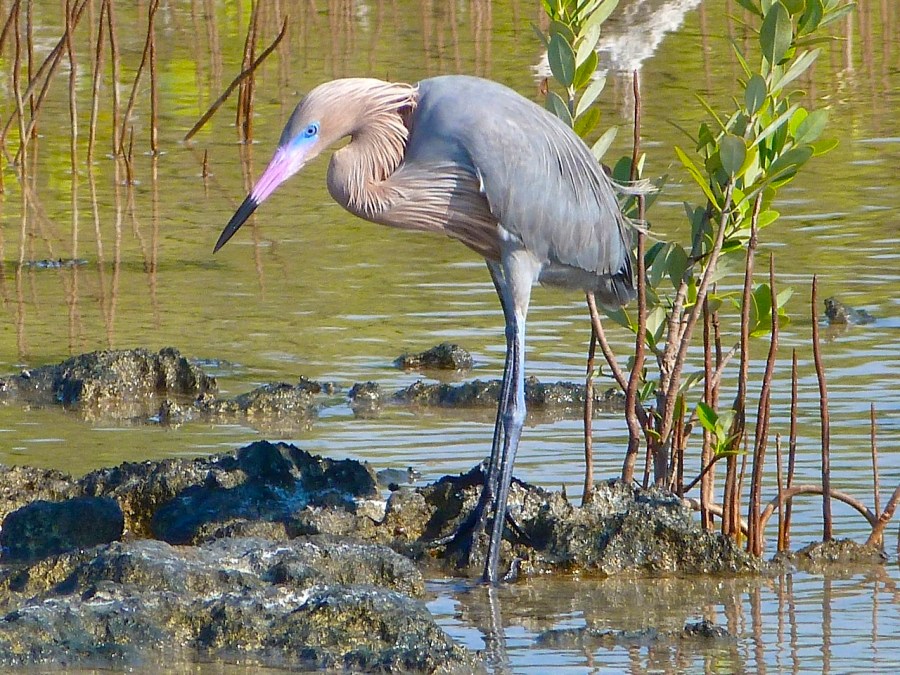
Since my last post (which was also my first post! Ha!) some things have been happening to me. There I was, safely on my nice beach [Winding Bay, Cherokee Sound – map below] when the wind started to get scary and the sea kept coming further up the beach. And a whole lot more splashy. So I just hid at the back of the beach until it got better again. I knew if that nice lady came back to see me it would mean I could come out again. And she did. So I did. I showed her my bands so she’d know it was me. Green on blue; black on gray. That’s me and no other bird.
Piping Plover Tuna, banded in NJ, on Abaco 2 (Rhonda Pearce)

Showing Rhonda my bands so she knows mePiping Plover Tuna, banded in NJ, on Abaco 3 (Rhonda Pearce)

Mr Harbour wrote and told people about how I was ok after a big storm. He said:

“TUNA THE PIPL: UNRUFFLED BY HURRICANE JOAQUIN” Oct 3. Despite big seas & high winds reaching N Baha on the fringes of the hurricane, Tuna has returned safely to Watching Bay. Photos clearly showing bands. π Rhonda Pearce”

A lot of people [c2000] read about this and Michelle said “yay!!! go tuna!!!”, so maybe people had been a bit worried about me. People passed the story round. What ever a ‘Chorlito Valiente’ is, it sounds good and I’m glad to be one. I’m doing just fine, thank you… 

IMG_5013 copy

                                                       piping-plover                     piping-plover                    piping-plover

Since then I had THE BEST NEWS. My mum Paula has been found! She’s gone to a different beach that’s not very close to here [Joulter Cays, Andros]. She got a different leg thing called a “UR Green Flag PE2” and somebody saw her! I’m so excited (and I hope my dad Ross is safe too). She was in a crowd of 32 other birds just like her, and a lot of other birds friends too. 

Joulter Cays, Andros, Sep 28. Thousands of shorebirds including over 100 PIPL. Including Paula.Piping Plovers & other shorebirds, Joulter Cays Andros

Tuna’s mum Paula, one of a group of 32 piping plovers on Joulter CaysPaula

“UR Green Flag PE2”12124591_10156120828430564_2098794849_o - Version 2

Joulter Cays, pinpointing Paula’s exact position 25.304095; -78.126642Joulter Cays, Andros (PIPL Paula)

I hope if I get that feeling again that I need to fly a long way, my mum gets it too. And my dad. Then we might all end up on the same beach where I cracked out! But I’m planning to stay on my own beach for now. More news from me soon. Cheeps from Tuna.

Watching Bay, Cherokee, Abaco jpg

TUNA’S FIRST FOUR MONTHS

  • JUN 10      Hatched
  • JUN 11      Banded & measured
  • JUL 05       Fledged
  • AUG 28     First sighted on Abaco – preliminary ID
  • SEP 16       Seen again on the same beach – ID confirmed
  • SEP 22       Last sighting before Hurricane Joaquin
  • SEP 28       Paula re-sighted on Joulter Cays, Andros
  • OCT 03      Tuna safely back on the beach again after Hurricane Joaquin

PIPL Watching Bay, Cherokee, Abaco. 1 bird. Banded. Rhonda Pearce 2 copy copy

NOTE If you ever wondered why birds are banded and what on earth use it is, the answer is in this story. Banding & tagging enables detailed research at both ends of the migration which in turn enables protection of the species and conservation of threatened habitats. There are only 8000 PIPL left. Degradation of the breeding grounds or the overwintering grounds – let alone both – may result in extinction. This seems to have been a good summer for the piping plover; let’s hope the winter treats them well so that this summer’s chicks like Tuna will be able to breed safely next year.

This Diary extract shows that not only can an individual banded bird’s migration movements be monitored, but also (with a bit of luck) a parent or sibling – even though they may chose to overwinter in quite different places. It is of particular significance if they then return to the same area in summer for breeding.

For details of all this season’s PIPL sightings, check out ABACO PIPING PLOVER WATCH 

TUNA’S DIARY (1)

EDWIN B FORSYTHE NWR

CONSERVE WILDLIFE FOUNDATION of NJ

Credits: thanks to bander Michelle Stantial, birder Rhonda Pearce, CWFNJ & cohorts, Matt Jeffery and all other providers of info snippets; Birdorable for the cartoon; and as ever Xeno-Canto for the recording

Unknown's avatar

MARINE DEBRIS: BALLOONS – WHAT GOES UP MUST COME DOWN…


Marine Debris - Balloons & Plastic (Balloons Blow)

MARINE DEBRIS: BALLOONS – WHAT GOES UP MUST COME DOWN…

Two sisters, Chelsea and Danielle, grew up by a Florida beach. With their parents,they learned from an early age to collect rubbish from the beach and to keep it clean. When they were little, the problems weren’t so great. Gradually, the tide changed. Literally. And indeed littorally. As is a common experience with any shoreline these days however remote and unspoilt, all manner of debris washes in on every tide, from plastic straws to SPACE ROCKET FAIRINGS. There has been a massive increase in ‘single-use’ plastic items. Most of it will take years, decades or even centuries to decompose. And there are deflated balloons, with their strings.

A typical haul of a lot of plastic and several balloons from just one beach collectionMarine Debris - Balloons & Plastic (Balloons Blow)

As ‘business’ on the Florida beach increased, so it became clear that balloons were becoming a significant problem. The increasing popularity of mass releases of balloons at sports events, civic or institutional occasions, and smaller celebrations means 100s or even 1000s of balloons being released into the sky. In most cases they are filled with helium – a finite resource – which carries them high over the earth. Very festive. Then the problems begin. They get caught in thermals, winds and crosswinds, gales and storms. Whether onto land or water, they all have to come down eventually. The problems caused therefore affect creatures inland, on the shoreline and out to sea.

Marine Debris - Balloons & Plastic (Balloons Blow)

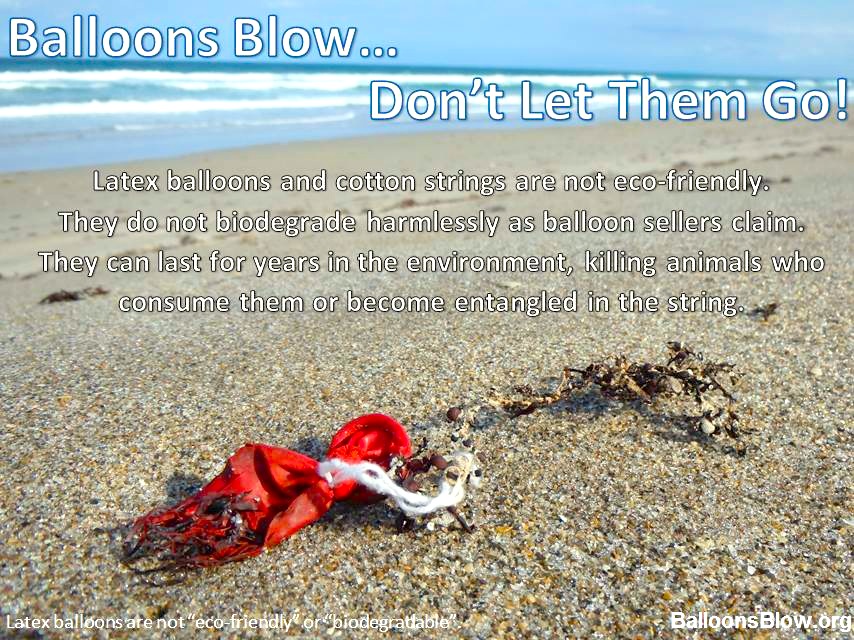
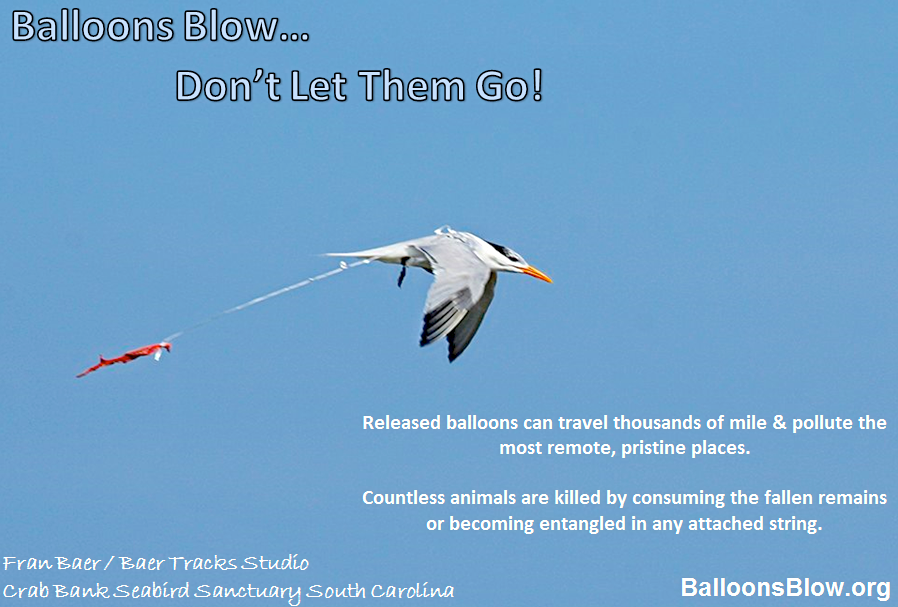
Eventually the sisters decided to take action. They started a website BALLOONSBLOW.ORG, linked to a FB page. They post regularly about their beach clean-ups, now extended to other beaches on the south-west coast of Florida. They also produce balloon-based information sheets and flyers such as these:

Balloons Blow fact sheet

Marine Debris - Balloons & Plastic (Balloons Blow)

I have a folder in which I keep some horrific images of incapacitated, dying or dead creatures. I use them sparingly because in the main they are upsetting. Almost every one of them involves entanglement in or ingestion of such materials as plastic, mylar, styrofoam, rubber or latex. Here are just 3 examples involving balloon strings – I’ll spare you others I have collected (e.g. a turtle that died trying to excrete the remains of a balloon).

Marine Debris - Balloons & Plastic (Balloons Blow)Marine Debris - Balloons & Plastic (Balloons Blow)Sea Turtle tied up in balloon string (Blair Witherington : NOAA)

I don’t have a down on ‘fun’ – and nor do Chelsea and Lucy I’m sure. But, now in their 20s, they have had years of direct hands-on experience clearing their beach and one can see why they decided to take wider action. From one area they have accumulated a vast collection of balloons that will take many decades to break down. Even then, the degraded pieces and micro-pieces will be eaten by fish, turtles and birds.

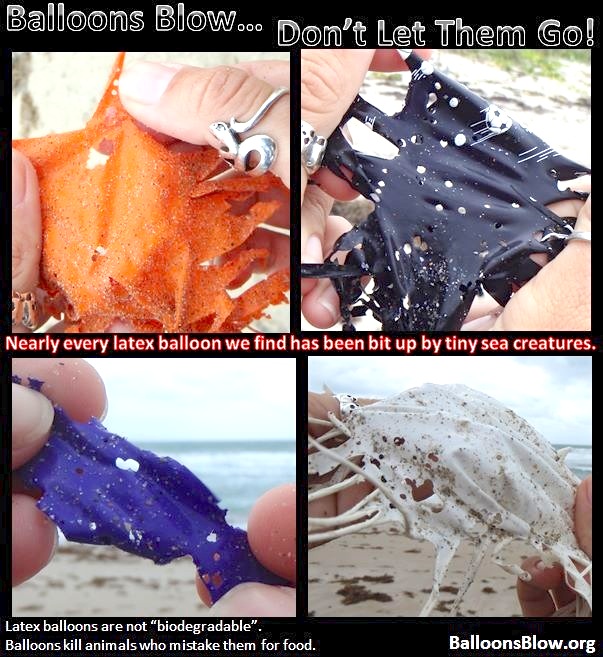
Here’s an illustration of the problem of creatures nibbling away at latexMarine Debris - Balloons & Plastic (Balloons Blow)

Marine Debris - Balloons & Plastic (Balloons Blow)

The Delphi beach is very regularly cleaned up, of course, but there’s nothing that can be done to stem the arrival of debris large and small on every tide. Beautiful and remote though the one-mile curved strand may be, one cannot walk far without seeing plastic of some description. As a matter of interest, I tried a test: walking south on the beach in the tide-line, how long would it take to find balloon evidence? The answer was, less than 10 minutes.

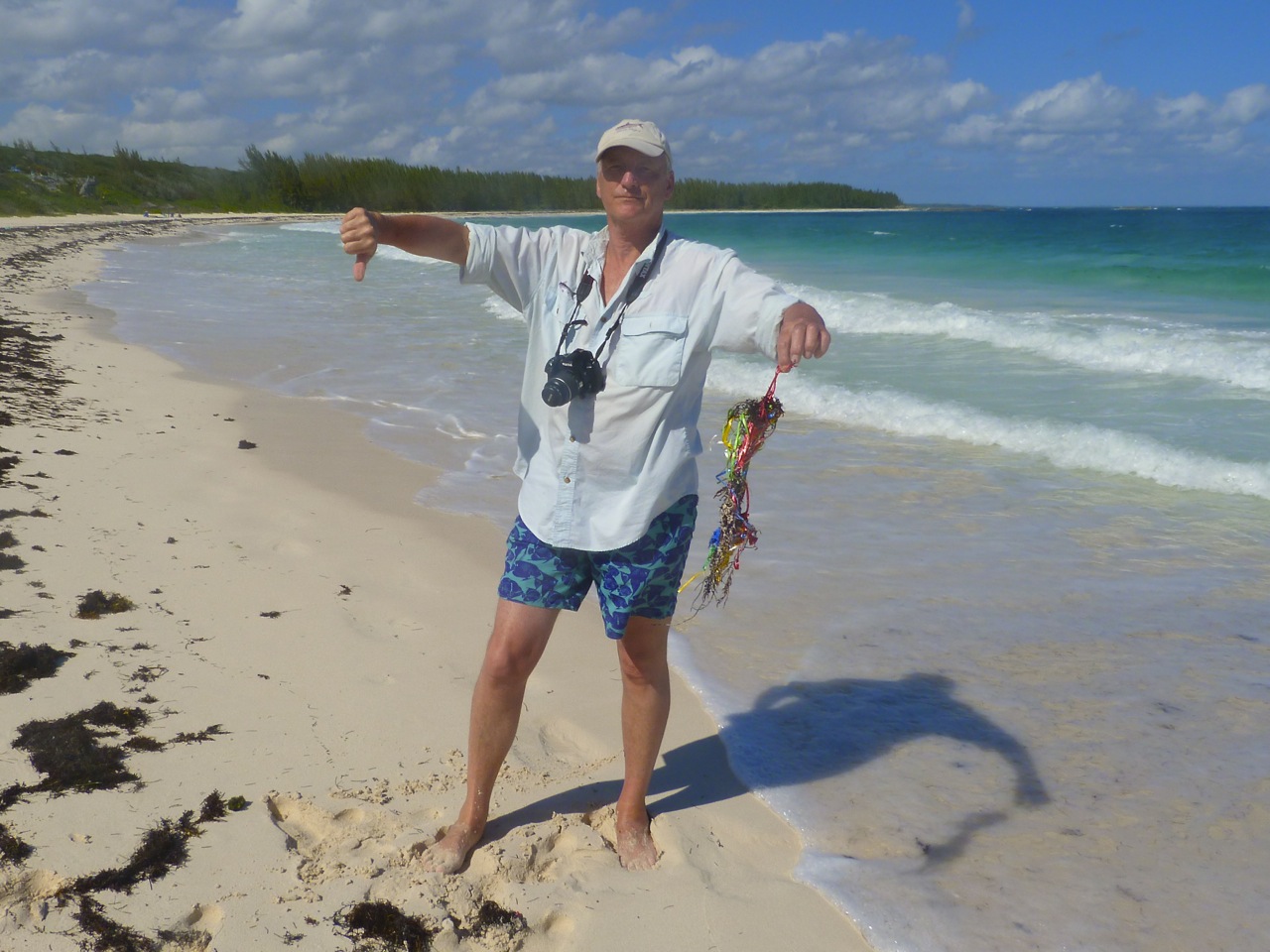
Marine Debris: RH on DCB beach - balloon strings

The decomposition rate of various common itemsPlastic trash -5 Gyres Infographic

The Balloons Blow website is constructive in offering festive alternatives to mass balloon releases, rather than merely chronicling the downsides. The balloons and other plastic junk mostly arrives from the western fringes of the North Atlantic Gyre, in the Sargasso Sea, where the trash gets caught in the sargassum and is eventually forced onto the shoreline by currents, winds and tides. 

             North Atlantic Gyre hotspot infographic                           North Atlantic Gyre Garbage Patch wired_com

Marine Debris - Balloons & Plastic (Balloons Blow)

This post has concentrated on the dangers to wildlife caused by latex and mylar balloons that are sometimes claimed to be biodegradable but are not. There’s more to be said about plastic marine trash, but I’ll keep that for another day. 

Marine Debris - Balloons & Plastic (Balloons Blow)

IMG_4836

RELATED POSTS

MARINE DEBRIS / NOAA PAGE

MARINE DEBRIS? NO THANKS!

MAPPING ABACO

Credit:  BALLOONSBLOW.ORG 

Marine Debris - Balloons & Plastic (Balloons Blow)

Unknown's avatar

“I’M WITH THE BAND…” PIPING PLOVER TUNA’S GUEST POST


 Tuna the Piping Plover: from New Jersey to Abaco (Rhonda Pearce)

“I’M WITH THE BAND…” PIPING PLOVER TUNA’S GUEST POST

Hello, readers of Mr Harbour’s blog. My name is Tuna. This is the first part of my autobiography, and I’m only just 3 months old. I’ve already made a 1000-mile journey to Abaco for reasons I don’t quite understand. Maybe because it’s nice and warm here. This is my story so far.

I was born on June 10th in the Holgate Unit of the Edwin B Forsythe National Wildlife Refuge, New Jersey. If I’d known then what  ‘beautiful’ was, this would have been it.

StationPhoto2

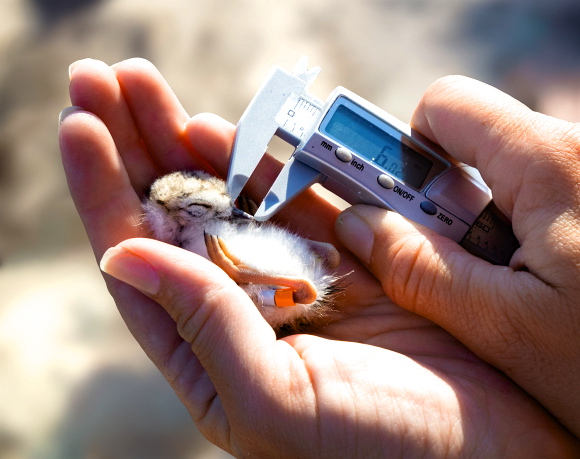
My dad is called Ross. My mum is called Paula. I had a brother but suddenly he stopped being there. We didn’t see him again, I never knew why. Anyway, the day after I was born a very kind lady called Michelle (Stantial, CWF-NJ) picked me up and sort of cuddled me in her fingers. I was weighed and measured. She also put coloured rings on my top bits of leg. I had blue & green on one leg and black & gray on the other. Very smart. A chic chick. It was very quick and it didn’t hurt at all. After that I never really thought about them again, they just were part of me. As I grew bigger they sort of grew with me.

It made for an exciting first full day of my life, June 11. Here are some pictures of Michelle doing this with other chicks from the same region so you can see how gentle she was. The chicks’ names were Meg, Joe and Nod. Mr Northside Jim watched them every day and took photos of them to record how they grew up. You can read about us and the other shorebirds, Ospreys and Peregrine Falcons  of LBI NJ HERE

Meg being picked up for measuring and bandingpicking-up-piping-plover chick1 π Northside Jim LBI NJ

Banding Meg with a unique colour combo for IDpiping-plover-chick-banding-lbi π Northside Jim LBI NJ

Beak and leg measuringpiping-plover-chick-measurement π Northside Jim LBI NJ

I grew very quickly and my mum and dad showed me how to get food for myself. They looked after me in the nest and kept an eye on me when I went for a wander. Soon I was trying out my wings to see what would happen. Nothing. 

This isn’t me but was taken quite near my bit of beach. Can you see the other chick?Piping Plovers Conserve Wildlife Foundation NJ

It’s fun exploring the big world but it’s dangerous for little birds. I lost several friends along the way. That’s how my brother disappeared I think. As you grow bigger the world seems to get smaller. Which is weird.piping-plover-sit-in-dune π Northside Jim LBI NJmeg-beach-pea PIPL chick π Northside Jim LBI NJ

I got good at finding my own food, going further away from the nest and trying out the water. My wings seemed to be starting to work a bit. Quite soon I felt nearly ready to have a go at flying.Piping Plover (juv) CT (Danny Sauvageau)

On July 5 I managed to fly. Yup, I fledged and I flew. That was only 25 days after I cracked out. Mum and Dad had been talking about making a journey, a long one, and wondering when I would be ready for it. This was puzzling. I liked it where we were. But something was telling me I needed to fly somewhere else for some reason. Then one day I just took off and headed south…

_Piping_Plover_on_the_Fly (USFWS Mountain-Prairie wiki)

After several days of flying and landing in new places to rest and flying again, I reached a place that I knew was exactly right. I don’t know how, but something told me that it would be a good place to stay until I needed to move again. So I landed on a beach called Watching Bay on Abaco. I’d travelled 1000 miles from where I cracked out, and I wasn’t even 3 months old. Cool, huh?

EBF NWR to Cherokee Map jpg

There were some other birds on the beach, including one just like me except she didn’t have any coloured rings. Ha! There were very few humans apart from a few taking a walk. On Aug 28 one lady stopped and pointed something at me. I wonder why? She kept her distance so I wasn’t scared.

August 28 Watching Bay, Cherokee, Abaco. Rhonda Pearce’s photos led to provisional ID of Tuna
#10 Aug 28. Watching Bay, Cherokee Abaco. 1 bird. Banded. Rhonda Pearce 2#10 Aug 28. Watching Bay, Cherokee, Abaco. 1 bird. Banded. Rhonda Pearce 1

There was plenty to eat on the beach, and it was quite sheltered from the wind. It seemed safe. I liked it a lot and decided to stay there

Watching Bay, Cherokee, Abaco jpg

On Sep 16 I saw the same lady again, and she saw me. She was very careful not to get me worried, and she pointed that thing at me again. Then she walked away. I hope she comes back. She seems nice.

Sept 16 Watching Bay, Cherokee, Abaco. Rhonda’s new photos led to confirmed ID of TunaTuna the Piping Plover: from New Jersey to Abaco (Rhonda Pearce)      Tuna the Piping Plover: from New Jersey to Abaco (Rhonda Pearce)Tuna the Piping Plover: from New Jersey to Abaco (Rhonda Pearce)  #19 PIPL Bands close-up jpg

I’m planning to stay on this beach for now. More news from me soon. Cheeps from Tuna.

PIPL Watching Bay, Cherokee, Abaco. 1 bird. Banded. Rhonda Pearce 2 copy copy

TUNA’S FIRST THREE MONTHS

  • JUN 10      Hatched
  • JUN 11      Banded & measured
  • JUL 05       Fledged
  • AUG 28     First sighted on Abaco – preliminary ID
  • SEP 16       Seen again on the same beach – ID confirmed
  • SEP 22       Last sighting before Hurricane Joaquin
  • OCT 03       Back on the beach again after Hurricane Joaquin

STOP PRESS Tuna’s mother Paula was re-sighted on Sep 28 on Joulter Cays, Andros

NOTE If you ever wondered why birds are banded and what on earth use it is, the answer is in this story. Banding & tagging enables detailed research at both ends of the migration which in turn enables protection of the species and conservation of threatened habitats. There are only 8000 PIPL left. Degradation of the breeding grounds or the overwintering grounds – let alone both – may result in extinction. This seems to have been a good summer for the piping plover; let’s hope the winter treats them well so that this summer’s chicks like Tuna will be able to breed safely next year.

For details of all this season’s PIPL sightings, check out ABACO PIPING PLOVER WATCH 

EDWIN B FORSYTHE NWR

CONSERVE WILDLIFE FOUNDATION of NJ

Credits: huge thanks for info and fab photos to Michelle Stantial, Northside Jim, Danny Sauvageau and Rhonda Pearce for the strands to weave this (slightly creative) tale; to USFWS Mountain-Prairie for the PIPL in flight; as always Xeno-Canto for bird sound recordings non pareil; oh, and Meg, Joe & Nod

images

Edwin B Forsythe NWR map

Unknown's avatar

MANGROVE DIE-BACK IN THE ABACO MARLS: THE FACTS


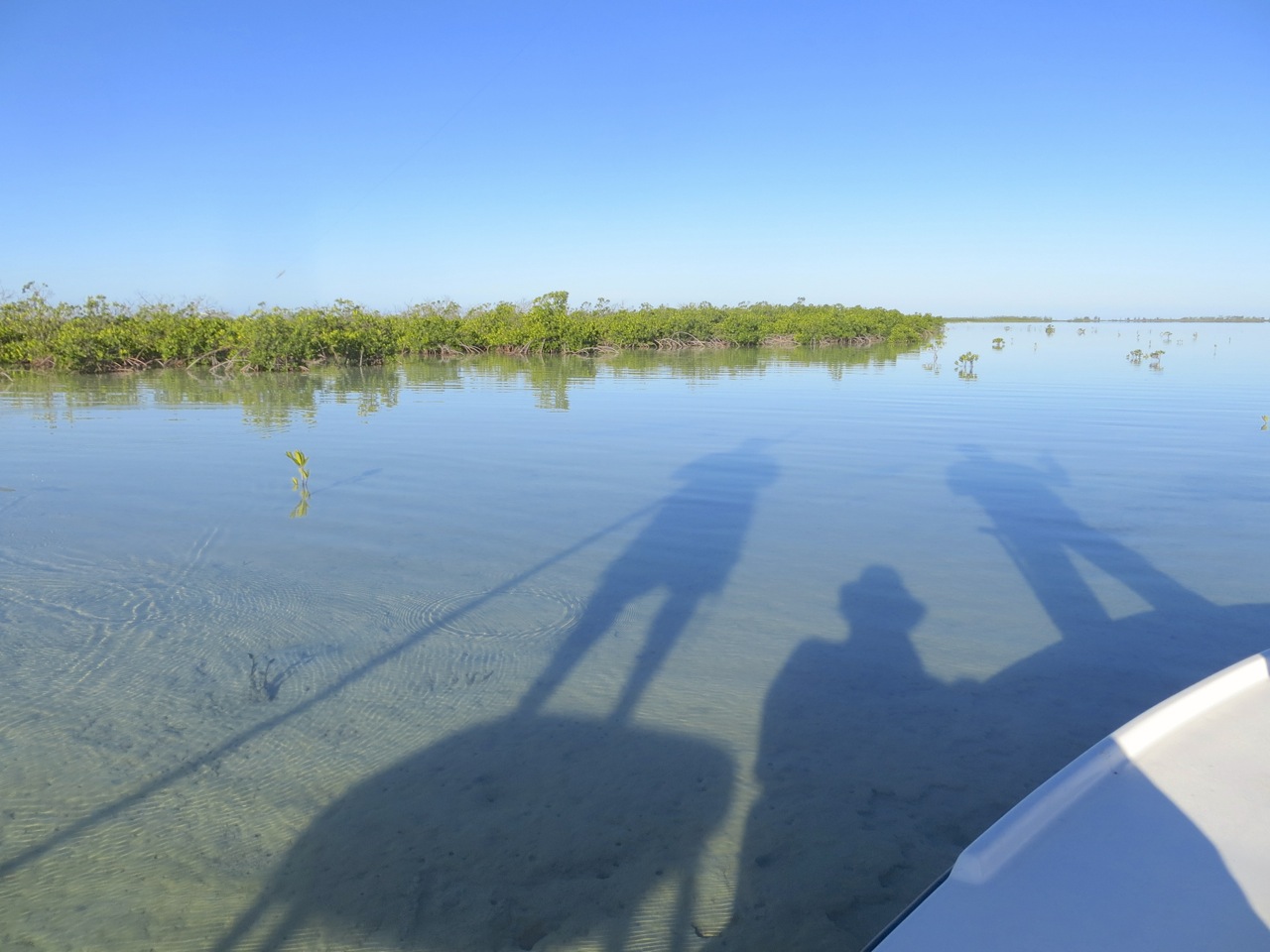
Mangroves, The Marls, Abaco, Bahamas (Keith Salvesen, Rolling Harbour)

MANGROVE DIE-BACK IN THE ABACO MARLS: THE FACTS

For some time now, there has been understandable concern about the increasing evidence of mangrove die-back in the Abaco Marls and elsewhere in Abaco waters. Scientific investigations are ongoing and you will find some of the survey results so far on the excellent Abaco Scientist interactive map HERE. You’ll find other relevant and authoritative mangrove material if you check out the BLOG menu of the website.
Abaco - The Marls

The ‘200 sq. miles’ in my map is debatable, depending what one includes. Other estimates are of 300 or even 400 sq. miles. Whichever, the Marls cover a massive area of mangroves, islets, flats, channels and wonderfully diverse wildlife. A large proportion of the many species – fish, birds, turtles etc – depend on the complex ecology of the mangroves for food, shelter and breeding. Depletion of the mangroves from whatever cause will have a direct effect on the creatures of the Marls.

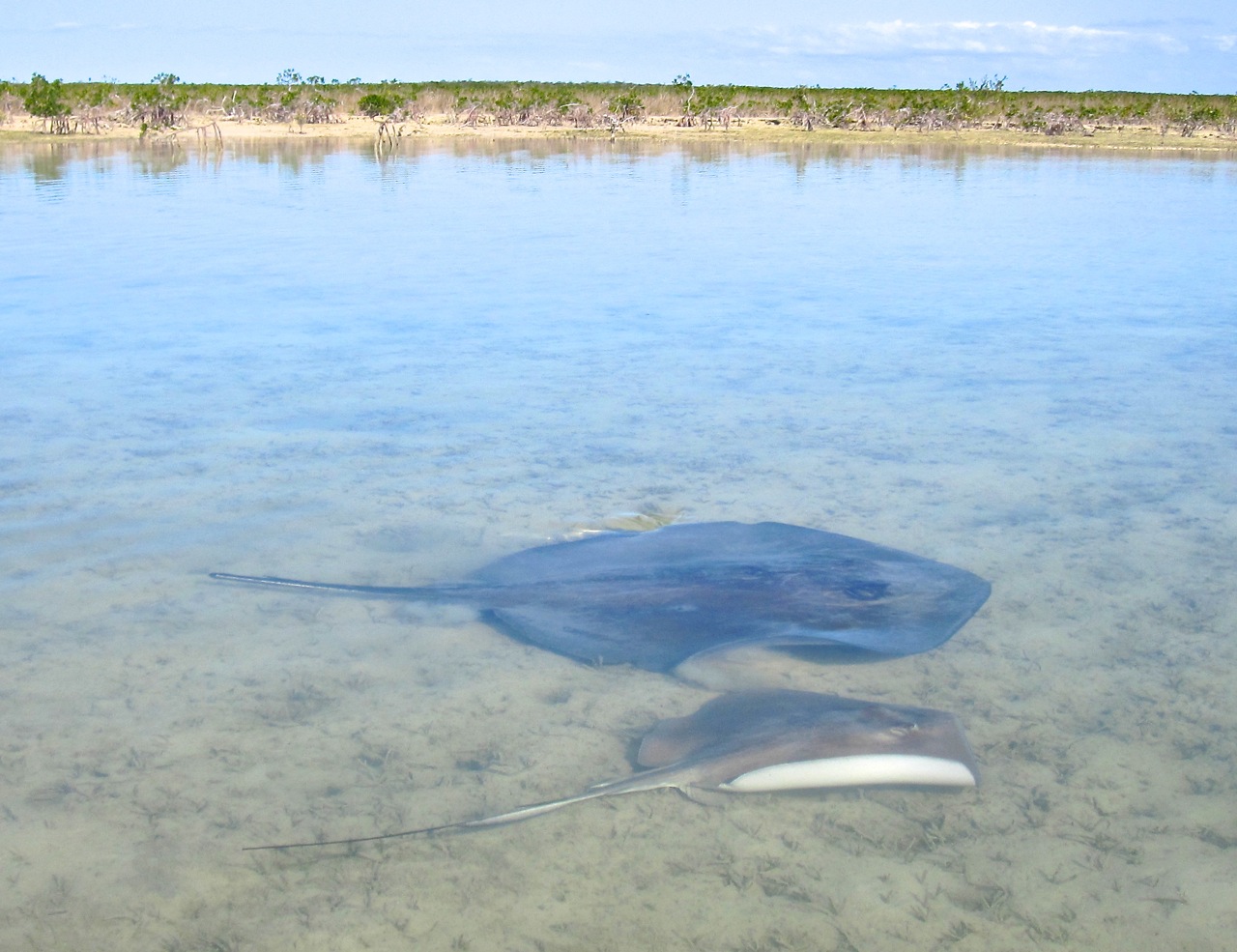
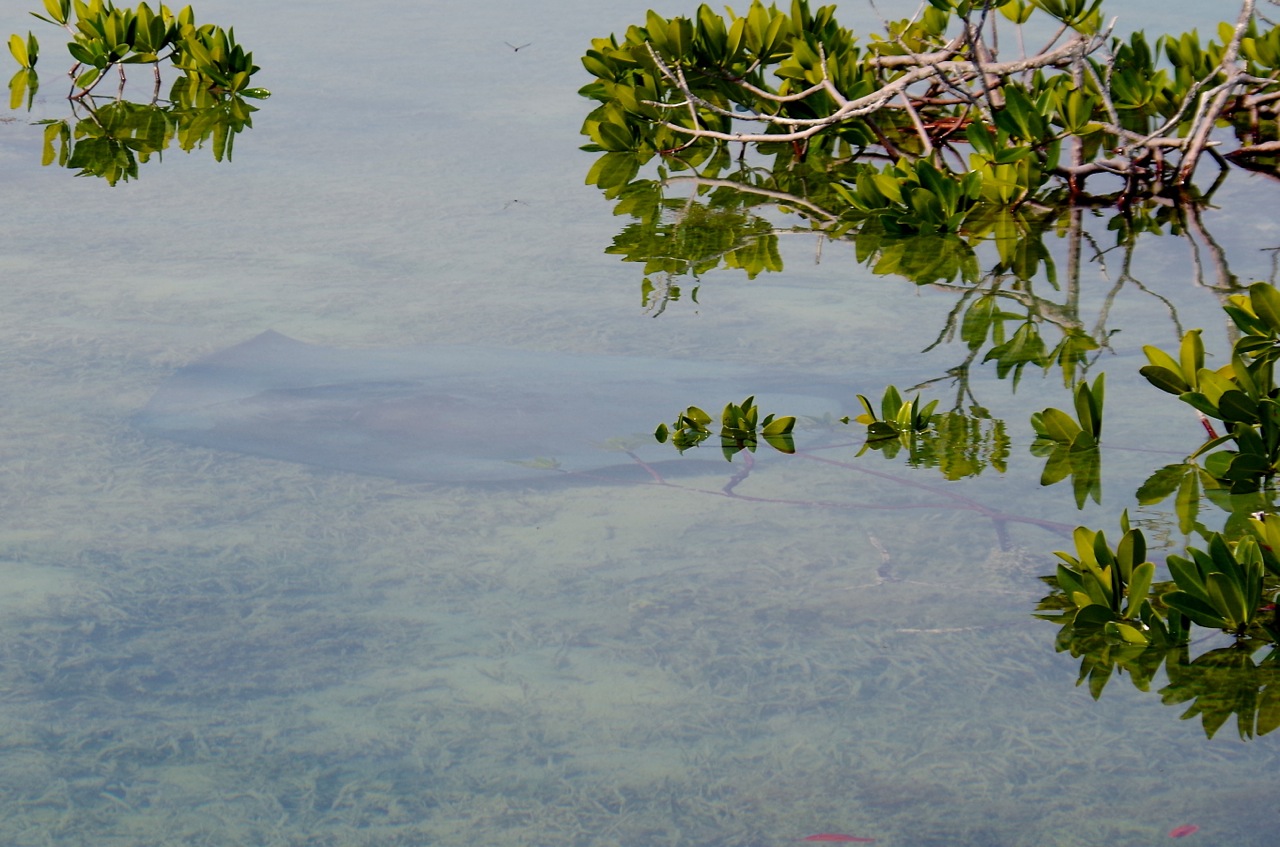
Stingrays Abaco Marls 6

Ryann Rossi, a PhD student with North Carolina State University, has been researching the worrying phenomenon of mangrove die-back in the Marls this summer. She has written an interesting and informative  account (conveniently in the RH ‘Facts about…’ style) that was published in Abaco Scientist last week. The blue links will take you to the ABSCI site for further information on each topic. I’m grateful to Ryann and ABSCI for permission to use the material.

Five Things to Know About the Mangrove Die-back in The Marls (at this point, anyway)

1. This die-back appears to be the result of multiple stressors acting together. Think of it in the sense of our own body – when our immune system is down, we are often more susceptible to getting sick. The same thing is likely happening to the mangroves.Mangrove Die-back 1 (Abaco Scientist : Ryann Rossi)

2. It appears as though a fungal disease may be taking advantage of already stressed mangroves and causing die-back. We did preliminary surveys across Abaco and found fungal lesions nearly everywhere. However, the fungus was present in different densities in different areas. In the die-back area nearly all the leaves remaining on trees have lesions. We think that this pathogen capitalized on the mangroves being weakened by other stressors such as hurricanes, which cause extensive leaf drop, change in the movement of water, change in sedimentation and erosion.

Mangrove Die-back 2 (Abaco Scientist : Ryann Rossi) jpg

3. We are still working on identifying the pathogen associated with the lesions we’ve found. We are confident that it is a fungus and are currently growing fungal cultures in the lab to examine defining morphological characteristics in addition to using DNA sequencing to identify the culprit.

4. We have documented the presence of the Robust Bush Cricket (Tafalisca eleuthera) in the die-back areas as well as other areas with high densities of lesions. These crickets are documented to consume Red and White mangrove leaves. As such, we were concerned about their potential role in die-back. We set out a caging experiment to exclude the crickets from certain dwarf Red mangrove trees to see just how much grazing they may be doing in the die-back area. This experiment is ongoing.

Mangrove Die-back 3 (Abaco Scientist : Ryann Rossi) jpg

5. The take home: there is likely more than one causal agent of the die-back in The Marls. Many factors govern mangrove productivity and functioning: nutrient availability, salinity, sedimentation rate, herbivory, and disease are just a few of the factors that contribute to overall mangrove function making it very difficult to pin point which factors may be driving the die-off. On the bright side, we are confident that we have a lead on the causes and we are working hard in the field and laboratory to fully understand what is going on in The Marls.

By Ryann Rossi|August 26th, 2015|Disease, fungus, Insects, Mangroves and Creeks, The Marls
All pics below taken while fishing on the Marls except Melinda’s shark (I’ve never got a good one)
Hawksbill Turtle, Abaco Marls (Keith Salvesen)Bonefish Abaco Marls 4Shark 4 ©Melinda Riger @ G B Scuba copyOsprey - Abaco Marls 1 Reddish Egret (White Morph), Abaco MarlsRoyal Tern, Abaco, Bahamas (Marls) 3Willet, The Marls, AbacoSouthern Stingray, Abaco Marls (Keith Salvesen 4)
FRIENDS OF THE ENVIRONMENT has also included an article on die-back by Ryann in its latest Newsletter:

Mangrove Die Off on Abaco by Ryann Rossi, NCSU

This summer Stephanie Archer and I continued research efforts focused on determining the cause of the mangrove die-off in The Marls (work funded by the National Science Foundation). Our efforts were predominantly focused on the fungal pathogen we found associated with the die-off site. We created a small citizen science and outreach project to document the presence or absence of the pathogen across Abaco. This project consisted of short surveys and leaf collections. In total, 92 areas were surveyed including locations from Abaco and San Salvador. We also took this outreach project to the annual Bahamas Reef Environment Education Foundation (BREEF) teacher training conference.  There we disseminated survey packets to teachers from islands throughout The Bahamas who will help us collect more data on the presence (or absence) of this pathogen on other Islands.

3 men on a skiff, Abaco Marls (Keith Salvesen : Rolling Harbour)

Three men on a skiff – Abaco Marls

On Abaco, we constructed an experiment to investigate the role of grazing and the presence of fungal lesions on Red mangroves. We simulated grazing using crafting scissors to cut small sections on 600 leaves in 4 different mangrove creeks. We observed the leaves for 28 days to determine if cutting leaves predisposed leaves to fungal infection. At these sites we also trapped for insects to gain an idea of what kind of grazers may be chewing on the leaves. We also did a series of disease incidence surveys that will be routinely monitored for disease progress over the next 2 years. These surveys will allow us to systematically track the progress of the disease. In addition to our field work, we spent many hours in the laboratory isolating fungi from leaves to grow in culture. These cultures were brought back to North Carolina State University and will be sequenced in order to help us identify the fungal pathogen responsible for making the lesions on the mangrove leaves.

Mangroves, Abaco Marls (Keith Salvesen)

Credits: Source material Ryann Rossi; Abaco Scientist; all photos © Keith Salvesen @ Rolling Harbour except those by Ryann / ABSCI in the main article and Melinda Riger’s cool shark

Unknown's avatar

“GOOD MIGRATIONS” by THE BEACH BIRDS


Piping Plover 32 (banded as an adult in 2010 at Manistee, MI Sleeping Bear Dunes N L, MI)

Banded in Michigan in 2010 – in Florida right now!

“GOOD MIGRATIONS” by THE BEACH BIRDS

It’s started already. The autumn migration of piping plovers from up north to down south. It seems only the other day (April in fact) that the last PIPL were seen on Abaco. Since then, they have spent the summer in their breeding grounds, raising families. This seems to have been a successful breeding season, with good reports that included a record number in the tiny Great Lakes population. But the attrition rate to predation is high: for example, of the 4 chicks in one family that was closely observed on Long Beach Island NJ, only one (‘Beth’) has survived.

Piping Plovers - 2 chicks, 2 eggs - CT (Danny Sauvageau)

Piping plovers: 2 chicks & 2 eggs, Connecticut

WHAT’S SO SPECIAL ABOUT THESE BIRDS?

A recent estimate put the world’s supply of these little birds at 8000. And of these, many spend their winter in the Bahamas, Abaco being one of their favoured destinations. The survival of the species is in the balance. Habitat degradation at either end of their migrations could be disastrous; at both ends, more than doubly so.

Piping Plover (juv) CT (Danny Sauvageau)

Piping Plover juvenile, Connecticut

HOW CAN THEIR SURVIVAL BE ASSURED?

A number of organisations and individuals are dedicated to looking out for the PIPL. This includes ensuring preservation of habitat integrity and protection on the beaches where they nest, and banding programs so that birds can be tracked and monitored during their migrations. This is one aspect which people on Abaco (and elsewhere) can help with – looking out for these birds, reporting their location and how many are seen, and if possible describing the bling: colour of bands, which legs, which order,visible numbers etc. Or better still, taking photos!

Piping Plover CT (Danny Sauvageau)

WHERE WILL I FIND PIPING PLOVERS ON ABACO?

On beaches and shorelines. On the mainland, places where they were reported last year included Long Beach, Crossing Rocks, Schooner Bay, the beach at Delphi, Bahamas Palm Shores, Casuarina and Little Harbour. They also visit the cays, with a number reported on Man-o-War Cay for example.Piping Plover (Danny Sauvageau) 3

HOW FAR HAVE THEY GOT IN THEIR TRAVELS?

Well on their way south. Danny Sauvageau, who combines monitoring beaches in Florida with being a wonderful bird photographer, has just reported the first arrivals. On 23 July he saw 3 unbanded PIPL in Dunedin Fl. – here’s one of them.Piping Plover, Dunedin, FL (Danny Sauvageau)

Then on 29 July Danny found his first banded Piping Plovers of the 2015-16 wintering season at Fort Desoto – 6 birds of which 5 were banded. This enabled him to recognise them as returners, and to identify their origin: “Two were from the Great Lakes (Michigan), two were from the Great Plains (North Dakota and South Dakota) and one was from Nebraska!”.

These 3 examples show the wide variation in banding in the different locations. Which is why a photo of a bird’s legs is particularly helpful for the research into the species.

PPL-106- 2nd year at Ft Desoto - Banded in Nebraska PPL-35 - 3rd year at Ft Desoto - Banded as a chick 2012 Vermillion, MI along Lake Superior PPL-2 - 3rd year at Ft Desoto - Banded as a adult 2013 Whitefish Point, MI along Lake Superior

The CONSERVE WILDLIFE FOUNDATION OF NJ is involved annually with researching the piping plovers of Abaco. Many will be familiar with the scientists Todd Pover and Stephanie Egger who visit each year to monitor the plovers. For those who do not already have a direct line to them I would be very pleased to receive reports of sightings to collate and pass on. The monitoring work provides exactly the kind of information that will help to ensure the survival of this adorable but vulnerable species. Please email me at rollingharbour.delphi@gmail.com or, better still, upload info / pics to the new FB page I have set up, ABACO PIPING PLOVER WATCH 2015 – 16Piping Plover Charadrius melodus (Ontario, MDF : wiki)

The most helpful information to have is date; time; location; number of birds; whether banded or unbanded; and if banded, as much information as possible or ideally a photo…

lbi-piping-plover-chick

TYPICAL MUSICAL DEVIATION FROM THE TOPIC

The referencing in the title to a famous ‘disc’ from 1966 by a ‘popular beat combo’ does not presage a re-formation. In the past there was acrimony. Some drink ‘n’ drugs hell. Splits and re-formations. Sadly not all former members are still with us. Here’s a memory of them from (arguably) their most satisfyingly inventive era… **EARWORM ALERT** now you won’t be able to get the wretched tune out of your head. It’s given you ‘excitations’. Sorry about that.

Credits: All photos courtesy of Danny Sauvageau except ‘lone chick’ MDF & ‘chick in hand’ CWFNJ; shout outs to Danny, Todd, Stephanie and all PIPL researchers. Plus Bay Soundings. And the Beach Boys…

ADDENDUM AUG 2 A good article about the significance of banding can be found at BAY SOUNDINGS (based around Tampa Bay). It includes contributions from Danny and a useful info box:

Reporting banded birds

Reporting banded birds is one of the most important activities for citizen-scientists, says Wraithmell. “It’s the only way we have to solve the mystery of migration – to learn where they stop and where they winter so we can protect that habitat too.”

Most photographers stumble upon their first banded birds accidentally because they don’t always see the bands until they review their images on a computer screen. After that, they’ll learn to watch for the bands even if they don’t get close enough to see them with their naked eye.

“There’s something very exciting about photographing banded birds, learning where they came from and following their travels if they’ve been seen and reported before,” Sauvageau said.

But capturing an image shouldn’t outweigh allowing the bird to rest or feed in peace, Wraithmell said. “One thing that’s really important is not disturbing the birds, whether they’re nesting or just resting,” she said. If nesting birds are disturbed, they fly off and leave their eggs or babies in broiling sun and defenseless against predators. Wintering birds need to rest and pack on the pounds before they fly back to their summer breeding grounds.

“Some birds, like piping plovers, actually spend more time here than they do nesting,” she said. “Their main job over the winter is eating and resting so they can nest successfully. And breeding is hard work – it takes a lot of energy to make an egg and then to feed and defend a chick until it’s old enough to take care of itself.”

For the scientists who band birds, “it’s like putting a message in a bottle and throwing it in the sea,” Wraithmell said. “Every resighting is valuable because we learn something new.”

Unknown's avatar

A VISIT TO BIMINI’S MARINE ENVIRONMENT (2)


Seahorse (Bimini's Marine Protected Area Campaign)

A VISIT TO BIMINI’S MARINE ENVIRONMENT (2)

In this second part of the look at Bimini’s Marine Protected Area Campaign and the photographs that illustrate the vital importance of the mangroves, reefs, sea grass and pristine sea to marine life, it’s time to look at some of the the smaller sea creatures in their underwater habitat. Many of these are vulnerable to changes in their environment; some are already rare. 

SPINY LOBSTER

Spiny Lobster Bimini's Marine Protected Area Campaign copy 3 Spiny Lobster Bimini's Marine Protected Area Campaign

SEA HORSES

Sea Horse Bimini's Marine Protected Area Campaign Seahorse Bimini's Marine Protected Area Campaign Seahorses Bimini's Marine Protected Area Campaign

SEA HARE

For more information on this creature, click HERE

164441_607403889277224_192821659_nSea Hare squirting ink Bimini's Marine Protected Area Campaign

BATFISH

To learn more about Batfish, click HERE

Batfish Bimini's Marine Protected Area Campaign

QUEEN CONCHQueen Conch Bimini's Marine Protected Area Campaign

SILVERSIDES

At first glance you may wonder why these little fish are worth including. The answer lies in the food chain. The clean environment in which these bait fish thrive provides food for larger species and so on up the chain… If silversides ceased to exist, a vital source of marine nutrition would be lost.

Silversides Bimini's Marine Protected Area Campaign copySilversides Bimini's Marine Protected Area Campaign

CREDITS: Bimini’s Marine Protected Area Campaign with many thanks for use permission of their material including images © Grant Jonson / 60 Pound Bullet Photography, and to all other photographers featured. Overall, cheers to Bimini, wildlife and conservation…