Unknown's avatar

ABACO FROM SPACE: NASA / ISS VIEWS 225 MILES ABOVE THE BLUE PLANET


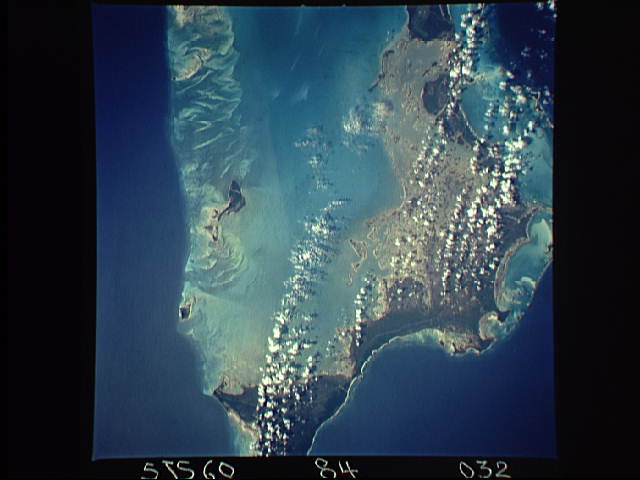
STS060-84-32

ABACO FROM SPACE:  NASA  /  ISS VIEWS 225 MILES ABOVE THE BLUE PLANET

I have had another look through NASA‘s stock of Bahamas images taken from the INTERNATIONAL SPACE STATION. They come in differing formats. Over time the Station’s orbit takes it directly over or close to Abaco. In the past I have posted images of Hurricane Irene and Hurricane Sandy taken from space; and one of the astonishing Bahama variations of the colour BLUE. Here is a further selection.

The first two images show an orbit from north to south. I have annotated the first for those unfamiliar with the geography of Abaco. I assume the next was taken only a second or two later, with the whole of the southern tip / National Park / Hole-in-the-Wall area of Abaco now shown.

Abaco Map NASA:ISSA annotated STS060-84-33

This image gives an idea of the underwater connection between the island land masses. Here, a corrugated underwater sequence of ridges and troughs can be seen linking the southern end of Abaco with the south western end of Grand Bahama. Moore’s Island and, barely visible below it, Gorda (‘Castaway’) Cay rise above sea level between the two larger islands. The Berry Is. and Great Harbour Cay can be seen bottom left; Eleuthera snakes downwards bottom right. [At Rick Guest’s suggestion, I have rotated the image 90˚ from the original to make sense of a view distorted by angle (the space station’s), earth curvature and my own misinterpretation… It makes far more sense now, and I have corrected geographic errors accordingly… I’ve also added an annotated aeroplane’s-eye view below it, taken from much closer to the earth and therefore less subject to distortion. Many thanks, Rick]STS108-724-71 copyAbaco Map  - Island relationships

Abaco seen from the southeast. Little Abaco and Grand Bahama are at the top, and all are shown inter-connected underwater. The reef chain of the Abaco Cays – the world’s third longest barrier reef – can clearly be seen on the rightISS017-E-12812

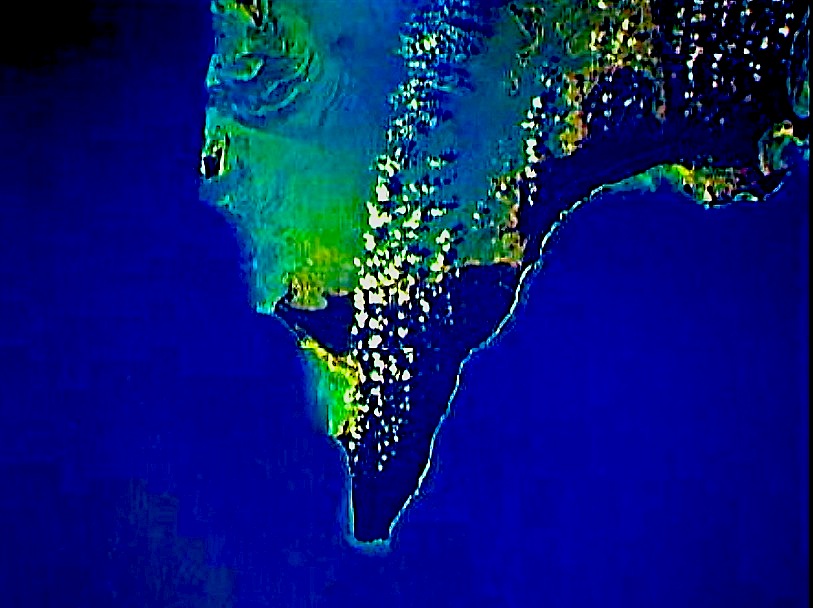
This image appears to be a blow-up of the sharper ‘filmic’ second one above. The detail has become hazy and indistinct, though part of the island-long ribbon of highway remains clearly visible. Time for a photo-enhancing experiment…
NASA clip

I played around with the contrast and colour settings of the photo above, to see what effect it produced (below). The most marked result is that areas of low water  – the coastline, the underwater high ground, the Marls and mangrove swamps, the low water of Cherokee Sound – became vividly highlighted. I don’t know what the small russet patches are, particularly visible in the Marls. My (ill-)educated guess is that they represent mangrove / mud islands that are underwater at high tide only, and that were in tidal transition as the Space Station passed overhead. Any ideas welcomed via the comment box.NASA clip - Version 2

Unknown's avatar

QUEEN ANGELFISH (Holacanthus ciliaris) – BAHAMAS REEF FISH (2)


Queen Angelfish Holacanthus ciliaris

QUEEN ANGELFISH (Holacanthus ciliaris)  – BAHAMAS REEF FISH (2)

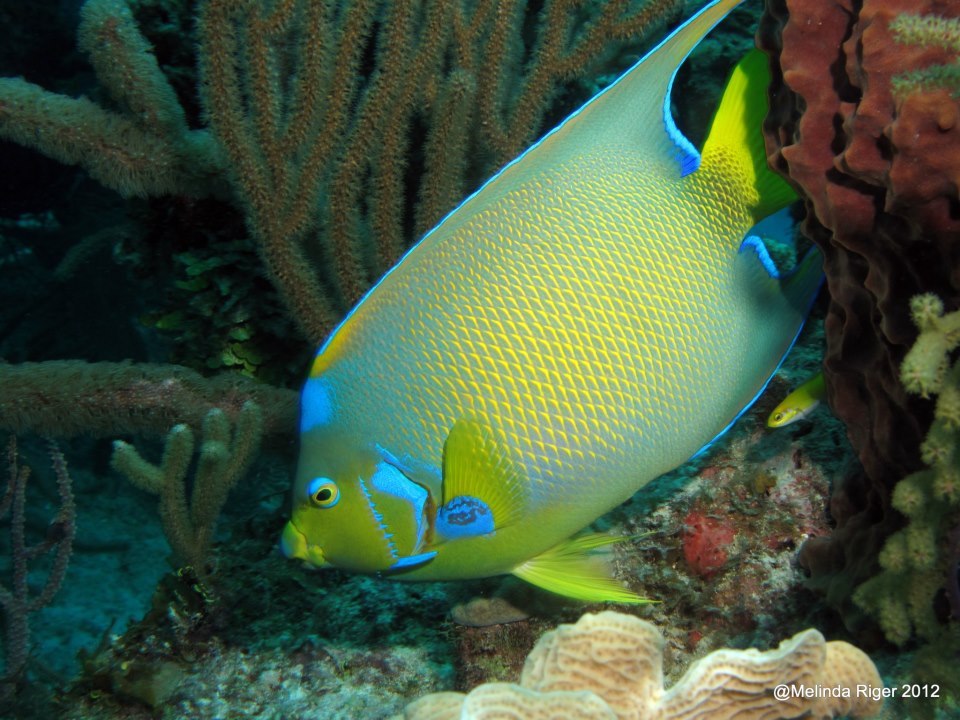
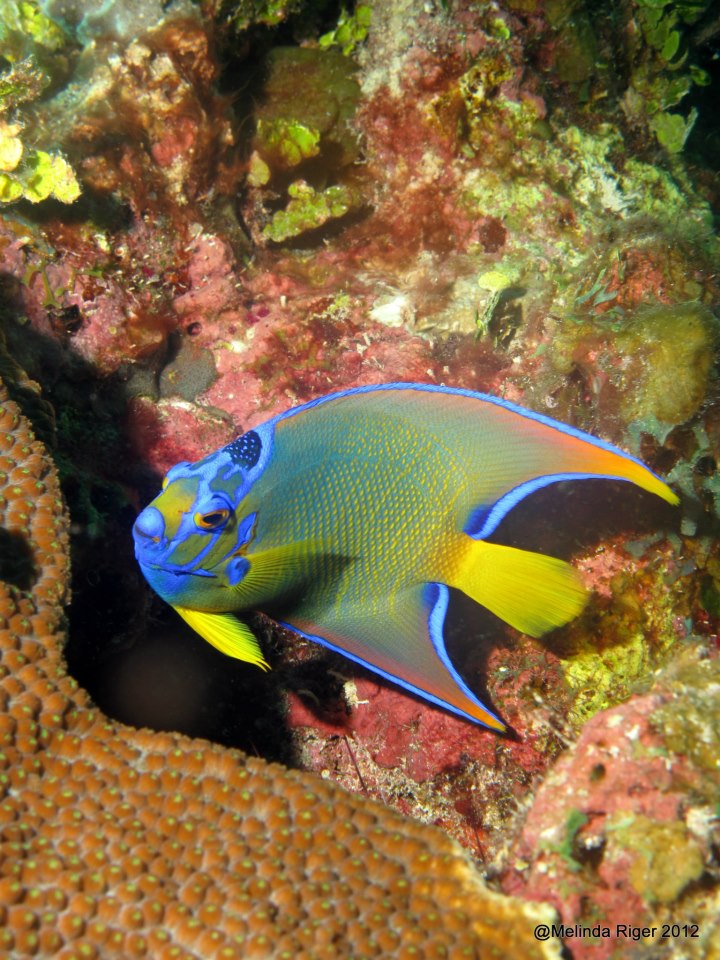
The Queen Angel is one of several reef fish species where the difference in colouring between juveniles and adults is marked.  They are commonly found in the waters of Florida and the Bahamas, with a range extending to the Gulf of Mexico. Adults can grow to 3.5 lbs (to mix metric with avoirdupois) and they can live up to 15 years. Like all Angelfish, they rely on their pectoral fins for propulsion as they forage on the reefs for their mixed diet of sponges, coral, plankton, algae, and even jellyfish. As the photo below shows, they have no problem swimming upside down…

QUEEN ANGELFISH (JUVENILE) Juvenile Queen Angel ©Melinda Riger GB Scuba

Evidence suggests that adult Queen Angels may form ‘monogamous’ pairings. Brief research in the factosphere suggests that the proposition is somewhat tenuous. Maybe pairs just like hanging out – possibly to gain some territorial advantage – and anthropomorphising that into lifelong partnership terms may be overstating the relationship… Whether wed for life or not, the actual mating process is remarkably efficient. The pair snuggle up close, simultaneously releasing large quantities of sperm and tens of thousands of eggs. The fertilised eggs hatch within a day. Respect!

QUEEN ANGELFISH (ADULT)Queen Angel fish ©Melinda Riger GB ScubaQueen Angelfish ©Melinda Riger / Grand Bahama ScubaQueen Angelfish (juv) ©Melinda Riger @GBS

Photo Credits for the amazing main images: ©Melinda Riger (Grand Bahama Scuba), with thanks; header image WikiPic

Unknown's avatar

SPOTTED DRUM FISH – BAHAMAS REEF FISH (1)


SPOTTED DRUM FISH Equetus punctatus BAHAMAS REEF FISH (1)

This post is the first of a planned series on Bahamian reef fish. Those who follow this blog (I thank you both) may recall with horror (or worse, pity) my own efforts with reef fish, using a tiny cellphone-sized video camera.  Misty stills culled from video footage. Enthusiastically wobbly movies as I struggle to swim and breathe simultaneously in an alien element. I am more underwater CLOUSEAU than COUSTEAU. However, thanks to Melinda Riger, who with husband Fred runs GRAND BAHAMA SCUBA, I have kind permission to borrow and display images from her stock of wonderful reef fish photographs.

The spotted drum fish (related to two other Caribbean drumfish, the High-Hat and the Jack-knife fish) belongs to a large worldwide family, the Sciaenidae. Besides other drum varieties, the family includes ‘croakers’. These species are all named for the repetitive throbbing or drumming sounds they make. This involves the fish beating its abdominal muscles against its swim bladder. If I find out the reason for this (Species communication? Food call? Alarm? Warning? A piscine ‘advance’? Happiness?) I will add it here in due course. Here an example of an atlantic croaker from the excellent DOSITS site (Discovery of Sounds in the Sea)

[audio http://www.dosits.org/files/dosits/croaker48.mp3]

The spotted drum is one of the few fish of the species to inhabit coral reefs – most are bottom-dwellers (often in estuaries), avoiding clear water. These fish tend to be nocturnal feeders, feeding on small crabs, shrimp and small invertebrates. As far as I can make out they are solely (or primarily) carnivore, and do not graze on algae of other reef plant life.

Drumfish

Drumfish

The photos above are of adult spotted drums. The ones below are of juveniles, and show the remarkable growth-pattern of these fish, from the fragile slender creature in the top image, through the intermediate phase of the one below it (with the amazing brain coral), to the striking adult versions above. People like to keep these pretty fish in aquariums; fine, I’m sure there are plenty to go round, but these ones look pretty happy to me in their natural reef environment…

Juvenile Drum Fish (pre-school)Juvenile Drumfish 2 ©Melinda Riger GB Scuba

Juvenile drum fish (school-age)

Juvenile Drumfish ©Melinda Riger GB Scuba(Header image credit: Wiki-Cheers)

Finally, I’ve just come across this short video from a “Florida Aquarium”, showing how these fish swim. It rather looks as though it has been fin-clipped for some reason… or just damaged, maybe

[youtube http://www.youtube.com/watch?v=dqEWqfLeqOw]

Unknown's avatar

BMMRO: WHALE ETC SIGHTINGS; BLAINVILLE’S BEAKED WHALES; WINTER NEWSLETTER


D

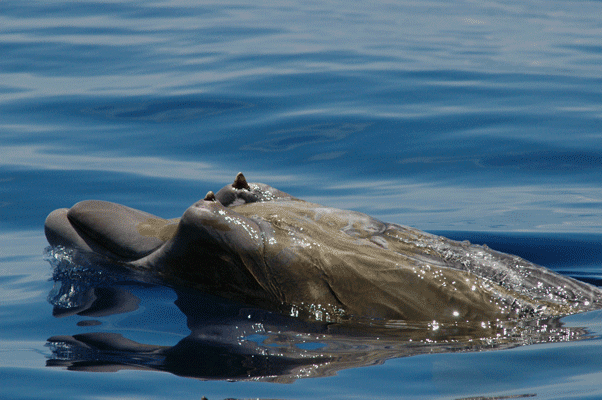
Blainville’s Beaked Whale, Abaco, Bahamas

SIGHTINGS REPORT OCT – DEC 2012

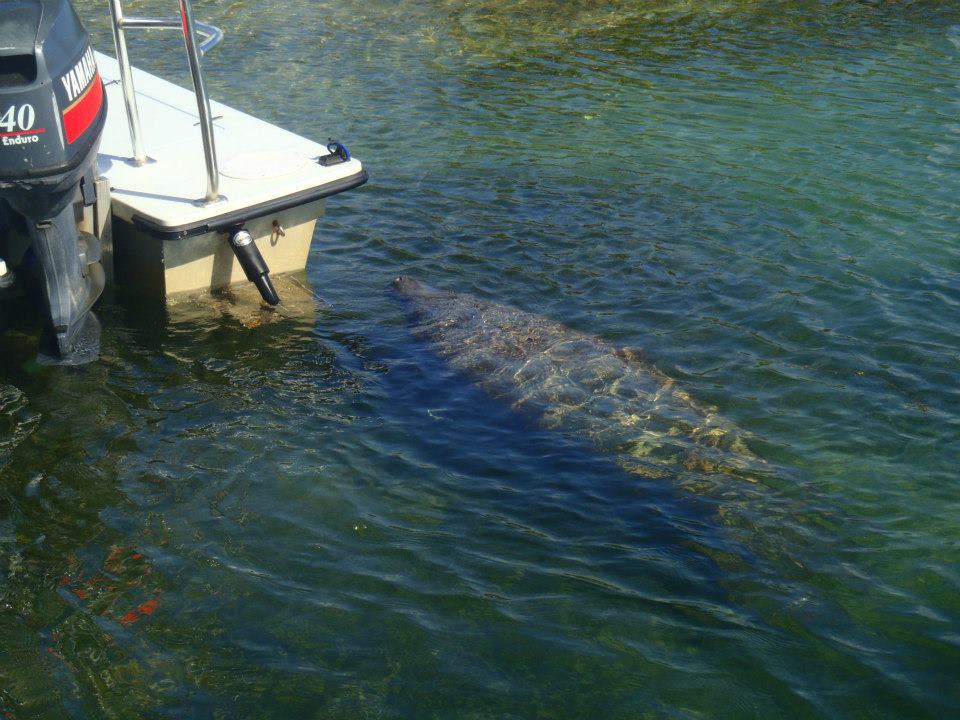
The last quarter of 2012 produced relatively few open-ocean CETACEAN sightings, not least because of a reduction in spotting trips during the period, with some members of the team elsewhere in the world completing their research. SIRENIAN activity is thankfully on the increase, with reporting opportunities increased by the manatees’ preference for sticking close inshore, usually in harbour areas. Georgie has gained her first yellow spot as Abaco’s only resident manatee following her long trip over from the Berry Is. (and away from mother Rita) last summer. She has  taken up residence in Cherokee. She performed a worrying vanishing trick during Hurricane Sandy, holing up (presumably) in seagrass off-shore, and (definitely) in an inshore channel for some of the time. She went AWOL again before Christmas, but has returned to Cherokee in good condition after a short vacation. Having shed her tag (several times) it was not possible to track her. The big plus is that she has proved capable of independent living, and has not become reliant on proximity to humans and their offerings of cabbage leaves etc… This photo was taken at Cherokee a few days ago.

Manatee Georgie, Abaco, Bahamas

The other notable new entry is a manatee sighting in the Freeport area of Grand Bahama. A single photo exists – a head shot – but it hasn’t been possible to identify the creature as a known one. (S)he may be a new visitor to the Bahamas. People in the area are asked to report any further sightings in the area to the BMMRO – and if possible to get a picture!
BMMRO CETACEAN SIGHTINGS OCT:DEC 12

BLAINVILLE’S BEAKED WHALES

RANGE MAP                                                         IUCN RATING “DATA DEFICIENT”


Mid-frequency broadband sounds of Blainville’s beaked whales

Recent research has been carried out on the sound variations of this relatively little-understood species of whale. “Recordings from acoustic tags show that five Blainville’s beaked whales produced mid-frequency broadband sounds on all of their deep dives, with each sex producing two different sound types. These broadband sounds are atypical of the regular echolocation sounds previously described for this species. One male produced a total of 75 sounds over four dives, between the depths of 109 and 524 meters, and four females produced a total of 71 sounds over 18 dives, between the depths of 305 and 1289 meters. Ninety-six percent of the male sounds and 42 percent of the female sounds were produced before the onset of foraging echolocation sounds, and all were produced before the deepest point of the dives. These sounds may be candidate communication signals, with their production timed to mitigate the risk of both predation and hypoxia (oxygen deprivation).”

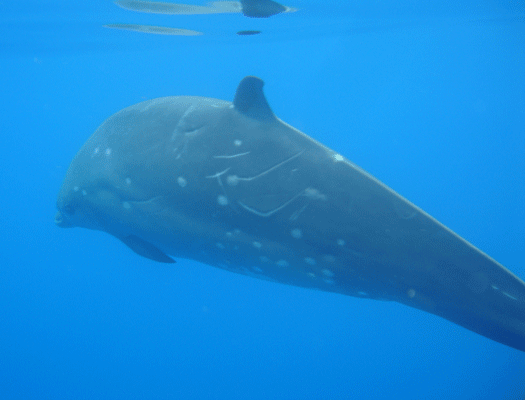
The report includes sample sounds from the 3 BBWs shown below, and the one heading the page. I haven’t found a way to embed the sounds, but I am working on it (there’s a time -consuming method involving conversion to MP3, but maybe another day…)

Blainville’s Beaked Whales, Abaco, Bahamas Blainville's Beaked Whale AbacoDA

Thanks to the prolific DEAR KITTY for a cross-reference to this topic on her website, featuring a fine video of  BBW in French Polynesia

[youtube http://youtu.be/Ks1aLp5_hqo]

Finally, the action-packed, information-filled, image-laden 4 page winter newsletter. Click below to open.

BMMRO WINTER NEWSLETTER 2012 (Jan13)

Georgie Manatee BMMRO SUPPORT LOGO

mantsw~1

Unknown's avatar

THE PLURAL OF ‘OCTOPUS’ & RELATED CEPHALOPOD MYSTERIES…


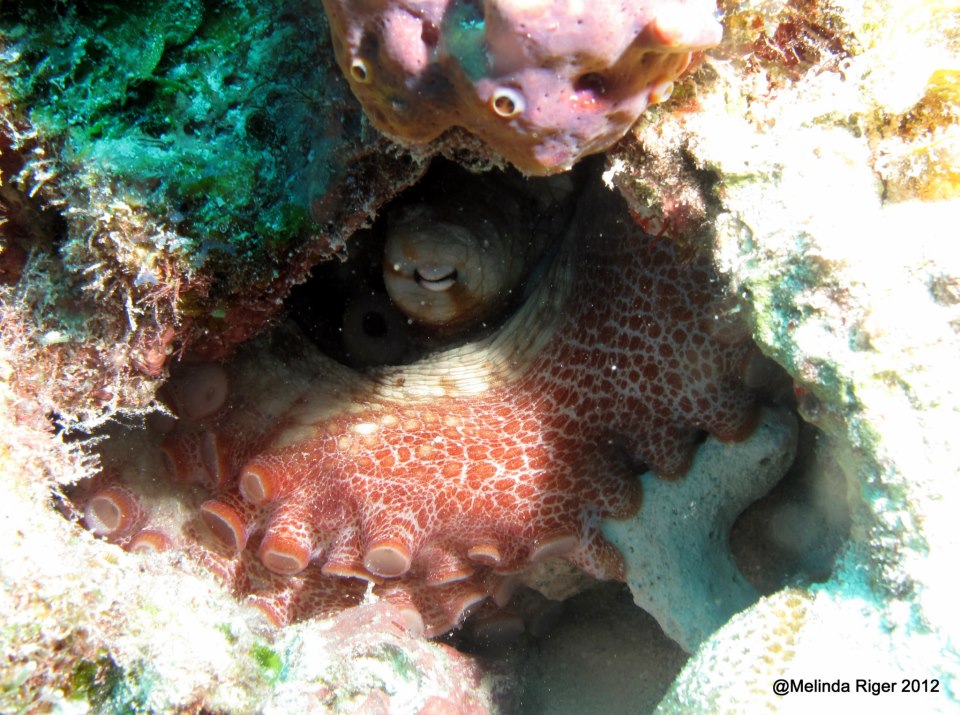
Octopus (Melinda Riger / G B Scuba)

THE PLURAL OF ‘OCTOPUS’ & RELATED CEPHALOPOD MYSTERIES…

The correct plural of ‘octopus’ is a singular mystery wrapped in tentacles and hidden beneath a rock. Shall we have the grammatical discourse first, or save it for later? Let’s have some octopi  octopuses octopodes to look at first… [oh, and it’s definitely not ‘octopussies’, not even for 007] 

 Melinda Riger GRAND BAHAMA SCUBAOctopus 2 ©Melinda Riger GB Scuba

12 TASTY OCTOPUS FACTS TO ASTOUND YOUR FAMILY & FRIENDS

  • Their 8 ‘arms’ come in pairs ( the back two act more like legs) and they are bilaterally symmetric
  • Their beak is hard, but they have no internal or external skeleton (so they can squeeze into tight crannies)
  • They paralyse their prospective meals with saliva from their beak; or drill holes in molluscs, stun them with venom and rip them out
  • They defend themselves with squirted ink, jet propulsion, camouflage or venom
  • All species are venomous; only one species is deadly to humans (not found in the Bahamas)
  • They are able to detach an arm (autotomy) to distract predators with the wriggling shed limb
  • The male’s 3rd right arm is the one used for reproduction… (stop giggling at the back)
  • Well, you asked: 1. special hidden extra arm 2. packets of sperm 3. into the female’s ‘mantle cavity’
  • No, I don’t know any more than that – ask your father.
  • Oh, and the males tend to die within months of mating, deftly using death to sidestep parenting 8-limbed offspring
  • They are unlikely to make a good pet for your family. Those who try, fail
  • They are eaten throughout the world, sometimes alive (e.g. Korea)

Another photo of Melinda’s, showing how an octopus can tuck itself away inside a small gap in the rocks.  It can still keep an eye on you, thoughOctopus ©Melinda Riger GB Scuba

THE CORRECT PLURAL OF ‘OCTOPUS’

There’s much debate about this comparatively unimportant question. Not even an octopus would care. The viable candidates are: octopuses; octopodes; and octopi.  Since all are in common usage, none is ‘wrong’, though some are more correct than others…

1. OCTOPUSES An anglicised grammatical progression of a latin-sounding word to a logical plural, similar to ‘virus’ and viruses’. Only an extreme pedant would want to argue for ‘viri’ or ‘virii’. Similarly with bonus: “We all got boni for Christmas”. No, you didn’t. They were bonuses.

2. OCTOPODES the origin of ‘octopus’ is a Greek word ὀκτάπους, later latinised. The correct plural in Athens would have been ‘octopodes’. It is not derived from a 2nd declension latin noun, as often assumed, in which case the plural might indeed be ‘octopi’ (cf annus / anni; year / years). Using this etymologically accurate form in conversation might lead to a lonely life as people begin to move away from you. But you would still be in the right, if that matters to you so much…

3. OCTOPI see above. In a picky world, this is the least correct of the 3, being a pluralisation based on the wrong root origin (i.e. on latin, not greek), and therefore etymologically unsound. In practice, it’s quick and easy, and everyone knows what you mean, which is largely the point of language, I guess. Personally, I’d use octopuses if I ever used the word.

SUMMARY: 2 is the most technically correct, and also the most likely to get you chucked off the side of the boat. Fully clothed. 1 is a logically correct anglicisation. 3 is a technically incorrect form, but long usage has made it acceptable to all but verbal Luddites. Push them off the boat too.

If you bothered to plough through that, you deserve some quality recreation. Even if you gave up in despair, you deserve these 2 videos (both taken in the Bahamas), which show the incredible way that these creatures move. Those who have never seen a live octopus will be amazed at their bodily transformations. If you only have time for one, see the top one – professionally done, and shorter. The lower one is a good amateur video, with a certain amount of diver  heavy breathing and gurgling.

[youtube http://www.youtube.com/watch?v=cKAIzFEo75M]

[vimeo https://vimeo.com/13280607]

ADDENDUM This was never going to be easy! What about ‘cactus / cacti’, do I hear? Yes, cactus was known to Greeks as κάκτος (kaktos); but it was equally known to the Romans as ‘cactus’, not as a word that had to be imported by them from the Greeks and adapted. So the word’s root is as much latin as greek. No doubt that explains similar latin-origin ‘i’ plurals such as alumnus / alumni and stimulus / stimuli.

While fact-checking – a rare pleasure for me – I discovered a cheerful ‘Merriam-Webster’ video dealing authoritatively with the vexed ‘octopus plural’ debate (best skip the terrible ad)

[youtube http://www.youtube.com/watch?v=wFyY2mK8pxk]

Octopus (Adam Rees)

Unknown's avatar

ART FOR THE [NATIONAL] PARKS: 3 DAY EVENT IN AID OF ABACO’S WILDLIFE


Atala Hairstreak LogoSUPPORT ABACO WILDLIFE CONSERVATION AND THE WORK OF THE BNT

LOCAL ARTISTS & ARTISANS; LECTURES; ENVIRONMENTAL GAMES; FRESH MARKET

(Help to make sure that the creatures pictured below stay off the IUCN ‘threatened species’ list) 

Art for the Parks: Abaco National Parks

Unknown's avatar

BAHAMAS SATELLITE VIEW: 50 SHADES OF BLUE…


Wildcat MapBahamas-Satellite

BAHAMAS SATELLITE VIEW: 50 SHADES OF BLUE…

I’ve come across this dramatic view from space in several places online. I’ve recently been examining the shallows and underwater canyons of the Bahamas group of islands, and this NASA / ISSS map  perfectly illustrates, with natural colour shading, the greatly contrasting sea depths of the region. It also shows the extent of the long protective reefs, and clearly reveals underwater ‘high ground’ and ridges. There’s an almost abstract beauty about it, too, that’s worth sharing…

Bahamas Satellite Map (Wildcat)

Unknown's avatar

KING HELMET SHELLS (Cassis tuberosa) MORE DELPHI CLUB SHELLS


KING HELMET SHELLS (Cassis tuberosa) FROM THE DELPHI COLLECTION

It’s time to look at another shell from Delphi. The club has glass jars displaying small shells in the Great Room. Larger shells like the ones below are displayed on shelves. The King Helmet is the largest of the helmet shells of the family Cassidae. They are found in the Western Atlantic from North Carolina through the Caribbean and the gulf of Mexico down to Brazil. They tend to bury themselves during the day, becoming active and feeding at night. In humans this behaviour is found mainly in students and in those involved in the music business and similar louche occupations.

King Helmet Shell 1 King Helmet Shell 2

King Helmets prey mainly on sea urchins and other echinoderms, using their foot to grip their meal. The dining arrangements are somewhat protracted. The snail makes a hole in the urchin through the combined action of a glandular secretion which is rich in sulphuric acid, while using its RADULA to rasp and dig through the shell to get at the trapped occupant, which it gradually consumes… That’s enough about that.
King Helmet Shell 3
King Helmet Shell 4

Unknown's avatar

“SO THIS IS CHRISTMAS…” ABACO WILDLIFE APPEALS TO EVERYONE!


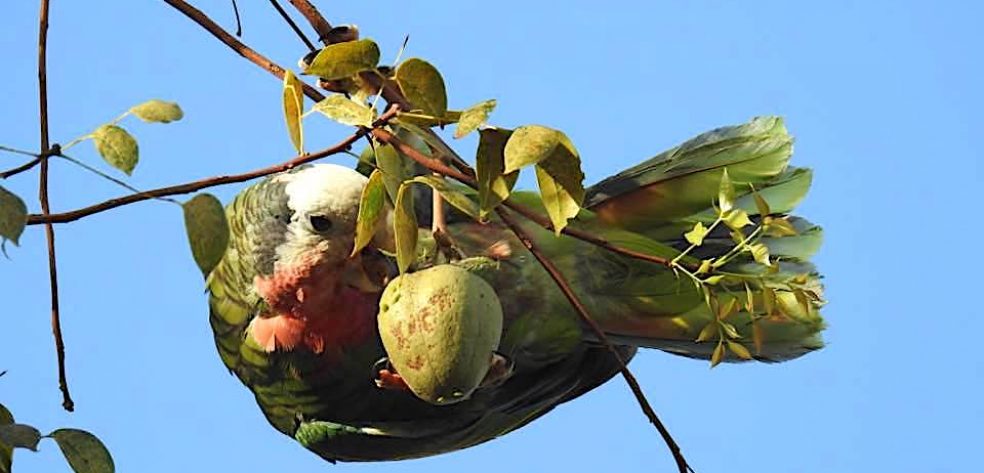
“SO THIS IS CHRISTMAS…” Abaco (Cuban) ParrotImage: ©RH

Christmas time. Holidays. Festive season. Yuletide. ġéohol*. Noel. Winterval. However you describe it, there’s a reassuring ritual each year. To many, the familiar religious carols and rites. To all, the cheerful sound of jingling tills. The exchange of presents happily bought and excitedly received. The groaning table weighted with victuals. Light and laughter. Glasses generously filled and refilled.  Sudden growing dizziness and a strange lack of coordination. Wondering what others are saying. Wondering what you are saying. Drowsiness. Overwhelming sleepiness. The passage of time. The groaning hangover as seven West Indian woodpeckers attack your skull with hammer-drills… Time for a soothing image.

BMMRO Dolphin Image copyImage ©BMMRO

Where was I? Oh yes. This is a very good time to draw attention to the various wildlife organisations based on Abaco and in the wider Bahamas. During the year they look after the birds, the marine mammals and so forth that help make Abaco such a very special place to be. I am simply going take the opportunity to post the link to my updated page for ABACO WILDLIFE CHARITIES. Oh. I just have. Well, is there one that appeals to you, I wonder? Just asking… Meanwhile, here’s the music of the heading to get you in the mood

Delphi Xmas + lights* Old English / Anglo-Saxon origin of “Yule”

Unknown's avatar

HOLE-IN-THE-WALL, ABACO: THE ‘HOLE’ THAT’S NO LONGER A WHOLE


DCB GBG Cover Logo curly

HOLE-IN-THE-WALL, ABACO: THE ‘HOLE’ THAT’S NO LONGER A WHOLE

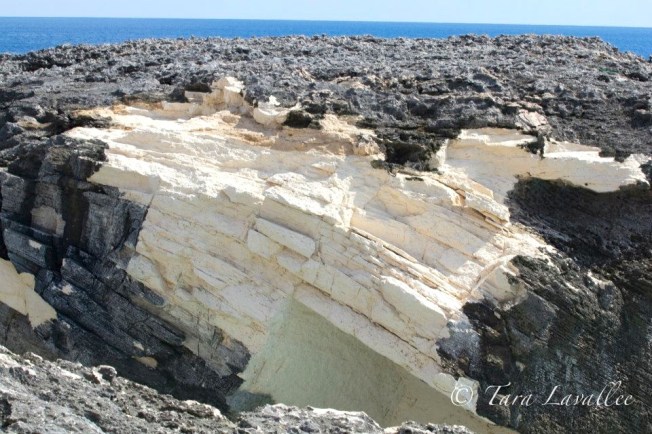
I recently posted 3 items from different perspectives about Hole-in-the-Wall, the destruction of its “roof” by Hurricane Sandy, and the consequent creation of a small islet (provisional names suggested include ‘Holey Isle’ & ‘Sandy Isle’). I also showed what were apparently the last images of the Hole with its roof on (Jack Bowers); and the first of the new post-Sandy geology taken on November 6th (John Haestad) CLICK HERE. It now transpires that some excellent photos were in fact taken a the previous day, November 5th, when Tara Lavalle and her family went to HitW for an outing and to investigate the reports about the Hole. So the pictures below taken by Tara and Luc (to whom many thanks for use permission) now stand as the first post-Sandy images of the ‘Gap’. Unless anyone knows better…

The lighthouse and outbuildings looking back from the Hole-in-the-Wall routeHOLE-IN-THE-WALL LIGHTHOUSE ABACO post Sandy

OMG! Surveying the new scenery           HOLE-IN-THE-WALL ABACO post Sandy 2

The  water still boils through as before…HOLE-IN-THE-WALL ABACO post Sandy 1

The northern end of the new islet, showing the bright new rock-face. Beyond, Nassau… HOLE-IN-THE-WALL ABACO post Sandy 3

Unknown's avatar

THREATS TO SEA TURTLES: ABACO, BAHAMAS… IN FACT, EVERYWHERE


Hawksbill Turtle © Melinda Riger @ G B ScubaDCB GBG Cover Logo dolphin

THREATS TO SEA TURTLES: ABACO, BAHAMAS… IN FACT, EVERYWHERE

The Bahamas has breeding populations of 5 of the world’s 7 sea turtle species – Green, Loggerhead, Hawksbill, Leatherback and Kemp’s Ridley turtles (the other two are Olive Ridley – occasionally found in the Bahamas – and Flatback turtles). All are endangered. There’s no getting away from the fact that Man and Man’s activities are now the primary threats. The IUCN ratings below make for sad reading.

GREEN TURTLE  (Chelonia mydas)

.Photo of turtle swimming towards surface with diver in background

HAWKSBILL TURTLE (Eretmochelys imbricata)

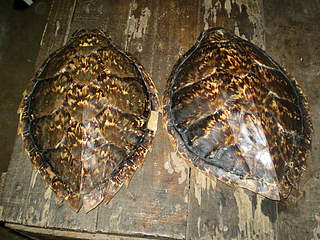
Hunted almost to extinction for their shells

Photo of swimming turtle

LOGGERHEAD TURTLE (Caretta caretta)

A loggerhead sea turtle in an aquarium tank swims overhead.  The underside is visible. Photo of a loggerhead swimming above a reef.

LEATHERBACK TURTLE  (Dermochelys coriacea)

The largest sea turtle

A leatherback sea turtle digging in the sand

KEMP’S RIDLEY TURTLE (Lepidochelys kempii)

The smallest sea turtle


A helpful source of information about sea turtles and their protection is the BAHAMAS SEA TURTLE CONSERVATION GROUP Their excellent summary of the multiple threats to these creatures (below) puts the critical situation very well. Anyone who has watched a TV program about sea turtles and their breeding will be familiar with the vulnerability of turtle nests and hatchlings to predation – and that’s before they ever get to the sea. Despite that, all the species managed to flourish until human intervention (direct or indirect) tipped the balance of survival much further against them. So if we lose one or more of these wonderful species, at least we’ll know who to blame.

1. NATURAL THREATS
In nature, sea turtles face a host of life and death obstacles to their survival. Predators such as raccoons, crabs and ants raid eggs and hatchlings still in the nest. Once they emerge, hatchlings make bite-sized meals for birds, crabs and a host of predators in the ocean. After reaching adulthood, sea turtles are relatively immune to predation, except for the occasional shark attack. These natural threats, however, are not the reasons sea turtle populations have plummeted toward extinction. To understand what really threatens sea turtle survival, we must look at the actions of humans.

2. HUMAN-CAUSED THREATS
In many cultures around the world, people still harvest sea turtle eggs for consumption. Most countries forbid the taking of eggs, but enforcement is lax, poaching is rampant, and the eggs can often be found for sale in local markets. In these same areas, adult sea turtles are harvested for their meat. Turtle products, such as jewelry made from hawksbill shells, also create a direct threat to sea turtles. Lack of information about sea turtles leads many Americans to unwittingly support the international trade in these endangered species. Buying and selling turtle products within the U.S. is strictly prohibited by law, but turtle shell jewelry and souvenirs are the most frequent contraband seized by customs officials from tourists returning from the Caribbean. Indirect threats are harder to quantify, but they are likely causing the greatest harm to sea turtle survival.

Illegal turtle shells (IUCN)IUCN: illegal turtle shells
3. COMMERCIAL FISHING
The waters of the Gulf of Mexico and west Atlantic coast are a major habitat for turtles, but are also the main shrimping grounds in the U.S. Each year, thousands of turtles become entangled in fishing nets and drown. Worldwide, shrimp trawling probably accounts for the incidental death of more juvenile and adult sea turtles than any other source. At one time, as many as 55,000 sea turtles were killed each year in shrimp nets in the southeastern United States alone. Today, all U.S. shrimpers are required to put Turtle Excluder Devices (TEDs) in their trawl nets. Unfortunately, not all fishermen comply with the law, and sea turtles continue to drown in shrimp nets.

Sea turtle entangled in a ghost net

4. INGESTION OF DEBRIS AND PLASTIC
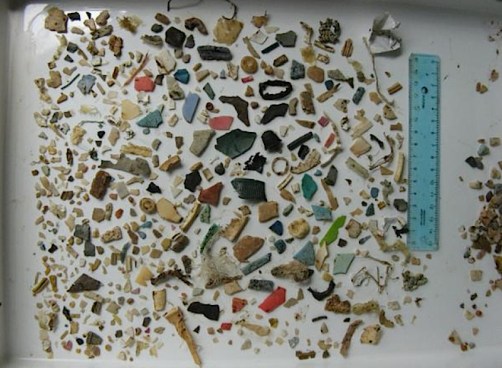
Thousands of sea turtles die from eating or becoming entangled in non-degradable debris each year, including packing bands, balloons, pellets, bottles, vinyl films, tar balls, and styrofoam. Trash, particularly plastic bags thrown overboard from boats or dumped near beaches and swept out to sea, is eaten by turtles and becomes a deadly meal. Leatherbacks especially, cannot distinguish between floating jellyfish — a main component of their diet — and floating plastic bags (my italics).

One sea turtle’s accumulated ingested plastichttp://www.wired.com/wiredscience/2011/03/sea-turtle-plastic/Credit: http://www.wired.com/wiredscience
5. ARTIFICIAL LIGHTING
Nesting turtles once had no trouble finding a quiet, dark beach on which to nest, but now they must compete with tourists, businesses and coastal residents for use of the beach. U.S. beaches are rapidly being lined with seaside condominiums, houses and hotels. Lights from these developments discourage females from nesting and cause hatchlings to become disoriented and wander inland, where they often die of dehydration or predation.

Florida at night- NASA : ISSS

6. COASTAL ARMORING 
Coastal armoring includes structures such as sea walls, rock revetments and sandbags that are installed in an attempt to protect beachfront property from erosion. These structures often block female turtles from reaching suitable nesting habitat and accelerate erosion down the beach. Armoring is especially problematic along the east coast of Florida, where beach development is occurring in the very places where sea turtles come to nest by the thousands.

ProTec-Godfrey

7. BEACH NOURISHMENT
Beach nourishment consists of pumping, trucking or otherwise depositing sand on a beach to replace what has been lost to erosion. While beach nourishment is often preferable to armoring, it can negatively impact sea turtles if the sand is too compacted for turtles to nest in or if the sand imported is drastically different from native beach sediments, thereby potentially affecting nest-site selection, digging behavior, incubation temperature and the moisture content of nests. If renourishment is allowed to proceed during nesting season, nests can also be buried far beneath the surface or run over by heavy machinery.

Beach restoration WIKI

8. POLLUTION
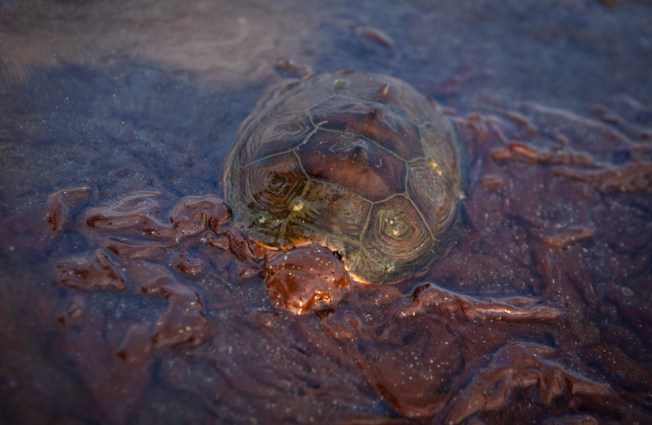
Pollution can have serious impacts on both sea turtles and the food they eat. New research suggests that a disease now killing many sea turtles (fibropapillomas) may be linked to pollution in the oceans and in nearshore waters. When pollution kills aquatic plant and animal life, it also takes away the food sea turtles eat. Oil spills, urban runoff of chemicals, fertilizers and petroleum all contribute to water pollution.
Although the problems of habitat destruction and exploitation seem almost too big to overcome, there are many things within our control that can be changed. Greater public awareness and support for sea turtle conservation is the first priority. By learning more about sea turtles and the threats they face, you can help by alerting decision-makers when various issues need to be addressed.

“Look on thy works, ye Humans, and despair…”  [Gulf of Mexico]Sea Turtle / Oil Pollution Boston.com / ReutersCredits boston.com / Reuters
FURTHER REFERENCES (click logos)

 Bahamas Sea Turtle Research Logo            BAHAMAS SEA TURTLE RESEARCH

BSTCG logo green sea turtles       BAHAMAS SEA TURTLE CONSERVATION GROUP

Bahamas National Trust Logo                BAHAMAS NATIONAL TRUST (Factsheets)

seaturtle.org         SEATURTLE.ORG (image library)

Sea Turtle Conservancy http-:www.conserveturtles.org        SEA TURTLE CONSERVANCY

article-1369438-0B529C0E00000578-415_306x220

Credits: BSTCG; Wiki (images / IUCN tables); wire.com / wiredscience; Boston.com; Reuters; NASA; STC
Unknown's avatar

MANATEES AND BONEFISH: THE BEST OF TWO WORLDS ON ABACO


DCB GBG Cover Logo dolphin

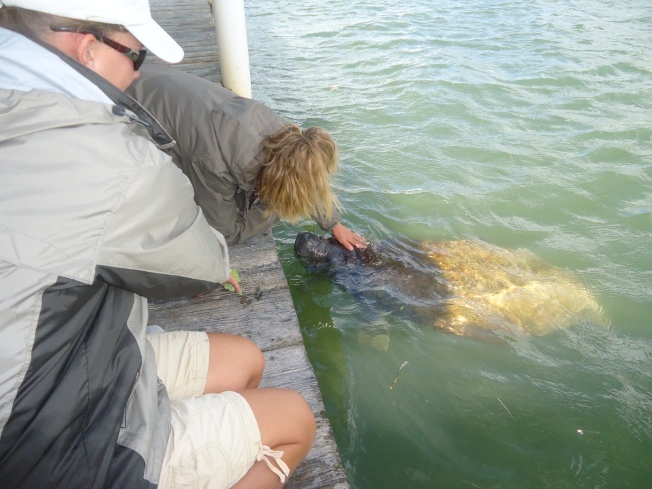
Trish has featured before in this blog, in particular recounting a day’s bonefishing at CHEROKEE. She and Alex have just returned from a gratifyingly successful bonefishing trip at the Delphi Club, Abaco (see below). She also went with guide Dana Lowe to see Georgie the manatee, who likes it so much at Cherokee that she has made it her home. She (Trish, I mean…) has sent me two very recent images, adding “…it was so brilliant seeing such an animal in reality and feeding her cabbage.” DANA & TRISH FEEDING GEORGIE (2)Dana & Trish greeting Georgie Manatee

Delphi Bonefish Logo

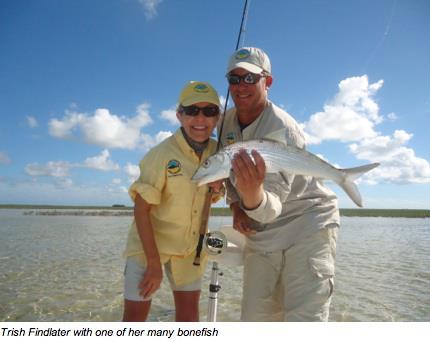
Trish and Alex also got among some large bones during their stay. She boated a fine fish when out with guide Robin Albury…

405022_10151177586874482_1500147974_n

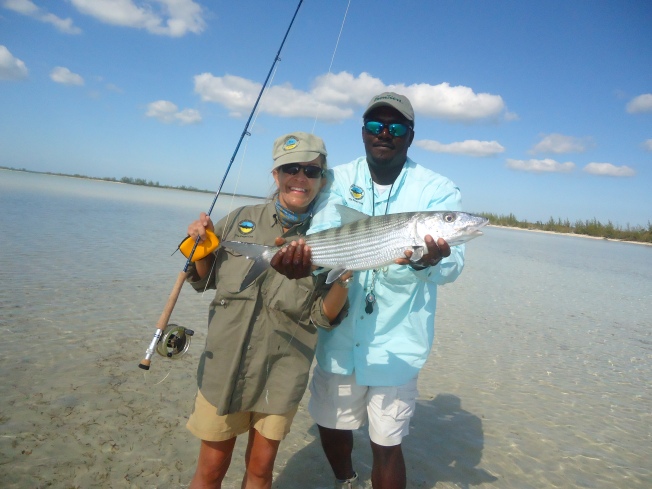
…only to surpass herself a few days later with what is reckoned to be the Delphi Club guest record with a 9 lb+ fish when out with guide Tony. As I am still way short of that myself, I can only look at the fish with wonder and resolve to do better in 2013…TRISH WITH GUIDE TONY & THE BIG FISH

Unknown's avatar

THE CORALS OF FOWL CAY MARINE PRESERVE, ABACO [VIDEO]


DCB GBG Cover Logo dolphin

THE CORALS OF FOWL CAY MARINE PRESERVE, ABACO

coral6

I usually have 3 or 4 planned posts on the go. Some are quick to compose, some are not. Especially those requiring technical input from the technically unsound – downloading a video, changing the file format, editing and polishing, uploading to a compatible ‘carrier’ etc. I’ve been meaning to get round to making some fish and reef videos from footage of a trip with Kay Politano of Abaco Above & Below. Now I have…coral8

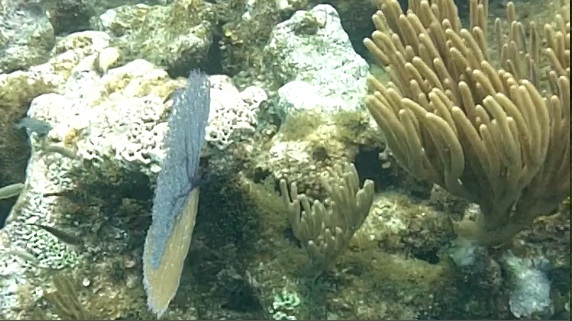
If you are tolerant enough to at least start this one, which focusses on coral, can I restate the excuses? I swim like a panicking cat. I hadn’t snorkelled for a great many decades years until 2011. I was a stranger to underwater scenery, let alone photography. I wave my tiny camera around too excitedly, though not deliberately to inflict seasickness on hapless viewers… It is a bit less bad this time round, however. Luckily I can tell from my stats if anyone has bothered to click on the video below, and you can rely on me to trash the thing if I find a paltry (or non-existent) response. Best just to watch on the small screen, though.coral14

With those dire warnings, here is the video. I would be very interested to ID all the corals that can be seen. There are the easy ones like sea fan, elkhorn, mustard hill, brain… but what’s that one over there? No, behind the waving one…? Comments / suggestions welcome. And if you don’t much care for coral, there are some pretty fish to look at…

Music Credit: Adrian Legg’s ‘Old Friends’, from ‘Guitar Bones’

ADDENDUM JAN 13 I am really grateful to Capt Rick Guest for taking the time to view the video, and the trouble to analyse the contents. He has very helpfully highlighted many points of interest in the film, both as to coral and as to fish, so I’ll post his commentary in full, with my thanks. Of both interest and concern are Rick’s remarks about the Elkhorn Coral. I had wondered about its bleached look. It’s dying…

CORALS ETC

  • At 0:36 a lavender Sea Fan…(Gorgonia ventalina).
  • At 0:52 Yellow “Leaf”,or “Letuce Coral”. Agaricia species growing around a living soft coral called a “Sea Rod”. Soft Corals have living polyps which feed on plankton just like the hard corals.
  • At 1:02 More Agaricia, and a small Brain Coral at bottom. Either a Diploria, or Colpophylia species.
  • At 1:10 A Sergent Major fish, (Abedefduf saxatilus). One of my favorite Taxanomic names! Behind is mostly dead, Elkhorn Coral. The white areas being indicative of “White Plague”. A disease responsible for Coral Whiting…..Death!
  • At 1:37 A Blue Tang swims over some “Mustard Coral”… Porites porites.
  • At 1:55 A chubby “Chub” swims by. Likes caves and caverns and edible, but not palatable.  
  • At 2:33-38  Much coral bleaching damage here on these Elkhorn Corals.  
  • At 2:40-48 A Thalassoma bifaciatum,or “Blue Headed Wrasse” is swimmin’ about. This guy used to be a lady,but he’s a product of Protandric Hermaphrodism! When there’s a paucity of males in the area, a yellow female will step up and become a male for the school.
  • At 3:29 Lower right: a fine example of Millepora complanata,”Fire Coral”. Fire Coral is more related to Man-O-War, and jellyfish than Corals.
  • At 3:50 More Elkhorn Coral with White Plague  
  • At 4:23 Brain Coral, probably Diploria clivosa 
Unknown's avatar

ABACO: WHALES, DOLPHINS & MANATEES – BMMRO POST-SANDY REPORT

HURRICANE SANDY – AND AFTER

A report by Kendria Ferguson on the impact of Hurricanes Sandy for the BMMRO

After all the exciting but unexpected events of October, slowly life is returning to normal. As the whimsical but intimidating winds of Hurricane Sandy encompassed the research center, we felt a few limited blockbuster hits. Without power for four days and no contact with the world outside of Sandy Point, we felt like we were in a twilight zone! Hurricane force winds crept up on Abaco during the wee hours on Thursday, October 25th; predicted to be a Category 1, Hurricane Sandy surely made her presence felt! Luckily, we only had a few minor leaks at the research center but the community of Sandy Point and other parts of Abaco had severe flooding and extensive damage. 

Trapped in a house for four days with a hurricane that refused to leave, our concern for Georgie (the Christopher Columbus of our Bahamian manatees) began to grow. Georgie recently separated from her mother (Rita) in June of this year, and shortly thereafter decided to take a detour to Abaco, over 70 miles from the Berry Islands, Northern Bahamas, where she previously resided with a small population of manatees. Having travelled a tremendous distance around Abaco, she finally settled in at a small community called Cherokee Sound, located on the eastern side of Abaco. During Hurricane Irene, October 2011, Georgie and her mother swam from Spanish Wells, Eleuthera to Nassau. Whether this shift in locations was entirely due to the passing of a hurricane is unknown but scientists feared that Georgie could possibly get confused during the storm and take off to an unknown location.

Last sighted on the 24th of October, Georgie wasn’t seen again until November 4th, almost a week after Sandy had passed the community of Cherokee. She returned with a back covered in moss, an outstandingly healthy looking figure and thankfully no visible injuries/wounds as a result of the storm (these photos were taken on November 5th).

After hurricanes, an increase in shark bites has been documented amongst the dolphin population that inhabit the Little Bahama Bank (Fearnbach et al. 2012). Scientists believe that hurricanes may be the driving force for the relocation of dolphins to waters deeper than their preferred habitat which therefore makes them more accessible to predators such as oceanic sharks. Increase in wave height, storm surge, sediment erosion and deposition can make these once tranquil shallow habitats confusing for dolphins and manatees to navigate.

Photograph of a juvenile dolphin with a fresh and severe shark-bite wound on its flank

In the 1980’s and 1990’s, a decline in adult survival rate after the passing of major hurricanes (Category 3 and higher) among manatee populations in Florida were attributed to possible injury from debris, strandings and displacement of animals as a result of habitat loss and strong water currents (Langtimm et al. 2003).

As we hoped, Georgie appeared to have tucked herself into the nearby mangroves and returned within eyesight when she felt it was safe enough to leave the shelter she sought out during hurricane Sandy. Now that the storm has passed, falling debris has been cleared and our shallow water habitats have returned to the calm and often crystal clear waters we remembered them to be. We can all now let out a huge sigh of relief! We all survived Super-Storm-Sandy!

Fearnbach, H. D. (2012). Seasonality of calving and predation risk in bottlenose dolphins on Little Bahama Bank. . Marine Mammal Science, 28(2), 402-411. 
Langtimm, C. A. (2003). Lower survival probabilities for adult Florida manatees in years with intense coastal storms. Ecological Applications, 13:257-268.

Story by Kedria Ferguson, BMMRO’s education officer and manatee expert

The End

Unknown's avatar

GEORGIE THE ABACO MANATEE: IS SHE RELATED TO AN ELEPHANT?


GEORGIE THE ABACO MANATEE: IS SHE RELATED TO AN ELEPHANT?

Georgie, having returned to Cherokee after Hurricane Sandy, is still around there and seems to have made it her home. While she was missing, it was thought she had headed off instinctively for the protection of the mangroves. However a number of sighting reports made since Sandy suggest that she had sensibly swum up the canal at Casuarina, where she was able to keep her head down until the storm had safely cleared northwards, and she was able to return to base. Because she had shed her tag, we’ll never know the full story… 

Georgie safely back at Cherokee after Hurricane Sandy

Recently an interesting article by BEACH CHAIR SCIENTIST considered the relationship between sirenians and pachyderms, and added some handy comparative facts (you can seen more manatee facts on this blog HERE). Thanks, BCS, for use permission (the relevant credits are contained in the article).

Are manatees and elephants related?

by Beach Chair Scientist

It might be very difficult to imagine, but manatees (also known as ‘sea cows’) share a common ancestor with elephants which might come as a surprise if you thought manatees shared a common ancestor with other marine mammals such as dolphins, whales, or sea lions. Here are 10 facts that link manatees and elephants are long-lost relatives.

1. Scientifically, manatees and elephants are classified as subungulates. Other mammals in the Subungulata superorder are hyraxes and aardvarks.
2.Manatees and elephants have an uncommon-shaped heart that is spherical. To compare, most mammals have a single-pointed tip at the base (i.e., “heart”—shaped).
3. The West Indian and West African manatee have three or four fingernail-like structures on the tip of their flippers, just like that of the toenails on the feet of elephants.
4. Manatees and elephants both have a thick, gray skin with very sparse hair.
5. Manatees and elephants have molars which move toward the front of the mouth, eventually break off, and are restored by those at the rear. Elephants have a limited number while manatees are never-ending.
6. Manatees have two incisors that bear a resemblance to elephant tusks.
7. Manatees use their large, flexible muscular lips to break apart vegetation in the water and skillfully steer food to their mouths. This is very similar to the action of the elephant eating with his trunk.
8. Manatees and elephants are herbivores. Manatees tend to feast on sea grass and freshwater plants and consume up to 100-150 pounds a day. Elephants tend to feast on small plants, bushes, fruit, twigs, tree bark, and roots and consume up to 330-375 pounds a day.
9. Male manatees and elephants are known as bulls. Female manatee and elephants are known as cows. Young manatee and elephants are known as calves.
10. Manatees and elephants are both endangered. Their numbers have dropped due in a large part to human activities.

Manatee image (c) cruisenaplesflorida.com, elephant image (c) gallery.hd.org

Here is a fantastic TEACHING RESOURCE from the University of Florida and Se Grant extension I uncovered while pulling this post together.

Credit: SavetheManatee.org

To whom thanks also for this: WHAT DO MANATEES SOUND LIKE? 

[audio http://www.savethemanatee.org/Manatee%20Sounds/Track03mp3.mp3]


Unknown's avatar

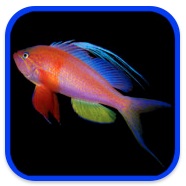
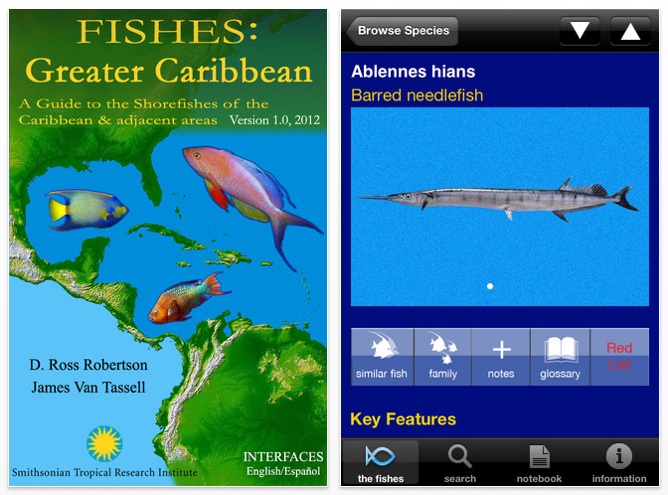
FISHES OF THE GREATER CARIBBEAN: IMPRESSIVE FREE APP FOR YOUR iGADGET


FISHES OF THE GREATER CARIBBEAN: AN IMPRESSIVE FREE APP FOR YOUR iGADGET

In these parts we are seriously tech-savvy. Occasionally I test and review relevant apps – see RH APP TEST BENCH. Thanks to a heads-up from Friends of the Environment  via The Abaco Scientist, here’s a new way to wean yourself off Angry Birds…

   FREE      RH provisional rating ****

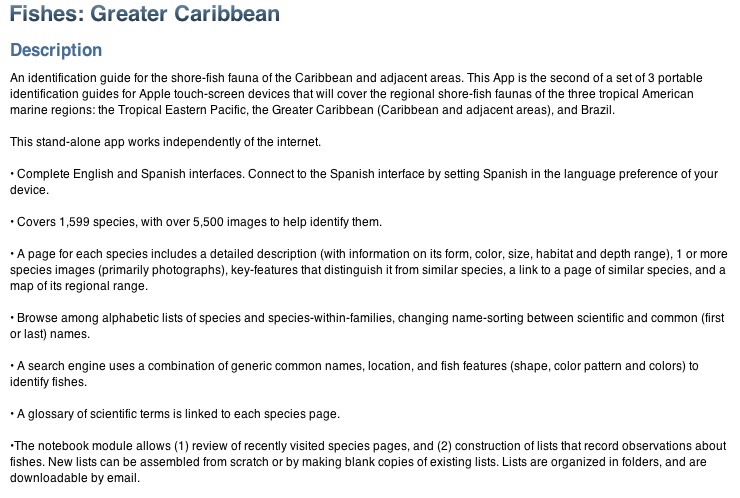
I’ve just put this on my iTimewaster, and first impressions are that this is a seriously useful app from the Smithsonian, certainly from a layman’s point of view. Be warned that it is extremely comprehensive and therefore takes up 0.5 gb of space, so on an iPhone you may have to remove Angry Birds completely to make space, plus your most recent impulsive and misguided music downloads.

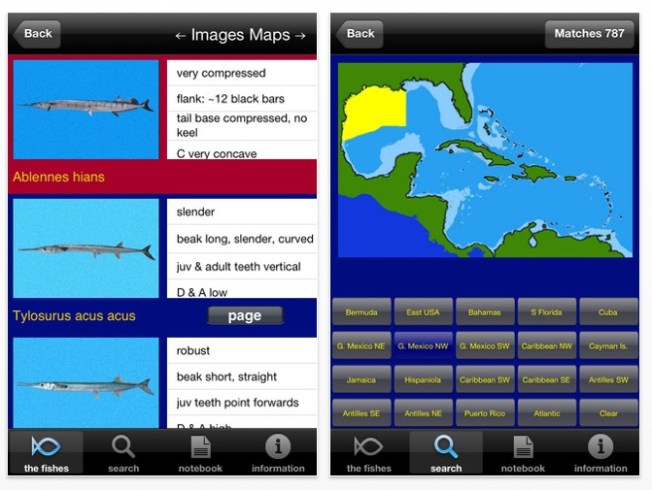
The first option is to browse fish by species or family. Either will take you to first-class photos (some drawings) that really look like what you see underwater (not every app is so good). You are offered a helpful ‘similar fish’ option; there’s a notebook to enter your data; a glossary;and the IUCN status for each fish. The descriptions are clear, as are the range maps for particular species.

There’s also a very good search feature for when someone tells you to look out for the ‘Lucifer’s Gonadfish’ at Fowl Cay and you have no idea what one looks like. (If they exist. Which they don’t). This is subdivided into name / location/ shape/ colour pattern and colours options to help pinpoint the fish. Later you can even recall ‘recently visited species’.

I have only had a quick flick around on my phone. I guess it will be more impressive still on an iPad. It’s hard to believe that this is free, when similar ID apps cost several dollars. I’ll play with it a bit more, and use it for a couple of IDs I am struggling with. NB There is a risk that I might find myself upgrading the rating to the rare and coveted Rolling Harbour 5*****

SCREENSHOT 1
SCREENSHOT 2

Interested? Direct link to the iTunes page is HERE

Unknown's avatar

HURRICANE SANDY AFTERMATH: ABACO PICTURES, NEWS FROM DELPHI CLUB, BAHAMAS & MANATEE UPDATE


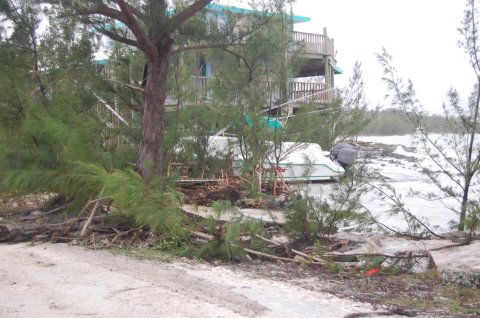
DAMAGE FROM HURRICANE SANDY AT THE DELPHI CLUB, ABACO

The storm has passed from the Bahamas and the clear-up is underway – but further north communities are bracing themselves for the onslaught. The news today  from contacts, from Facebook and the web generally, is of thankfully little lasting damage, with power and comms restored in many places. There’s been plenty of flooding – eg Sandy Point – and tree / plant mayhem.

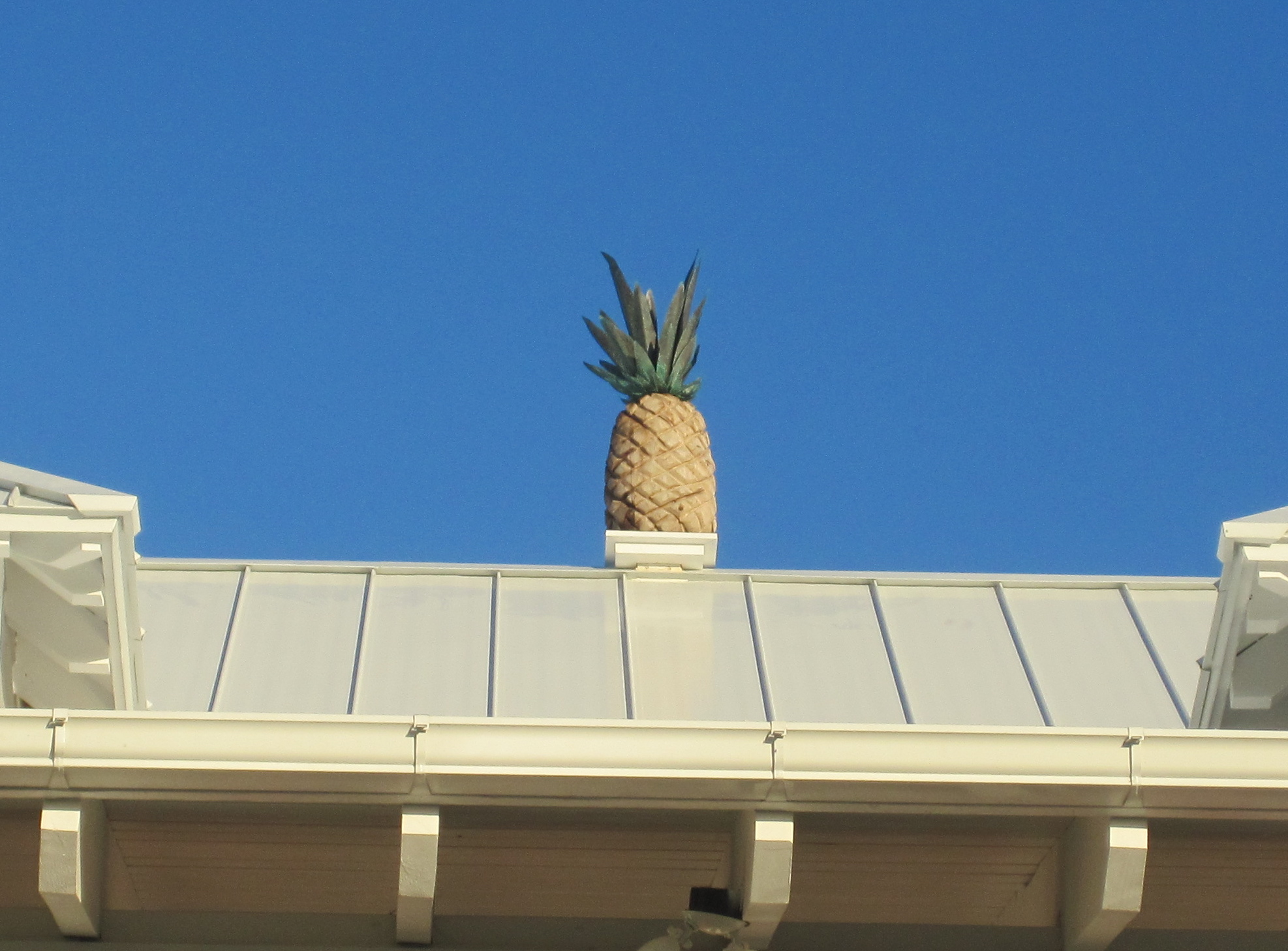
The Delphi Club was again, as with Irene last year, almost directly beneath the eye of the storm. Then, a couple of leaves were lost from the pineapple crown (above), a few fittings were smashed, and the gardens were unceremoniously rearranged. Peter Mantle, Delphi Club supremo, has posted his record of the last few days at the club – the approach of Sandy, the storm, and the aftermath. I am posting extracts below, to be read (chronologically) from the bottom entry to the top of the page. For those who haven’t experienced a storm of this violence, Peter’s account gives a vivid picture of the before, the during and the after…

Apologies for having posted about Sandy in detail with maps etc, and at the crucial time tailing off  while I was away and had only an iPhone™  and a sporadic connection…

STOP PRESS: AMERICAN OYSTERCATCHERS – BRAVE OR FOOLISH? 29 October

Peter Mantle has just sent me a ‘Sandy’ photo from the Delphi Club beach, showing a group of oystercatchers on the rocks at one end of Rolling Harbour. Storm detritus already festoons the rocks. Have the birds seen what’s about to hit them? Are they waterproof? 

STOP PRESS: BMMRO MANATEE UPDATE 29 October
The BMMRO has posted news from Sandy Point and for those who have been asking after manatee Georgie’s welfare, an update:

“Hi Everyone, everything is ok here at the research center! We are working on getting information on Georgie’s whereabouts and we will happily update everyone as soon as we hear anything. There’s still a bit of damage here in Abaco that is preventing travel but hopefully we will be able to get up to Georgie soon”.

STOP PRESS: SOME ABACO IMAGES 28 October
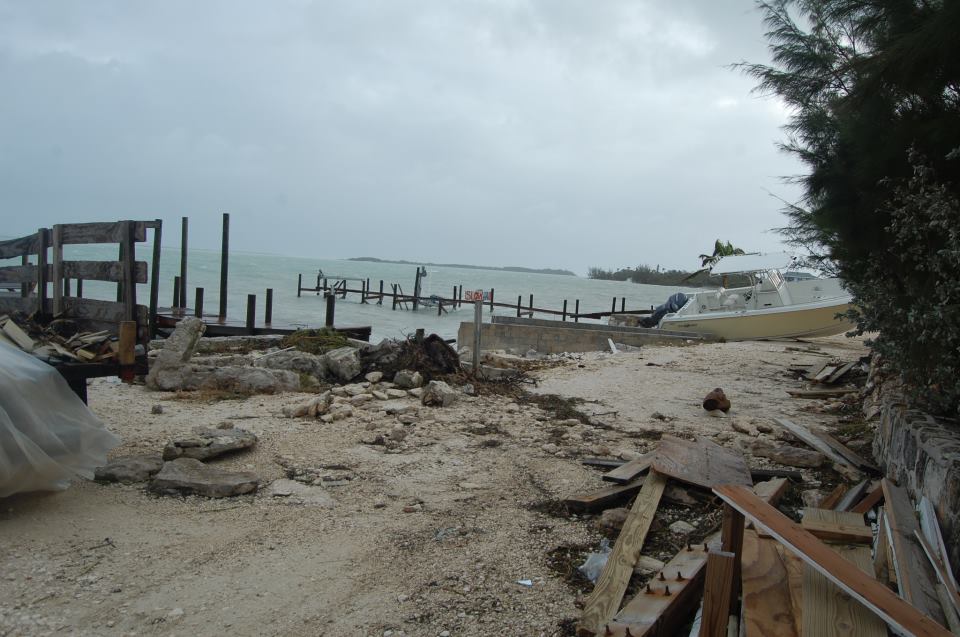
(credits to Timothy Roberts & Cindy James Pinder and their facebook posts)

SANDY TAKES BONEFISH; DARK HUMOUR ON DARK DAYS

OCTOBER 27th Among the many bits of minor damage caused by Hurricane Sandy was the destruction of our bonefish weather vane. This had been hand-made by the other Sandy, our general manager, and stood atop his lodgings. Snapped off, the copper creation was found nearby, bruised and dented, rather like ourselves.

Yet again, we have been very fortunate – staff and guests are all well. And most of the damage caused by the 100mph winds was minor. The storm had its moments, but the worst bits were at nighttime when many people were huddled safe in bed. Lots of bumps and bangs provided a spooky soundtrack, but it was more of a B movie than a full-blown Hollywood epic. That said, I hate to think what a really big Category 3, 4 or 5 hurricane would be like.

We still have no mains electricity; thank God for the gennie. We have no phones or mobile connection, so we have little idea of what is going on elsewhere on the island. We hope for the best but fear not all will have escaped as lightly as we did. Some of the staff from Crossing Rocks are stranded here by flooding. But the wireless internet is back so all will soon be revealed.

Yet again, the gardens have been shredded. The banana trees have been snapped off mid-fruiting. My favorite banyan tree has broken in half again, having nearly bounced back from Irene. The big Bismark ferns are banjaxed, the bougainvillea is blasted leafless and the pool is a mess. But who cares. We are fine. Dunkirk spirit? Well, very black humour and spirits of a different kind have seen us through.

“I survived Sandy” T-shirts are now in preparation, but that’s a staff joke about their hyperactive and heroic boss…..

A BAD HAIR DAY…

OCTOBER 25th It is getting distinctly breezy here, with winds as bad as any Irish gale. But Hurricane Sandy, now upgraded to a Category 2 hurricane, is still some 18 hours away and currently features average winds of 105mph with higher gusts. It may get even worse, they say. So no fishing today. More guests have made it in. Bahamasair even ran a plane out of Nassau at first light this morning.

While we still have power and phones, the lines are buzzing and we are glued to the internet. It seems odd to see that Sandy is the lead news story on the BBC. Non-technical guests have adjourned to the library (where “A Perfect Storm” and “Winnie the Poo and the Blustery Day” are current favourites). The air of gloom is more attributable to the fact that Arsenal lost at home last night than to any fears for personal safety.

We may go quiet for a while.

NOTHING VERY FEMININE ABOUT THIS SANDY

OCTOBER 24th, noon Tropical storms are now given boys’ and girls’ names alternately; in the old days they were all girls. The one that currently threatens us is Sandy, a name that is more commonly applied to females in this part of the world. But there is nothing too feminine about this storm; as the forecast deteriorates and Sandy intensifies into a hurricane over Jamaica, we are becoming more and more concerned by its macho capabilities.

The National Hurricane Centre now predicts that Sandy will pass very close to Abaco – the predicted path having shifted overnight. As it now looks, the eye may pass just 25 miles from us, which would basically be a direct hit since damaging winds spread far out from the centre. We are going to have to keep a very close on on this little girl over the next 48 hours.

ALL EYES ON SANDY

OCTOBER 23rd No sooner has the Club reopened for the new season than a tropical storm appears on the horizon. And, in a twist of divine humour, it’s been christened after our general manager, Sandy.

Sandy (the mostly human version) is tracking Sandy (the swirling tempest) on an hourly basis. As it now stands, we are in the “cone” of the likely track of the storm over coming days. Currently south of Jamaica, TS Sandy is turning north and could yet morph into a hurricane. It’s expected to be over or near us by Friday night, with “average” winds of nearly 60mph and gusts of up to 90mph.

Hatches will therefore be battened, outdoor furniture put back indoors and supplies of grog reinforced. The lucky fishers in residence will have to take a breather, while the new chef, John, will receive a special form of baptism.

Tropical storms this late in the year are a great rarity. Somehow that is not very reassuring just now. But the forecast for the following week is rather better… 

Click image to visit the Delphi Club

Unknown's avatar

“MANATEE MANIA IN THE ABACOS” BMMRO FALL 2012 NEWSLETTER


“MANATEE MANIA IN THE ABACOS” – BMMRO FALL 2012 NEWSLETTER

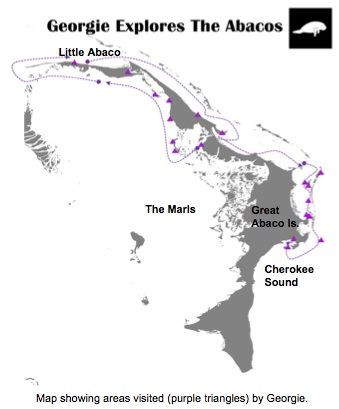
The BMMRO has just published the Fall 2012 newsletter, and it’s no surprise to find that the front page news is the arrival of young manatee Georgie on Abaco. After nosing and indeed grazing her way around Abaco and the Cays, she still appears to be contentedly moored in Cherokee after the best part of a month. Here’s the official map of her wanderings 

Besides the manatee there’s plenty more to read and look at including 

  • Charlotte Dunn’s ‘President’s Update’
  • Articles on whales, and a friendly bottlenose dolphin’s visit to Hope Town
  • Fall ‘cetacean sightings’ map
  • Students at ‘Whale Camp’
  • A quiz to make sure you have taken it all in…

To read the four-page document –  and admire the photos – CLICK BMMRO FALL 2012 NEWSLETTER

Unknown's avatar

GEORGIE THE ABACO MANATEE – CHEROKEE’S SIRENIAN VISITOR STAYS ON…


GEORGIE THE ABACO MANATEE – CHEROKEE’S SIRENIAN VISITOR  STAYS ON…

There must be something special about Cherokee on Abaco. Georgie the Manatee, having travelled over from the Berry Is. early last month, spent 4 weeks or so on the move. She was tracked on the west side of Abaco in the Marls, moving north and rounding Little Abaco, then travelling south visiting various Cays along the way, ending up in Hope Town harbour. After a few days she moved across from Elbow Cay to the Little Harbour area, before settling down in Cherokee. That was nearly 3 weeks ago. She’s still there, by far the longest she has stayed in one place

Maybe the sea grass is especially good there. Or maybe she has found a tasty freshwater spring. Or it could be that she is enjoying the company there, and the welcome from the community – though she of course has been a very popular visitor in all her ports of call. Whatever the reason, she seems to be happy and in good health. Kendria Ferguson (BMMRO) has just sent me 3 photos from her visit to Cherokee today. Georgie has managed to shed her tag – again – but since everyone knows where she is, it doesn’t matter for now…

The image below is also posted on the BMMRO’s FACEBOOK PAGE and maybe gives a clue to why Georgie is so content – calm, friendly interest and attention. The next one is of a young boy inspecting Georgie, also in Cherokee. Equally peaceful.

Let’s compare and contrast those serene pictures with another taken recently – the woman below who was detained in Florida for her ‘manatee riding’ antics…

Unknown's avatar

NETTICA (‘NETTIE’) SYMONETTE’S ABACO BONEFISHING LEGACY


Nettie's Point, Abaco - the cut to the sea

NETTICA (‘NETTIE’) SYMONETTE’S ABACO BONEFISHING LEGACY

As a companion-piece to the previous post about Abaco bonefishing, I’ve made a short movie of the final stage of the skiff trip after a day out on the Marls back to Nettie’s Point and the skiff launching / landing ground there. It’s always a interesting ride, and I took the footage just for the fun of it. At very high tide, the channel can (must?) be taken at speed, and end with an 007 flourish. When the tide is low, however, it can be slow progress with the propeller precariously close to the rock for much of the channel’s length… Small crabs scuttle for cover in limestone holes as you pass, and you can see clearly what a huge amount of rock had to be cleared out.

Approaching the mouth of the channel at high tide, with rock spoil on both sides

Then I got to thinking about the originator of this canal cut through rock from the firm ground of the pine forest through to the open sea. ‘Nettie’s’ is named after Nettica Symonette, Eleutheran-born owner of ‘Different of Abaco’, the now defunct bonefishing lodge on the road off the main highway to Casuarina. She was clearly a striking figure – tall, strong-minded, and a passionate promoter of out-island tourism. She must have had plenty of insight into the importance of the natural resources that might make Abaco attractive to visitors, for she was not just a bonefishing pioneer, but also a wildlife enthusiast.

Flamingos and chicks on Inagua, 2012 (photo credit: Melissa Maura)

Nettie attempted to reintroduce flamingos to Abaco as breeding birds (there had been none breeding on Abaco for some 50 years). That involved the relocation of a number of juvenile birds from the National Park on Inagua (see FLAMINGO POST). They were flown to Abaco and resettled in the Casuarina area with their wings clipped. This was 15 – 20 years ago, and I don’t know if there was any successful breeding. I believe further birds were brought over, but for some reason the hoped-for breeding colony did not become established. It’s possible that there were problems with predation, as with the Abaco parrots.

Unhitching a skiff into the boat basin at high tide

Nettie’s lasting legacy is the construction of the canal cut through to the mangrove swamps and the ocean, and the ‘boat basin’ that allows safe launch and return for skiffs. This made possible what must have been very difficult given the geology of the terrain – easy boat access to the prolific fishing grounds over the vast area of mangroves and the labyrinthine water channels that is the Marls. It’s worth the comment that the whole project is entirely natural – it involves no man-made materials of any description. Contrast this with what might have been: concrete, iron, steel, wood – maybe a bit of plastic trim to round it off…

The first skiff sets off for the day…

I don’t know (perhaps someone can help via the comment box or email me) when and how this was done or how long it took, But when you watch the video as it follows the channel’s full length, you will see the rock spoil and appreciate the feat – and the vision – involved. And in places you can also see the shelving rock below the waterline that makes steering a steady central course advisable…

Aha! More arcane music from the Rolling Harbour archive, I hear you say. The music is Preston Reed’s ‘Along the Perimeter’ from ‘Handwritten Notes’ – an astonishing guitarist with a two-handed playing technique that also involves hitting and slapping various areas of the guitar (saves the cost of a drummer). He uses experimental open tunings that are found in no ‘How to play guitar nicely’ manuals. And if you like this, try Erik Mongrain who is simply astounding. Almost a trick guitarist. But I digress…