Unknown's avatar

WHEN NEW PROVIDENCE WAS OLD: MAPPING BAHAMAS HISTORY


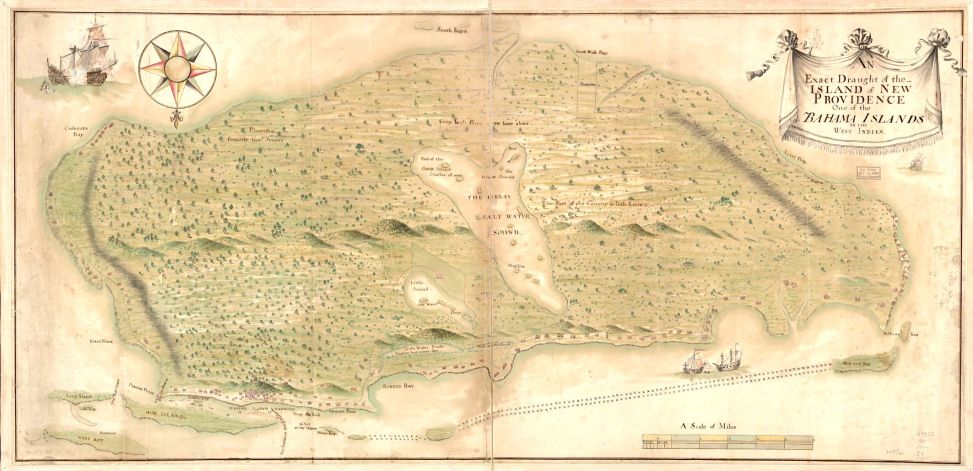
Map of New Providence / Nassau Bahamas (early c18)

WHEN NEW PROVIDENCE WAS OLD: MAPPING BAHAMAS HISTORY

‘Exact Draught of the Island of New Providence

One of the Bahama Islands in the West Indies’

ORIENTATION

Lateral thinking is one thing; topsy-turvy thinking is in another league. The map that graces the top of this page is of New Providence and Nassau in the the early c18. By today’s exacting mapping conventions, which historically were less rigorously  observed, it is upside-down, with Nassau on what we would call the south-west corner. However the convention that maps were orientated to the North was not generally accepted before C19. And in the middle ages maps were mostly orientated to the East (whence the term ‘orientating’). With advancing survey techniques from C17 on, maps were mostly orientated to the South like this map of New Providence.

DATE

The map is undated on the face of it, and I have found attributed dates of both 1700 and 1750 (see below). It could be anywhere in-between. At the time this map was made, New Providence was sparsely populated except for Nassau itself; and little was known about the island’s interior. Contemporary accounts describe a haven for pirates operating around the coastline. Not for nothing was Nassau protected by a battery and a fort. I’ve divided to map into sections to make it easier to take a closer look at each area. You can click each to enlarge.
new-providence-c18-map-part-7-2

1. TOP LEFT CORNER (the south-east of NP in actuality), with the compass pointing downwards to the north. A smattering of houses dot the ‘west’ coast. There is one significant property above Little Sound, standing in what looks like a cleared or even cultivated area. I’ll look at that in more detail below. Note the words above The Great Salt Water Sound: “Very High Pines Grow Here Aboue (sic)”, evidence that forests of tall pines familiar even today on Abaco were found on NP 300 years ago. The island is otherwise mostly marked as if the landscape was fairly open.

new-providence-c18-map-part-1

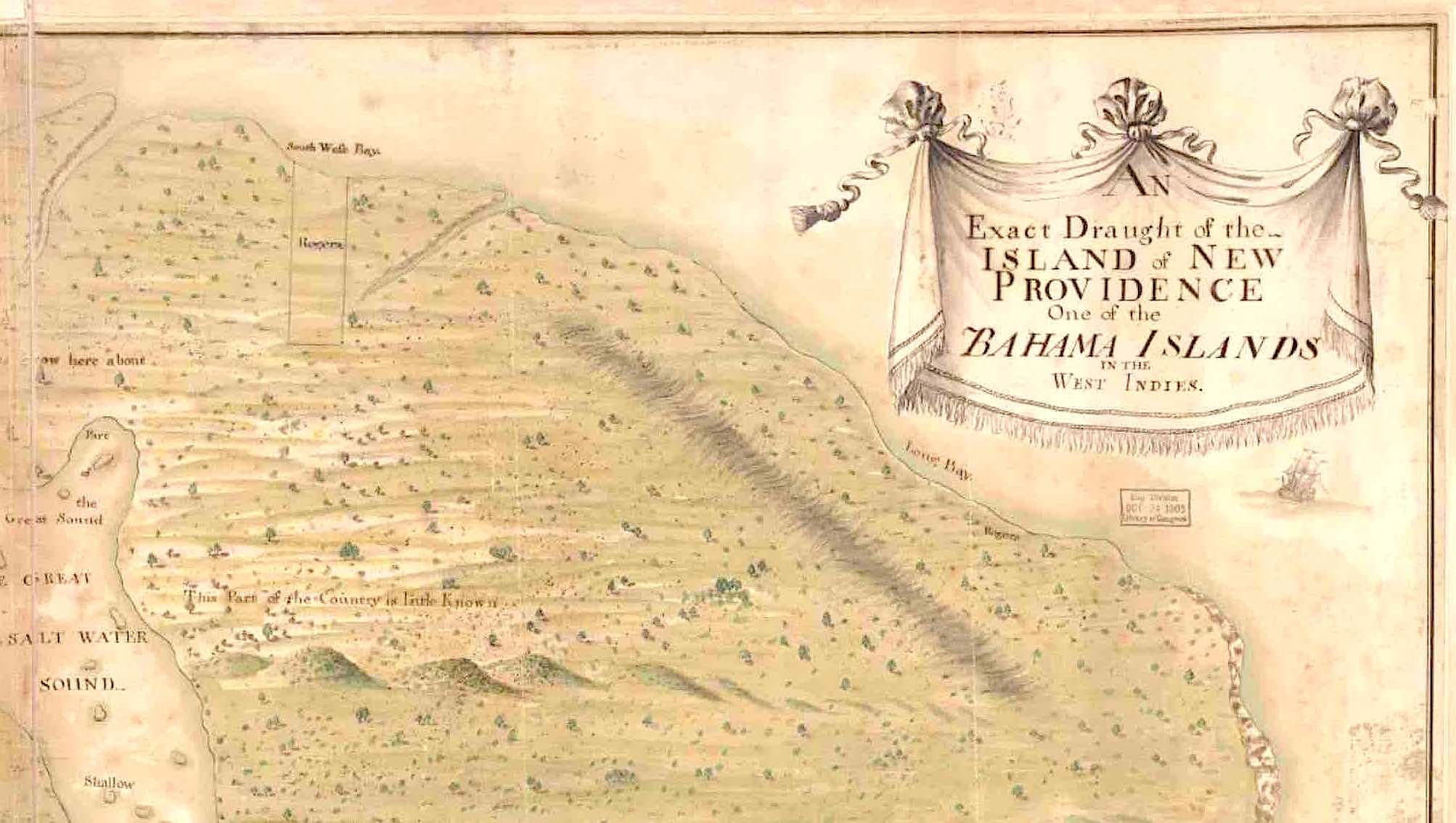
2. TOP RIGHT CORNER (south-west & west), with the confident title in a cartouche proclaiming exactness. This was not uncommon in historic map-making – the cartographical equivalent of today’s boastful product slogans – ‘simply the best’ and so on**. The caption next to the Great Sound, This Part of the Country is little Known, suggests an unexplored and perhaps hostile environment – possibly one of marshes and bogs. This sector of the island appears to have been uninhabited, or at least to having no population centres worth recording.
new-providence-c18-map-part-3-2

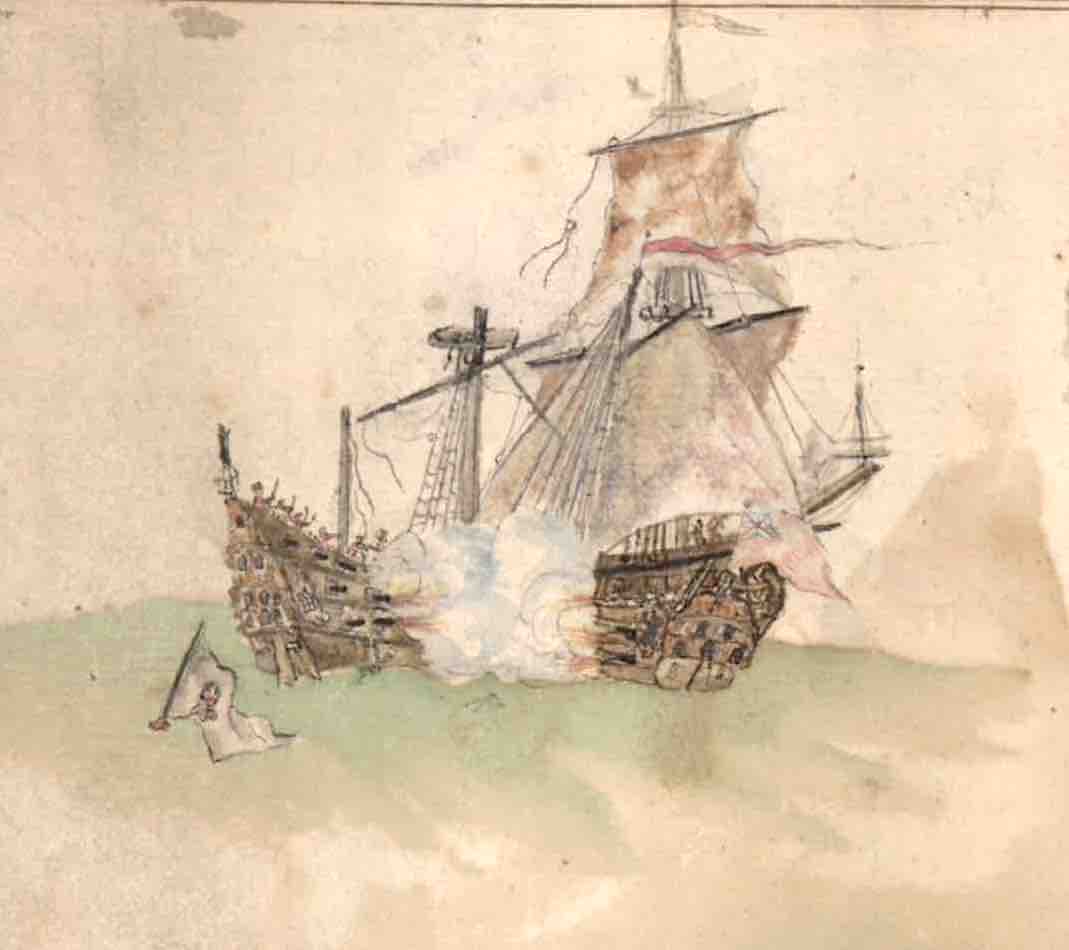
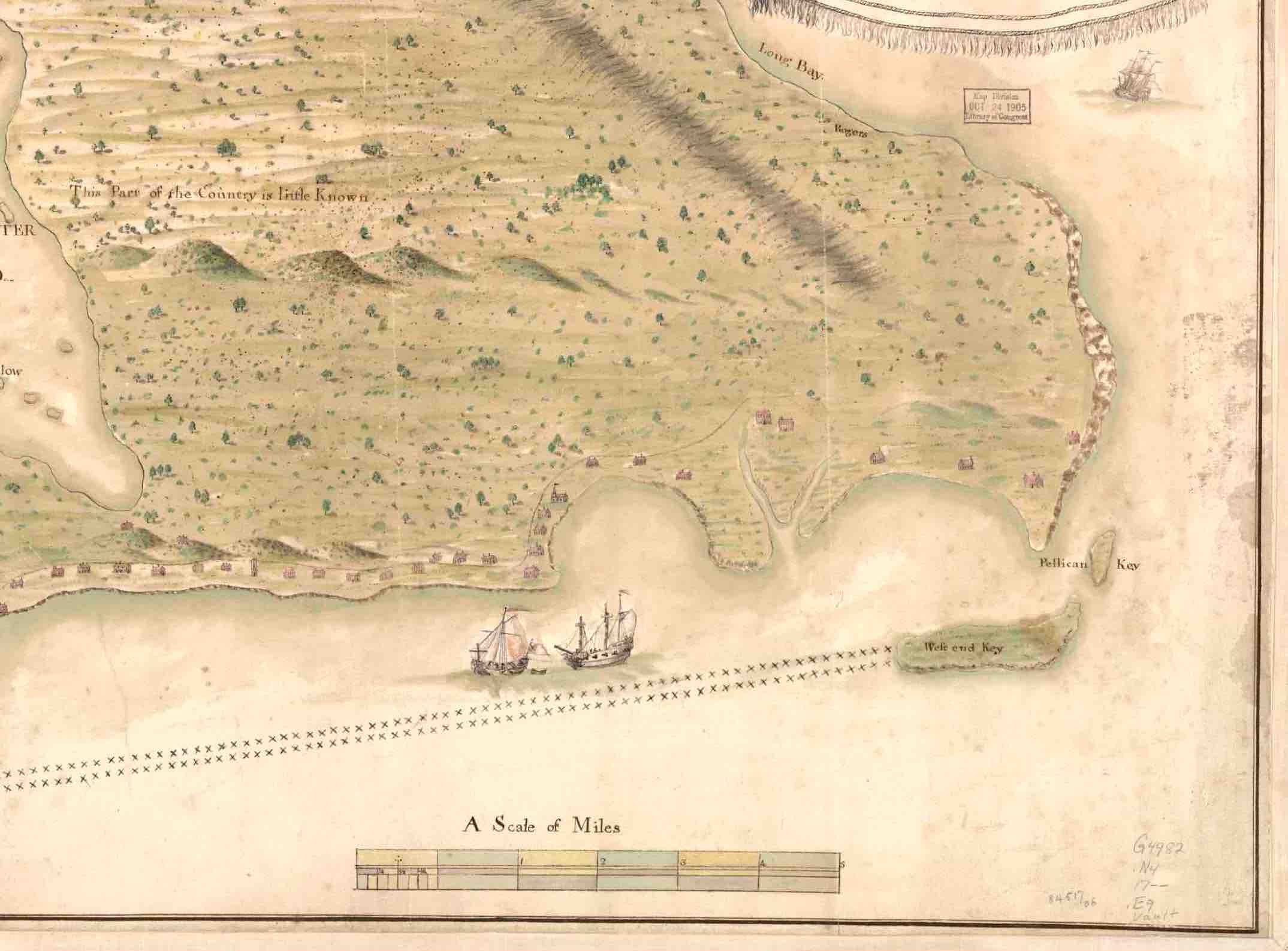
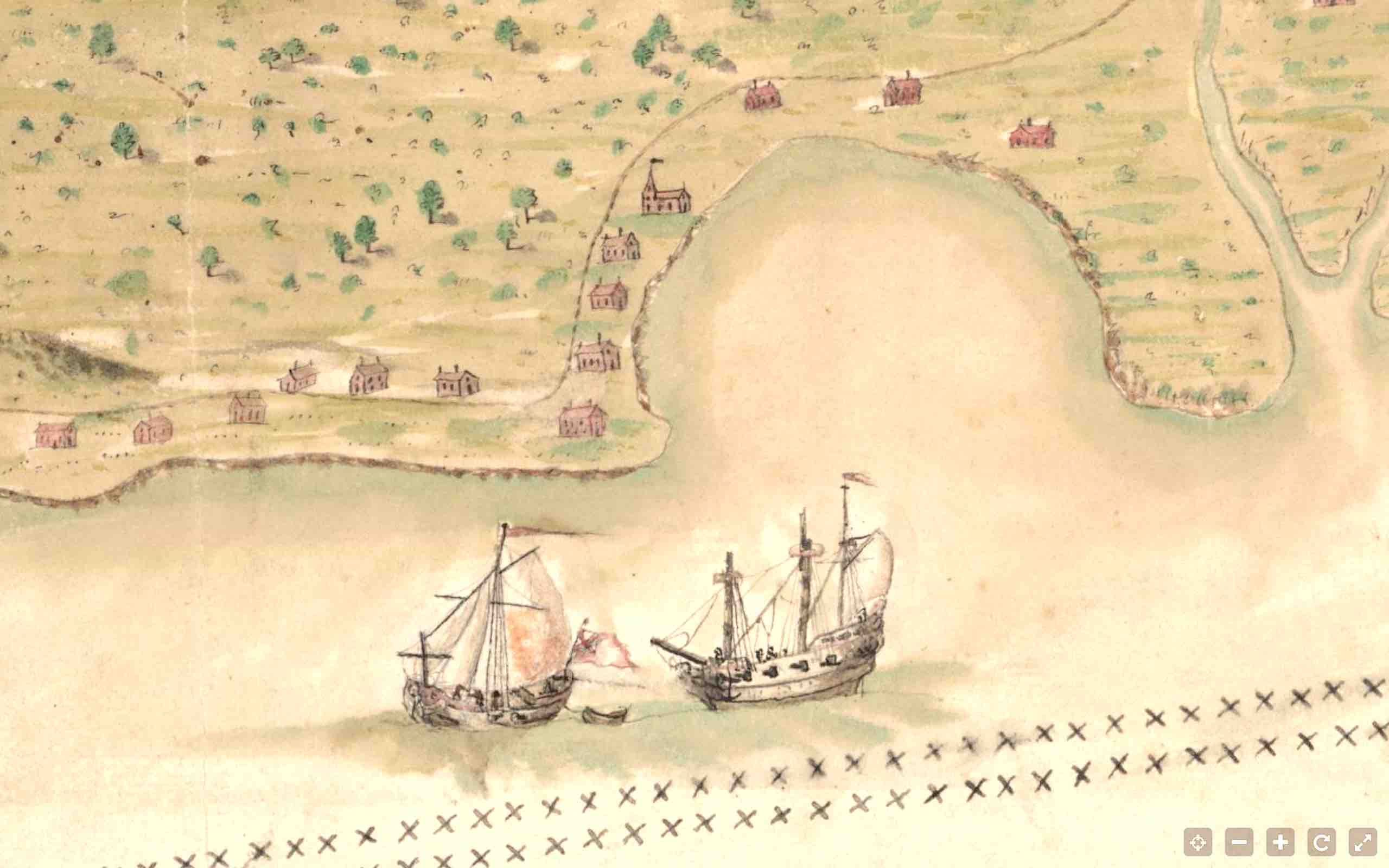
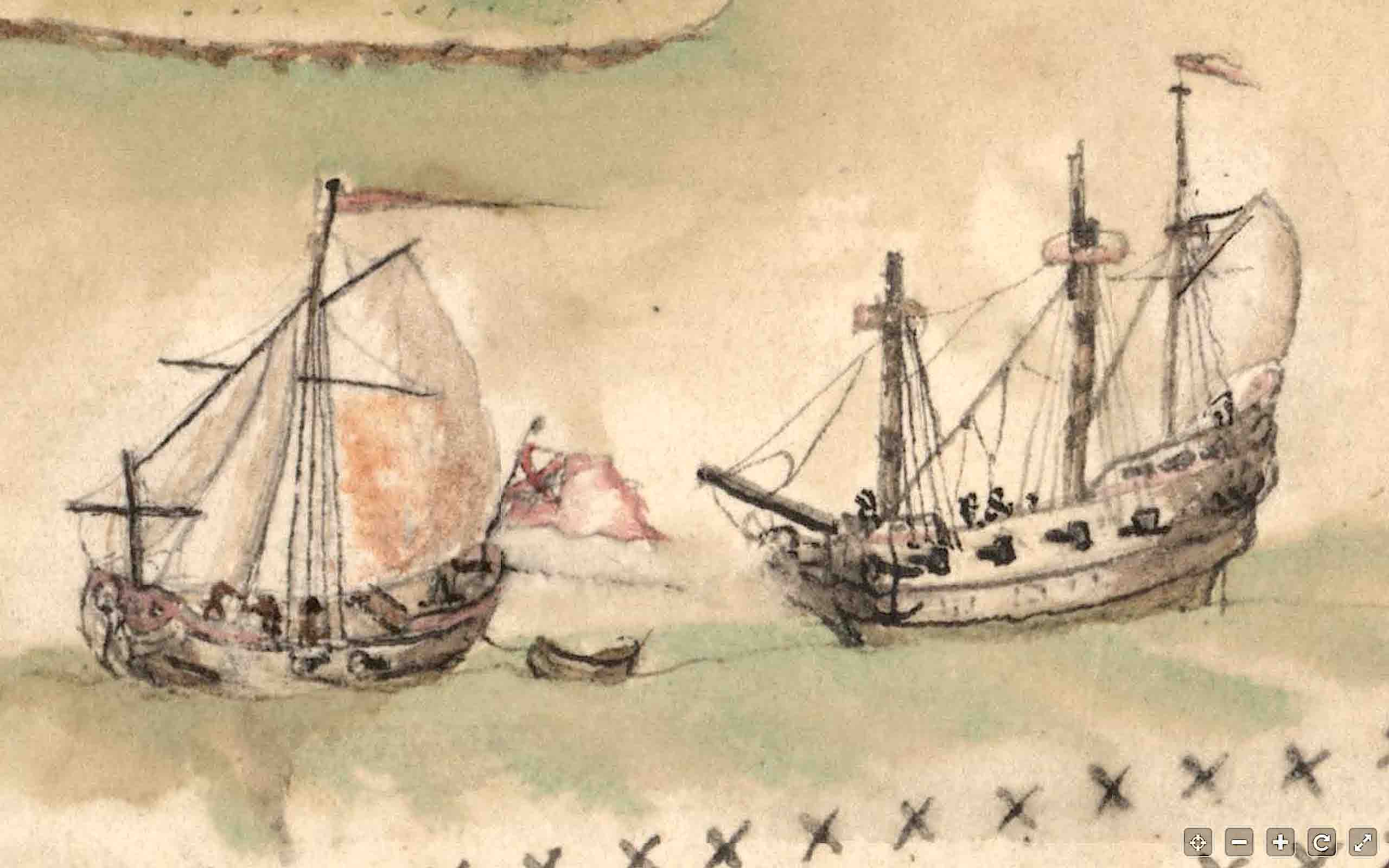
3. BOTTOM RIGHT CORNER (north-west). At last there is more evidence habitation, with a string of dwellings along the coastline. The 2 cays shown have names, West End and ‘Pellican’. And it looks as though the two ships have set out from port. On the left side of the bay above them, a church can be seen. Initially I thought the double row of crosses might indicate an area close to the shoreline that might be safe – or at least safer – from pirate attack. The leading ship – as the detailed crop shows clearly – is a warship. No harm in romantically speculating that it is escorting a trading vessel… More recently an online friend Klausbernd told me that the double crosses on map are in fact a navigational aid indicating cross bearings.
new-providence-c18-map-part-4

new-providence-c18-map-part-5

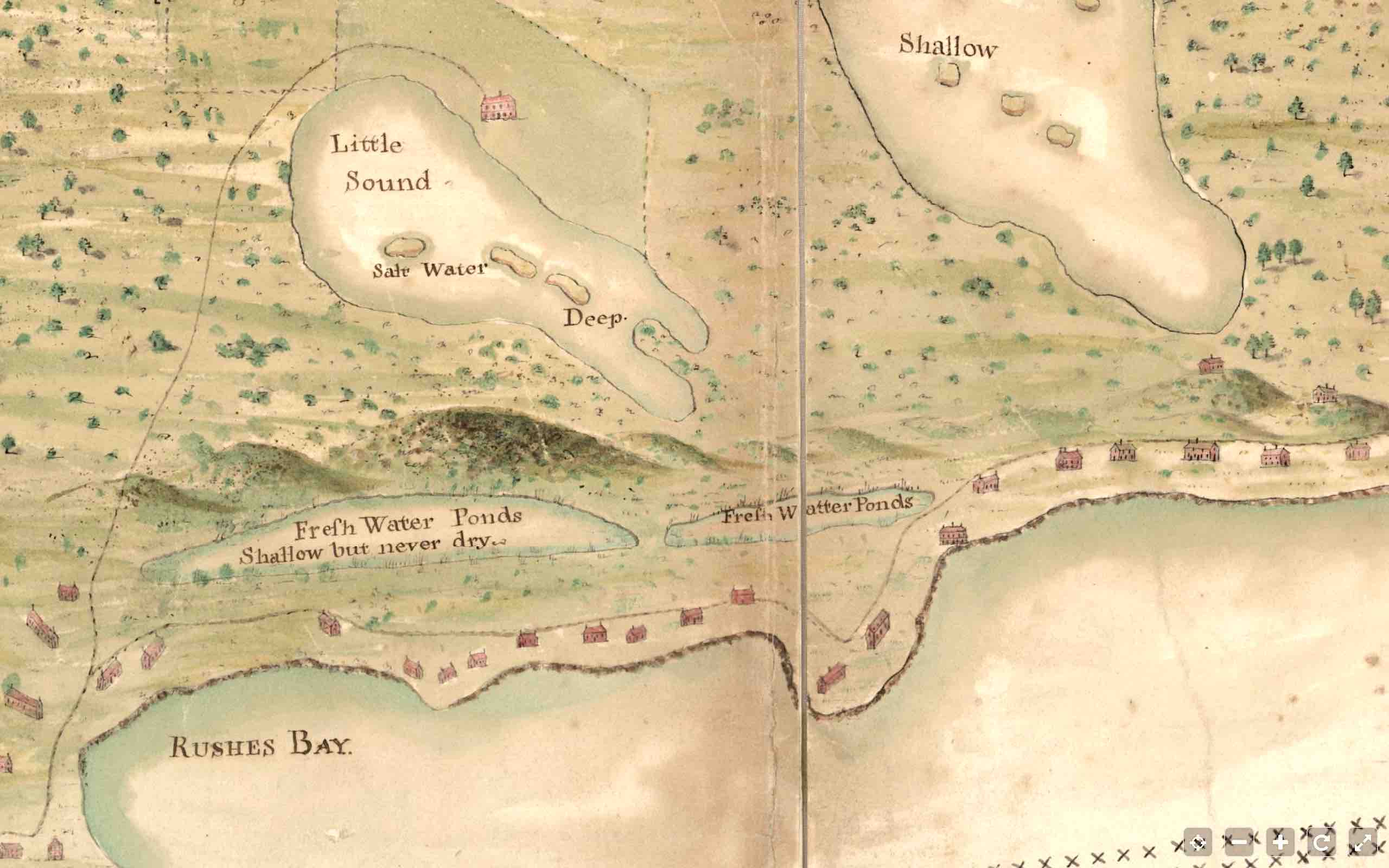
4. BOTTOM MIDDLE SECTION As we move towards the main – indeed only – town on the island, it is clear that the northern coast was the most desirable place to live. The scattering of houses along the coast continues; and the captions for the ponds show a possible reason why: fresh water, on an island where other areas of water are actually marked as ‘salt’ or which might have been unpleasantly brackish. And now we can see more of the posh establishment I referred to above. Not only did it lie in open (or perhaps cultivated) country, but it was plainly of some importance. It is notably larger that other buildings depicted, for a start; and it has its own very long track that forks off the coastal track.
new-providence-c18-map-part-10

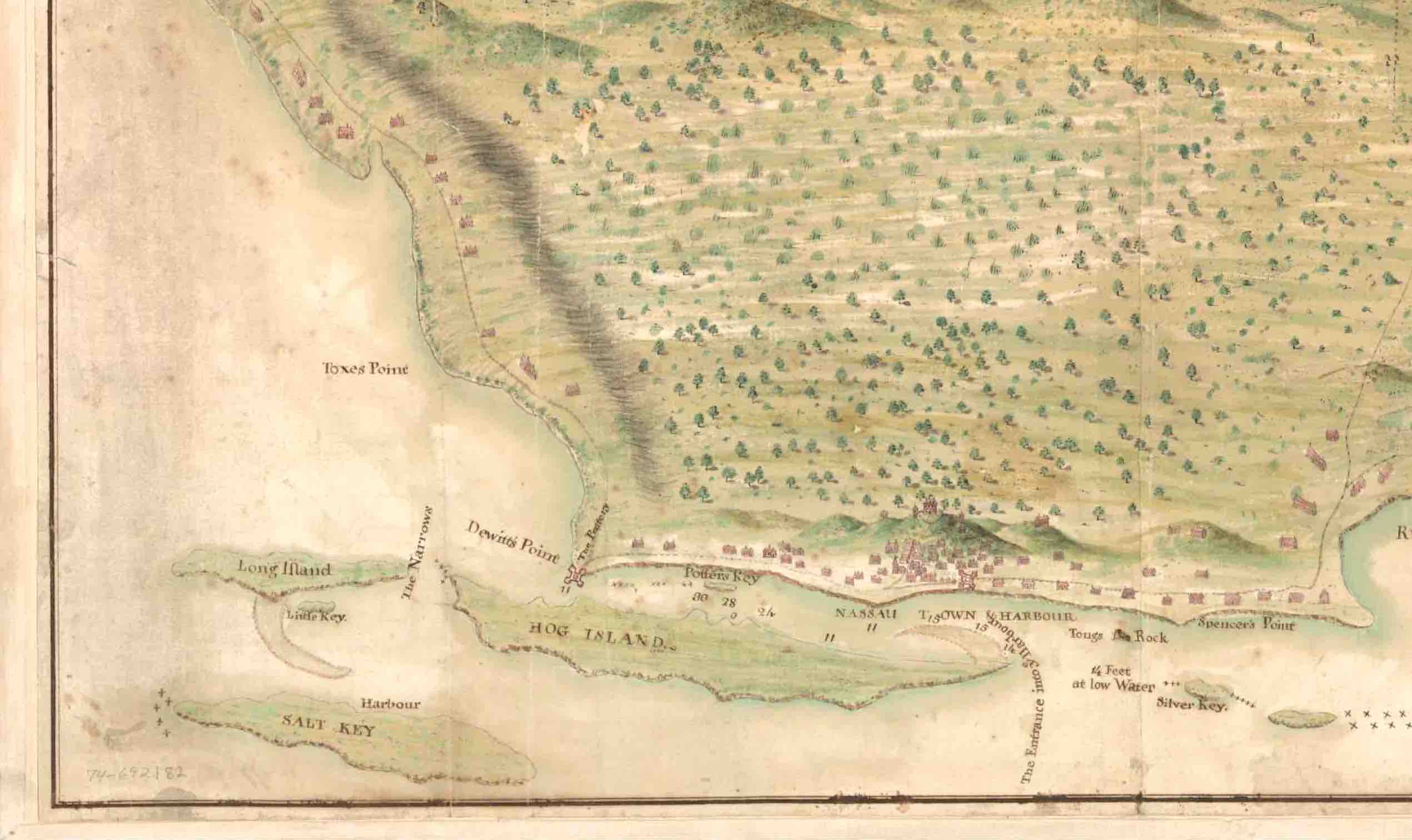
5. BOTTOM LEFT CORNER: NASSAU We have reached the big city, the centre of the population, and the port – with the harbour entrance handily marked. It bore the same name then as now; though the other names marked (as far as I can make out) have mostly if not all changed over 3 centuries. The Baha Mar development and its attendant travails seem light years away from this map. The double line of crosses ends here (bottom right at the first cay). If they marked a safe zone for vessels passing back and forth into Nassau harbour, they did not need to extend further because of the town fortifications (see detailed crop). There is a fort right on the shore; and at the far end of the harbour sound is a battery at Drewitt’s Point. The town is watched over by a substantial building – presumably a Governor’s residence – that is surrounded by a stockade . In the early c18 Nassau put on a show of strength to deter invaders and pirates.
new-providence-c18-map-part-2new-providence-c18-map-part-14

DO WE KNOW THE EXACT DRAUGHT’S EXACT DATE?

The map itself is undated. The Library of Congress, whose map I have chopped up for this post, simply dates it as 17– and notes: 

Manuscript, pen-and-ink and watercolor; Has watermark; Oriented with north to the bottom; Relief shown pictorially and by shading; Depths shown by soundings.

The excellent David Rumsey Historical Map Collection chooses the year 1750, the maker unknown. Another source puts the date at 1700.

Whichever, a clue to establish the map in the first half of the c18 is that the publisher is believed to be ‘William Innys [et al.]’, London. Innys and his brother John (the ‘et al’ presumably) were active at that time. In 1726, for example, they published an edition of Newton’s  Philosophiae naturalis principia mathematica (first published in 1687), indicating that they must already have been well-established.

new-providence-c18-map-part-7-2

WHAT ABOUT THE PIRATES?

The “Deposition of  Capt. Matthew Musson” made on  5 Jul 1717 in London, contains some excellent contemporary  pirate-based material. The middle passage in particular gives an indication how well organised and extremely well-armed the pirates were. And it is clear that piracy was actually driving inhabitants away from New Providence.

  • “On March last he was cast away on the Bahamas. At Harbour Island he found about 30 families, with severall pirates, which frequently are comeing and goeing to purchase provissons for the piratts vessells at Providence. There were there two ships of 90 tons which sold provissons to the said pirates, the sailors of which said they belong’d to Boston”.
  • “At Habakoe one of the Bahamas he found Capt. Thomas Walker and others who had left Providence by reason of the rudeness of the pirates and settled there. They advis’d him that five pirates made ye harbour of Providence their place of rendevous vizt. [Benjamin] Horngold, a sloop with 10 guns and about 80 men; [Henry] Jennings, a sloop with 10 guns and 100 men; [Josiah(s)] Burgiss, a sloop with 8 guns and about 80 men; [Henry?] White, in a small vessell with 30 men and small armes; [Edward] Thatch, a sloop 6 gunns and about 70 men. All took and destroyd ships of all nations except Jennings who took no English; they had taken a Spanish ship of 32 gunns, which they kept in the harbour for a guardship”.
  • “Ye greatest part of the inhabitants of Providence are. already gone into other adjacent islands to secure themselves from ye pirates, who frequently plunder them. Most of the ships and vessells taken by them they burn and destroy when brought into the harbour and oblidge the menn to take on with them. The inhabitants of those Isles are in a miserable condition at present, but were in great hopes that H.M. would be graciously pleas’d to take such measures, which would speedily enable them to return to Providence their former settlement, there are severall more pirates than he can now give an accot. of that are both to windward and to leward of Providence that may ere this be expected to rendevous there he being apprehensive that unless the Governmt. fortify this place the pirates will to protect themselves”. Signed, Mathew Musson. Endorsed, Read 5th July, 1717. 1½ pp. [C.O. 5, 1265. No. 73.]

new-providence-c18-map-part-11

CAN I BUY THIS MAP FOR MY WALL?

You certainly can. Well, not an original obviously. But you can find prints of it on eBay and elsewhere – just google the map title. You can get a modern copy for around $20 + shipping

** I have an enjoyable example of this tendency on a William Guthrie map of Europe dated c1800 that I own. A map from “the beft authorities” could surely have no serious rival!

img_4771

Credits: Library of Congress Online Catalog (Geography and Map Division); David Rumsey Historical Map Collection; Baylus C Brooks, Professional Research & Maritime Historian, Author, & Conservator / “America and West Indies: July 1717, 1-15,” in Calendar of State Papers Colonial, America and West Indies: Volume 29, 1716-1717, ed. Cecil Headlam (London: His Majesty’s Stationery Office, 1930), 336-344; Bonhams (Auctioneers). Thanks to Klaubernd for his advice on map orientations.

Map of New Providence / Nassau Bahamas (early c18)

Unknown's avatar

MAPPING ABACO, BAHAMAS: ON THE MAP IN 1702


Map of the Bahama Islands - Samuel Thornton - c1702

MAPPING ABACO: ON THE MAP IN 1702

In the Old World, 1702 was a turbulent year politically, royally, and militarily. Treaties made were broken; new treaties were made. Queen Anne succeeded to the throne of England after William III died of complications after falling off his horse. Anne went on to have 17 children, any one of whom would have secured the succession, but the extraordinary and sad fact is that none survived beyond childhood. In the New World, English troops were abroad, attacking St Augustine in (then-Spanish) Florida.

Map of the Bahama Islands - Samuel Thornton - c1702

Meanwhile in the world of cartography, the development of mapping continued apace with the Dutch retaining their pre-eminence, and the French and British making important contributions. Which brings me to Samuel Thornton, hydrographer, and his mapping ways. He was the son of the more famous cartographer, John Thornton, considered the principal English chart-maker of the late c17. As his father aged, a degree of uncertainty seems to have crept in over the authorship of Thornton maps. It is clear that after John’s death in 1708, Samuel took over the business and reissued maps under his own name, sometimes with little alteration other than the name in the cartouche. However there was possibly a ‘grey area’ for a few years before, when the same practice applied. 

Map of the Bahama Islands - Samuel Thornton - c1702

Samuel Thornton’s ‘…New Chart of the Bahama Islands and the Windward Pafsage (sic)’ is thought originally to date from c1702, when presumably the enjoyably colourful Cartouche (above) in fact bore his father’s name. The map covers an extensive geographical area besides the Bahamas, with the Florida coastline revealed as remarkably unpopulated. Zeroing in on the northern Bahamas (and as is usual with historic maps), certain features stand out, not least with spelling. Andros was written Androfs (sic). The Bahama Banck (sic) is shown to extend quite a long way north of Abbaco (sic) and Grand Bahama (shown as Bahama I). And as noted in earlier posts relating to Abaco’s history (see links below), ‘Hole in the Rock’ (ie Wall) is the only mainland location marked. This was not because there was any sizeable settlement there, but because for at least a century beforehand, Abaco’s most notable topographic feature was a significant and instantly recognisable navigation marker for shipping at the southern end of the island.

Map of the Bahama Islands - Samuel Thornton - c1702

One problem with Samuel Thornton’s reissues of his father’s maps was that flaws an original map from which a reproduction was derived went uncorrected. For example if you look at the header image of the full map, there’s a dark band right down the centre of the map, which persisted in later versions. More importantly, there was probably little or no correction of errors that new expeditions in the area might have revealed. Be that as it may, the Thornton map plays a significant role in the mapping of the Bahama Islands and beyond, and marks the start of an increasing sophistication as the new century progressed.

RELATED POSTS

MAPPING ABACO Bahamas and Florida in the c17

MAPPING ABACO Bellin’s Map 1764

MAPPING ABACO A journey back to c18

A HISTORY OF HOLE-IN-THE-WALL IN MAPS

Map of the Bahama Islands - Samuel Thornton - c1702

Unknown's avatar

SAWMILL SINK, ABACO: INDUSTRIAL ARCHAEOLOGY IN A POST-APOCALYPTIC LANDSCAPE


Sawmill Sink Abaco 8

SAWMILL SINK, ABACO

INDUSTRIAL ARCHAEOLOGY IN A POST-APOCALYPTIC LANDSCAPE

This article was written quite some time ago but I reckoned that, several years on, it might still be of interest. I haven’t changed much because it is what it was, so please ignore the time-slip. This was by chance a fire-fuelled opportunity to uncover a relic of Abaco’s industrial past.

The Blue Holes of Abaco are geological wonders about which much has been written. Sawmill Sink is one of the best-known inland ones. These are deep chasms in the limestone rock, some leading to extensive and complex cave systems under the island. Divers exploring Sawmill Sink have found many prehistoric fossils, including those of an extinct giant tortoise, and land crocodiles. The sink area was also a location for such finds.

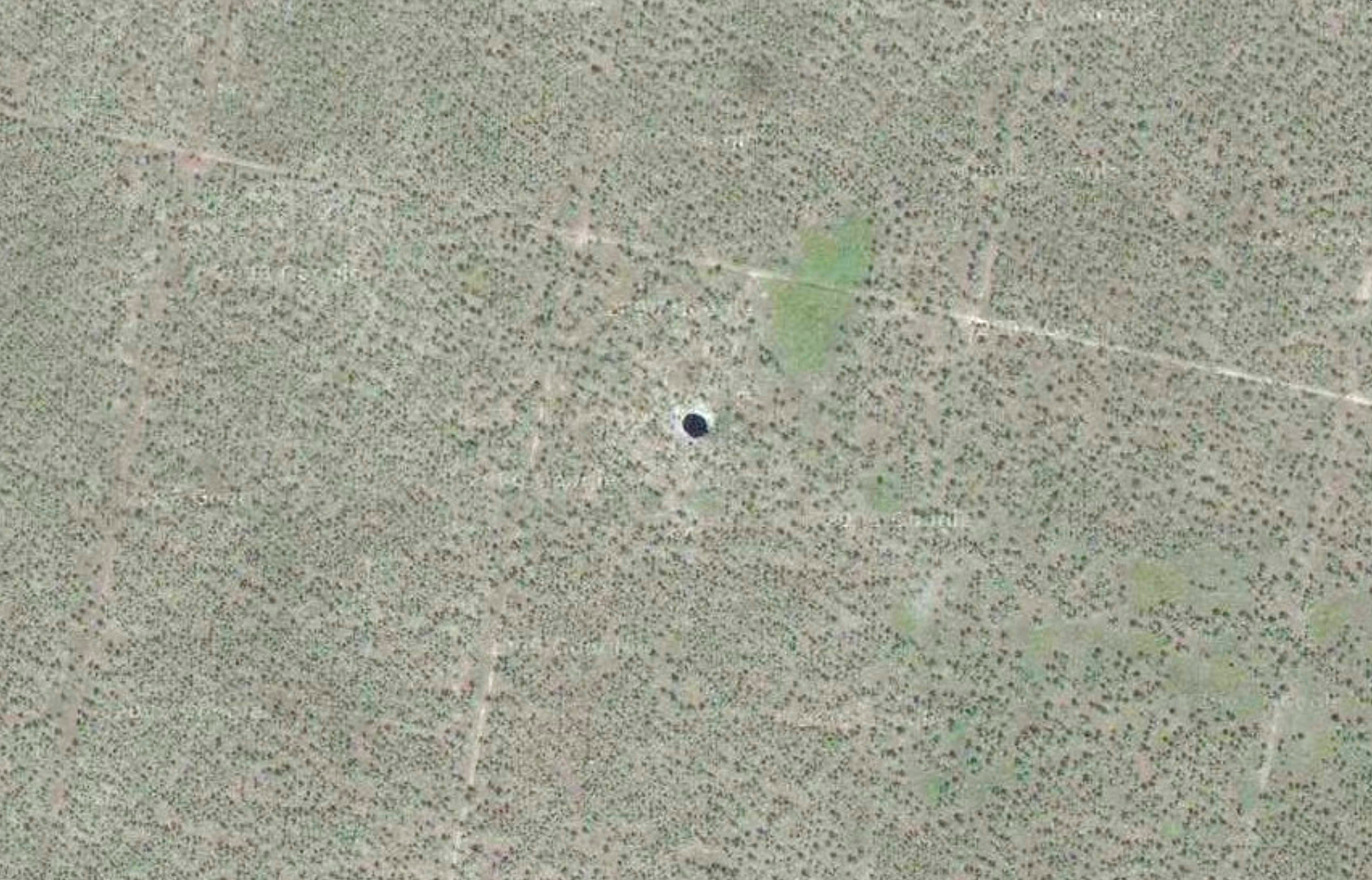
AERIAL VIEW OF SAWMILL SINK DEEP IN THE PINE FOREST

Screenshot 2024-11-16 at 17.15.58

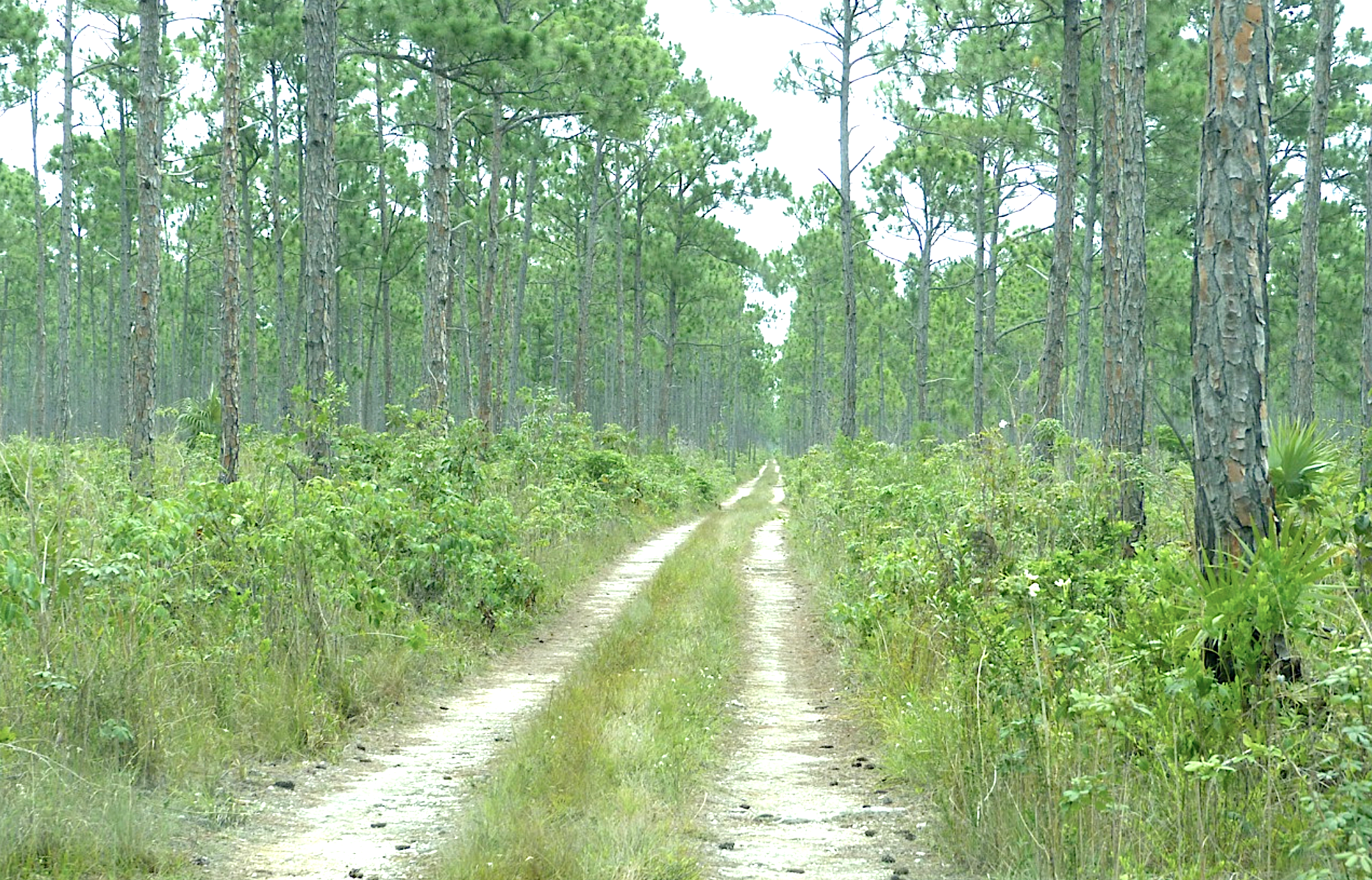
LOGGING TRACK TO SAWMILL SINK BLUE HOLE

Screenshot 2024-11-16 at 17.15.30

LOGGING HISTORY

South Abaco – defined loosely as the area south of Marsh Harbour – is dominated by pine forest. There are a few settlements and individual residences, all by the coast. The forested swathes are criss-crossed by an extensive system of logging tracks, many now all but impassable. They are reminders of Abaco’s historic importance as a source of wood deriving from the ubiquitous tall, slim pines. One use to which they were put was as mine pit props in the collieries of Wales.

 1996.2039.db

TRACKING RAILS

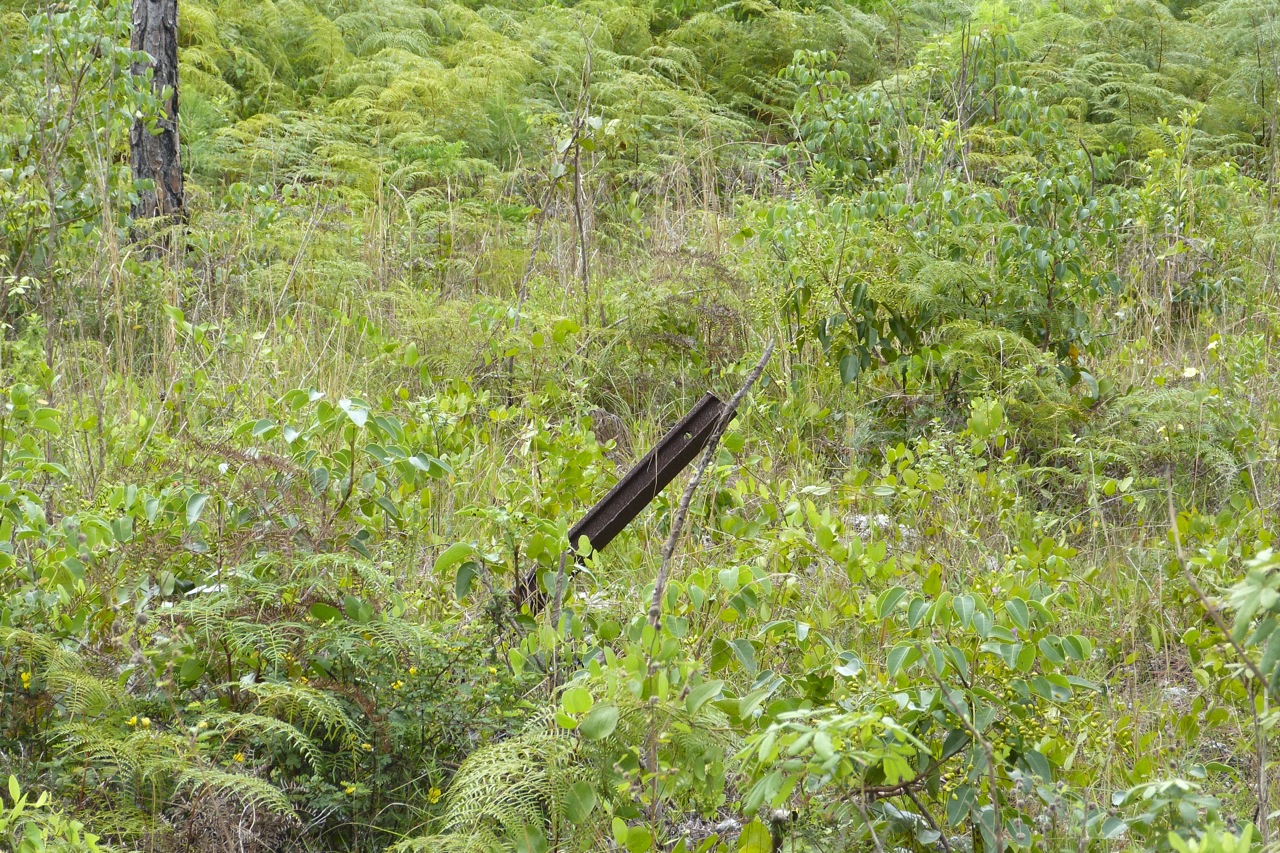
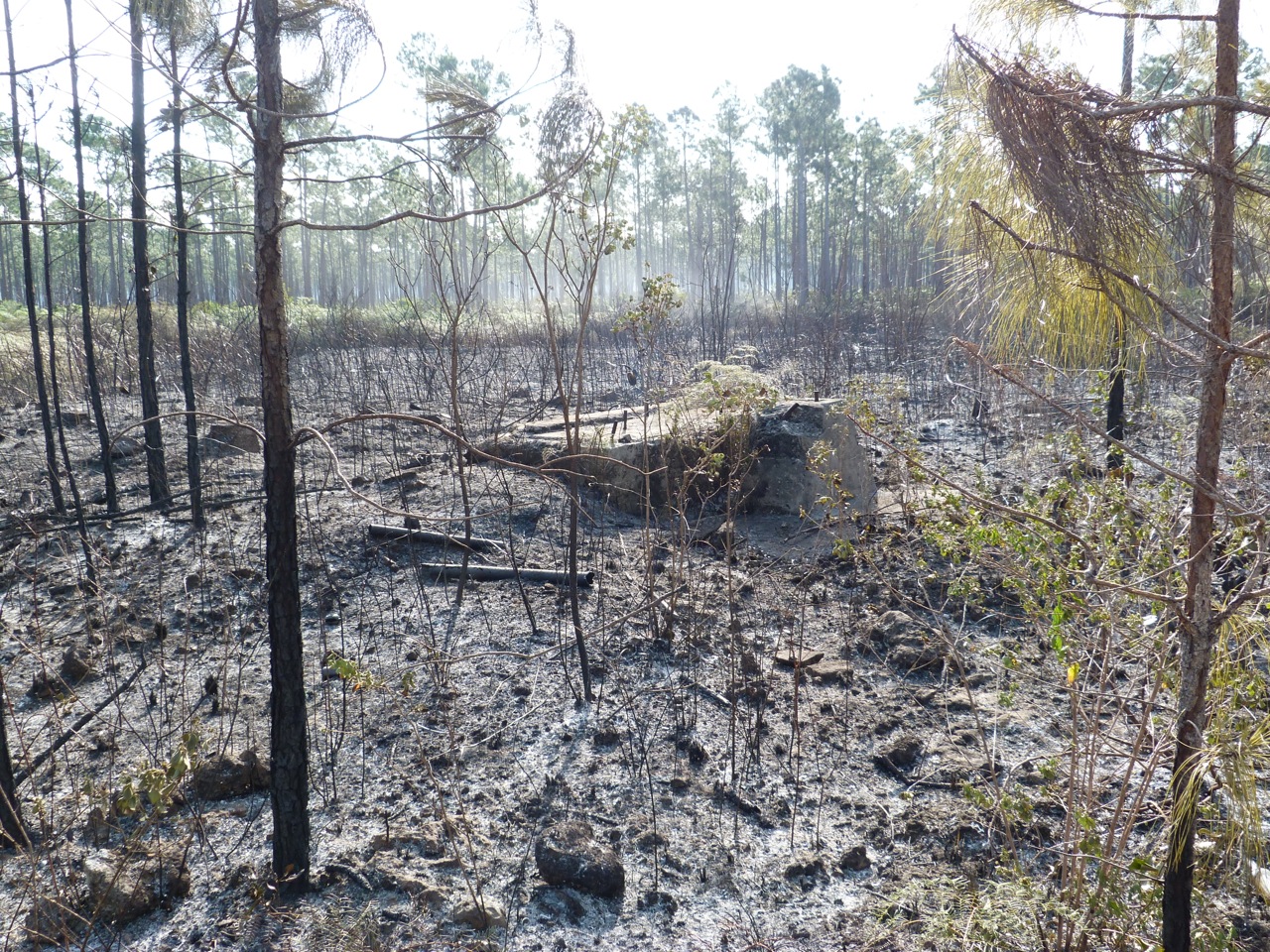
During a walk to Sawmill Sink, we noticed a rusty rail sticking up from the undergrowth. This was a remnant of the light railway tracks that had been laid through the forest to carry felled timber to the highway. From there it was transported to the coast to be loaded onto ships.

Sawmill Sink Abaco 17

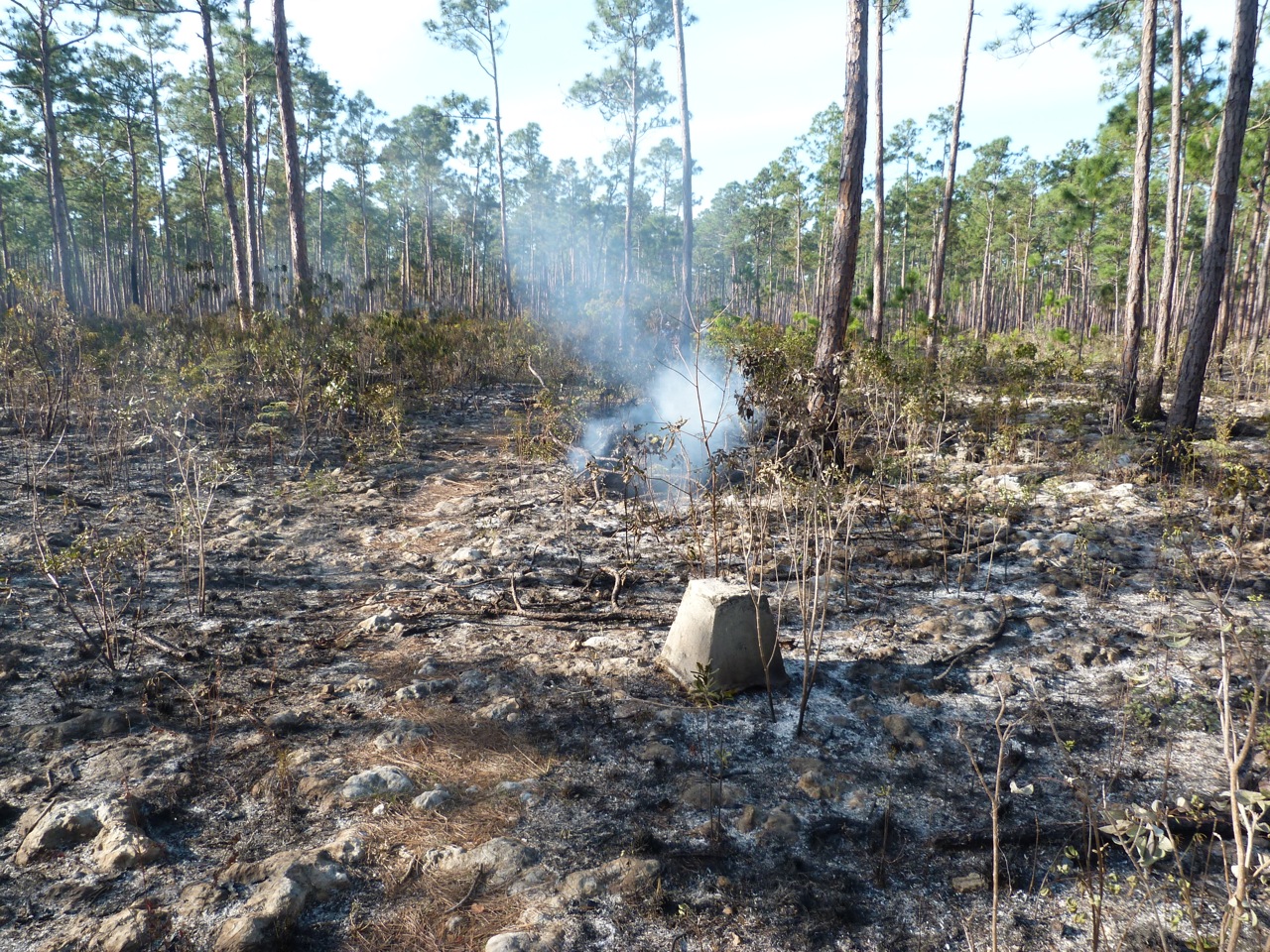
Later, we went back to Sawmill Sink at a time when the south part of the island was enduring the annual outbreak of forest fires, some natural and some set to clear undergrowth. While the occasional natural fire is actually good for regeneration of a forest (cf burning moorland), a fire out of control and fuelled by wind can very quickly damage a vast area. Thick palls of smoke drift across the island and out to sea. Even while we were fishing far out on the Marls, flames were visible as tall pines burned, with the acrid smell of the blaze was carried on the wind.

REMEMBERED EMBERS

The photos that follow show the area round Sawmill Sink immediately after a fire had swept through the area, revealing the past. Trees were still smouldering and in places the ground was still hot to the touch. The evidence of the former usage had been laid bare. Some images below  show the paved path that leads from the logging track to the Sink. I never found out if these were the first detailed images of so many visible remains of the logging trade revealed by the burnt-off undergrowth. 

Sawmill Sink Abaco 1 Sawmill Sink Abaco 2 Sawmill Sink Abaco 3 Sawmill Sink Abaco 5 Sawmill Sink Abaco 6 Sawmill Sink Abaco 7 Sawmill Sink Abaco 9 Sawmill Sink Abaco 10 Sawmill Sink Abaco 11 Sawmill Sink Abaco 12 Sawmill Sink Abaco 13 Sawmill Sink Abaco 14

PREHISTORY

We found this rock close to the Sink. Are those plant fossils? Bearing in mind that in prehistory the ocean covered this area entirely (the highest point on Abaco is a mere 134 feet ASL), might these be anemones or sponge fossils of some sort? As I said then, ‘comments from fossilologists welcome’, and a kind follower FOSSIL LADY (aka Kathi) reponded:  Those don’t look like plant fossils to me, they remind me of stromatolites, a sponge like creature that first dominated the earth billions of years ago. Some varieties still survive today. It would be worth it to have a geologist have a look see. ps the sinkhole is awesome!

Sawmill Sink Abaco 15

Photo credits: all RH except pit props (Scottish Mining Museum); aerial view (Gmaps)

Unknown's avatar

WHEN NEW PROVIDENCE WAS OLD: MAPPING BAHAMAS HISTORY


Map of New Providence / Nassau Bahamas (early c18)

WHEN NEW PROVIDENCE WAS OLD: MAPPING BAHAMAS HISTORY

‘Exact Draught of the Island of New Providence

One of the Bahama Islands in the West Indies’

ORIENTATION

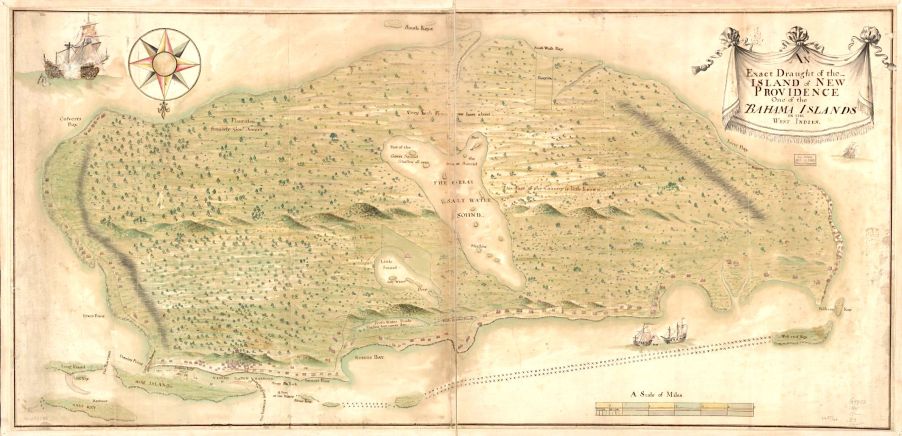
Lateral thinking is one thing; topsy-turvy thinking is in another league. The map that graces the top of this page is of New Providence and Nassau in the the early c18. By today’s exacting mapping conventions, which historically were less rigorously  observed, it is upside-down, with Nassau on what we would call the south-west corner. However the convention that maps were orientated to the North was not generally accepted before C19. And in the middle ages maps were mostly orientated to the East (whence the term ‘orientating’). With advancing survey techniques from C17 on, maps were mostly orientated to the South like this map of New Providence.

DATE

The map is undated on the face of it, and I have found attributed dates of both 1700 and 1750 (see below). It could be anywhere in-between. At the time this map was made, New Providence was sparsely populated except for Nassau itself; and little was known about the island’s interior. Contemporary accounts describe a haven for pirates operating around the coastline. Not for nothing was Nassau protected by a battery and a fort. I’ve divided to map into sections to make it easier to take a closer look at each area. You can click each to enlarge.

new-providence-c18-map-part-7-2

1. TOP LEFT CORNER (the south-east of NP in actuality), with the compass pointing downwards to the north. A smattering of houses dot the ‘west’ coast. There is one significant property above Little Sound, standing in what looks like a cleared or even cultivated area. I’ll look at that in more detail below. Note the words above The Great Salt Water Sound: “Very High Pines Grow Here Aboue (sic)”, evidence that forests of tall pines familiar even today on Abaco were found on NP 300 years ago. The island is otherwise mostly marked as if the landscape was fairly open.

new-providence-c18-map-part-1

2. TOP RIGHT CORNER (south-west & west), with the confident title in a cartouche proclaiming exactness. This was not uncommon in historic map-making – the cartographical equivalent of today’s boastful product slogans – ‘simply the best’ and so on**. The caption next to the Great Sound, This Part of the Country is little Known, suggests an unexplored and perhaps hostile environment – possibly one of marshes and bogs. This sector of the island appears to have been uninhabited, or at least to having no population centres worth recording.

new-providence-c18-map-part-3-2

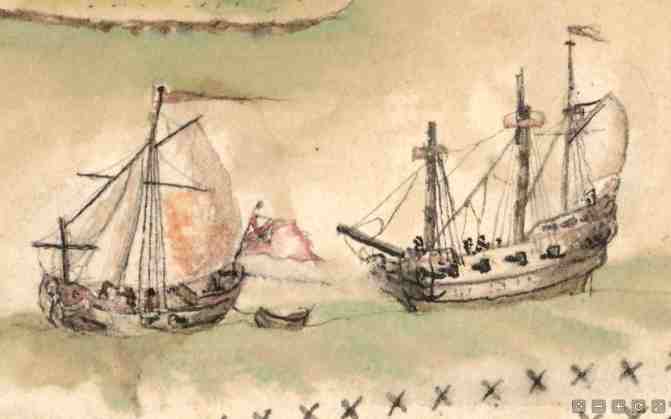
3. BOTTOM RIGHT CORNER (north-west). At last there is more evidence habitation, with a string of dwellings along the coastline. The 2 cays shown have names, West End and ‘Pellican’. And it looks as though the two ships have set out from port. On the left side of the bay above them, a church can be seen. Initially I thought the double row of crosses might indicate an area close to the shoreline that might be safe – or at least safer – from pirate attack. The leading ship – as the detailed crop shows clearly – is a warship. No harm in romantically speculating that it is escorting a trading vessel… More recently an online friend Klausbernd told me that the double crosses on map are in fact a navigational aid indicating cross bearings.

new-providence-c18-map-part-4

new-providence-c18-map-part-5

4. BOTTOM MIDDLE SECTION As we move towards the main – indeed only – town on the island, it is clear that the northern coast was the most desirable place to live. The scattering of houses along the coast continues; and the captions for the ponds show a possible reason why: fresh water, on an island where other areas of water are actually marked as ‘salt’ or which might have been unpleasantly brackish. And now we can see more of the posh establishment I referred to above. Not only did it lie in open (or perhaps cultivated) country, but it was plainly of some importance. It is notably larger that other buildings depicted, for a start; and it has its own very long track that forks off the coastal track.

new-providence-c18-map-part-10

5. BOTTOM LEFT CORNER: NASSAU We have reached the big city, the centre of the population, and the port – with the harbour entrance handily marked. It bore the same name then as now; though the other names marked (as far as I can make out) have mostly if not all changed over 3 centuries. The Baha Mar development and its attendant travails seem light years away from this map. The double line of crosses ends here (bottom right at the first cay). If they marked a safe zone for vessels passing back and forth into Nassau harbour, they did not need to extend further because of the town fortifications (see detailed crop). There is a fort right on the shore; and at the far end of the harbour sound is a battery at Drewitt’s Point. The town is watched over by a substantial building – presumably a Governor’s residence – that is surrounded by a stockade . In the early c18 Nassau put on a show of strength to deter invaders and pirates.

new-providence-c18-map-part-2new-providence-c18-map-part-14

DO WE KNOW THE EXACT DRAUGHT’S EXACT DATE?

The map itself is undated. The Library of Congress, whose map I have chopped up for this post, simply dates it as 17– and notes: 

Manuscript, pen-and-ink and watercolor; Has watermark; Oriented with north to the bottom; Relief shown pictorially and by shading; Depths shown by soundings.

The excellent David Rumsey Historical Map Collection chooses the year 1750, the maker unknown. Another source puts the date at 1700.

Whichever, a clue to establish the map in the first half of the c18 is that the publisher is believed to be ‘William Innys [et al.]’, London. Innys and his brother John (the ‘et al’ presumably) were active at that time. In 1726, for example, they published an edition of Newton’s  Philosophiae naturalis principia mathematica (first published in 1687), indicating that they must already have been well-established.
new-providence-c18-map-part-7-2

WHAT ABOUT THE PIRATES?

The “Deposition of  Capt. Matthew Musson” made on  5 Jul 1717 in London, contains some excellent contemporary  pirate-based material. The middle passage in particular gives an indication how well organised and extremely well-armed the pirates were. And it is clear that piracy was actually driving inhabitants away from New Providence.

  • “On March last he was cast away on the Bahamas. At Harbour Island he found about 30 families, with severall pirates, which frequently are comeing and goeing to purchase provissons for the piratts vessells at Providence. There were there two ships of 90 tons which sold provissons to the said pirates, the sailors of which said they belong’d to Boston”.
  • “At Habakoe one of the Bahamas he found Capt. Thomas Walker and others who had left Providence by reason of the rudeness of the pirates and settled there. They advis’d him that five pirates made ye harbour of Providence their place of rendevous vizt. [Benjamin] Horngold, a sloop with 10 guns and about 80 men; [Henry] Jennings, a sloop with 10 guns and 100 men; [Josiah(s)] Burgiss, a sloop with 8 guns and about 80 men; [Henry?] White, in a small vessell with 30 men and small armes; [Edward] Thatch, a sloop 6 gunns and about 70 men. All took and destroyd ships of all nations except Jennings who took no English; they had taken a Spanish ship of 32 gunns, which they kept in the harbour for a guardship”.
  • “Ye greatest part of the inhabitants of Providence are. already gone into other adjacent islands to secure themselves from ye pirates, who frequently plunder them. Most of the ships and vessells taken by them they burn and destroy when brought into the harbour and oblidge the menn to take on with them. The inhabitants of those Isles are in a miserable condition at present, but were in great hopes that H.M. would be graciously pleas’d to take such measures, which would speedily enable them to return to Providence their former settlement, there are severall more pirates than he can now give an accot. of that are both to windward and to leward of Providence that may ere this be expected to rendevous there he being apprehensive that unless the Governmt. fortify this place the pirates will to protect themselves”. Signed, Mathew Musson. Endorsed, Read 5th July, 1717. 1½ pp. [C.O. 5, 1265. No. 73.]
new-providence-c18-map-part-11

CAN I BUY THIS MAP FOR MY WALL?

You certainly can. Well, not an original obviously. But you can find prints of it on eBay and elsewhere – just google the map title. You can get a modern copy for around $20 + shipping

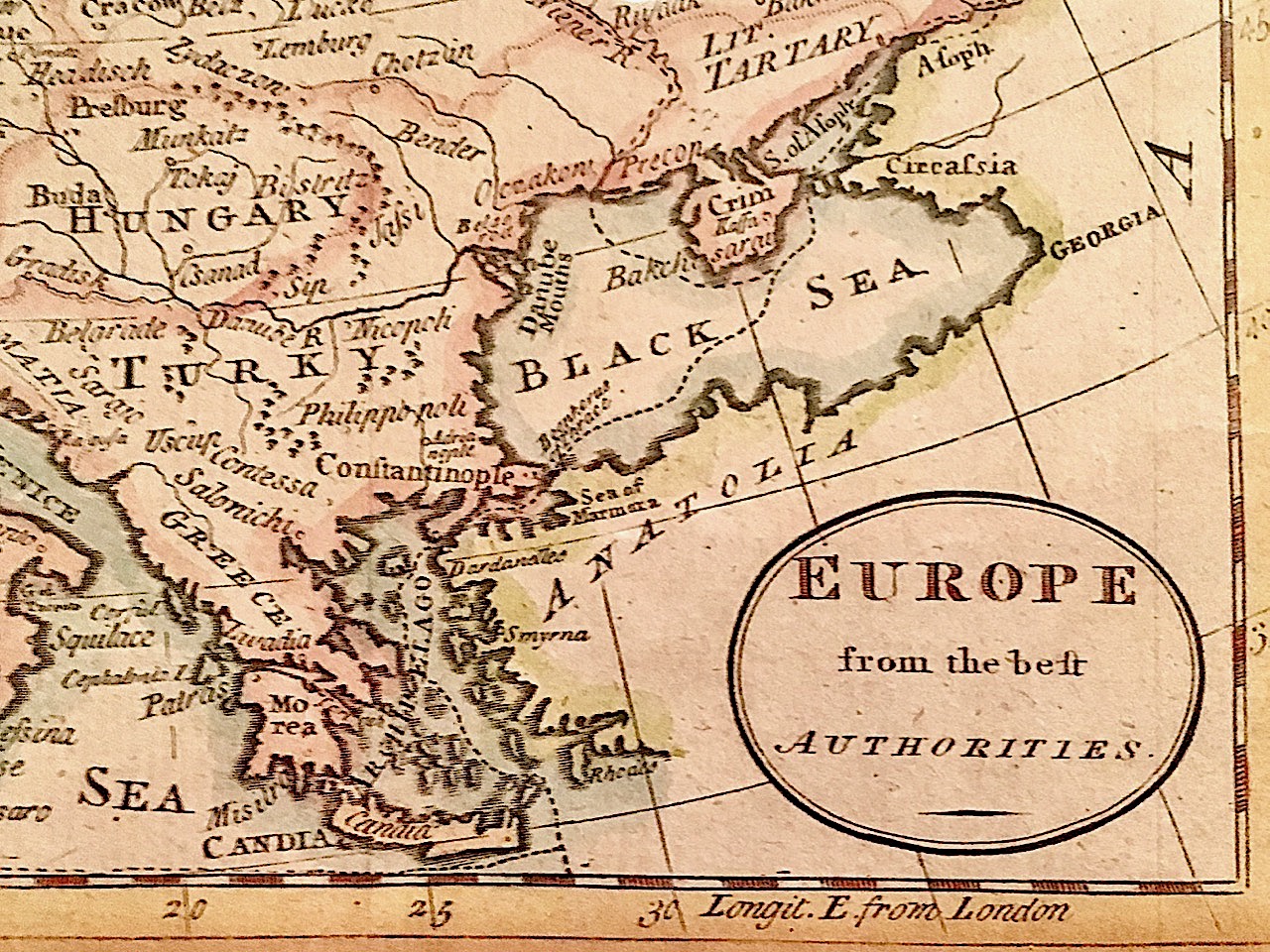
** I have an enjoyable example of this tendency on a William Guthrie map of Europe dated c1800 that I own. A map from “the beft authorities” could surely have no serious rival!
img_4771

Credits: Library of Congress Online Catalog (Geography and Map Division); David Rumsey Historical Map Collection; Baylus C Brooks, Professional Research & Maritime Historian, Author, & Conservator / “America and West Indies: July 1717, 1-15,” in Calendar of State Papers Colonial, America and West Indies: Volume 29, 1716-1717, ed. Cecil Headlam (London: His Majesty’s Stationery Office, 1930), 336-344; Bonhams (Auctioneers). Thanks to Klaubernd for his advice on map orientations.
Map of New Providence / Nassau Bahamas (early c18)

Unknown's avatar

ABACO PARROT FOR A CHEERFUL YULETIDE & OPTIMISM FOR 2023


Thanks to all followers, likers, commenters, regular visitors, one-offs, local wildlife organisations, and friends of Rolling Harbour in general. This year we passed 1 million hits over the ten years of this blog. Proving that people love Abaco, the Bahamas, birds, marine mammals, manatees, reef fish, sharks, turtles, shore-life, shells, insects, plant life, bonefishing, lighthouses, local history, maps, conservation and a whole lot more; and are prepared to tolerate bad puns, haphazard presentation, and a less than rigourous scientific approach to it all.

Weirdest search term ever: How to dispose of dead bodies?

Unknown's avatar

WHEN NEW PROVIDENCE WAS OLD: MAPPING BAHAMAS HISTORY


Map of New Providence / Nassau Bahamas (early c18)

WHEN NEW PROVIDENCE WAS OLD: MAPPING BAHAMAS HISTORY

“Exact Draught of the Island of New Providence, One of the Bahama Islands in the West Indies”

Lateral thinking is one thing; topsy-turvy thinking is in another league. The map that graces the top of this page is of New Providence and Nassau in the the early c18. By today’s exacting mapping conventions, which historically were less rigorously  observed, it is upside-down, with Nassau on what we would call the south-west corner. The map is undated on the face of it, and I have found attributed dates of both 1700 and 1750. It could be anywhere in-between. At the time this map was made, New Providence was sparsely populated except for Nassau itself; and little was known about the island’s interior. Contemporary accounts describe a haven for pirates operating around the coastline. Not for nothing was Nassau protected by a battery and a fort. I’ve divided to map into sections to make it easier to take a closer look at each area. You can click each to enlarge.

new-providence-c18-map-part-7-2

  1. TOP LEFT CORNER (the south-east of NP in actuality), with the compass pointing downwards to the north. A smattering of houses dot the ‘west’ coast. There is one significant property above Little Sound, standing in what looks like a cleared or even cultivated area. I’ll look at that in more detail below. Note the words above The Great Salt Water Sound: “Very High Pines Grow Here Aboue (sic)”, evidence that forests of tall pines familiar even today on Abaco were found on NP 300 years ago. The island is otherwise mostly marked as if the landscape was fairly open.

new-providence-c18-map-part-1

2. TOP RIGHT CORNER (south-west & west), with the confident title in a cartouche proclaiming exactness. This was not uncommon in historic map-making – the cartographical equivalent of today’s boastful product slogans – ‘simply the best’ and so on**. The caption next to the Great Sound, This Part of the Country is little Known, suggests an unexplored and perhaps hostile environment – possibly one of marshes and bogs. This sector of the island appears to have been uninhabited, or at least to having no population centres worth recording.

new-providence-c18-map-part-3-2

3. BOTTOM RIGHT CORNER (north-west). At last there is more evidence habitation, with a string of dwellings along the coastline. The 2 cays shown have names, West End and ‘Pellican’. And it looks as though the two ships have set out from port. On the left side of the bay above them, a church can be seen. Initially I thought the double row of crosses might indicate an area close to the shoreline that might be safe – or at least safer – from pirate attack. The leading ship – as the detailed crop shows clearly – is a warship. No harm in romantically speculating that it is escorting a trading vessel… More recently an online friend Klausbernd told me that the double crosses on map are in fact a navigational aid indicating cross bearings.

new-providence-c18-map-part-4

new-providence-c18-map-part-5

4. BOTTOM MIDDLE SECTION As we move towards the main – indeed only – town on the island, it is clear that the northern coast was the most desirable place to live. The scattering of houses along the coast continues; and the captions for the ponds show a possible reason why: fresh water, on an island where other areas of water are actually marked as ‘salt’ or which might have been unpleasantly brackish. And now we can see more of the posh establishment I referred to above. Not only did it lie in open (or perhaps cultivated) country, but it was plainly of some importance. It is notably larger that other buildings depicted, for a start; and it has its own very long track that forks off the coastal track.

new-providence-c18-map-part-10

5. BOTTOM LEFT CORNER: NASSAU We have reached the big city, the centre of the population, and the port – with the harbour entrance handily marked. It bore the same name then as now; though the other names marked (as far as I can make out) have mostly if not all changed over 3 centuries. The Baha Mar development and its attendant travails seem light years away from this map. The double line of crosses ends here (bottom right at the first cay). If they marked a safe zone for vessels passing back and forth into Nassau harbour, they did not need to extend further because of the town fortifications (see detailed crop). There is a fort right on the shore; and at the far end of the harbour sound is a battery at Drewitt’s Point. The town is watched over by a substantial building – presumably a Governor’s residence – that is surrounded by a stockade . In the early c18 Nassau put on a show of strength to deter invaders and pirates.

new-providence-c18-map-part-2new-providence-c18-map-part-14

DO WE KNOW THE EXACT DRAUGHT’S EXACT DATE?

The map itself is undated. The Library of Congress, whose map I have chopped up for this post, simply dates it as 17– and notes: 

Manuscript, pen-and-ink and watercolor; Has watermark; Oriented with north to the bottom; Relief shown pictorially and by shading; Depths shown by soundings.

The excellent David Rumsey Historical Map Collection chooses the year 1750, the maker unknown. Another source puts the date at 1700.

Whichever, a clue to establish the map in the first half of the c18 is that the publisher is believed to be ‘William Innys [et al.]’, London. Innys and his brother John (the ‘et al’ presumably) were active at that time. In 1726, for example, they published an edition of Newton’s  Philosophiae naturalis principia mathematica (first published in 1687), indicating that they must already have been well-established.

new-providence-c18-map-part-7-2

WHAT ABOUT THE PIRATES?

The “Deposition of  Capt. Matthew Musson” made on  5 Jul 1717 in London, contains some excellent contemporary  pirate-based material. The middle passage in particular gives an indication how well organised and extremely well-armed the pirates were. And it is clear that piracy was actually driving inhabitants away from New Providence.

  • “On March last he was cast away on the Bahamas. At Harbour Island he found about 30 families, with severall pirates, which frequently are comeing and goeing to purchase provissons for the piratts vessells at Providence. There were there two ships of 90 tons which sold provissons to the said pirates, the sailors of which said they belong’d to Boston”.
  • “At Habakoe one of the Bahamas he found Capt. Thomas Walker and others who had left Providence by reason of the rudeness of the pirates and settled there. They advis’d him that five pirates made ye harbour of Providence their place of rendevous vizt. [Benjamin] Horngold, a sloop with 10 guns and about 80 men; [Henry] Jennings, a sloop with 10 guns and 100 men; [Josiah(s)] Burgiss, a sloop with 8 guns and about 80 men; [Henry?] White, in a small vessell with 30 men and small armes; [Edward] Thatch, a sloop 6 gunns and about 70 men. All took and destroyd ships of all nations except Jennings who took no English; they had taken a Spanish ship of 32 gunns, which they kept in the harbour for a guardship”.
  • “Ye greatest part of the inhabitants of Providence are. already gone into other adjacent islands to secure themselves from ye pirates, who frequently plunder them. Most of the ships and vessells taken by them they burn and destroy when brought into the harbour and oblidge the menn to take on with them. The inhabitants of those Isles are in a miserable condition at present, but were in great hopes that H.M. would be graciously pleas’d to take such measures, which would speedily enable them to return to Providence their former settlement, there are severall more pirates than he can now give an accot. of that are both to windward and to leward of Providence that may ere this be expected to rendevous there he being apprehensive that unless the Governmt. fortify this place the pirates will to protect themselves”. Signed, Mathew Musson. Endorsed, Read 5th July, 1717. 1½ pp. [C.O. 5, 1265. No. 73.]

new-providence-c18-map-part-11

CAN I BUY THIS MAP FOR MY WALL?

You certainly can. Well, not an original obviously. But you can find prints of it on eBay and elsewhere – just google the map title. You can get a modern copy for around $20 + shipping

** I have an enjoyable example of this tendency on a William Guthrie map of Europe dated c1800 that I own. A map from “the beft authorities” could surely have no serious rival!img_4771

Credits: Library of Congress Online Catalog (Geography and Map Division); David Rumsey Historical Map Collection; Baylus C Brooks, Professional Research & Maritime Historian, Author, & Conservator / “America and West Indies: July 1717, 1-15,” in Calendar of State Papers Colonial, America and West Indies: Volume 29, 1716-1717, ed. Cecil Headlam (London: His Majesty’s Stationery Office, 1930), 336-344; Bonhams (Auctioneers)

Map of New Providence / Nassau Bahamas (early c18)

Unknown's avatar

MAPPING ABACO: ON THE MAP IN 1702


Map of the Bahama Islands - Samuel Thornton - c1702

MAPPING ABACO: ON THE MAP IN 1702

In the Old World, 1702 was a turbulent year politically, royally, and militarily. Treaties made were broken; new treaties were made. Queen Anne succeeded to the throne of England after William III died of complications after falling off his horse. Anne went on to have 17 children, any one of whom would have secured the succession, but the extraordinary and sad fact is that none survived beyond childhood. In the New World, English troops were abroad, attacking St Augustine in (then-Spanish) Florida.

Map of the Bahama Islands - Samuel Thornton - c1702

Meanwhile in the world of cartography, the development of mapping continued apace with the Dutch retaining their pre-eminence, and the French and British making important contributions. Which brings me to Samuel Thornton, hydrographer, and his mapping ways. He was the son of the more famous cartographer, John Thornton, considered the principal English chart-maker of the late c17. As his father aged, a degree of uncertainty seems to have crept in over the authorship of Thornton maps. It is clear that after John’s death in 1708, Samuel took over the business and reissued maps under his own name, sometimes with little alteration other than the name in the cartouche. However there was possibly a ‘grey area’ for a few years before, when the same practice applied. 

Map of the Bahama Islands - Samuel Thornton - c1702

Samuel Thornton’s ‘…New Chart of the Bahama Islands and the Windward Pafsage (sic)’ is thought originally to date from c1702, when presumably the enjoyably colourful Cartouche (above) in fact bore his father’s name. The map covers an extensive geographical area besides the Bahamas, with the Florida coastline revealed as remarkably unpopulated. Zeroing in on the northern Bahamas (and as is usual with historic maps), certain features stand out, not least with spelling. Andros was written Androfs (sic). The Bahama Banck (sic) is shown to extend quite a long way north of Abbaco (sic) and Grand Bahama (shown as Bahama I). And as noted in earlier posts relating to Abaco’s history (see links below), ‘Hole in the Rock’ (ie Wall) is the only mainland location marked. This was not because there was any sizeable settlement there, but because for at least a century beforehand, Abaco’s most notable topographic feature was a significant and instantly recognisable navigation marker for shipping at the southern end of the island.

Map of the Bahama Islands - Samuel Thornton - c1702

One problem with Samuel Thornton’s reissues of his father’s maps was that flaws an original map from which a reproduction was derived went uncorrected. For example if you look at the header image of the full map, there’s a dark band right down the centre of the map, which persisted in later versions. More importantly, there was probably little or no correction of errors that new expeditions in the area might have revealed. Be that as it may, the Thornton map plays a significant role in the mapping of the Bahama Islands and beyond, and marks the start of an increasing sophistication as the new century progressed.
RELATED POSTS

MAPPING ABACO Bahamas and Florida in the c17

MAPPING ABACO Bellin’s Map 1764

MAPPING ABACO A journey back to c18

A HISTORY OF HOLE-IN-THE-WALL IN MAPS

Map of the Bahama Islands - Samuel Thornton - c1702

Unknown's avatar

NEW YEAR, NEW WORLD, NEW COMMS AT LAST!


Bahamas Map Stamp

NEW YEAR, NEW WORLD – NEW COMMS AT LAST!

Rolling Harbour downtime is coming to an end. Christmas is a cheery (bleary?) memory, with evidential leftovers in the kitchen and (thankfully) some overbought (accidentally, maybe?) drink in the cupboard, under the table, oh! look! there’s another bottle on the bookcase. The last of the grandchildren is with us and a bright shiny New Year is… good grief, tomorrow. In the interim, we have had a wifi blackout of 5 days and a power outage for 2 days – and this is in the UK, not Abaco as you might expeect! So, no viable internet, and indeed no electrics at all. But we have wood fires and plenty of wood; a large supply of candles; and gas to cook on. 

All of which leads up to an apology for emails undealt with, bird ID queries apparently ignored, comments unanswered and similar impolitenesses. Normal service will be resumed next week. That is my first (and easiest) New Year’s Resolution, before we come to the more testing things I’ll resolve not to do…

Bahamas Map Stamp (First Day Cover)

I thought I’d post these Bahamas stamp images (from ‘Mr Columbus’ on eBay) to celebrate (symbolically) the imminent New Year. I suspect they are somewhat contentious fact-wise. For example, I wonder if Columbus and his crew really believed they had covered such a relatively short distance before making landfall. 

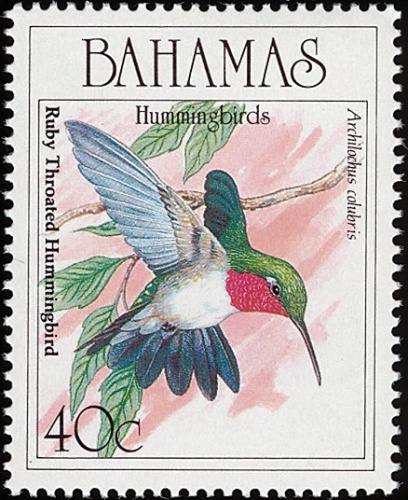
For now, a very Happy New Year to all those that take the trouble to follow the musings from Rolling Harbour. There’s some great stuff lined up for 2018. Here’s an example of the Bahamas Postal Service’s excellent work in producing eye-catching wildlife stamps to end with (nb these particular birds are very rare on Abaco – the island’s third and least reported hummer).

Bahamas Hummingbird Stamp

Unknown's avatar

MAPPING ABACO: BELLIN’S MAP 1764


Bellin Map 1764 - Carte des Isles Lucayes

MAPPING ABACO: BELLIN’S MAP 1764

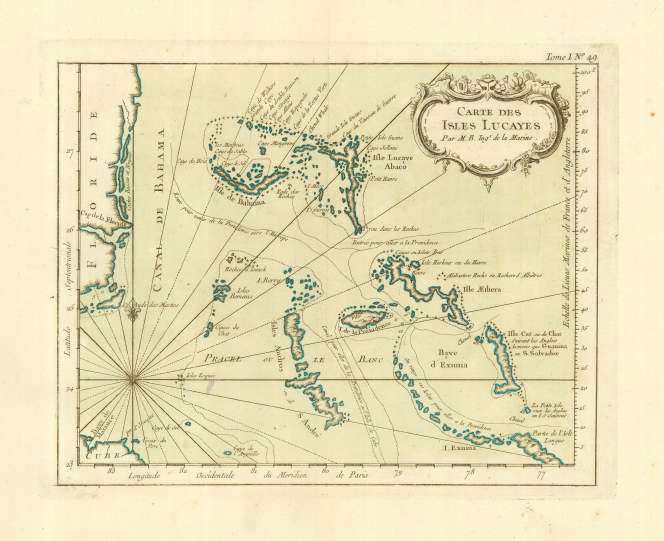
Jacques Nicolas Bellin (1703 – 1772) was a French naval hydrographer & geographer. He was a prolific mapmaker, especially of French territories, and was noted for his meticulous technique and attention to detail. He was elected to the Royal Society; and in due course was appointed Official Hydrographer of the French King.

Bellin Map 1764 - Carte des Isles Lucayes

In 1764, Bellin’s Petit Atlas Maritime was published. I am featuring one sheet from the atlas, the “Carte des Isles Lucayes”. The whole work came as a 5-volume set of map sheets, containing a total of 580 detailed charts. As you will see here, this copperplate engraving can be found in various forms: plain black & white; hand-washed or hand-coloured; or grandly multicoloured. These variations are the consequence of the distinction of Bellin’s work, which led to repeated re-publication in the c18 and beyond. Additionally, his work was admired and copied abroad.

Bellin Map 1764 - Carte des Isles Lucayes

Bellin’s map contains plenty of information – including depth markings and advised shipping routes – though some of the topography might be considered debatable by modern standards. As you look more closely, some of the details are startling. For example, on New Providence (see above) the only place-name is simply designated ‘Ville’, as though the settlement there lacked the significance to merit a name. And look at it now… Andros is completely name-free, with not even a Ville marked – as is Grand Bahama for that matter, though a few Cays are named. Let’s turn to Abaco.
Bellin Map 1764 - Carte des Isles Lucayes
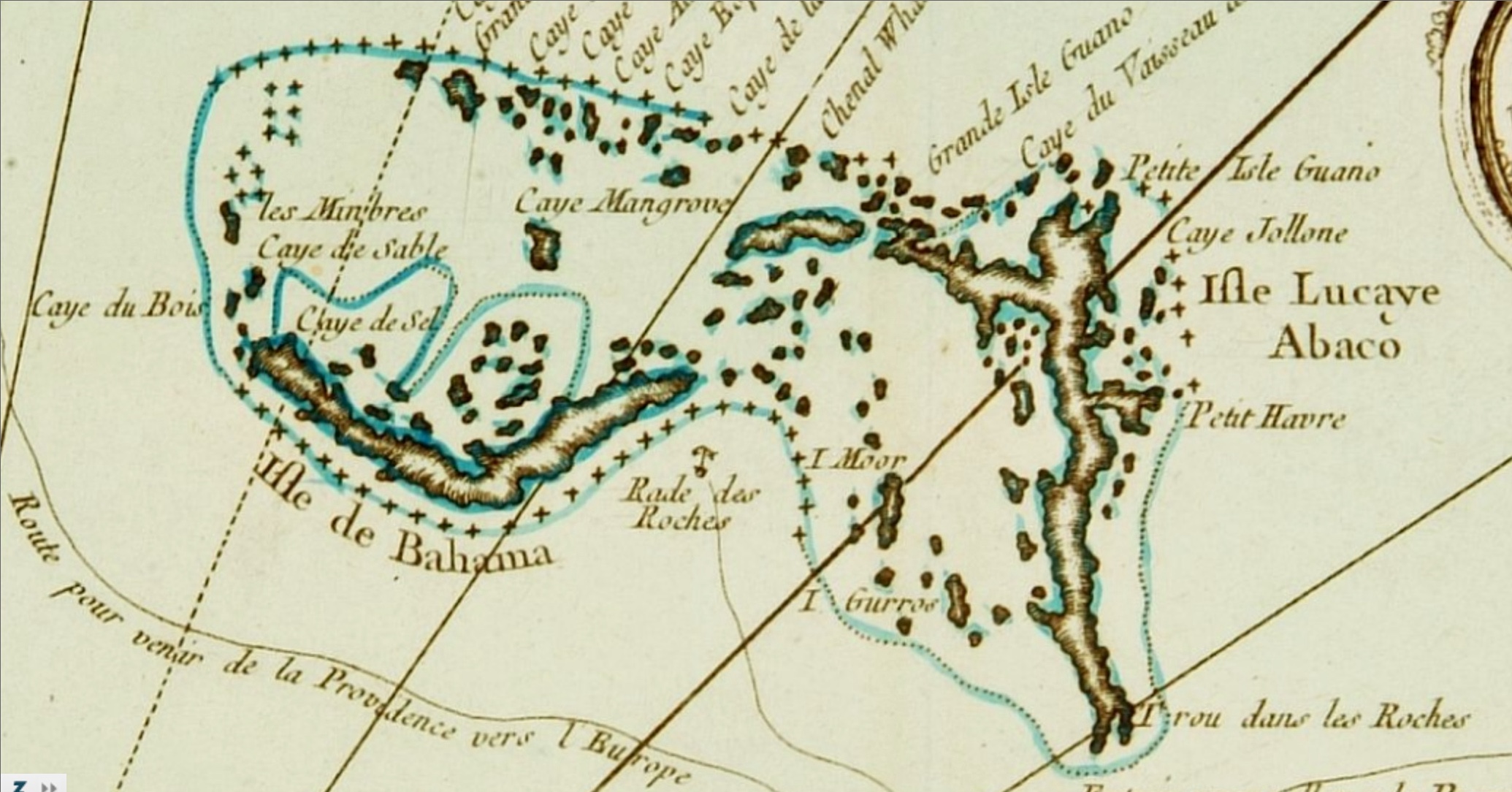
This section of the Bellin map also appears in my Abaco mapping article relating to HOLE-IN-THE-WALL. This geographical feature at the southern extremity of Abaco (now sadly blown apart by HURRICANE SANDY after millennia) was an important navigational landmark for shipping  by c17. The name, in French here, underwent a number of changes of the centuries, as you can see using the HITW link above.
Also of note is that at least Abaco was credited with a single named location – Little Harbour, the first settlement to feature on early maps, and the only one for a surprisingly long time. I imagine the position of this inlet and the safe anchorage it could provide for relatively large vessels became well-known. Like Hole-in-the-Wall, it was of seafaring significance.
A c18 mariner, looking at Bellin’s map in contemplation of a trip to the Isles Lucayes, might conclude that the seas around Abaco and Grand Bahama might be treacherous. The profusion of rocky areas and the indication of depth changes around the islands and cays suggest caution would be needed for a voyage. And as we know, throughout history ships have been wrecked in these seas – a situation somewhat improved (but not entirely eliminated) when the three ABACO LIGHTHOUSES were built.
Bellin Map 1764 - Carte des Isles Lucayes
RELATED POSTS
Credits: Library of Congress; Barry Ruderman Cat.; OS auctions inc eBay (!)
Unknown's avatar

MAPPING ABACO, BAHAMAS & FLORIDA IN THE c17


MAPPING ABACO, BAHAMAS & FLORIDA IN THE c17

I once wrote a post tracking the history of Abaco in general, and Hole-in-the-Wall in particular, in historic maps spanning 4 centuries. You can read it HERE.

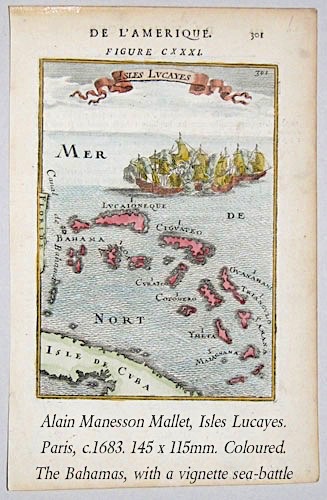
The post includes a map of the Bahama Islands (‘Isles Lucayes’) by the early French mapmaker Alain Manesson Mallet, published in Paris in 1683. The header shows a later hand-coloured version. The splendid original looks like this. Now that is a map (as Crocodile Dundee once said of a knife)

The recognisable shape of Abaco – I. Lucaioneque – lies weirdly on its side beneath the billowing sails of the vignette, with Grand Bahama (Bahama) between it and Floride. The confusingly named and sized I. Abacoa is Andros; I. Ciguateo is Eleuthera; and I. Curateo is Exuma. I. Guanahani was the landfall for Columbus, and was renamed by him San Salvador. New Providence may or may not be made from the two similar shapes shown west of Andros (at the time, the Lucayan name was Nema). And so on. There’s more to be said on the historic Lucayan names in the Bahamas – maybe one day I’ll get round to saying it…

For now, I want to move on to another map by Mallet that I have just come across. Published in c.1684 (sources vary), this map is of Florida (and beyond), titled rather strangely in German but otherwise in French. Here, the Isles Lucayes are very much a side-feature, reduced to the West End of Grand Bahama, and 4 unspecified small cays like the 4-dot on dice. There’s no embellishment besides the simple ‘draped’ title, the trees and mountains – no fleet of ships in full sail in the Gulf of Mexico. To be honest, though dated within a year or 2 of each, other the maps are so entirely different in style and even script that they could easily have been made by different people. In fact I had to double-check the authorship with various online sources.

Florida is named Tegesta, for the Native American tribe that lived in the region. The name still exists in the form Tequesta, in Palm Beach County Fl. You can read more about this fascinating tribe, their lives and cultural practices HERE. Just two settlements in Tegesta – St. Augustine and St. Mathieu – are shown. I’ve gone rather off-piste from my usual Bahamian territory, but this early map provides an enjoyably interesting cartographic overview of the known topography / geography of the day.

Approximate territory of the Tequesta in the 16th centuryFLMap-Tequesta-tribe2.PNG

If the earth had an uniform surface like a ping pong ball there would be nothing for a geographer to study. But it is not thusly uniform – the actual earth has numerous variations of every sort studied by geographers. Topography maps the physical surface, and geology explores the underground features. But the geography of the earth includes many other [factors] like economics, weather, climate, social distribution, trade, etc.  At the core of geography is cartography – which is the mapping of all these things. Rudolf G. Barton, BA in geography UCB (Commercial Pilot ret.)
Credits: the maps are open source – frequently passed around on the internet and impossible to locate the originator; Wiki for the diagram; Geography lesson, as shown above…
Unknown's avatar

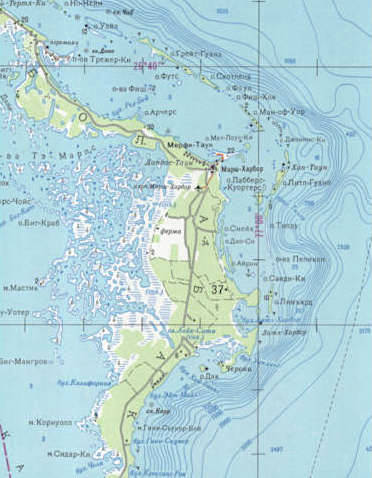
АБАKО: SOVIET RUSSIAN MILITARY MAP OF ABACO


Soviet Russian Military Map of Abaco 1979

АБАKО: SOVIET RUSSIAN MILITARY MAP OF ABACO

I had been toying with a plan to write something fishy today. Lifting the lid on the secrets of the creole wrasse, maybe. Then something arrived in my inbox overnight that changed my course entirely. I was struck  by an idea  harder than a torrent of mixed metaphors speeding towards a bullseye in the motherlode. A map! A map of Abaco!! All in Russian!!! From the Soviet Russian Military Survey!!!! Irresistible. An occasion for multiple exclamation marks.509px-hammer_and_sickle_black_large_on_transparent-svg

‘Russian Soviet Military Topographic Maps’

Map sheet G-18-1 GREAT ABACO ISLAND ed. 1979 – scale 1:500 000, map size 66 cm x 55 cm

Soviet Russian Military Map of Abaco 1979

509px-hammer_and_sickle_black_large_on_transparent-svg

My blog is stuffed full of maps. They are scattered everywhere, like cartographical confetti. There’s even a page for some of them HERE. Want a map of Abaco’s HIGHEST POINT (134m, if you have the energy).  Need to see what Abaco looked like 300 years ago? Try HERE. Need a history of Hole-in-the-Wall in maps? Try THIS. And so on.
509px-hammer_and_sickle_black_large_on_transparent-svg

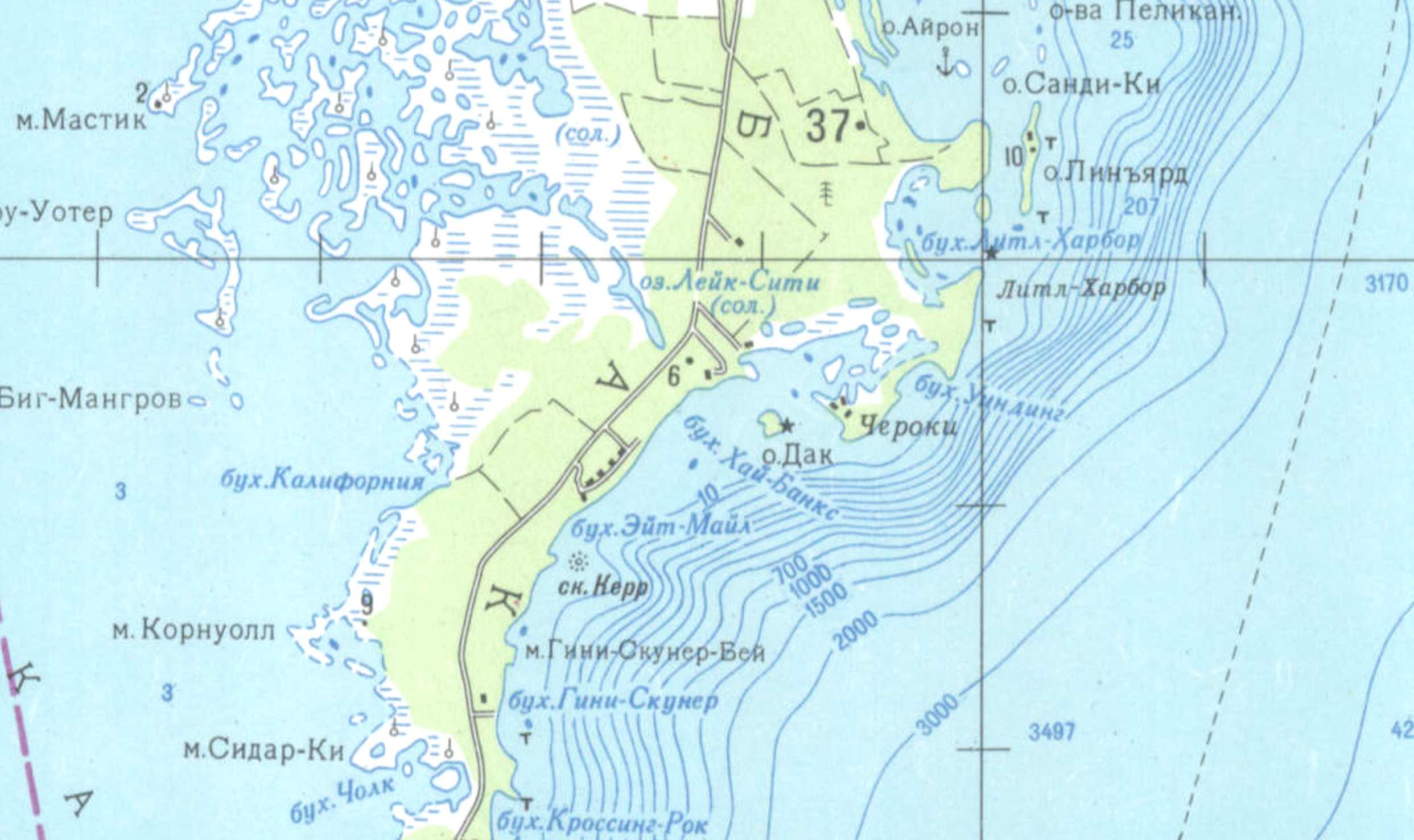
The header map is a merely the bottom-left corner of the much larger map immediately above. As a crop of the much larger area, it’s illegible. Which is next to useless, because the best thing about this map is that it is all in Russian. And I really wanted to see how they had mapped Marsh Harbour. Treasure Cay. Man-o-War. And the rest. I looked around online and reached this one. Even with some work on the image, you can only get a blurry glimpse – just a few tempting hints of Cyrillic. But it’s impossible to locate Марш Харьор, Трежер Ки, or Ман-оф-Уор Ки…

Soviet Russian Military Map of Abaco 1979

509px-hammer_and_sickle_black_large_on_transparent-svg

So, back to the interweb thing. And eventually, something usable turned up. Here, with props to Clicpic, is Abaco in the late Soviet era. Check out where you live – in Russian. Got friends on Грейт Гуапна Кй? Sadly, the northern end of Abaco and the whole southern end from Crossing Rocks down to Hole-in-the-Wall and right round to Sandy Point is absent. That area is of course the perfect place for missile silos**. Except now it’s a National Park, so that wouldn’t be possible… would it?

509px-hammer_and_sickle_black_large_on_transparent-svg

I’ve split the map into 3 sections to make it as big as possible. The maps overlap to keep the proportions equal on-screen. Double click to zoom in. Hope you enjoy travelling around it…

Soviet Russian Military Map of Abaco 1979 Detail 1 Soviet Russian Military Map of Abaco 1979 Detail 2 Soviet Russian Military Map of Abaco 1979 Detail 3

** Vladdy, mate, if you or your agents have picked up on this, (1) only joking, right? and (2) you’ve  anyway got better things to worry about these days…

Unknown's avatar

WHEN NEW PROVIDENCE WAS OLD: MAPPING BAHAMAS HISTORY


Map of New Providence / Nassau Bahamas (early c18)

WHEN NEW PROVIDENCE WAS OLD: MAPPING BAHAMAS HISTORY

“Exact Draught of the Island of New Providence, One of the Bahama Islands in the West Indies”

Lateral thinking is one thing; topsy-turvy thinking is in another league. The map that graces the top of this page is of New Providence and Nassau in the the early c18. By today’s exacting mapping conventions, which historically were less rigorously observed, it is upside-down, with Nassau on what we would call the south-west corner. The map is undated of the face of it, and I have found attributed dates of both 1700 and 1750. It could be anywhere in-between. At the time this map was made, New Providence was sparsely populated except for Nassau itself; and little was known about the island’s interior. Contemporary accounts describe a haven for pirates operating around the coastline. Not for nothing was Nassau protected by a battery and a fort. I’ve divided to map into sections to make it easier to take a closer look at each area. You can click each to enlarge.

new-providence-c18-map-part-7-2

  1. TOP LEFT CORNER (the south-east of NP in actuality), with the compass pointing downwards to the north. A smattering of houses dot the ‘west’ coast. There is one significant property above Little Sound, standing in what looks like a cleared or even cultivated area. I’ll look at that in more detail below. Note the words above The Great Salt Water Sound: “Very High Pines Grow Here Aboue (sic)”, evidence that forests of tall pines familiar even today on Abaco were found on NP 300 years ago. The island is otherwise mostly marked as if the landscape was fairly open.

new-providence-c18-map-part-1

2. TOP RIGHT CORNER (south-west & west), with the confident title in a cartouche proclaiming exactness. This was not uncommon in historic map-making – the cartographical equivalent of today’s boastful product slogans – ‘simply the best’ and so on**. The caption next to the Great Sound, This Part of the Country is little Known, suggests an unexplored and perhaps hostile environment – possibly one of marshes and bogs. This sector of the island appears to have been uninhabited, or at least to having no population centres worth recording.

new-providence-c18-map-part-3-2

3. BOTTOM RIGHT CORNER (north-west). At last there is more evidence habitation, with a string of dwellings along the coastline. The 2 cays shown have names, West End and ‘Pellican’. And it looks as though the two ships have set out from port. On the left side of the bay above them, a church can be seen. I’m not sure what the double row of crosses indicates (maybe someone can help here), but I wondered if they might indicate the area close to the shoreline that might be safe – or at least safer – from pirate attack. The leading ship – as the detailed crop shows clearly – is a warship. No harm in romantically speculating that it is escorting a trading vessel…

new-providence-c18-map-part-4

new-providence-c18-map-part-5

4. BOTTOM MIDDLE SECTION As we move towards the main – indeed only – town on the island, it is clear that the northern coast was the most desirable place to live. The scattering of houses along the coast continues; and the captions for the ponds show a possible reason why: fresh water, on an island where other areas of water are actually marked as ‘salt’ or which might have been unpleasantly brackish. And now we can see more of the posh establishment I referred to above. Not only did it lie in open (or perhaps cultivated) country, but it was plainly of some importance. It is notably larger that other buildings depicted, for a start; and it has its own very long track that forks off the coastal track.

new-providence-c18-map-part-10

5. BOTTOM LEFT CORNER: NASSAU We have reached the big city, the centre of the population, and the port – with the harbour entrance handily marked. It bore the same name then as now; though the other names marked (as far as I can make out) have mostly if not all changed over 3 centuries. The Baha Mar development and its attendant travails seem light years away from this map. The double line of crosses ends here (bottom right at the first cay). If they marked a safe zone for vessels passing back and forth into Nassau harbour, they did not need to extend further because of the town fortifications (see detailed crop). There is a fort right on the shore; and at the far end of the harbour sound is a battery at Drewitt’s Point. The town is watched over by a substantial building – presumably a Governor’s residence – that is surrounded by a stockade . In the early c18 Nassau put on a show of strength to deter invaders and pirates.

new-providence-c18-map-part-2new-providence-c18-map-part-14

DO WE KNOW THE EXACT DRAUGHT’S EXACT DATE?

The map itself is undated. The Library of Congress, whose map I have chopped up for this post, simply dates it as 17– and notes: 

Manuscript, pen-and-ink and watercolor; Has watermark; Oriented with north to the bottom; Relief shown pictorially and by shading; Depths shown by soundings.

The excellent David Rumsey Historical Map Collection chooses the year 1750, the maker unknown. Another source puts the date at 1700.

Whichever, a clue to establish the map in the first half of the c18 is that the publisher is believed to be ‘William Innys [et al.]’, London. Innys and his brother John (the ‘et al’ presumably) were active at that time. In 1726, for example, they published an edition of Newton’s  Philosophiae naturalis principia mathematica (first published in 1687), indicating that they must already have been well-established.

new-providence-c18-map-part-7-2

WHAT ABOUT THE PIRATES?

The “Deposition of  Capt. Matthew Musson” made on  5 Jul 1717 in London, contains some excellent contemporary  pirate-based material. The middle passage in particular gives an indication how well organised and extremely well-armed the pirates were. And it is clear that piracy was actually driving inhabitants away from New Providence.

  • “On March last he was cast away on the Bahamas. At Harbour Island he found about 30 families, with severall pirates, which frequently are comeing and goeing to purchase provissons for the piratts vessells at Providence. There were there two ships of 90 tons which sold provissons to the said pirates, the sailors of which said they belong’d to Boston”.
  • “At Habakoe one of the Bahamas he found Capt. Thomas Walker and others who had left Providence by reason of the rudeness of the pirates and settled there. They advis’d him that five pirates made ye harbour of Providence their place of rendevous vizt. [Benjamin] Horngold, a sloop with 10 guns and about 80 men; [Henry] Jennings, a sloop with 10 guns and 100 men; [Josiah(s)] Burgiss, a sloop with 8 guns and about 80 men; [Henry?] White, in a small vessell with 30 men and small armes; [Edward] Thatch, a sloop 6 gunns and about 70 men. All took and destroyd ships of all nations except Jennings who took no English; they had taken a Spanish ship of 32 gunns, which they kept in the harbour for a guardship”.
  • “Ye greatest part of the inhabitants of Providence are. already gone into other adjacent islands to secure themselves from ye pirates, who frequently plunder them. Most of the ships and vessells taken by them they burn and destroy when brought into the harbour and oblidge the menn to take on with them. The inhabitants of those Isles are in a miserable condition at present, but were in great hopes that H.M. would be graciously pleas’d to take such measures, which would speedily enable them to return to Providence their former settlement, there are severall more pirates than he can now give an accot. of that are both to windward and to leward of Providence that may ere this be expected to rendevous there he being apprehensive that unless the Governmt. fortify this place the pirates will to protect themselves”. Signed, Mathew Musson. Endorsed, Read 5th July, 1717. 1½ pp. [C.O. 5, 1265. No. 73.]

new-providence-c18-map-part-11

CAN I BUY THIS MAP FOR MY WALL?

You certainly can. Well, not an original obviously. But you can find prints of it on eBay and elsewhere – just google the map title. You can get a modern copy for around $20 + shipping

** I have an enjoyable example of this tendency on a William Guthrie map of Europe dated c1800. A map from “the beft authorities” could surely have no serious rival!img_4771

Credits: Library of Congress Online Catalog (Geography and Map Division); David Rumsey Historical Map Collection; Baylus C Brooks, Professional Research & Maritime Historian, Author, & Conservator / “America and West Indies: July 1717, 1-15,” in Calendar of State Papers Colonial, America and West Indies: Volume 29, 1716-1717, ed. Cecil Headlam (London: His Majesty’s Stationery Office, 1930), 336-344; Bonhams (Auctioneers)

Unknown's avatar

STARK’S “HISTORY OF & GUIDE TO THE BAHAMAS”


047-copy

STARK’S “HISTORY OF & GUIDE TO THE BAHAMAS”

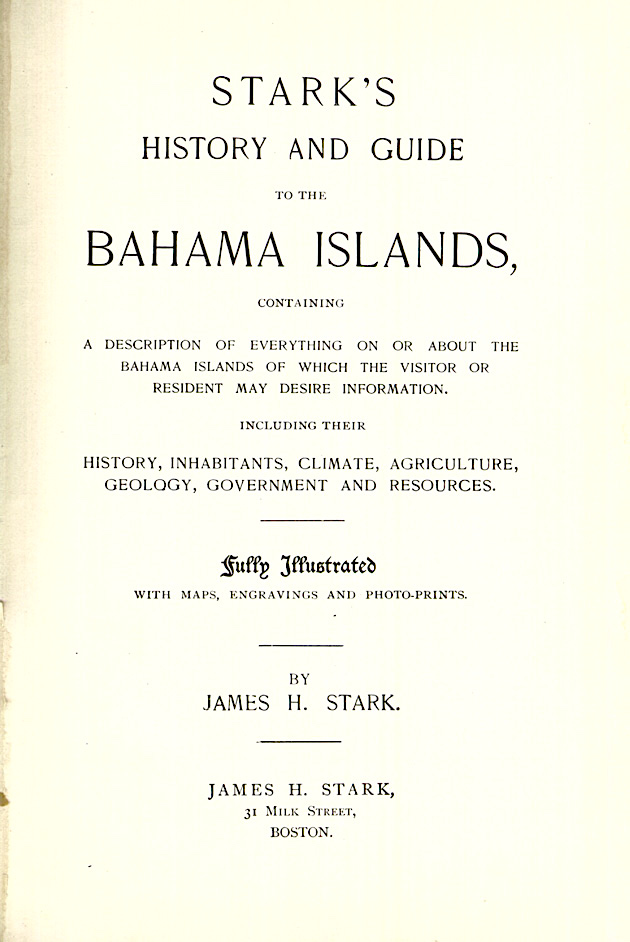
James H. Stark appears to have been, for his time, a veritable Rough Guide for the Caribbean. In 1891 he produced an entrancing tome, the commendably grammatically correctly-titled “Stark’s History of and Guide to the Bahama Islands Containing a Description of Everything on or About the Bahama Islands of Which the Visitor or Resident May Desire Information, Including Their History, Inhabitants, Climate, Agriculture, Geology, Government and Resources”. More of his other magna opera below.

Stark's History of & Guide to the Bahamas     Stark's History of & Guide to the Bahamas

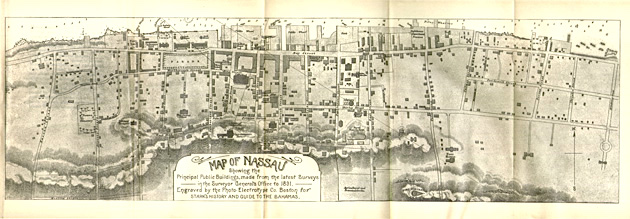
 The jaunty and classic late c19 cover depicts the landing of Columbus, lest the unwary reader should be so ill-informed as the be unaware of the location of the great explorer’s landfall. And gives the date of the event, for the sake of completeness. The title page is most informative of the contents, and manages to namecheck the author three times (or thrice, as he might have put it). The illustrations and in particular the maps are wonderful, and call for a small gallery for your enjoyment. The “Coast Chart” is compiled from “the latest… surveys.” The map of Nassau is most interesting to compare with a map of 125 years later. And the engraved map is set at an unusual angle to say the least. [I’ve tried to clip the Abaco part to check the place names, but I can’t yet get a clear enough image to read].

Stark's History of & Guide to the Bahamas - Bahamas Map

Stark's History of & Guide to the Bahamas - Nassau map

Stark's History of & Guide to the Bahamas - Bahama Islands Map

An historic map from 100 years earlier: note the place names, eg ‘Alabaster’ (Eleuthera)129

The ‘History of & Guide to’ has detailed sections on all the islands. I have lifted the relevant pages – only a few – concerning Abaco. See what a difference 125 years makes…

145146147

I enjoyed reading the ‘opinions of the press’. How unlike our own dear Amazon reviews…Stark's History of & Guide to the Bahamas    Stark's History of & Guide to the Bahamas

005

RAISING A CONTROVERSY…

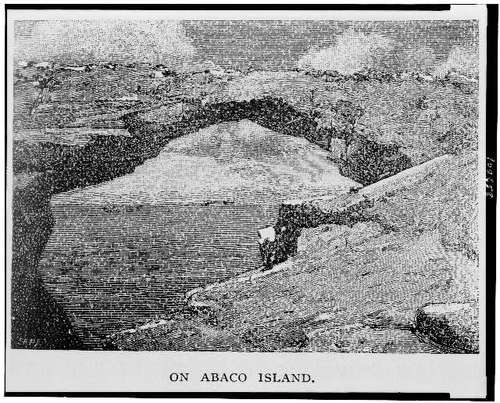
This is a topic I have touched on before. It concerns the authentic location of the ‘Glass Window’ of Winslow Homer’s famous painting. Is it Eleuthera (as claimed) or Abaco (as contended). The argument is lodged with the Brooklyn Museum, custodian of the Homer painting. In Stark’s book of 1891 is a fine photograph of a – or the? – ‘glass window’, assigned to Eleuthera. Below is an earlier engraving entitled ‘On Abaco Island’. It is the work of Homer, named by him, and seemingly a preliminary study for the painting. The same view? Or different? The jury is still listening to the arguments… 

136aHole-in-the-Wall Picture

Winslow Homer G W Original Brooklyn

Other books by James H. Stark that you may enjoy:

Stark’s History and Guide to Barbados and the Caribee Islands, Containing a Description of Everything on or About These Islands of Which the Visitor or Resident May Desire Information – Including Their History, Inhabitants, Climate, Agriculture, Geology (1893)

A ditto for Trinidad.

A ditto for ‘Boston and its Suburbs’

A ditto to the County of Ohio

md14322205683

HOLE-IN-THE-WALL for more about Hole-in-the-Wall, Abaco and Winslow Homer

Credits: my primary source is the University of Florida Digital Collection, to which thanks. However there are plenty of mainstream online sites that offer this book to view; and you can download it or even get your own POD (‘print on demand’). 

Unknown's avatar

MAPPING ABACO: A JOURNEY BACK TO THE c18


acaco-map-1778-crop

MAPPING ABACO: A JOURNEY BACK TO THE c18

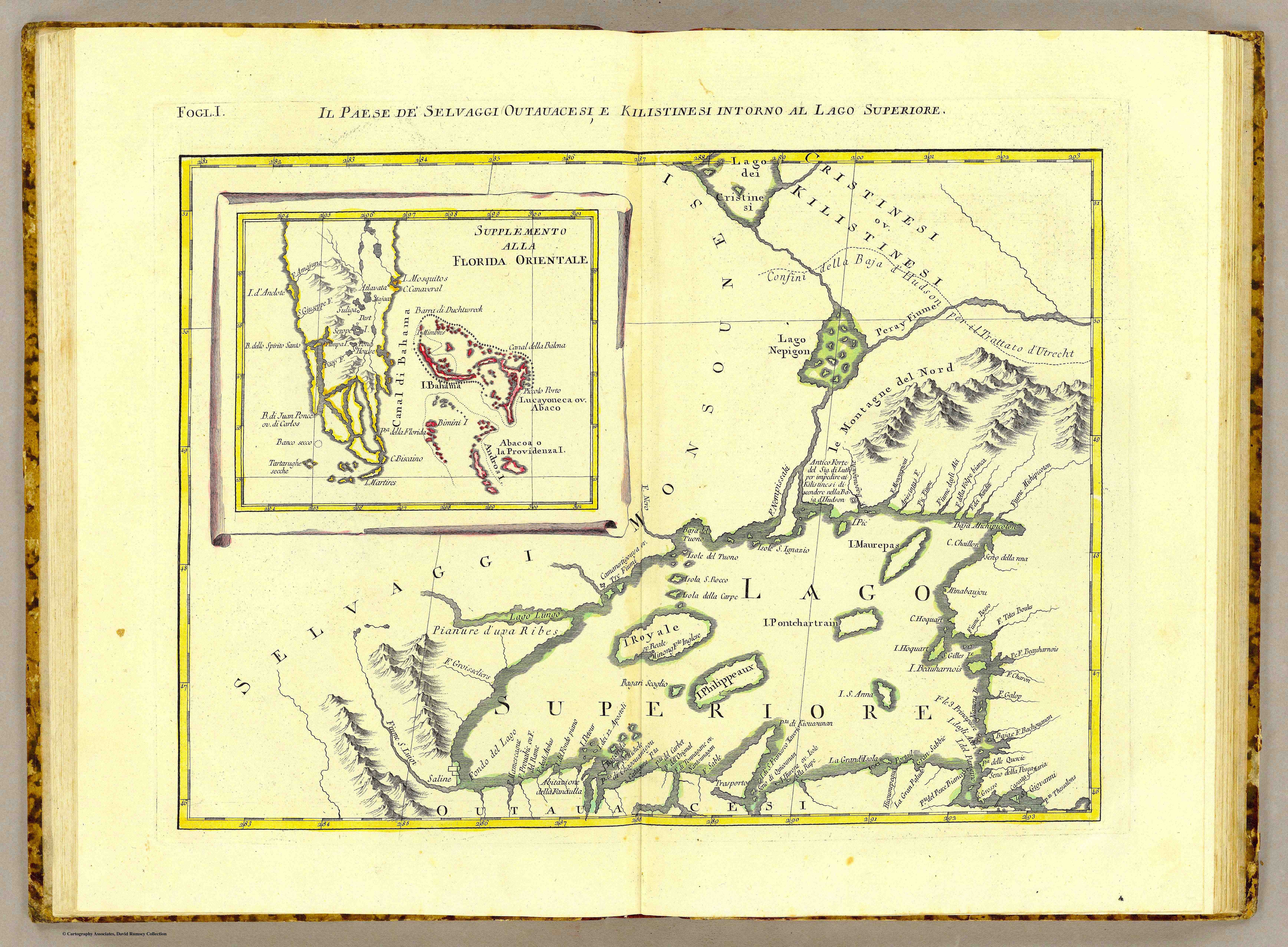
From time to time I come across historic maps of the Bahamas in general and Abaco in particular. Many were included in a post I wrote some time ago about the maritime and geographic importance of Hole-in-the-Wall, HERE. Almost all pre-c20 maps of the Bahamas contain insights into the maritime and geo-political history of the islands that are worth investigating. One that recently caught my eye is a map dated 1778 from Italy, published in Venice, with the excellent title “Il Paese de’ Selvaggi Outauacesi, e Kilistinesi Intorno al Lago Superiore”, attributed to Antonio Zatta, John Mitchell and G T Raynal.  “The title translated, might read, “The Country of the Savage Ottowas and Christineaux on the shores of Lake Superior.” Except for Ile Royale, the large islands in the lake are fictitious. The somewhat distorted outline of southern Florida in the inset is in keeping with general lack of British knowledge about this area” Portinaro & Knirsch 

Zatta was a Venetian cartographer who produced some important maps in the 1770s and 1780s, including a 4-volume atlas of the world. Mitchell was a geographer and botanist, best known for the first comprehensive map of eastern North America (1755); Guillaume Thomas Raynal was a French writer and journalist most famous for his treatise on the ‘philosophical and political history of the establishment of commerce by Europeans in the the two Indies’, a work that was considered controversial (it was banned in France, and copies burned). 

THE COMPLETE MAP

Lake Superior, with the ‘Supplemento alla Florida Orientale’ inset – a strange juxtaposition…abaco-map-zatta-1778-sm

FOCUS ON FLORIDA

The ‘eastern Florida’ inset conveniently happens to include the northern Bahamas. Staying with Fl. for a moment, of note is the inclusion of C. Canaveral, spelled then as now. Key Biscayne is also shown. I wondered about the place marked Tartarughe Secche – ‘Dry Turtles’. It is now Dry Tortugas National Park. “Mostly water, this remote park features abundant marine & bird life plus a 19th-century fort. It comprises 7 islands, plus protected coral reefs. Garden Key is home to beaches and the 19th-century Fort Jefferson. Loggerhead Key has a lighthouse and sea turtles. On nearby Loggerhead Reef, the Windjammer Wreck, the remains of an 1875 ship, is a popular dive site. Bush Key is a nesting site for seabirds like sooty terns.”** I suspect that these coral reef islets were marked on maps in days before lighthouses because of the hazards they posed to navigation at sea; and because, like Hole-in-the-Wall on Abaco, they were useful navigation aids.

abaco-map-inset-italian-c18

ABACO & NORTHERN BAHAMAS

Unacknowledged in both the map and the inset titles, are the northern Bahamas islands. We can pass by Bimini, Andros and (Grand) Bahama which, apart from distinct oddities of scale, shape, and location are more or less as one might expect for the period. Let’s look at some details of the depiction of Abaco. 

acaco-map-1778-crop

  • ABACO(A) The first geographical jolt comes not from the well-known fact that historically, present-day Abaco was originally called Lucaya (or variations), but that (New) Providence was called Abacoa. Adding to the confusion, some early maps also show certain cays as ‘Abaco’, ‘Abacoa’, or in the case of Tilloo Cay in 1815, ‘Aboca’, possibly through errors or misunderstandings. This map is one of the few I have seen that shows both the mapped transition of Lucaya (or its variants) to Abaco; and of Abaco(a) to Providence. If anyone has any idea why this came about, I’d be pleased to know!
  • HITW? The next surprise is that Hole-in-the-Wall, an established and mapped nautical landmark for some decades, is not marked. Shown on maps since at least 1738, this is the first map I have found – other than the most basic – that does not feature HITW (in whatever language) or ‘Lighthouse Point’. An odd omission.
  • PORTO PICCOLO’s inclusion is interesting because it continues a tendency – eg 1738, Couvens & Mortier – to show Little Harbour as the only named settlement, though by 1778 there must have been others. LH was clearly a place of some significance, and this presumably had a nautical explantation: the harbour is perfectly placed to offer protection and a safe refuge in stormy weather.
  • CANAL DELA BALENA refers to what, by the early c20, was called ‘Whale Cay Channels’ (below), by which time it was more accurately mapped. Other c18 maps also show ‘Chenal Whale’ and ‘Whale Channel’, but considerably north of the actual location. But in those days, even the outline of Abaco and the location of the cays was usually endearingly wonky.whale-cay-abaco-map-crop
  • BARRA DI DUCHTWRECK I haven’t been able to find out much about this location, or the wreck that gave it its name. A map by Thompson (1815) calls it ‘Dutch Wreck Bar’, and I can only assume that at some time in the early c18 – or even the c17 – a Dutch vessel came to grief on the reef. I need to look into this more. Someday. Oddly, the modern Italian for a reef is barriera not barra. Maybe the word has changed over time, or the usage barra then was colloquial; or perhaps in mapping terms it was a generally accepted abbreviation.
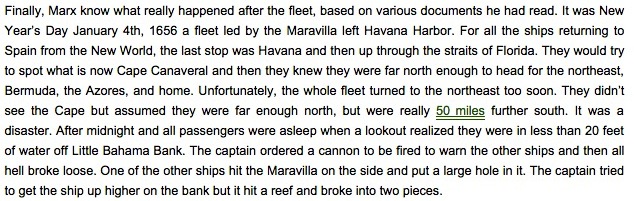
  • I MIMBRES This reef or shoal area of is usually mapped as Matanilla Reef, Maternillo Bank or Reef, or variants. In 1656 this area – presumably dangerous for shipping – was the scene of a dramatic tragedy involving a treasure ship, the flagship of a fleet. I dug up reports of the events in Portugese which baffled ‘Google Translator. I was bailed out by an article about treasure hunter Robert Marx and his findings:

shipwreck-ac-marxshipwreck-ac-marx-copy-2bahamabank-1

If you have got this far at all, or even with the assistance of 2 or 3 Kaliks, thanks for bearing with me. The old Abaco maps are fascinating, and of course once one begins to dig, so more stuff emerges… and so on.

Credits: David Rumsey Historical Map Collection, http://www.davidrumsey.com / Cartography Associates – in particular for licensing non-commercial use of material via a Creative Commons License; magpie pickings from multiple open-source sites.

**Dry Tortugas National Park review comments are eclectic and include “Crystal clear water, lots of wildlife, nice people and such a cool fort”; “The Dry Tortugas area first gained significance after the War of 1812” and “Constant nice breeze and comfortable night time temperatures for sleeping.”

Unknown's avatar

“TUVU” (TURKEY VULTURE) ON LUBBERS QUARTERS, ABACO


Turkey Vulture, Lubbers Quarter, Abaco (Larry Towning)

“TUVU” (TURKEY VULTURE) ON LUBBERS QUARTERS, ABACO

Lubbers Quarters is a Cay off the southern tip of Elbow Cay, and home to the excellent Cracker P’s restaurant. Also, home to Larry Towning, who takes terrific sunrise and sunset photos, among other subjects that include birds. He recently happened upon a Turkey Vulture sitting on a POISONWOOD stump (do not rush to try that – you may not sit down again for weeks). I like the immediacy of these. Most TUVU shots – by me, anyway – are (a) flying – usually coming out as silhouettes; or (b) atop a utility post with wires in the way, or (c) on the ground scavenging something revolting in the way of carrion. This bird is only dreaming about doing that.

“WARTS AND ALL…”Turkey Vulture, Lubbers Quarter, Abaco (Larry Towning)

The nostrils are not divided by a septum, but are perforated; from the side one can right see through (and as I have previously noted, some humans also suffer from MSS  – missing septum syndrome. They tend to sniff a lot)Turkey Vulture, Lubbers Quarter, Abaco (Larry Towning)

LUBBERS QUARTER CAY        Lubbers Quarters Map

NOT SAD… JUST THINKING ABOUT DEAD DECAYING THINGS TO EATTurkey Vulture, Lubbers Quarter, Abaco (Larry Towning)

To read much more about Turkey Vultures, find a bundle of interesting facts and learn about their sex lives and frankly disgusting habits with urine and vomit, check out ‘CARRION SCAVENGING‘.

Photo credit: Larry Towning; Tropicat (Poisonwood link)

Unknown's avatar

ABACO’S MAJESTIC SUMMIT (134 ft asl) : ABACO LANDMARKS (2)


Matterhorn from Domhütte - 2.jpg

ABACO’S MAJESTIC SUMMIT (134 ft asl) : ABACO LANDMARKS (2)

The header photograph is in fact nothing to do with Abaco. Apologies for any confusion. You can put away your ice axe, crampons or skis. It’s the Matterhorn, towering over the border of Switzerland and Italy, complete with high altitude, year-round snow and sub-zero temperatures. Abaco has its own skiing, of course, but solely of the watery sort.

I was curious as to the exact location of Abaco’s highest point. There are a couple of rocky hills in the pine forests of South Abaco that I thought might be candidates. All sources I checked agreed that the altitude is a dizzying 134 feet, with some equating that with 40 metres and others with 41. It would be nit-picking to use the straight conversion of 40.8432 metres. I am that nit-picker.

A site called PEAKBAGGER is useful for such queries. Click on the link and it takes you to the Abaco entry; elsewhere on the site there is a mass of remarkable worldwide altitude information that you could easily spend an hour or 2 investigating.

EIGHT ESSENTIAL ABACO SUMMIT FACTS TO ASTOUND YOUR FRIENDS

  • Elevation: 41 meters / 134 feet
  • Name: “Unnamed High Point” [according to John Bethel, it is known locally as ‘Pidgeon Hill’]
  • Latitude/Longitude: 26° 34′ 6” N; 77° 8′ 14” W 26.568399, -77.137319
  • 3rd highest point in the Bahamas
  • 54th highest point in the Caribbean
  • 1014th highest island point in the world
  • Nearest high point is on Eleuthera
  • No ‘ascents’ by registered ‘Peakbaggers’ (this is now on my bucket-list for personal achievements – and it’s an easy start on the way to fame and the conquest of Everest).

THE PRECISE LOCATION OF ABACO’S HIGHEST POINT

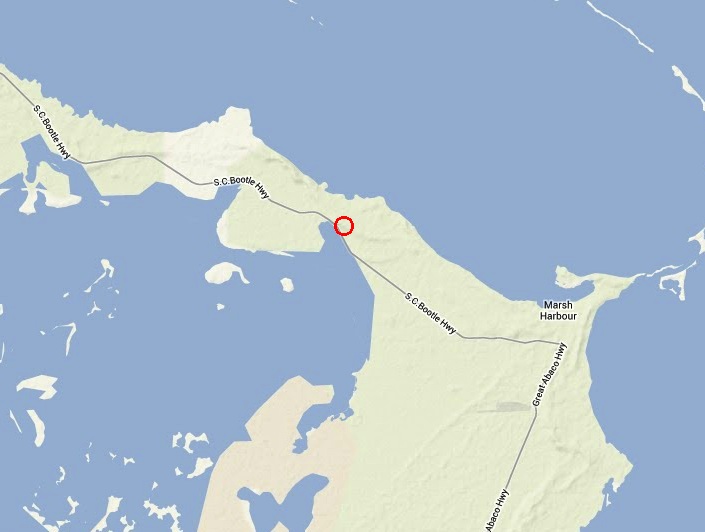
Peakbagger’s map places the high point close to the Highway north of Marsh Harbour. Although the land relief shown on the Peakbagger map suggests a higher ridge to the north-west of the red circle, it is in fact only 30 metres high.Abaco High Point Map 1

Quite a while back I contacted Sandy Estabrook, éminence grise behind the wonderful ABACO ESCAPE website. Within a very short time he got back to me with a clipping from a nautical map, confirming the high point’s location as the one given by Peakbagger. Abaco Nautical Chart

Far more importantly, it turned out that Sandy actually ascended the summit in 2009 with a friend and without oxygen. His expedition journal states simply:

“Heading South along Queens Hwy, Frank pointed out a hill on the Sea of Abaco side of the road. It had quite some elevation of over a hundred feet or more it seemed. I have not seen a higher place in all of Abaco. And atop the hill was a tower that I was told was built by real estate interests some years ago for prospective clients to view the surroundings. We climbed the tower and I took a couple pics”. 

The tower will be familiar to travellers passing by on the Highway. I had read that this was a good place to look out for birds, and had assumed it was some sort of fire-watching tower. The use of a tower to scope out land for development is an ingenious one, but the landscape remains undeveloped. Here are some photos from the vantage point taken on Sandy’s expedition.

View roughly south-east from the tower to Hope Town. The lighthouse is visible to the right.Frank View from Tower 84 copy

Looking north-east, with Great Guana Cay just visible on the horizonFrank View from Tower 82 copy

The view north(ish) along the ridge, with the Highway snaking up to Treasure CayFrank View from Tower 83 copy

AERIAL VIEWSMount Abaco 5 copyMount Abaco 3 copy

WHERE IS BASE CAMP?

Turn east off the Highway and take the spur road to the right. Park at the wider area near the end. Prepare for a scramble up. If there is – or was – a path to the top, I expect it’s overgrown now, unless for some reason it has been cleared. And if anyone undertakes the challenge, it would be fun to post your account of the adventure plus views from the top – especially looking west.

Thanks to Sandy Estabrook and to Peakbagger

 Abaco Escape logoPeakbagger Logo

This is a rijig of a post I did in 2013, because it fits in with my new ‘Landmarks’ series. Also, I (luckily) have loads more followers these days. If there have been any significant changes to the location, I’d be pleased to hear and amend accordingly. And if there are any other local names for the hill, I’ll add them. 

Unknown's avatar

CRYSTAL CATHEDRALS: ABACO’S ASTOUNDING UNDERGROUND CAVES (6)


Abaco's Underground Caves (Hitoshi Miho, with Brian Kakuk)

CRYSTAL CATHEDRALS: ABACO’S ASTOUNDING UNDERGROUND CAVES (6)

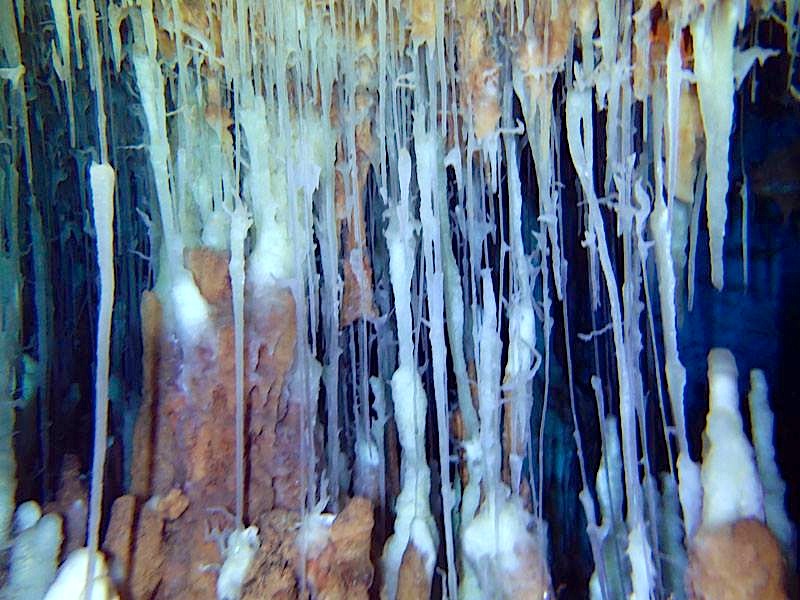
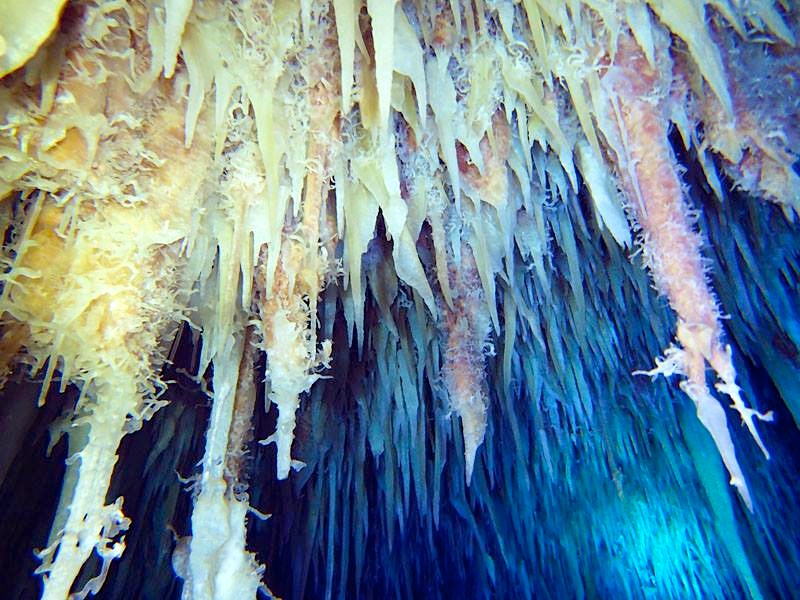
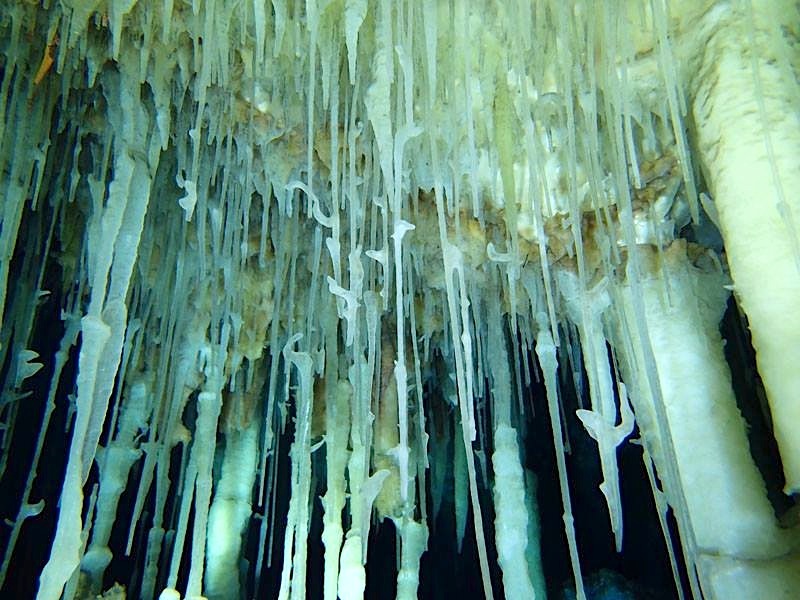
The photos you see in this post were all taken by Hitoshi Miho during an amazing 3 days of diving with Brian Kakuk deep in the pine forests of South Abaco. It’s not the first time they have explored together the wonders that lie beneath those hundreds of acres of pines and scrub; I’m sure it won’t be the last.

Abaco's Underground Caves (Hitoshi Miho, with Brian Kakuk)Abaco's Underground Caves (Hitoshi Miho, with Brian Kakuk)Abaco's Underground Caves (Hitoshi Miho, with Brian Kakuk)

The most spectacular cave systems are the adjacent Ralph’s and Dan’s Caves. These systems are believed to be linked, and I know Brian has been trying to find where they meet – a difficult and dangerous task carried out underwater many metres below the forest floor, and requiring sophisticated diving equipment and great expertise. 

Abaco's Underground Caves (Hitoshi Miho, with Brian Kakuk)Abaco's Underground Caves (Hitoshi Miho, with Brian Kakuk)Abaco's Underground Caves (Hitoshi Miho, with Brian Kakuk)

The latest 3-day exploration involved 12 dives and nearly 30 hours underwater in Ralph’s Cave. Narrow passages open out into massive caverns filled with wonderful and complex crystal stalagtites and stalagmites formed over eons. I hope you enjoy examples from the ‘Rooms’ and passages, many with exotic names (Glass Factory, Ninja Passage, Erabor); some more prosaic (Fred’s Room). Then try to imagine that you are actually swimming there.

Abaco's Underground Caves (Hitoshi Miho, with Brian Kakuk)Abaco's Underground Caves (Hitoshi Miho, with Brian Kakuk)Abaco's Underground Caves (Hitoshi Miho, with Brian Kakuk)

I shall be posting some more photos in due course showing some of the details of the cave formations – intricate patterns, delicate tracery, irridescent colouring, pencil-thin rods, ‘rock’ folds that look like the finest linen. As always I am immensely grateful to both intrepid divers for use permission. I won’t pretend that these thrilling caves are easily accessible – this is emphatically not an adventure to try unguided with a snorkel and flippers. But as you drive along the highway past miles of forest, it’s worth reflecting that far below you are some of the most magnificent cave systems anywhere in the world – right there, on your very own island… 

Abaco's Underground Caves (Hitoshi Miho, with Brian Kakuk) Abaco's Underground Caves (Hitoshi Miho, with Brian Kakuk) Abaco's Underground Caves (Hitoshi Miho, with Brian Kakuk)

As it happens, the Delphi Club is very close to these caves, which lie within the boundaries of the newly created ‘South Abaco Blue Holes Conservation Area (see map). This is one of several such conservation areas on Abaco and in the wider Bahamas that are designed to protect the natural resources of the islands from development and exploitation. The second map shows how tantalisingly close Dan’s and Ralph’s caves are… and suggests that further exploration may lead to the missing link.

abaco-caves-map-jpgAbaco Caves Ralph & Dan jpg

Finally, here is a 4-minute video of one small part of the exploration, which gives a very good idea of what is entailed in investigating the narrow passages and huge cathedral-like caverns. Welcome to the Fangon Forest…

Hitoshi Miho, Ralph's Cave, Abaco

Unknown's avatar

A RARE SPOONBILL VISITS GILPIN POND, ABACO


Roseate Spoonbill, Gilpin Pond, Abaco (Keith Kemp)4

A RARE SPOONBILL VISITS GILPIN POND, ABACO

In past posts I have mentioned what an excellent birding place Gilpin Point has become. There’s the large pond; and right beside it, dunes, the other side of which is a fine secluded beach and the ocean. The place is a magnet for birds of all shapes and sizes, from brown pelicans down to the tiny endemic Bahama woodstars. There are water birds, wading birds, shorebirds and coppice birds. It has become a place where Abaco parrots regularly congregate. You can reach the Gilpin FB page HERE.

A while back, there was a rare visitor, a Flamingo that stayed a few months then disappeared again. It was in some ways a sad reminder of past flamingo glory days, when they were commonly found on Abaco. Now they are confined to Inagua apart from the occasional vagrant. For more on the the topic, with wonderful photos by Melissa Maura of the breeding season on Inagua, click HERE. Another rare vagrant – formerly quite plentiful on Abaco – was recently found at Gilpin by Keith Kemp, who skilfully managed to get photos of it from some distance away: a Roseate Spoonbill.

Roseate Spoonbill, Gilpin Pond, Abaco (Keith Kemp)2

I have featured spoonbills before in a post IN THE PINK, but the photos were taken on New Providence by Woody Bracey. I had no Abaco spoonbill photos. To be fair, we did once see one while we were bonefishing far out on the Marls. It was on the edge of the mangroves a good distance away, and the pale pink tinge caught my eye. My photo with an iPhone 4 (the one with the risibly cr@p camera – remember?) was so utterly pathetic that I dumped it (the photo, I mean, but the phone soon followed). But we knew what we had seen, and that was enough.

roseate-spoonbill                roseate-spoonbill               roseate-spoonbill

STOP PRESS 1 I should add that a friended visited the pond after the side-effects of Hurricane Joaquin had receded, and the spoonbill had gone. So the spoonbill alone would not make the journey worthwhile!

STOP PRESS 2 A check of eBird reveals that a handful of spoonbills have been reported in Northern Bahamas this year, about 6 in all. Almost none before that. I have the impression that birding intensity in The Bahamas, coupled with the ease of uploading reports to eBird, will increasingly make a difference to the incidence of sightings of uncommon and rare species, cf the recent WHIMBRELS of Grand Bahama.

Spoonbill, Gilpin Pond, Abaco (Keith Kemp)3

GILPIN POINT LOCATION

Gilpin Point is just south of Crossing Rocks. The brackish pond – sometimes an alarming reddish colour that I assume is algal – is just inland from the shoreline and provides a wonderful haven for birds. It’s a long mile from the highway. There is no vehicle nor even human traffic apart from occasional birders and walkers. Please note that the drive and the property are private. However Perry Maillis is always welcoming to tidy birders who (as I have written elsewhere) bring only enthusiasm and take only photographs (though a picnic on the beach is worth considering. And maybe a swim…). 

Helpful location mapsGilpin Map 1 Gilpin Map 2 Gilpin Map 3

WHAT SPECIES MIGHT BE FOUND AT GILPIN?

A brief list includes regular visits from parrots. It’s the only place we have found a furtive little sora skulking in the reedy margins. It’s a reliable spot for herons and egrets of every kind, white-cheeked (Bahama) pintails by the score, black-necked stilts and lesser yellowlegs. Occasionally a northern pintail, ruddy duck or merganser. Turkey vultures. Limpkins. We’ve seen belted kingfishers, Bahama woodstars, cuban emeralds, american kestrels, Bahama swallows, doves, pigeons, western spindalis and many more coppice birds besides. One flamingo. One spoonbill. Pelicans have been seen on the rocks on the beach. Shorebirds include turnstones, sundry plovers & sandpipers, and oystercatchers. You may well see tropicbirds and frigate birds off-shore, and assorted gulls and terns. I can’t personally be more species-specific  because I have never ‘shorebirded’ properly there, but I have noticed an impressive mix…

When we launched THE BIRDS OF ABACO at the Delphi Club, we were delighted that Pericles was able to come to the party. He took a few photos and I’m sure he won’t mind my including a small gallery to end with, featuring a couple of the Gilpin entries in his signed copy.

10153160_10152104925423929_44675888_n 1926631_10152104925178929_80294246_n11856_10152104921903929_1879699722_n 1525102_10152104925648929_1614125758_n

Bahamas birding nobility: Tony White with Caroline Stahala; Woody Bracey & Bruce Hallett
1911624_10152104926303929_1596185906_n

Credits: Keith Kemp for the great spoonbill photos; Perry for the Delphi photos

Unknown's avatar

SEEING THE BACK OF HURRICANE JOAQUIN: LATEST UPDATE OCT 3


Hurricane Joaquin at dawn from International Space Station, Oct 2 (Scott Kelly / ISS / NASA)

Hurricane Joaquin at dawn from International Space Station, Oct 2 (Scott Kelly / ISS / NASA)

SEEING THE BACK OF HURRICANE JOAQUIN: LATEST UPDATE OCT 3

Since my post yesterday HERE confirming evidence that Joaquin was hooking out into the Atlantic and away from northern Bahamas, the storm has picked up speed as it now heads for Bermuda. It is also on a direct route to Ireland and the UK, but is already weakening. With the storm now reduced to a Cat. 3, a continuing lessening of intensity is predicted.

In this second – and, I hope, final – post of the hurricane season, the images below show the current state of play early today. I’ll repeat the weather watch links at the end.

Joaquin clears the Bahamas & heads out into the Atlantic towards Bermuda as a Cat. 3 stormHurricane Joaquin Storm path October 3

Forecast eye-path early on Oct 3Hurricane Joaquin Storm path October 3

The remarkable storm path, hooking round over Central Bahamas & going back on itseslfHurricane Joaquin Storm path October 3

The strange beauty of a hurricane captured from spaceHurricane Joaquin over central Bahamas, seen from space

USEFUL DIRECT LINKS FOR HURRICANE INFORMATION

NOAA / NHC

WUNDERGROUND

WEATHER CHANNEL

ACCUWEATHER

NASA

and for local Bahamas news

TRIBUNE 242

Credit: 'Watts Up With That

Sources: NASA, NOAA, ISS / Scott Kelly, Wunderground, Accuweather

Unknown's avatar

HURRICANE JOAQUIN: LATEST TRACKING UPDATE OCTOBER 2


Hurricane Joaquin Oct 2nd 6

HURRICANE JOAQUIN: LATEST TRACKING UPDATE OCTOBER 2

There’s a great deal of information about Hurricane Joaquin flying around the internet right now, which is completely understandable. How quickly things have progressed since Irene in 2011 in the very early days of this blog, when there was little public information and an almost complete absence of information on social media. I posted daily (or more) updates as the hurricane swept up over the Bahamas. In 4 days, and despite communications being largely blanked, I had over 15,000 hits and a mass of questions along the lines ‘Any news of Treasure Cay’; ‘Can you find out how my boat is – Saucy Sue in Little Harbour’; and ‘Hi I’m on Elbow Cay, can you tell my mom in Maine that I’m ok’ [+ email]…

Here is the position today, at 05.00 EDT, according to the various resources that people turn to. Central Bahamas has taken – is taking – a battering and we have the people there very much in mind. But for the northern Bahamas the picture has improved, with the veer of Joaquin’s predicted path to the northeast increasing overnight. This does not mean an absence of strong winds and big waves – these are already being felt. But the most serious area of this Cat 4 hurricane is not expected to pass over Abaco – the direct concern of most readers of this blog. How different from Irene which wrought its havoc right over the island; and Sandy, which took much the same route.

USEFUL DIRECT LINKS FOR HURRICANE JOAQUIN INFORMATION

NOAA / NHC

WUNDERGROUND

WEATHER CHANNEL

ACCUWEATHER

NASA

and for local Bahamas news

TRIBUNE 242

Anyway, all the best to everyone affected by this fierce storm directly or indirectly, and good luck.

Credit: 'Watts Up With That

Hurricane Joaquin Oct 2nd 1Hurricane Joaquin Oct 2nd 3Hurricane Joaquin Oct 2nd 4Hurricane Joaquin Oct 2nd 7Hurricane Joaquin Oct 2nd 5Hurricane Joaquin Oct 2nd 2Sources: NASA, NOAA, Wunderground, Weather Channel, NYT, Accuweather